Blue bluebells and the digital debate…..

_MG_4965Much has been said in the film versus digital debate. I was a film user for many years and perhaps withstood the digital explosion for a little longer than I should have done. But there is one situation in which digital wins hand over fist.

Last week I visited Castle Woods, near Llandeilo in Carmarthenshire, to photograph the bluebells there. What a display! The best in Wales, someone told me, although I cannot vouch for that…..  Conditions were perfect.  There was little wind to cause unwanted movement of the flower spikes or beech leaves. Light cloud cover acted as a giant diffuser, preventing the appearance of disruptive shadows and areas of excessive contrast on the woodland floor.  Oh joy!

The great advantage of digital is that the bluebells are actually recorded as blue on the sensor, rather than the ghastly purple or puce they would appear as on film. Much was written in the photographic press about how to get blue bluebells in those days. Perhaps that was why they invented digital?

My visit to Castle Woods took place on the journey back from Skokholm Island, off the Pembrokeshire coast, where I spent three days. I may write more about that at a later date but needless to say I spent many happy hours in this wonderful place filling memory cards with images of birds, many of which I will eventually delete. Oh, hang on………. there’s another big advantage of digital. However did wildlife photographers manage when each single click of the shutter was measured in actual money spent on film?

To follow Tales from Wild Wales, please scroll right down to the bottom and click the follow button.

Wales at Waters’ Edge nominated for Welsh Book of the Year Award…but only under the author’s name.

It was announced this afternoon that my recent book with Jon Gower – “Wales at Waters’ Edge” – has been shortlisted for the 2013 Welsh Book of the Year Award. But only under Jon Gower’s name.

The idea for the book came several years ago when I heard that the All-Wales Coastal Path would be completed in 2012. It seemed like a very good idea to hang a book project upon. During autumn 2009 I approached a very talented  writer friend to see if she would be interested in collaborating on a joint project on the Welsh coastline. We had a preliminary meeting with the publisher, Gomer Press, in November 2009 , and the book grew from there. A Welsh-language author was brought on board for the Welsh edition, and following the promise of funding being made available to me from the Countryside Council for Wales,  I began work on the book in spring 2010.

It was a rocky road during late 2010/ early 2011 when, in the last of a series of  “hiccups”,  the author eventually dropped out for personal reasons. But Jon Gower stepped in at short notice in spring 2011 and despite having a huge workload finished his excellent text  on time. While Jon and I have progressed in very different directions since our younger days, we both have a background in wildlife conservation which really helped us to work together. The English-language version was published in May 2012.

Just a bit of background there, then. But back to the award. If it really is for the  “Welsh Book of the Year” then surely both of two joint contributors should be credited for their work? Or is it really only an award for “Author of the Year”? Perhaps the idea remains among the literati that a photographer is only fit to illustrate the words and ideas of his obviously more creative writing partner. Photography is often seen as a poor relation among the art forms, and one learns to live with it. But how will the awards judges be able to evaluate the text alone in what is, I would argue, an image-led publication, without being influenced by the photographs?

To follow Tales from Wild Wales, please scroll right down to the bottom and click the follow button.

Third time lucky (Part 2)

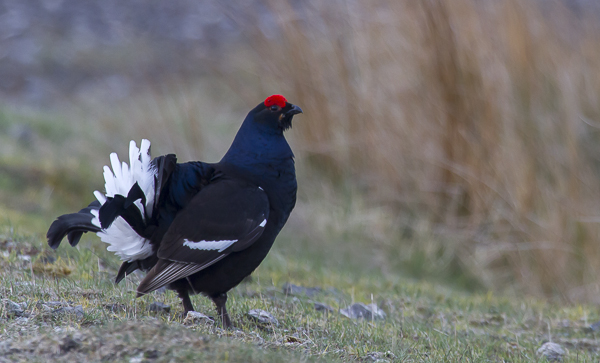
Black grouse, north Wales

The very briefest of weather windows seemed to be opening up over the weekend following my unsuccessful trips described in Part 1. Heavy showers and sunny intervals were forecast for the Saturday evening followed by a sunny couple of hours first thing on Sunday morning. I decided to go for it.

All was quiet when I arrived at the lek site in the early evening. The setting itself looked a bit scrappy – probably linked to some abandoned quarries nearby – but suddenly four blackcock swept in together. Almost immediately they took up their stances and hostilities began. It was quite comical really; these birds were quite clearly not strangers to each other and yet all of a sudden it was handbags. While the light wasn’t good, the distances I would be working at were very useful.  I took a series of images of the birds over the next hour and a half, at which point –  for no apparent reason – the grouse flew, only to return again just before dusk.  I felt reasonably confident that a morning session would be profitable, so set my alarm clock for 5.30 am; I should get a decent night’s sleep……….

At 2.30 am the first rally car sped past. For more than an hour there was the sound of burning rubber on tarmac every few minutes as one car followed another around the bend beside which I was parked up. One stopped alongside and the driver shouted “hello?” before heading off again. As silence eventually fell over the moorland at 4 am, and the very first hint of dawn began to appear, the bubbling and hissing sounds of lekking black grouse became apparent. I could just see their white tail feathers in the gloom through my binoculars. It looked like some serious action was underway on the lek. By 5.30 it was just about light enough to begin work with the camera and such are the joys of having a camper van, I did not need to leave the warmth of my sleeping bag to do so! Just sit up, reach over for the camera and open the side window…..

While the promised sunny morning did not actually materialise the birds did come very close, closer than I could have hoped for, really. I recalled the adverts I had seen on the internet offering dawn visits to hides near leks for upwards of  £100 a go. Here I was doing the same thing  in much more comfort for free!  Other leks not too far away could be heard in a light breeze. And fortunately several other birder/photographers who arrived later on did not leave their vehicles until after  the birds left of their own accord. Light levels were quite poor, however, and it seemed likely that any photographs of moving birds would be disappointing. Nevertheless I felt that the series of portraits I took of standing birds should contain at least something usable, and this has proved to be the case. I’d like to have a go here in brighter sunlight at some stage but I feel now that I’ve made a good start on the new project. And it really was third time lucky.

To follow Tales from Wild Wales, please scroll right down to the bottom and click the follow button

Early morning in the saltmarsh

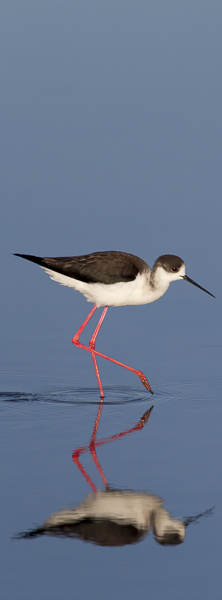
Black-winged stilt, Ile de Re.

Jane and I have different ideas about what a holiday should be.  For me its largely about seeing new landscapes and   new birds, while she likes …… well ……. to relax. We seem to have come to an understanding, though, and as long as it also involves us both enjoying cups of coffee in atmospheric street cafe’s we can live with our differences.

Last month we went to western  France. Travelling almost entirely by train we spent one to three days in five different locations, from La Rochelle to the north as far as  St Jean Pied de Port in the foothills of the Pyrenees. I had planned each stop fairly carefully  to give me the chance of doing some bird photography in some, while in others we could both enjoy some delightful French countryside, villages and cities. The Ile de Re is a rather lovely island near La Rochelle which is joined to the mainland by a bridge. It’s almost completely flat, and crisscrossed by a maze of cycle tracks which should put most local authorities in  Britain to shame.

By a stroke of good fortune I had booked some accommodation towards the western end of the island close to the best section, bird-wise,  of salt-marsh.  So it was a doddle to get up at dawn and potter off to the marshes on the bike for some early morning birding – even more so as France is two hours ahead of GMT and the sun didn’t rise until about 7 am. I do find the freshness of early morning particularly stimulating.  Wildlife is more active and seems to be more approachable and dawn can bring a feeling of mist and mellow fruitfulness to the landscape at any time of the year.

Perhaps the star bird of the marshes was the black-winged stilt. One of those species that even a non-birder could identify, it is a neat black and white wader with extraordinarily long coral-red legs. There was no shortage of them on the island and they were, frankly, quite easy to photograph. After years of using only the central focus point and the “focus and recompose” method I’ve recently discovered the outer focus points of my Canon 7d.  It’s certainly not rocket science to use them and it got me wondering …… what might all those other little buttons do? So as well as  experimenting with that in the field I’ve also been trying out with different cropping ratios and I think this upright version works quite well.

So after a couple of hours of solitude in the marshes I would tootle back to the chambre d’hote just in time for a delicious breakfast prepared for us by the lady of the house. Jane would probably be up by then and tell me about the wonderful night’s sleep she had had, and I could enthuse about the birds I had seen and photographed.  Then we would spend most of the rest of the day together.

Third time lucky (part 1)

Beginning a new project is always a daunting time. A blank page opens up before you and you realise you will have to fill it. It is difficult not to feel a faint sense of panic, and so it is with me at the moment.

I’ve been moving away from photographing landscape recently towards what might be described as birds within the landscape. It’s a very different regime; the subject matter is typically very small, moving erratically and much too far away. So one needs to master a whole range of new equipment and techniques, and I wouldn’t suggest that I’m even part way there yet. However it gives me a new challenge and from time to time we all need that.

Perhaps typically I decide to go for the one photograph first that I never thought would be possible. The black grouse is a rare bird in Wales but there is an apparently thriving population in a small part of the north, thanks to the activities of the conservation organisations. Particularly in April and May, male black grouse perform a “lekking” display – a series of postures, movements and sounds designed to show off their plumage and prove to watching females what successful fathers they could be. It takes place at traditional sites known as leks. By a stroke of good fortune I got to speak to an ornithologist based in that area who agreed to tell me where I might go to photograph this phenomenon, using my van as a hide. I knew that the birds could be seen from a moorland road but he would check out some exact locations and let me know.

I hadn’t yet heard from him but in early April I decided to have a crack at it. It’s about a two-hour drive from Aberystwyth and on the journey I discovered I had left behind my crate full of household necessities and food. Tea bags? Who needs them? An urgent purchase of supplies and equipment followed………… On arrival I discovered that the moorland road was blocked by snow. Not really what one expects at this time of year! Making the best of a bad job I took a walk along the road through the snowdrifts and could see and hear the grouse doing their thing.

My second attempt followed over the recent bank holiday weekend. The road was open this time and I could see the birds but they really were too far away to photograph. I considered the possibility of dragging my sleeping bag and photographic gear up onto the hillside and sleeping under a bush, so that I would be there at first light when the lekking began. A minor problem revealed itself when I looked at the site again…….there was no bush. It really was a completely open location with no possible hiding place for the photographer. A very dismal day of waiting followed. The landscape itself looked and felt as if it were still winter. All I felt capable of doing was eating and sleeping.

The next morning dawned windy with low cloud – this really wasn’t going well. As the fog lifted I could see the grouse posturing and strutting in the distance but this was definitely not the photo-op that I had been hoping for. By coincidence an early morning programme on Radio Wales contained  an item about watching black grouse lekking  at Llandegla, not far away, but this was no consolation at all.  I drove home.

I had been back about an hour when the phone rang. It was my contact from north Wales. Would photographing a lek from a distance of twenty-five yards be good enough? You bet it would! “So where exactly is the location?” I asked him. I ran to fetch the large scale map from my van. He described a site about half a mile further up the moorland road than I had ventured before turning round!

While it was incredibly frustrating to find out how close I had been to success, it also meant that success could eventually be possible. Third time lucky? I certainly hope it will be………..

To follow Tales from Wild Wales, please scroll right down to the bottom and click the follow button
Wales at Waters Edge – the Exhibition (and related events).

Cardiff Bay barrage, Penarth, from "Wales at Waters Edge"
Cardiff Bay barrage, Penarth, from “Wales at Waters Edge”

I have now received definite dates from Aberystwyth Arts Centre, for the exhibition  “Wales at Waters Edge” : July 13th until September 7th this year. It is a great venue – one of the largest combined Arts Centres in Wales (and possibly the UK) and with Aberystwyth being my home town I am thrilled that it will be shown there.

In conjunction with the exhibition I will be giving a talk on Thursday August 8th at 6p.m., and leading a Landscape Photography workshop from August 29th until September 1st.

I will post further details when I have them.

To follow Tales from Wild Wales, please scroll right down to the bottom and click the follow button.

A case of mistaken identity

The Upper Rheidol Valley, Ceredigion

On my way back from a trip to the Teifi Marshes, just in Pembrokeshire, at the weekend, I stopped off at a National Trust property near Aberaeron where I spent some time photographing wild daffodils and snowdrops on the river bank.

At lunch time I bought myself a sandwich at the riverside cafe . Two men sitting at a table caught my eye. I know you, one said, you’re Jeremy Moore, aren’t you? “Erm….yes…..but I’m sorry I don’t recognise you…..” Ah, we both know who you are but you don’t know either of us!” That’s right, I said, somewhat bemused. “It’s the great Jeremy Moore,” the man said, “I’ve got two of your books!”  This was quite a surprise, but not an unwelcome one, as I had been feeling in need of a little boost to my self-esteem. His tongue was so far in his cheek, I suspected, that I was surprised I could understand a word he was saying.

Then he introduced himself. His name was John and he was an anti-windfarm campaigner. He reminded me that he had accosted me in an Aberystwyth cafe one day and been critical of my pro-windfarm stance. For my part I remembered the episode and how annoyed I had been. On Sunday he suggested that I must have changed my mind on the subject of windfarms but in fact I haven’t; I’ve never felt comfortable about wind turbines in the landscape but they don’t send me in to paroxisms of indignation every time one comes into view. We all use electricity. Wind turbines remind us of the uncomfortable fact that it has to come from somewhere, and we don’t like it.

About ten years ago I had an exhibition at MOMA Wales, a lovely little gallery in Machynlleth, Powys. The subject matter was a small area of land high up in the Rheidol valley – ‘wild Wales’ if ever it existed anywhere. The Battle of Hyddgen had taken place there over six hundred years ago. During my research for the exhibition I came across a poem by the great Welsh priest/poet R.S. Thomas, who had felt the weight of the ages while in this place. With the permission of his son, I reproduced the poem and framed it alongside the images in the exhibition. Shortly afterwards the hilltops surrounding Hyddgen had been proposed for a windfarm, the biggest in Wales.

John had taken a group of anti’s up to Hyddgen and recited the poem, which he believed I had written. So not only, in his estimation,  was I a notable anti-windfarm personality but was also poet of great wisdom and insight! No wonder he thought I must have changed my mind.

For the record, the windfarm has not yet been built, partly thanks to a concerted campaign by the anti’s. There is more doubt now than ever that the thing will go ahead, but if it does, we will be able to see part of it from our house. But if I were ever able to bounce a grandchild on my knee and answer the question “Grandad, what did you do about climate change?” I wouldn’t like to have to say “I campaigned against wind turbines in the Welsh hills”.

To follow Tales from Wild Wales, please scroll right down to the bottom and click the follow button.

A small country does very well indeed.

What a brilliant game on Saturday! Wales needed an 8 point win but hammered England by 30 points to 3. Even a non-expert like me could see that England were completely outplayed, especially in the second half. It was truly awe-inspiring, even on a tiny TV, to watch these great man-mountains knocking the hell out of each other for eighty minutes. I think I heard somewhere that the game of rugby union was designed so that no matter what the players’ physical attributes,  there was a role for them.  That may not be the case so much these days where you need to be both fast and huge to be successful! Needless to say there would never have been a place for me on a rugby pitch, though, unless it was to bring on the refreshments. Playing frisbee on the beach has been the pinnacle of my achievement in the world of sport.

IMG_0107I moved to Wales in 1978 and gradually became interested in rugby union during the 1990’s. Football seemed to have become a cross-fertilisation of religion and big business, played by overpaid prima donnas, and watched by idiots. The beautiful game? Surely they must have meant cricket? As my interest in rugby grew I felt Welsh in my heart but in my head I could still find some support for England. Now I can fully and justifiably count myself as Welsh; the sound of the Welsh National Anthem being sung by a crowd of 70,00 supporters brings tears to my eyes. It had always been one of my greatest desires to see a game at the Millennium Stadium before I died, and I was able to do so last summer when Wales played the Barbarians. Not being a full international it was a bit of a damp squib, though; more of a family affair with many hardcore Welsh supporters probably not even there, and the ground only half full. And most of the action seemed to be about a quarter of a mile away in the far corner of the pitch! So I resolved to stick to the TV.

Not that I fully understand the game, mind you. For long periods it seems to involve endless brawling, punctuated – if you are lucky – by brief moments of intense excitement as a player breaks away towards the try line. At other times it seems like Mornington Crescent, one round in the radio panel game “I’m Sorry, I Haven’t a Clue”, where the players actually DO make up the rules as they go along. But what impresses me over and over again is that those men on that pitch are not like you and me.

I mentioned earlier that football supporters were idiots. That is, of course, a gross generalisation, and what I should have said was that some of them were idiots.  Drunken behaviour, violence and the potential for violence at football matches was a real turn off for me, as was the link between football and right-wing politics.  I began to realise how different the atmosphere at a rugby union match was, even though in my youth I had been pretty dismissive of the “rugger buggers” at university. Crowds seem good-humoured (even if still drunk), and the players largely respectful of the referee’s decisions. I loved it that the referees in some big competitions were sponsored by Specsavers. And the ball is not even round….nowhere near! It seemed perfectly safe for children and women to attend big rugby matches and the two teams’ supporters were not kept in separate cages. The atmosphere in Cardiff city centre on a big match day is, in my experience, one of drunkenness and fun  – not nationalism and hatred. An opportunity for both teams supporters to let their hair down, and a great opportunity for the photographer!

Wales is a small country, and it doesn’t really excel at many things. So it means a lot to the Welsh when their rugby team does well. You can be sure that last Saturday evening, at the final whistle, three million Welsh men, women and children felt part of that team.

To follow Tales from Wild Wales, please scroll right down to the bottom and click the follow button.

What………..me, guv? (Part 2)

Kingfisher, south Wales

On Saturday morning I dragged myself away from the computer and drove down to south Wales. Arriving at the car park about lunch time I found three minibuses and a couple of dozen cars. This was not a good start. Groups of men dressed in wetsuits and flotation gear were milling around.
 
On enquiring if it was an organised event or activity, I was told that a number of individuals and groups were going gorge walking or canyoneering. My heart really sank! Plans for an afternoon of quiet enjoyment and photography by the river seemed to have hit a brick wall. In the event it appeared that they had  finished their activities for the day, as no-one seemed to be using the river during the afternoon. Birds were noticeable by their absence, however.
 
After a very cold night in the camper (ice inside on the windows…..) I made an early start on Sunday morning and walked across the footbridge to the falls. At least two pairs of dippers were present, making territorial flights along the river. I believe both they and grey wagtails nest alongside the falls, judging by their behaviour on this visit and previous ones.  Very soon I had my back against a tree by the river to wait for dippers. Almost immediately a commotion of calling came from the opposite bank; a kingfisher darted out, flying away fast and low up and over the falls. Then a second bird appeared, perching on a low twig just opposite me, about twenty yards away, if that. Sitting quietly, waiting and observing, is often recommended for watching wildlife, but I had only just arrived! This was pure magic. The bird dropped down into the shallows to grab a tiny fish, which it ate after returning to its twig. I was able to quietly pull out my 7D/long lens combination and set it up on the tripod without causing any disturbance at all.

At this time of year the presence of a pair suggests that a breeding attempt is imminent. But what surprised me more was that kingfishers were there at all. I had always thought they and dippers would be mutually exclusive on account of their different habitat requirements. The bird returned to its perch a short while later and caught another fish, bigger this time, which it took downstream.

I had hoped to be able to photograph dippers here because on previous visits the birds had been quite approachable. I even have a picture of the falls taken with a wide angle lens on which there is also a tiny dipper. It appears on one of my postcards! As it turned out they were rather flighty on this occasion and I felt it would be better to come back later in the year to have another go.

As for the kingfishers, what a bonus!  I have been studying Michael Warren’s bird paintings recently. The landscapes which the birds inhabit are given equal prominence in his work in a very surreal style which is almost psychedelic. They are “in focus” from the nearest foreground detail to the most distant horizon, despite high levels of magnification. The photographer will never be able to reproduce his vision succesfully. The optical limitations inherent in our gear are just too great. But when I photograph birds I  try to include their surroundings as part of the image: it’s part of my background as a landscape photographer. So while my picture of the kingfisher won’t win any prizes it is better than I can ever have hoped for.

Canyoneering
Canyoneering

By late morning the first group of four gorge walkers appeared. They jumped down the falls, swam in the pool below, took photographs of each other, and crawled along the ledge behind the torrent – a typical dipper nesting site. They must have spent about 15 minutes doing this, then carried on downstream, crawling, swimming and jumping.  I spoke to them before they left  and found they were polite and reasonable people, expressing concerns about the environment. Not the type to deliberately put wildlife at risk at all. But when I mentioned kingfishers being a schedule 1 species they looked blank. They also said that in summer the valley was “mad” with canyoneers. 

I cannot help but believe this kind of activity is likely to have deleterious effects on the nesting birds of the river. I do not believe that river birds will be able to tolerate such a level of disturbance in THEIR habitat. Small numbers of people might be acceptable but if the numbers present on Saturday lunchtime are any indication of the levels of activity in spring and summer , I fear it is only a matter of time before desertions take place. 
Canyoneering is “fun” for the more adventurous amongst us, I’m sure, but it has become rapidly more popular in the last few years, and it seems to have done so beneath the radar of the authorities responsible for wildlife protection. I understand that the National Park is working on a code of conduct for gorge walking in this valley. In my opinion this cannot come soon enough, and that there should be a closed season while birds are nesting. The dipper can have a very early breeding season so March 1st might be a suitable cut off point. In the meantime if kingfishers are found to be nesting on the river then a complete ban should be placed on gorge walking there this year.
 
I have brought this matter to the attention of the National Park authorities; and as it is sure to be an problem elsewhere in Wales (and the UK) have also informed the RSPB.

To follow “Tales from Wild Wales“, please scroll right to the bottom and click the Follow button

What…………me, guv? (Part 1)

Recently I’ve been struck by the selfish attitudes of some members of the public when it comes to the disturbance of wildlife. Birders and bird photographers are constantly reminded that the welfare of their subject matter always comes first, and, I think, in general, they take heed. But an idiot with a camera – that is a different matter altogether

One evening last week I was down at Aberystwyth, hoping to photograph the starling displays. It became more and more apparent that they were not going in to roost as normal. Or if they did, they didn’t stay very long. Large groups of birds were flying around offshore, very low over the water. I had noticed someone creeping along the beach and I wondered if s/he was still there. In the gloom I could see a dark figure under the pier, with camera to eye. I eventually realised that I was going to have to go down and ask him to leave.

It was not the young tearaway I was expecting, but a rather elderly man armed with what looked like a Pentax bridge camera. Not a specialist then. I told him that the first rule in bird photography was not to disturb one’s subject matter, and the second was that it was far too dark anyway!. His reply was classic – “But my camera can see in the dark.” No matter what argument I used, he was not going to budge. He just didn’t give a damn. I made my way back up to the Promenade. A small group of what I would describe as “heavy duty birders” had been watching, so I asked if they would like to assist me in removing the man from the premises. They declined..

Ironically, had the sun not already disappeared behind a bank of thick cloud, it would have been an excellent opportunity to photograph these very mobile flocks – from a respectable distance – against a fiery evening sky. Us regulars often bemoan the fact that once the birds have gone in under the pier, that’s it for the evening. We long for a peregrine to come along and create a little panic. But we would never be the cause of the disturbance ourselves.

Eventually, the little nuisance decided enough was enough, and climbed back up to the prom; the starlings began to return to their roost. I met him at the top of the steps, and began a short conversation, with the birds’ welfare at the heart of it. “But I’m not a bird-watcher, I’m a PHOTOGRAPHER…..” he told me, as if that justified his stance. Then….“I wasn’t photographing the birds, I was photographing the chaos.” Some interesting logic, I think you’ll agree, in the latter statement.

In recent years it has usually been at the beginning of March, just prior to leaving for their breeding grounds, when the starlings have put on their most stunning displays. This year? Virtually nothing – the birds tumbling like falling leaves, as one onlooker described it, down into the metal framework under the pier, almost as soon as they arrive.

Still, there’s always tonight. We live in hope.

To follow “Tales from Wild Wales”, please scroll right to the bottom and click the Follow button