After rousing myself from the sofa a couple of evenings ago I noticed my phone on the kitchen table. It showed a very high red aurora alert. I cursed my laziness when I saw that it had been red all evening! I rushed outside and through a break in the cloud – a rare phenomenon in itself – I could see that that, yes, the sky looked rather “different”. I threw on some more layers , grabbed my camera and tripod and walked along the road. As explained previously we live on an exposed east-west ridge with (almost) unobstructed views to the north and south – ideal for seeing the Northern Lights. I soon came across a couple who were obviously aurora watching. They had come up from the nearest village and told me how amazing it had been and showed me pictures on their phones. I was downcast but set the tripod up anyway; and soon noticed that the camera was almost out of battery! So it was back to the house and more piddling about. Finally almost semi-organised, I came back out just in time to discover that cloud was, by then, almost 100%. A popular photographic maxim in the past was “1/125th second at f8 and be there”. Those settings are clearly not appropriate for photographing the aurora but the last requirement certainly is and I had failed it completely!
2024 had been an excellent year for seeing the aurora here in west Wales, as it was in many other parts of the country. Twice – in May and October – I saw spectacular displays with a further moderate display on my birthday in September. So I’d had some fairly recent experience of the pitfalls and problems involved in aurora photography. I wrote about these experiences in this post and this post . In the former I said I could write a book on aurora photography: I was exaggerating, of course, but I do find the subject absolutely fascinating., and not only in a technical, “how to” sense.
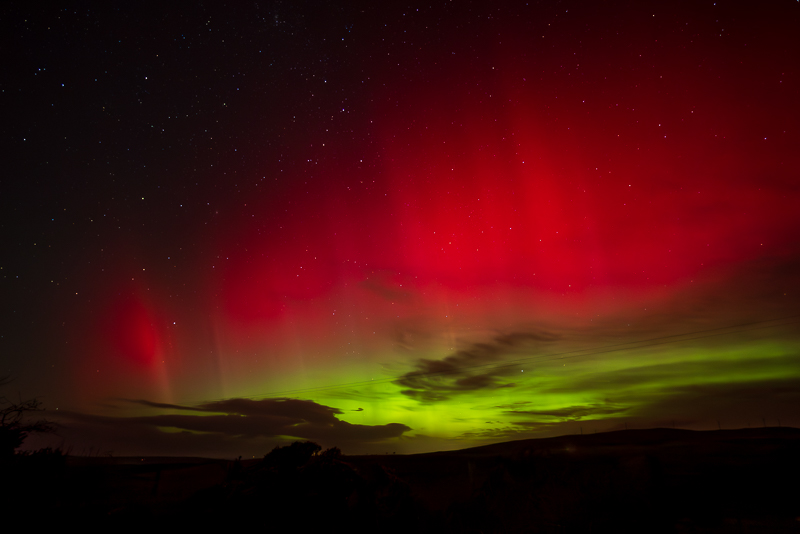
I explained in this post why it is that we see much less colour in the aurora when we look at it in “reality” than when see a photograph of it. To summarise, our eyesight is more sensitive to black-and-white than colour at low light levels. It is just the way our eyes work. So a digital sensor (or even film) will pick up more colour than our eyes do. The sensor is more “objective ” than our eyes are. Even that, I suspect, is a generalisation: The first time I ever saw the northern lights – in about 1984 – I was with a friend. My memories of that event were of a white-ish or pale green aurora, whereas he remembers a colourful one. There must be individual differences in the human ability to pick up colours at low light levels.
Another consideration might be how our camera (or phone) is set up to take and produce the photographs. When the photographer sees the result of their shutter press on their phone or the rear screen of the camera, they are looking at a jpeg file , already automatically processed by the device to give optimum results no matter what the subject is. Other photographers set their camera up to produce a raw file only, which needs to be manually processed using software (such as Lightroom) designed specifically for the task. When downloaded onto a computer the raw file usually looks like a dull version of reality, which needs individual treatment to get the best out of it. The camera also produces a jpeg which is what appears on the rear screen. And over- or under- exposure will affect the intensity of the colours in the digital file. Yet another variable!
Anyway…….. yesterday evening had been more or less cloudy but by 11 pm there were signs of a clearance coming up from the south. As I lay in bed , through the window I could see that the sky between broken cloud looked paler than normal. Could it have been a full moon effect in some way? No…. that was about a fortnight ago. I lay there considering the pro’s and con’s of leaving my warm and comfortable cocoon. Should I? What if? Steadily and calmly adding layer after layer of warm clothing and collecting my camera gear from several different locations (ever organised, me……) I was outside by about 11.20 pm. and straight away could see an aurora with the naked eye.
I had mounted a fixed focal length Panasonic 9mm f1.7 lens on the camera (18mm full-frame equivalent). While this is too wide for most situations I had purchased it partly with the Northern Lights in mind. Its main advantage is the f1.7 aperture. This allows much shorter shutter speeds to be used, and it gives an excellent depth of field, even open wide. I set the tripod up and pressed the shutter. I was elated on seeing the result. A deep crimson was visible on the rear screen which was barely visible to the naked eye, while the off-white/pale green colouration which had been visible became a deep lime green. Over the next fifty minutes the intensity of the aurora diminished steadily and although I waited for it to be re-invigorated it wasn’t to be.
One final philosophical consideration, though. If we can’t literally see something, does it really exist? My feeling is that it does.
To read more Tales From Wild Wales as they are published please click the Follow button.






 Tales from Wild Wales