Lovely weather – but spare a thought for the landscape photographer.

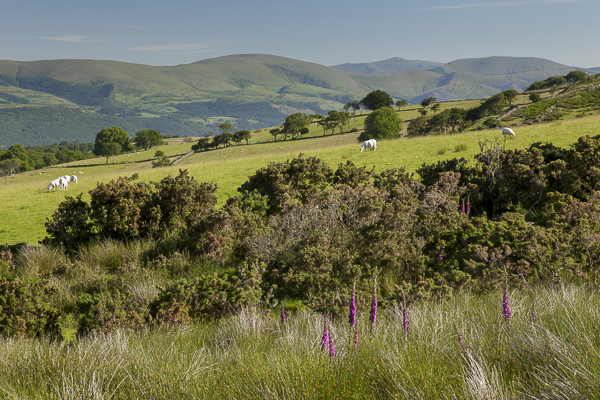
What little colour I could find above the Dyfi Valley.

After what seems like an eternity most of us are enjoying some warm sunny days. Living up in the hills as I do it is several years since I’ve been able to wear shorts and a tee shirt all day long for several days in a row. And I’m finally getting some serious wear out of the flipflops I rashly bought one September several years ago…….

But for the landscape photographer these conditions are the pretty close to the bottom of the barrel. Wall-to-wall sunshine with barely a cloud in the sky do not a happy photographer make, especially in mid-summer. Sunrise is so horribly early that an enormous effort is required to get up in time and without cloud disappointment is often the result. This week the sunsets have hardly been any more interesting and the disturbed sleeping patterns don’t help either. The predominant colour – often the only colour – in the landscape is mid-green.

I’ve recently been commissioned to provide some images for a footpath promotion project in the Dyfi Valley, just north of Aberystwyth.   They aren’t the most spectacular locations but they are very pleasant mid-Wales landscapes. However one is normally judged on one’s best work, and that is often made at the right time of year and in the very best atmospheric conditions. Most photographs I produce during the next month will, I suspect, be disappointing for the client.

My first efforts last Sunday morning made me realise that this wasn’t going to be an easy job at all. The best ‘views’ from just this one walk were in several different directions. They will need to be photographed at different times of day to make the most of the polariser which I usually use. And this uninterrupted sunshine really doesn’t help at all. Partial cloud cover acts as giant diffuser allowing gentle light to penetrate into the nooks and crannies that direct sunlight cannot reach. Without it the landscape looks harsh and uninteresting.

But I love mid-August onwards, well into September. The landscape seems to come alive as wild grasses wither, bracken begins to turn golden and all sorts of other subtle changes take place. And if you visit the right parts of the country the senses can be assailed by the intense pinks and purples found in heather moorland. It almost seems like a different season, and in fact, according to the Chinese Five Element theory, there IS a fifth season, rather uninspiringly translated into English as ‘late summer’. Some of the other characteristics of the season include ‘earth’ as the relevant element, ‘afternoon’ as the time of day, and ‘spleen-pancreas and stomach’ the bodily organs. But maybe we don’t need to go there…….

Back in the present,  I’ve been able to pack a few postcard and calendar orders off to customers in the last couple of days, so some progress has been made. But it feels so desperately wrong as a photographer to be hoovering the office, spring-cleaning the van and making marmalade, while outside the sun is beating down.

To follow Tales from Wild Wales, please scroll right down to the bottom and click the follow button

Photographic cliches and the ‘big stopper’

It’s funny how a disagreement can help to clarify one’s own ideas, rather than help one to see the opposite point of view.

Whilst browsing on a photography forum recently I came across a post asking for suggestions on how to use a 10 stop ND filter (I’ll call them ‘big stoppers’). I’ve been in photography for many years now and I can spot a new trend when I see one. So a few years ago when photographers began asking about these filters on the internet I thought something was afoot. But I just couldn’t understand why anyone should want to increase shutter speeds by so much – in the case of a big stopper by approximately one thousand times. For most of the history of photography the very opposite has been the case. Photographers have striven to reduce shutter speeds to the very minimum in order to stop subject movement.

Eventually I realised that some of the big names in landscape photography were either photographing moving water in almost complete darkness to produce the silky flowing effect that is now so common –  or were beginning to use what had hitherto been a very specialist filter to produce the same result. And the technique was beginning to trickle down to the masses. The trend quickly became unstoppable, and filter manufacturers were unable to keep up with demand.  A deluge of copycat images, some of very poor quality, appeared on the internet. Beginners with very little knowledge of basic photographic techniques were posting images taken with their big stoppers. Waterfalls galore appeared even though the flowing water “effect” can be easily obtained without the filter. The classic big stopper image was of a manmade structure by a shoreline, at dusk, with milky water washing around it. They were (and still are) everywhere on the internet and in the magazines. Some are very good, I’ll admit, but many just aren’t.

Skokholm Island, Pembrokeshire. (5 secs. @ f16)

So I suggested that the use of a big stopper in such situations had become a cliché. I likened it to the use of HDR processing, which also enjoyed a few years of popularity, before – I think – more or less dying a death. And they didn’t like it! How dare I impose my opinions on other people? But the truth is I’m not the only one and I have some well-known allies. David Ward, for example, discussing one of his images with Tim Parkin (OnLandscape Issue 59), recently said the following –

DW……. And it was timed for subsequent waves coming in so that you get a little bit of that kind of misty water effect further up the strand of the kelp but not too overboard. I am getting a bit bored with that.

TP: Milky water.

DW: Milky water indeed. Yeah, yeah, I am guilty I know. I’ve shot milky water in the past. Hands up. Yeah it was me. I suppose my problem with some of them is that there are…we were talking about means a second ago, there is definitely a meme of a bit of seaside architecture in milky water with either a completely blank sky or scudding clouds rendered as a blur. And yes, they’re perfectly attractive photographs. But to me, they don’t really say very much. What they actually talk about, to me, is more about that meme than they talk about their subject. They’re self-referential, aren’t they, in a way. And I suppose all photography is, to an extent, self-referential. But I think they are particularly about a style and that’s what you get out of them, is that reference to the style, rather than anything else. And, for me, this picture was more about colour of light and flow and those kind of things.

T: Moderation, again, isn’t it? It’s nice how it’s picked up the colour of the light, as well, the cool colour? …..(continues)…..

And in the December 2012 issue of Outdoor Photography David Noton made the following comment –

“…… certainly among the [Landscape Photographer of The Year] competition entries there were a lot of waves lapping around rocks at twilight. It’s understandable; they are fun pictures to make. I do wonder if the viewing public is as enthusiastic about these images. I have to admit to stifling a yawn when looking at another long exposure with milky seas and pink skies. That is, of course, rank hypocrisy on my part; my website has many such pictures in the galleries. I told you I’d make your blood boil! I undoubtedly will continue to be powerless to resist occasionally counting down the minutes of another long exposure at dusk, but I am under no illusions as to the novelty of the likely results.”

I did buy a big stopper. It was difficult not to, really. I would otherwise probably have been the only landscape photographer in the world without one. But I’ve not often found the opportunity to use it. It might be fun to try to remove all the traffic from the Severn Bridge with it and maybe I’ll have a go one day. For waterfalls you just don’t need them, and I couldn’t bear to copy all those milky-water-at-dusk-seascapes, especially now I’ve been so rude about them! But I have used it a couple of times in broad daylight at the coast,  for example on Skokholm Island earlier this year, and I quite like the results.

As I pondered over my internet disagreement, I realised again what I had always known; that my interest in photography is not about exploring what a particular piece of equipment can do. It’s all about exploring the world with the camera. The ‘kit’ I own is the set of tools that I use. My particular weakness may be the polarising filter but with a few other exceptions if it is obvious which particular tool I have used then I feel I may have failed.

To follow Tales from Wild Wales, please scroll right down to the bottom and click the follow button

A return visit to the waterfalls

Last week I made a return visit to the waterfalls described in a previous post  – What………..me, guv? (Part 2).  After an early breakfast in the van I set off on the steep and rugged walk down to the falls, kitted out ready for a long day by the river. It had been a still and very humid night – the midges were ravenous – and there were still signs of mist and fog in the valley. On arrival, about 7 a.m., I settled down with my back against the tree stump and began waiting to see what the day would bring.

There was no sign of the kingfishers I had seen on my previous visit but very soon it became apparent that both grey and pied wagtails had young nearby. It took me rather longer to realise that a dipper was perched on a log just upstream,  below the opposite bank. The valley bottom was still in shade, however, so I decided to walk the short distance back up to the falls themselves, and what a spectacular scene revealed itself there!  In the still humid atmosphere each separate “step” of the falls was creating large volumes of fine spray. The sun had just risen above the rim of the gorge directly behind the falls, back-lighting the spray in a very dramatic fashion.  It was rather a Stonehenge situation. Only very close to the summer solstice would this particular alignment of sunlight and landscape be possible, and  the spray was an added bonus.

Sgwd Clun Gwyn Isaf, Powys

My immediate reaction was “wow” and then “whatever do I do with this?”. The lighting was so extreme, and likely to be very short-lived,  that I began work immediately without giving technique much thought. I set up the tripod and, relying on the camera’s meter reading, began taking photographs. I don’t often use a vertical format but this scene was crying out for it; there was too much deep shadow to left and right.  Once my thought processes began to kick in again I experimented with various shutter speed/depth of field combinations which would produce different amounts of “flow” in the water. Over the next twenty minutes or so the quantity of spray gradually decreased as the sun rose and moved across the sky and I ended up with a selection of different compositions to choose from.  With very high levels of contrast in the images I was grateful for the processing power now possible with Lightroom v4, in particular the separate “whites” and “highlights” sliders which I have now got the hang of! You can see one of the best above.

After an exciting half-hour I returned to my post by the tree stump. The dipper was still there but very shortly after my arrival it began a short walk downstream towards me, feeding as it did.  It continued until it was directly opposite me, at which point it entered the river and perched on a couple of rocks mid-stream. I followed it with my camera. I felt almost certain that it was checking me out. It flew back to its log, still in deep shade despite the bright sun. And for the next four hours it spent all its time either there or in the water nearby,  preening and bathing.

…. scratch …….. tug ………. stretch left wing out ……… stretch right wing out ……. stretch both wings up …… fiddle …….. tug ……. fiddle ……. splash ……. shake ….

That’s the bird, not me. I had rather less to do.

I did get a couple of nice pictures of the grey wagtails during this time – despite their almost constant activity – and although I didn’t realise it until later, I learned an unexpected lesson about birds and their way of life.  After they have reared their young,  small birds go straight into moult. They skulk and become difficult to see while they lose their old feathers and grow new ones. And this is what the dipper was doing. My photographs showed that it was not in good condition, some of its wing primaries in particular looking to be missing.

Back at the falls, I noticed a juvenile dipper – probably reared in a nest nearby – a pair of grey wagtails feeding young, and a pair of spotted flycatchers visiting a potential nest site. A little higher up the valley  came the gorge walkers. A party of twelve inner-city teenagers. It may do them good but I still question if river wildlife can cope with such high levels of disturbance. And in a “Special Area for Conservation” as well. It appears that my conversation with the National Park authorities had not yet borne fruit.

A visit to Skokholm island ……. and the joys of running a business.

Razorbill, Skokholm Island

As mentioned earlier I spent a few days on the delightful island of Skokholm earlier this month. It is an excellent place to get close to razorbills and puffins, in particular, although the latter were conspicuous by their absence on this visit. Only during the first day – when it poured with rain – could they be seen standing conspicuously outside their burrows. And due to spring’s lateness this year, the vegetation was less colourful than I had hoped.

But my visit has become more memorable for the presence there of another photographer  – I’ll call him Greg. Soon after arriving we had a chat and he told me that, in addition to his full-time job, he was in the process of developing a sideline as a wildlife photographer.  I told him I had earned a modest living from landscape photography for about twenty years, but more recently wildlife was becoming my favourite subject matter. I told him about my “Wild Wales” calendar.

Back home a few days later I was browsing around ‘Talk Photography’ when I came across a post entitled “A trip to Skokholm Island”. I could hardly resist having a look, could I? And there were some landscape images of the island with the slogan “Wild Wales Photography” plastered across them. And yes, they were Greg’s. I immediately sent a personal message to him stating that I had been using  “Wild Wales” in my business for many years, that I was in the process of registering it as a Trade Mark, and that it would be better for both of us if he stopped using it.

During a short email conversation Greg told me that had bought “Wild Wales Photography” as a Limited Company about a year previously. It appears from the Companies House website that he actually registered it after returning from Skokholm this year, with the full knowledge that I was already using the name. He has also bought a “Wild Wales Photography” domain name.

It must be  genuinely  confusing for newcomers because, on one hand,  they can buy a domain name if it is available and immediately begin using it – no matter who else is already using one of  the myriad variations on the same theme. On the other hand if the name also happens to be someone’s business name, they are getting into much more difficult waters. In my case I have been using it for over twenty years and steadily building up an awareness of the “brand”.

This is the third time I have become involved in this kind of dispute. A year ago someone else living a few miles away from here also set themselves up as “Wild Wales Photography”, while three years ago another Jeremy Moore from Ceredigion also began trading as  “Jeremy Moore Photography”! Unlikely but true…….!  In both cases it was  the availability of domain names that began the whole process – leading to problems and unpleasantness for both of us and considerable expense for me. I’ve had to register my own name as a Trade Mark  – yes, it’s Jeremy Moore (TM)!

As for Wild Wales, once the process of registering it as a Trade Mark is complete it will trump Greg’s Limited Company name. He will never be able to use it. Through Talk Photography I have tried to explain this to him, as have several others, but he seems unwilling to listen. Oh, the joys of running a business…………

Now where was I? Ah yes  …….  Skokholm Island. It was a lovely few days, and I met some interesting people there. There was an exceptional print maker named Julia Manning; and Celia Smith, a sculptor who creates bird sculptures out of wire. It was good for me to talk to people whose interest in birds goes beyond counting and studying them – important though that is. And I found a pectoral sandpiper – a rare-ish American vagrant wader. In my opinion Skokholm is probably the best of the Welsh islands for bird photography. Skomer is great for a day visit but I’d describe  Skokholm  as “the connoisseur’s choice”.  Not only are the birds just as close – or even closer – but the island itself is much more colourful thanks to the red sandstone rock that forms its coastline. And its relative inaccessibility is an advantage too.

Postscript:  Greg has generously (cough) agreed to let me carry on using “Wild Wales” in my business.

To follow Tales from Wild Wales, please scroll right down to the bottom and click the follow button

Blue bluebells and the digital debate…..

_MG_4965Much has been said in the film versus digital debate. I was a film user for many years and perhaps withstood the digital explosion for a little longer than I should have done. But there is one situation in which digital wins hand over fist.

Last week I visited Castle Woods, near Llandeilo in Carmarthenshire, to photograph the bluebells there. What a display! The best in Wales, someone told me, although I cannot vouch for that…..  Conditions were perfect.  There was little wind to cause unwanted movement of the flower spikes or beech leaves. Light cloud cover acted as a giant diffuser, preventing the appearance of disruptive shadows and areas of excessive contrast on the woodland floor.  Oh joy!

The great advantage of digital is that the bluebells are actually recorded as blue on the sensor, rather than the ghastly purple or puce they would appear as on film. Much was written in the photographic press about how to get blue bluebells in those days. Perhaps that was why they invented digital?

My visit to Castle Woods took place on the journey back from Skokholm Island, off the Pembrokeshire coast, where I spent three days. I may write more about that at a later date but needless to say I spent many happy hours in this wonderful place filling memory cards with images of birds, many of which I will eventually delete. Oh, hang on………. there’s another big advantage of digital. However did wildlife photographers manage when each single click of the shutter was measured in actual money spent on film?

To follow Tales from Wild Wales, please scroll right down to the bottom and click the follow button.

Wales at Waters’ Edge nominated for Welsh Book of the Year Award…but only under the author’s name.

It was announced this afternoon that my recent book with Jon Gower – “Wales at Waters’ Edge” – has been shortlisted for the 2013 Welsh Book of the Year Award. But only under Jon Gower’s name.

The idea for the book came several years ago when I heard that the All-Wales Coastal Path would be completed in 2012. It seemed like a very good idea to hang a book project upon. During autumn 2009 I approached a very talented  writer friend to see if she would be interested in collaborating on a joint project on the Welsh coastline. We had a preliminary meeting with the publisher, Gomer Press, in November 2009 , and the book grew from there. A Welsh-language author was brought on board for the Welsh edition, and following the promise of funding being made available to me from the Countryside Council for Wales,  I began work on the book in spring 2010.

It was a rocky road during late 2010/ early 2011 when, in the last of a series of  “hiccups”,  the author eventually dropped out for personal reasons. But Jon Gower stepped in at short notice in spring 2011 and despite having a huge workload finished his excellent text  on time. While Jon and I have progressed in very different directions since our younger days, we both have a background in wildlife conservation which really helped us to work together. The English-language version was published in May 2012.

Just a bit of background there, then. But back to the award. If it really is for the  “Welsh Book of the Year” then surely both of two joint contributors should be credited for their work? Or is it really only an award for “Author of the Year”? Perhaps the idea remains among the literati that a photographer is only fit to illustrate the words and ideas of his obviously more creative writing partner. Photography is often seen as a poor relation among the art forms, and one learns to live with it. But how will the awards judges be able to evaluate the text alone in what is, I would argue, an image-led publication, without being influenced by the photographs?

To follow Tales from Wild Wales, please scroll right down to the bottom and click the follow button.

Third time lucky (Part 2)

Black grouse, north Wales

The very briefest of weather windows seemed to be opening up over the weekend following my unsuccessful trips described in Part 1. Heavy showers and sunny intervals were forecast for the Saturday evening followed by a sunny couple of hours first thing on Sunday morning. I decided to go for it.

All was quiet when I arrived at the lek site in the early evening. The setting itself looked a bit scrappy – probably linked to some abandoned quarries nearby – but suddenly four blackcock swept in together. Almost immediately they took up their stances and hostilities began. It was quite comical really; these birds were quite clearly not strangers to each other and yet all of a sudden it was handbags. While the light wasn’t good, the distances I would be working at were very useful.  I took a series of images of the birds over the next hour and a half, at which point –  for no apparent reason – the grouse flew, only to return again just before dusk.  I felt reasonably confident that a morning session would be profitable, so set my alarm clock for 5.30 am; I should get a decent night’s sleep……….

At 2.30 am the first rally car sped past. For more than an hour there was the sound of burning rubber on tarmac every few minutes as one car followed another around the bend beside which I was parked up. One stopped alongside and the driver shouted “hello?” before heading off again. As silence eventually fell over the moorland at 4 am, and the very first hint of dawn began to appear, the bubbling and hissing sounds of lekking black grouse became apparent. I could just see their white tail feathers in the gloom through my binoculars. It looked like some serious action was underway on the lek. By 5.30 it was just about light enough to begin work with the camera and such are the joys of having a camper van, I did not need to leave the warmth of my sleeping bag to do so! Just sit up, reach over for the camera and open the side window…..

While the promised sunny morning did not actually materialise the birds did come very close, closer than I could have hoped for, really. I recalled the adverts I had seen on the internet offering dawn visits to hides near leks for upwards of  £100 a go. Here I was doing the same thing  in much more comfort for free!  Other leks not too far away could be heard in a light breeze. And fortunately several other birder/photographers who arrived later on did not leave their vehicles until after  the birds left of their own accord. Light levels were quite poor, however, and it seemed likely that any photographs of moving birds would be disappointing. Nevertheless I felt that the series of portraits I took of standing birds should contain at least something usable, and this has proved to be the case. I’d like to have a go here in brighter sunlight at some stage but I feel now that I’ve made a good start on the new project. And it really was third time lucky.

To follow Tales from Wild Wales, please scroll right down to the bottom and click the follow button

Early morning in the saltmarsh

Black-winged stilt, Ile de Re.

Jane and I have different ideas about what a holiday should be.  For me its largely about seeing new landscapes and   new birds, while she likes …… well ……. to relax. We seem to have come to an understanding, though, and as long as it also involves us both enjoying cups of coffee in atmospheric street cafe’s we can live with our differences.

Last month we went to western  France. Travelling almost entirely by train we spent one to three days in five different locations, from La Rochelle to the north as far as  St Jean Pied de Port in the foothills of the Pyrenees. I had planned each stop fairly carefully  to give me the chance of doing some bird photography in some, while in others we could both enjoy some delightful French countryside, villages and cities. The Ile de Re is a rather lovely island near La Rochelle which is joined to the mainland by a bridge. It’s almost completely flat, and crisscrossed by a maze of cycle tracks which should put most local authorities in  Britain to shame.

By a stroke of good fortune I had booked some accommodation towards the western end of the island close to the best section, bird-wise,  of salt-marsh.  So it was a doddle to get up at dawn and potter off to the marshes on the bike for some early morning birding – even more so as France is two hours ahead of GMT and the sun didn’t rise until about 7 am. I do find the freshness of early morning particularly stimulating.  Wildlife is more active and seems to be more approachable and dawn can bring a feeling of mist and mellow fruitfulness to the landscape at any time of the year.

Perhaps the star bird of the marshes was the black-winged stilt. One of those species that even a non-birder could identify, it is a neat black and white wader with extraordinarily long coral-red legs. There was no shortage of them on the island and they were, frankly, quite easy to photograph. After years of using only the central focus point and the “focus and recompose” method I’ve recently discovered the outer focus points of my Canon 7d.  It’s certainly not rocket science to use them and it got me wondering …… what might all those other little buttons do? So as well as  experimenting with that in the field I’ve also been trying out with different cropping ratios and I think this upright version works quite well.

So after a couple of hours of solitude in the marshes I would tootle back to the chambre d’hote just in time for a delicious breakfast prepared for us by the lady of the house. Jane would probably be up by then and tell me about the wonderful night’s sleep she had had, and I could enthuse about the birds I had seen and photographed.  Then we would spend most of the rest of the day together.

Third time lucky (part 1)

Beginning a new project is always a daunting time. A blank page opens up before you and you realise you will have to fill it. It is difficult not to feel a faint sense of panic, and so it is with me at the moment.

I’ve been moving away from photographing landscape recently towards what might be described as birds within the landscape. It’s a very different regime; the subject matter is typically very small, moving erratically and much too far away. So one needs to master a whole range of new equipment and techniques, and I wouldn’t suggest that I’m even part way there yet. However it gives me a new challenge and from time to time we all need that.

Perhaps typically I decide to go for the one photograph first that I never thought would be possible. The black grouse is a rare bird in Wales but there is an apparently thriving population in a small part of the north, thanks to the activities of the conservation organisations. Particularly in April and May, male black grouse perform a “lekking” display – a series of postures, movements and sounds designed to show off their plumage and prove to watching females what successful fathers they could be. It takes place at traditional sites known as leks. By a stroke of good fortune I got to speak to an ornithologist based in that area who agreed to tell me where I might go to photograph this phenomenon, using my van as a hide. I knew that the birds could be seen from a moorland road but he would check out some exact locations and let me know.

I hadn’t yet heard from him but in early April I decided to have a crack at it. It’s about a two-hour drive from Aberystwyth and on the journey I discovered I had left behind my crate full of household necessities and food. Tea bags? Who needs them? An urgent purchase of supplies and equipment followed………… On arrival I discovered that the moorland road was blocked by snow. Not really what one expects at this time of year! Making the best of a bad job I took a walk along the road through the snowdrifts and could see and hear the grouse doing their thing.

My second attempt followed over the recent bank holiday weekend. The road was open this time and I could see the birds but they really were too far away to photograph. I considered the possibility of dragging my sleeping bag and photographic gear up onto the hillside and sleeping under a bush, so that I would be there at first light when the lekking began. A minor problem revealed itself when I looked at the site again…….there was no bush. It really was a completely open location with no possible hiding place for the photographer. A very dismal day of waiting followed. The landscape itself looked and felt as if it were still winter. All I felt capable of doing was eating and sleeping.

The next morning dawned windy with low cloud – this really wasn’t going well. As the fog lifted I could see the grouse posturing and strutting in the distance but this was definitely not the photo-op that I had been hoping for. By coincidence an early morning programme on Radio Wales contained  an item about watching black grouse lekking  at Llandegla, not far away, but this was no consolation at all.  I drove home.

I had been back about an hour when the phone rang. It was my contact from north Wales. Would photographing a lek from a distance of twenty-five yards be good enough? You bet it would! “So where exactly is the location?” I asked him. I ran to fetch the large scale map from my van. He described a site about half a mile further up the moorland road than I had ventured before turning round!

While it was incredibly frustrating to find out how close I had been to success, it also meant that success could eventually be possible. Third time lucky? I certainly hope it will be………..

To follow Tales from Wild Wales, please scroll right down to the bottom and click the follow button

Wales at Waters Edge – the Exhibition (and related events).

Cardiff Bay barrage, Penarth, from "Wales at Waters Edge"
Cardiff Bay barrage, Penarth, from “Wales at Waters Edge”

I have now received definite dates from Aberystwyth Arts Centre, for the exhibition  “Wales at Waters Edge” : July 13th until September 7th this year. It is a great venue – one of the largest combined Arts Centres in Wales (and possibly the UK) and with Aberystwyth being my home town I am thrilled that it will be shown there.

In conjunction with the exhibition I will be giving a talk on Thursday August 8th at 6p.m., and leading a Landscape Photography workshop from August 29th until September 1st.

I will post further details when I have them.

To follow Tales from Wild Wales, please scroll right down to the bottom and click the follow button.