It was a few minutes’ drive inland to my next location, a hilltop overlooking the Dyfi valley near Derwenlas. I knew from numerous previous visits (see this post) that it would be mid-morning before the sun would be where I wanted it. A heavy shower moved inland on my arrival, creating another fine rainbow. Light was still good half an hour later despite the sun’s relentless rising, and I got the shot I had come for; would it be suitable for a new postcard, I wondered? See the upper picture of the pair below.
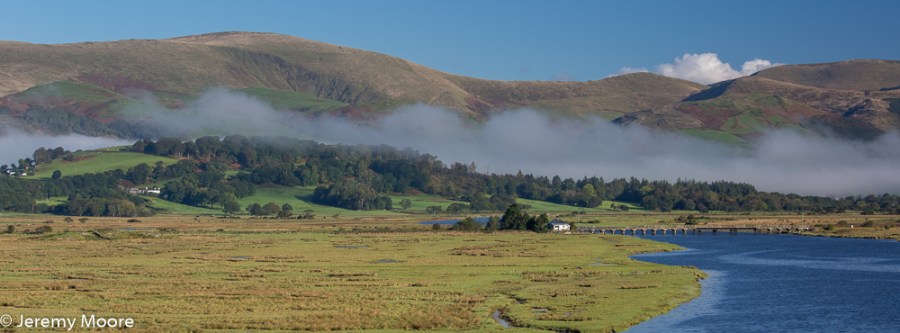
A couple of days later I decided to have another go at both the Glandyfi and Derwenlas viewpoints. Still conditions were forecast overnight and hence the formation of valley fog was possible. It was a very different morning to my previous visit. At Derwenlas all was gloomy low cloud but at Glandyfi a river of fog flowed continuously down towards the sea. Over about ninety minutes I took a number of images, but it was when the “river” began thinning and receding inland that I felt the best results were obtained (see above). It was an interesting contrast to the scene two days earlier (see previous post).
Dyfi valley, near Machynlleth (first visit)Dyfi valley, near Machynlleth (second visit)
Then it was back to the Derwenlas viewpoint. It was still like being inside a bundle of cotton wool when I arrived, but after a few minutes the cloud cleared entirely, revealing the gorgeously-lit Dyfi valley complete with a necklace of cloud draped around the hillside above Machynlleth. If this doesn’t work as a postcard, I’ll eat my hat!
As a postscript I have just sent a cheque for £70 to the charity Rewilding Britain (click for more info). This is a donation per work sold at the Aberystwyth showing of my Bird/land exhibition.
To follow Tales from Wild Wales, please scroll to the bottom and click Follow.
En route to Machynlleth the trunk road from Aberystwyth to north Wales, along with the railway line, is squeezed between the Dyfi estuary and its wooded slopes. Until a few years ago the road was narrow and winding with the occasional gridlock occuring if two large vehicles met there. There’s no doubt that the “Glandyfi Bends” needed improvement to improve journey times. Costs were orginally estimated at £10 million, but there must have been a bottomless purse for this project; a total of £18m was apparently spent altogether. The result is a smoothly curving, two-lane carriageway with excellent visibility. So what did the Highways Authority do? Slap a 40 mph speed limit on the new section of road and extend it all the way back to the village of Eglwysfach. Improve journey times my ****!
Like all trunk road improvements in Wales it is over-designed and over-engineered. There is a one-way lay-by for motorists driving northwards; access from the north or exit to the south is forbidden. On the lay-by there is a lay-by. Would you believe it! Oh yes, there’s a picnic table on a mound. The wall alongside the main road is too high over most of its distance for car drivers or passengers to enjoy the stunning views across the estuary. But the most prominent of all is the retaining wall to hold the hillside back. This massive construction is known locally as the Great Wall of Glandyfi. It can be viewed most conveniently from the north side of the river – in fact it is very hard to miss it for miles around.
There is a silver lining for the photographer, however. There is a narrow walk-way, fenced off for safety, along the top of the wall, which gives fabulous panoramic views across the estuary to the southern hills of the Snowdonia National Park. An access gate is half-heartedly padlocked at the eastern end. On the last day of September I headed up to Glandyfi on a morning when torrential downpours alternated with strong sunny intervals; ideal conditions for the photographer with good waterproof clothing! On arrival I prepared my gear in the van while it absolutely hammered down outside. The downpour moved over quickly and a brilliant rainbow appeared over the estuary. I quickly accessed the walk-way, set up the tripod and began taking pictures.
Rainbows are never easy. They are almost always unpredictable and may only last a couple of minutes. It is almost always raining and this plays havoc with one’s equipment. Filters are particularly vulnerable to wetting. As I wiped raindrops from one side of my 2 stop ND grad, a fresh crop appeared on the other side. This was just silly! Landscape photographers are sometimes advised that a polariser should be used to intensify the colours of a rainbow but I have never found this to be the case. You can easily completely remove a rainbow with a polariser but who would want to? Over a period of five minutes and despite rather feverish picture-taking, I had some rather excellent rainbow images in the can, such as the one above.
Bridge over the River Dyfi
When planning my landscape photography destinations I always take into account the time of day of the visit and hence where the sun will be. A polariser is always most effective at right-angles to the sun, while that rare thing, a rainbow, always appears opposite the sun. I can think of one location on the Mawddach estuary where you can use a polariser to your heart’s content but still be open to the possibility of a good rainbow image. The Great Wall of Glandyfi is another. Following the disappearance of the rainbow I swung around by ninety degrees and captured some images of saltmarsh, the railway bridge over the Dyfi and its accompanying solitary white cottage, in brilliant sunshine. The hills of southern Snowdonia were still in deep darkness and low cloud swept their summits. I used the polariser and the 2 stop ND grad to add to the drama of the scene. I felt that the resulting image worked well in a panoramic format.
It might seem that I was lucky that morning but I had already made several frustrating visits to the area with no worthwhile results. What I was quickly able to do on September 30th was get to the best spot quickly and take advantage of great conditions when they finally did appear. I’d been up there for about two hours – how time flies sometimes – when I heard the sound of chain-saws. Down on the main road maintenance men were removing branches from the vicinity of some electric cables. It soon became apparent, though, that a man with a chainsaw was also clearing branches from the walk-way upon which I was standing, and approaching quite fast. It was time to beat a hasty retreat!
To follow Tales from Wild Wales please scroll right down to the vottom and click Follow
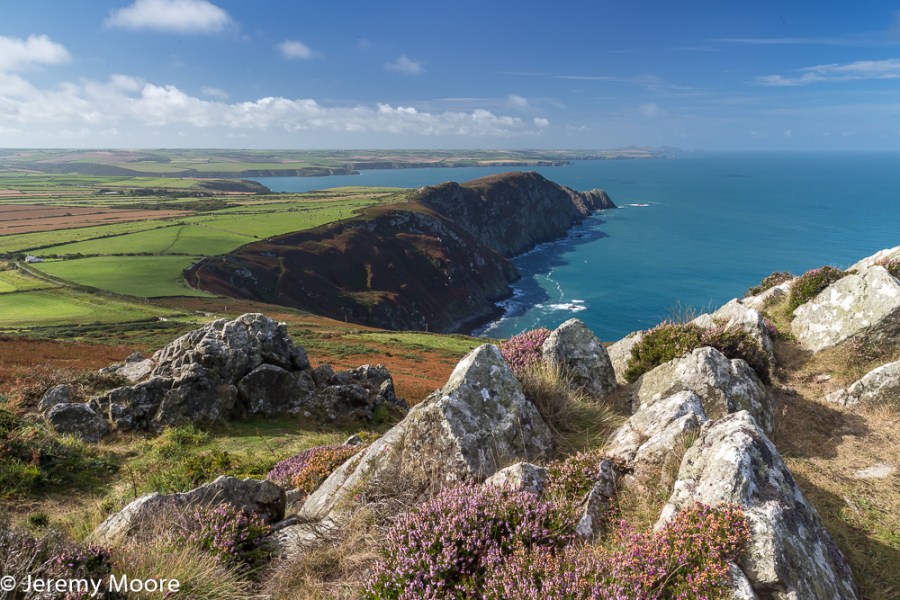
St David’s Head (in the far distance) from Garn Fawr.
One evening about ten days ago I headed down to Pembrokeshire. Postcards are still selling well down there and I need to renew a couple of cards for next season. One card in particular had sold out, a view of Strumble Head lighthouse from the mainland. I hoped that the heather would still be in flower so that it could appear in the foreground of the picture. Conditions for my journey down were poor but a clearance to sunshine was forecast for the following morning. I spent the night in my camper van on the car park just below Garn Fawr. This is a rocky 200 metre hilltop, complete with hill fort, on Pen Caer, the peninsula upon which Strumble Head is the northern-most point.
By 8.30 a.m the following day it was indeed clear and sunny. I walked the short distance up to the summit of Garn Fawr. It is a stunning viewpoint with 360 degree views across north Pembrokeshire, notably down the coast to St. David’s Head. It should have been perfect for photography, but it wasn’t. There was a murkiness in the air, possibly a legacy of the previous night’s rain, and the sky was cloudless – blue but uninteresting. After a few minutes I returned to the van. There was no point in even pressing the shutter when I knew that the results would not equal those I had achieved on previous visits. I brewed up some coffee and compared notes with another campervan driver who had recently arrived. I decided on a different walk nearby, and rather lazily drove the couple of miles to its starting point.
By this time it was about 10.30 am. I normally have a cut-off point of about 10 a.m. in summer, after which I feel that the sun is too high for successful landscapes. It’s all part of a process, of course, but shadows become insignificant and the light tends to become too harsh. But by this time some attractive clouds had begun forming and the air did appear to be sharper. So I decided to head back up to the summit of Garn Fawr instead. I could still walk from my new parking place although it would be a longer and steeper climb. One might prefer the sun to have been lower but I think you’ll agree from the picture above that it was worth it, though. And so one single, ten-minute picture-taking session made over a period of five hours was all that was needed for a successful morning’s photography.
Later that day a bank of thick cirrus cloud edged in from the north-west, gradually obscuring the sun. I walked along the coast path to the location for the lighthouse image I had in mind, but it was too late – the sun had gone. And the heather on the cliff-top was over – no longer the luscious pinky-purple that I love but brown. It was all a bit dispiriting. I returned to the van and buried myself in a book. I would have another go the following day.
Strumble Head lighthouse, Pembrokeshire.
The next morning I awoke before dawn and turned the radio on, just in time for the 5.30 a.m. weather forecast. Ever heard it? I thought not! The forecaster described the same band of cloud and, very unusually, added that there could be a good sunrise. I hadn’t thought of that! The Pen Caer section of the Pembrokeshire coast runs roughly west > east so the lighthouse might be set against a pink sunrise from my viewpoint. I gulped down a mug of tea and drove down to Strumble Head ; then there was the fifteen-minute walk! The sky was brightening and wispy cirrus pinking up quickly. But I made it. I took a series of images in the hope that one would include the lighthouse beam. A glance at the camera’s monitor was enough to tell me that I’d been successful. What a bonus! There was a real spring in my step as I walked back to the van.
The cirrus that had provided the focus of my sunrise picture proved to be a bit of a downer for the rest of the morning, however. More often than not the sun was behind it, which had the effect of casting a veil over the light on the landscape. It was the end of picture-taking for the day and I was back home by mid-morning. I had been away for 40 hours and during that time had actually had the camera in hand for 20 minutes. And yet I felt it had been a successful trip. Such is the life of the landscape photographer: you wait around and then you wait around some more. And if you’re lucky…….
To follow Tales from Wild Wales, scroll down to the bottom and click Follow.
A couple of years ago I posted about photographing hawfinches in a Welsh churchyard. (See this post). While it was exciting to come back with something usable it was not really the image of my dreams. So I kept my ear to the ground about other possible locations.
The hawfinch has always been an uncommon bird in the UK and has become increasingly scarce in recent years. In 2013 the maximum number of breeding pairs remaining in the UK was estimated to be one thousand. The 2013 BTO Bird Atlas noted that the Welsh population was becoming increasingly significant in a UK context. And – unlikely as it may seem – it has become more and more apparent over the last few years that one north Wales town is the British hawfinch hot-spot. The first hint of this came in 2004, when research published in “Welsh Birds” suggested a breeding population of about fifty pairs in the area, and a wintering population of more than a hundred birds. The increasing scarcity of the species and its growing presence in the area has resulted in further ringing and other studies being undertaken there. Both the BTO and the RSPB have become involved. The results have shown how numerous the species actually is there and how little we knew about the hawfinch!
Ornithologist Dave Smith and bird-ringer extraordinaire Tony Cross have set up a feeding station in woodland nearby which is kept well-stocked with sunflower seeds. Hawfinches can rely on this food source all year round and there they can be netted, ringed and released. The yellow plastic leg-rings, each with an individual letter and number combination, can be read relatively easily in the field. Perhaps the most astonishing information has come from just one garden in the leafy outskirts of the town. Shortly after moving into the house, inexperienced bird-watchers Trevor and Chris ******** began to notice some unusual-looking birds on their feeders. Delving into their field guide they realised they were hawfinches. Their garden has since developed into a hub of hawfinch-related activity. Trevor and Chris themselves have become, by their own admission, obsessed with the species. They sit in their kitchen and read ring numbers with a telescope. To date they have identified 185 different birds, with probably an equal number of un-ringed individuals. It really is hawfinch nirvana.
Thanks to my contacts in BTO Cymru Trevor and Chris very kindly agreed to let me visit their garden to do some photography. Trevor has himself taken many excellent photographs of the hawfinches through their kitchen window and posted them on Flickr. But there is no mistaking the fact that they are all taken at bird feeders. Not really the type of setting I felt they deserved. Tony Cross generously took me to his feeding site but the setting there is, if anything, less attractive. It is an extensive carpet of sunflower seed shells surrounded by ringing paraphernalia. We tried scattering seeds on the woodland floor around the “feeding table” but the birds just weren’t interested. Perhaps I should have been more patient……..
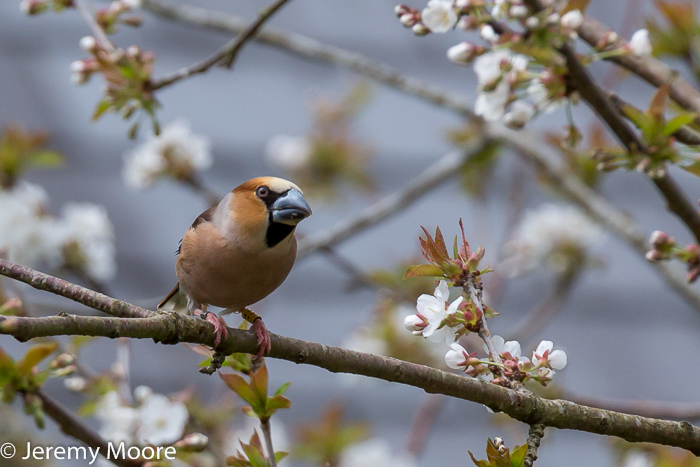
But there is a cherry tree in the ********s’ garden and the hawfinches sometimes perch in it before heading for the feeders. That sounded more promising! There followed a wait of several weeks for it to come into bloom and leaf. The strong northerlies of late April and early May held back flowering even longer than usual. Last Sunday the tree finally began to show some colour and it was amazing how much change there was in the following 24 hours. I chose a position in the garden where I could look across to the cherry tree against a dark background. For the first time in my life I set up the tripod, brought out the camping chair, sat down and draped a bag hide over myself and all my gear.
It took a bit of getting used to. Apart from the issue of physical comfort, tunnel vision was a problem. I could hear birds all around but often not see them. The lower branches of the cherry tree were visible but the lawn and bird-tables were out of sight. But when a hawfinch lands it has the tendency to sit tight for a few seconds and survey its surroundings. There is sometimes an air of deliberation about their activities. They seem to take their time and think things through. So on the few occasions when one did perch in the cherry tree I had the chance to catch it in a variety of postures and compositions before it dropped down onto the feeders. Light cloud was preferable to bright sunshine as it tended to illuminate tree, flowers and bird in a gentle, even light, and cast no shadows. I’m absolutely thrilled by this image.
NB I have removed Trevor and Chris’s surname to maintain their privacy, and also the name of the town.
To follow Tales from Wild Wales, scroll down to the bottom and click Follow
Last weekend Jane and I headed off to Glastonbury for a few days. It’s an unreal place. If ever you needed to visit a personal transformation coach, an angelic reiki practitioner or a shamanic hairdresser, make for Glastonbury. It would be easy to sneer at the apparent pretentiousness of it all, but that would be unfair. While there may be some charlatans involved, I’m sure many of these people are quite genuine in their thinking; and I sometimes think how comfortable it must be to live according to a ready-made belief system. It was curious to note the vigorous campaign for the retention of the last remaining bank (Barclays, if I remember correctly….) in the town, though.
An extensive area of former peat workings near Glastonbury has been reclaimed to create a cluster of wetlands and reedbeds, now known as the Avalon Marshes. These are home to several rare bird species, notably bittern and great white egret. The latter was fairly prominent at the Ham Wall RSPB reserve, and I photographed one on a beautiful, still, winter’s morning with warm light and a hint of frost on the ground. The former lived up to its reputation for skulking. But arguably the biggest draw on the Avalon Marshes in winter is its huge starling roost, which I spent three evenings trying to capture. For roosting, the birds have a very large area to choose from, and they can move from one site to another on a daily basis. Even the local birders and photographers admit to being unable to predict what they are likely to do next. On my first visit I found a likely looking foreground at sunset and hoped a flock would fill the sky with interesting shapes. Needless to say it didn’t work out how I had hoped, but there was the above; I’m not sure yet if the image works or not.
On the second night, from a different location, I watched as huge flocks gathered over farmland and in trees to the east against a dull background; and later, with mounting disbelief, as a continuous stream of starlings moved from one section of reedbed to another. The process lasted some 15 – 20 minutes; there must have been millions of birds altogether. But it was a frustrating encounter; they flew too low over the ground to photograph successfully. On the third night I sought out the trees where they had gathered the previous evening but again the results were disappointing.
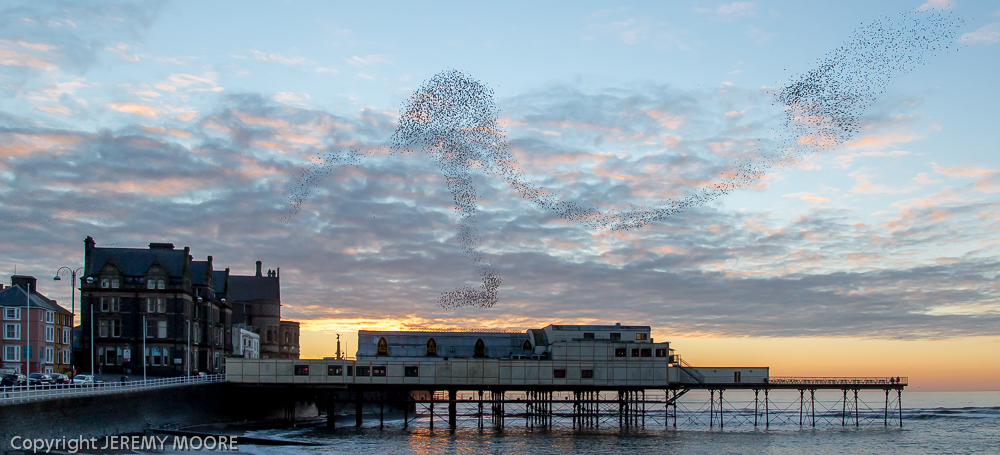
Starlings at Aberystwyth
Back in Aberystwyth, decent sunsets have encouraged me to visit the starling roost three times this week. Tuesday was just the most gorgeous winter evening; cloud had largely cleared during the afternoon and there was no wind. The starlings must have felt it too. For a few brief moments a flock briefly indulged in one of their spectacular ribbon/bracelet formations before dropping in under the pier. At last! Something to write home about……
For the last couple of months my camera bag might have been a door stop for all the use it has had, so it was good to pick up the camera again….. even if I could barely remember what some of its buttons were for! But the experience did remind me how important it is to be familiar with the controls of your equipment. A few seconds delay and confusion can mean the difference between getting the shot and missing it. And which shutter speed would blur the movement of birds in flight most successfully? I just couldn’t remember. But there is one thing about trying to photograph wildlife – it teaches you patience.
To follow Tales from Wild Wales, scroll down to the bottom of the page and click Follow.
I cannot remember such a long period when the weather has been so discouraging for the outdoor photographer. Days….. weeks!….. on end of cloud, rain and gales – and today is no exception. I’m shocked to discover that I’ve barely taken a decent photograph since the beginning of October.
But I can’t just blame the weather for that. In my last post I wrote how my priority over the summer was to work on images for new postcards. How one needed to visit the popular locations and somehow come up with something new. I eventually realised I was just going through the motions. I really was re-visiting the same old places and taking the same old photographs.
So as much as the weather really has been disastrous it was a partly a conscious decision to lay the camera down and give myself a break. This happened to me big time about twenty years ago. I put down the break-up of a relationship partly or largely to the fact that I saw myself as a photographer first and a human being second. There certainly were other factors but being an outdoor photographer does involve leading a very unpredictable lifestyle. Whatever…..after a few self-imposed months of keeping the business running and no more – certainly no actual photography – I picked up the reins more or less where I had left them. In my experience one’s creative side continues to develop even if putting it into practice actually takes a back seat for a while. After a few months break from photography I’m sure – well, fairly sure -that I’ll return to it with a bunch of new ideas and attitudes.
I hope it does, because I’ve recently had a very positive discussion with a publisher and author about a new book. There’s still plenty to be finalised, particularly the financial side of things, but I’ve come to the conclusion that my sanity is now more important than my bank balance! So even if it doesn’t pay very well, I’ll still do it.
In a post earlier this year I wrote about how I missed an opportunity to photograph the Northern Lights. Since March I have gained a better understanding of why and how a faint aurora – even an invisible one – can actually produce decent photographs. The reason is this : there are two types of sensor in the eye – cones and rods. The cones are colour sensitive, but the rods, which are 1000 times more sensitive than the cones and far more numerous, do not pick up colour. So our eyes do not perceive colour at low light levels. The sensor in our camera is equally sensitive to colour at low or high intensities so it will record what the eye cannot see.
A couple of evenings ago I received an “Aurora Watch” amber alert. To my surprise yet another cloudy day actually improved to an evening of clear periods and showers. There was quite a powerful moon but the northern skyline looked a bit odd. I couldn’t be sure whether it was a pale glow that I was seeing or some cloud hugging the horizon. I eventually realised that I would have to take some photographs to be sure if the aurora was present or not.
I set the ISO at 3200 and the meter gave a reading of 8 seconds at f4. When viewed on the camera’s LCD screen the first image immediately showed that there were vertical bands of purple in the clear sky which were completely invisible to the naked eye. I took a few more images to confirm it and then called it a day. On viewing the images this afternoon on the PC monitor it became clear that amongst the cloud on the horizon there had also been a green glow. The very localised orange glow on the horizon is usually visible to the naked eye as pale and colourless but the camera’s sensor has picked up its colour; it must be street lighting from a nearby village reflected off low-ish cloud. The image has of course been processed, but not to an excessive level – no more than I would expect on a typical landscape. This had been the real thing and without the camera I would never known!
Technically and artistically it is rather poor. I should have taken more care with placing the tripod and weighing it down, and the telephone pole in the foreground is hardly an attractive feature. But I’m treating it as a learning experience and hopefully there will be an opportunity to do better in the future.
Seasons Greetings to all from a wet and windy Welsh hilltop!
To follow Tales from Wild Wales, scroll down to the bottom and click Follow.
Following a talk in Aberystwyth by George Monbiot last spring on “rewilding”, a local ornithologist and friend Roy Bamford wrote a full-page article on the subject in our local newspaper, the Cambrian News. His main thrust, borne out of many years of personal experience, was that rewilding may happen – come what may – and that its effects may be unpredictable. The article was almost entirely uncontroversial but was followed a couple of weeks later by a letter from the Farmers Union of Wales. This included a personal attack on the author and a suggestion that he was quoting tittle-tattle from the internet (among other things) to support his case. I felt that this should not go unchallenged so wrote the following, which was published in the Cambrian a few weeks later.
I am writing with reference to Roy Bamford’s piece ( 3rd July) on rewilding and the subsequent letter from the Dafydd Jones, vice-chairman of the Ceredigion FUW.
Firstly I suggest that it is unfortunate that Mr Jones chose to make such personal comments in his letter. Mr Bamford has already defended himself on the letters page but a less modest man would have gone further. His knowledge is based on the many years of professional field work he has undertaken. It is upon this field work that much research into the relationship between agriculture and wildlife in the Welsh hills has been based. I cannot think of many people more qualified to make these observations than Roy Bamford. So if he quotes studies that include photographic evidence of sheep eating curlew’s eggs then this not an anecdote, it is a fact – unlikely as it may seem to most of us.
On a far more limited scale I have been surveying the same tract of land above Tal-y-bont for 20 years. I walk the same route twice a year and record every bird that I come across. I follow a fence line with improved grassland and heavy sheep grazing on one side, and unimproved grassland or “ffridd” on the other. The contrast could not be more marked. With its very low sheep numbers the ffridd is, in effect, rewilding in action, and it is home to a large and varied selection of small birds. The improved grassland might as well have been concreted over for all the wildlife it contains. A few meadow pipits and a few scavengers and that’s about it.
The farmers that Mr Jones represents have benefitted to the tune of many, many millions of pounds from the public purse since the last war. This same period has seen the Welsh uplands becoming demonstrably more and more impoverished in an ecological sense. The farming industry has itself become more depleted at the same time. Rather than the mixed farming of earlier generations, does the average hill farmer now grow more than one crop – grass? Does he farm more than one product – sheep? I suggest, in many cases, that the answer is no. Through its lack of vision the sheep farming industry has manoeuvred itself into a cul-de-sac, an evolutionary dead-end. So it is a shame that the FUW does not show a more open-minded attitude to the future – which may well include rewilding. It would be far more constructive to do so, and they would be doing their own members a service.
I could have published this letter under “name and address withheld” but chose not to. I’m not afraid to hold such opinions, which would, anyway, probably be held by a large percentage of the population. I realised that the letter might be read by the landowner whose land I walk and that there might be repercussions. And so indeed there have been. This year permission to access his land was refused.
The Cambrian News did not print the final sentence of my letter, which was as follows:
Instead we get the same anti-environment rhetoric that has become the norm from the farming unions – high on opinion and low on facts.
I’m not denying that hill farming might at times be a challenging occupation. I’m not denying that sheep farmers work hard. But so much of their income comes from the public purse. What benefit does the public receive in return for their support? By displaying such reactionary, head-in-the sand attitudes, and continuing to deny what is quite clearly true, farmers and their representatives are their own worst enemies. When the public money runs out they will need all the friends they can find.
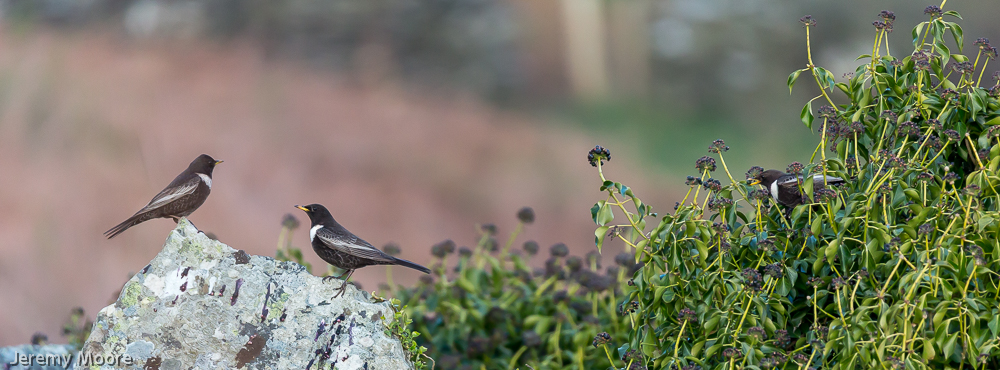
I’m including an image of ring ouzels taken yesterday. This has become a scarce species over the decades in Wales, and they are now difficult to see, let alone photograph. But this small group of migratory birds has been feasting on ivy berries not far from here in recent days.
To follow Tales from Wild Wales, scroll right down to the bottom and click Follow
Last autumn I was contacted by a writer and photographer called Charles Hawes who was in the process of walking the Wales Coastal Path, and blogging about his experiences. He had seen my most recent book – Wales at Waters Edge – and was planning to review it. Would I allow him to use some of the photographs? Under copyright legislation the use of photographs for review purposes is permissible without the copyright holder’s agreement. However, as the book had been published two and a half years earlier, I did have doubts in my mind about the validity of a review. Did the reviewer really just want some nice photographs free of charge to pad out his blog? I took a look at the blog. He had also reviewed Peter Watson’s photographic book on the Welsh Coast (published about a year before my own), and, quite frankly, it is unlikely that Hawes would be on Watson’s Christmas card list!
I had an interesting exchange of emails with Charles Hawes. While I largely shared his opinion of Watson’s book, I felt that it was unusual, to say the least, to put such a critical review into the public domain. I suspected that my own book might come in for similar treatment, and if that might be the case, why should I allow him the benefit of using the photographs? In the end, he suggested a compromise; he would allow me the right to a reply, which he would then publish verbatim on his blog. Having by that time seen a copy of the review, I felt that – on balance – this was a solution I could live with.
I think it would be fair to say that the review was mixed. Walking the entire coastal path, Charles Hawes has probably seen more of the Welsh coastline than I did. But quantity is not necessarily more valid than quality. He has only only visited one Welsh island, Anglesey, which one could argue is hardly an island at all. As a result, he’s missed out on some of our most special places, many of which I have had the pleasure of visiting. On some occasions he enjoys the wildlife that he encounters, but in general his attention is far more frequently drawn to the towns, villages and man-made structures he comes across. So there was a very clear disconnect between the two of us in this respect and it is not surprising that we see the coastline so differently. What I don’t accept is his opinion that the photographs almost completely avoided its built-up aspect.
Charles has kindly allowed me to add a link to his blog (below) for those of you who would like to further explore the content of the book, and the interesting difference of opinion that it has spawned. Following on from the review you will find my response, and some further comments from his readers. In particular, close to the end is a post from “John” (December 18th) with a further link to his own review of Wales at Waters Edge, which is rather more favourable than the original!
NB. Both reviewers are critical of the text by Jon Gower, and I would like to make it clear that I don’t agree with them………
On a Friday afternoon recently I was on my way to a 5 p.m. appointment with a customer when I encountered a traffic hold-up in a mid-Wales town. I soon realised there was no chance of making the appointment so I phoned up to re-arrange it. It took 55 minutes altogether to get through the bottleneck (a set of three-way traffic lights at some roadworks already abandoned for the weekend!) so I had plenty of opportunity to reassess the rest of my day. Would the evening be an opportunity for some landscape photography as I had originally planned? And, if so, where …….. ?
Another interesting possibility suddenly entered my consciousness. Some ten years ago I had been told that hawfinches could be seen at a particular churchyard during June. It wasn’t that far away! It might be worth a shot. Half an hour later I was there.
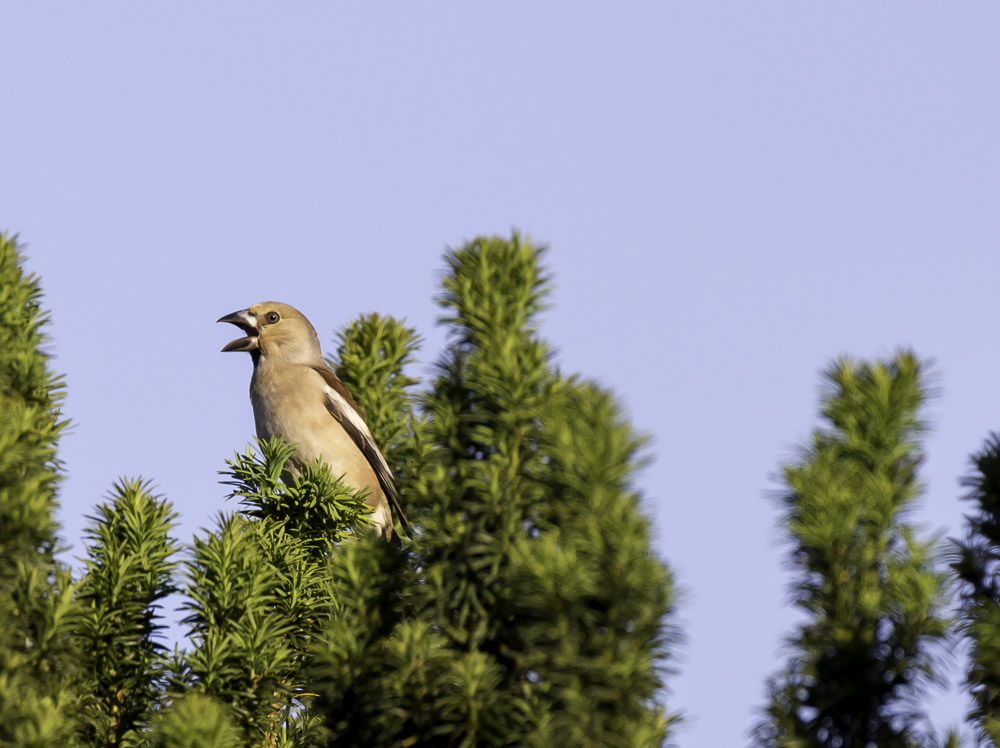
At first the churchyard was ominously quiet. Then a stocky bird flew behind a yew tree and disappeared. Hmmmm…..what was that? Before long a series of these apparently random bird movements began to build into a picture. And then a hawfinch perched for a few seconds on top of one of the yews. The churchyard was heaving with them! Well, I’m exaggerating, but these birds are so rarely seen, let alone photographed, and I felt that with patience I might have a chance to do the latter. Long after the sun had vanished behind cloud a hawfinch perched right out in the open on a gravestone.
The next morning one was present when I arrived about 7.30 a.m.; it flew immediately, landing briefly in a cherry tree (where I photographed it) before joining a group of others a few hundred yards away. It was to be my last opportunity for several hours. I searched for a position where I could observe as many of the yew trees as possible, eventually settling (literally) on a tomb by the main door of the church. Single hawfinches came and went, disappearing low into the yews, or dropping in from the top. A bird would fly behind a yew and not reappear from the other side. Birds flew behind the church. They flew into a sparsely-leaved holly tree and disappeared. It was as if they were wearing an invisibility cloak. On the odd occasion when a bird did perch out in the open it was silhouetted against an excessively bright sky. The sun was still behind the dark foliage of the yew trees so metering was difficult and a correct exposure virtually impossible. I tried to estimate an optimum exposure and use manual metering but that didn’t help. It wasn’t going too well.
More of the same followed during the afternoon. At one point a party of four (presumably a family) appeared from nowhere, flew a few yards above my head and went who knows where. I did manage to identify their redwing- or robin- like song/call but these were so high-pitched as to be almost “not there”. Enigmatic really is the best adjective to describe the hawfinch. To pass the time between their visits I photographed other species – house sparrow and jackdaw – images which, apart from their lack of rarity value, I prefer to those of the hawfinches that I did eventually manage.
Meanwhile passers by came and went. I felt rather self-conscious with my paparazzi-style lens. One young woman asked me what I was doing and I told her I was trying to photograph some unusual birds. What birds were they? “Hawfinches” I said. “Are they like magpies?” she asked….. Later she walked through without speaking and I got the feeling she had decided that the strange man lurking around the churchyard was up to no good. If you had a suspicious mind, read the wrong sort of newspaper, and knew nothing about birds, it would be easy to believe I was taking the ****. Hawfinches indeed……..
As the hours passed the sun gradually swung around to the west and sank lower in the sky. The light was getting better! There was a flurry of hawfinch activity during the evening and I managed the most successful images of the day. Phew! It had been worth the wait!
On my way back from a trip to the Teifi Marshes, just in Pembrokeshire, at the weekend, I stopped off at a National Trust property near Aberaeron where I spent some time photographing wild daffodils and snowdrops on the river bank.
At lunch time I bought myself a sandwich at the riverside cafe . Two men sitting at a table caught my eye. I know you, one said, you’re Jeremy Moore, aren’t you? “Erm….yes…..but I’m sorry I don’t recognise you…..” Ah, we both know who you are but you don’t know either of us!” That’s right, I said, somewhat bemused. “It’s the great Jeremy Moore,” the man said, “I’ve got two of your books!” This was quite a surprise, but not an unwelcome one, as I had been feeling in need of a little boost to my self-esteem. His tongue was so far in his cheek, I suspected, that I was surprised I could understand a word he was saying.
Then he introduced himself. His name was John and he was an anti-windfarm campaigner. He reminded me that he had accosted me in an Aberystwyth cafe one day and been critical of my pro-windfarm stance. For my part I remembered the episode and how annoyed I had been. On Sunday he suggested that I must have changed my mind on the subject of windfarms but in fact I haven’t; I’ve never felt comfortable about wind turbines in the landscape but they don’t send me in to paroxisms of indignation every time one comes into view. We all use electricity. Wind turbines remind us of the uncomfortable fact that it has to come from somewhere, and we don’t like it.
About ten years ago I had an exhibition at MOMA Wales, a lovely little gallery in Machynlleth, Powys. The subject matter was a small area of land high up in the Rheidol valley – ‘wild Wales’ if ever it existed anywhere. The Battle of Hyddgen had taken place there over six hundred years ago. During my research for the exhibition I came across a poem by the great Welsh priest/poet R.S. Thomas, who had felt the weight of the ages while in this place. With the permission of his son, I reproduced the poem and framed it alongside the images in the exhibition. Shortly afterwards the hilltops surrounding Hyddgen had been proposed for a windfarm, the biggest in Wales.
John had taken a group of anti’s up to Hyddgen and recited the poem, which he believed I had written. So not only, in his estimation, was I a notable anti-windfarm personality but was also poet of great wisdom and insight! No wonder he thought I must have changed my mind.
For the record, the windfarm has not yet been built, partly thanks to a concerted campaign by the anti’s. There is more doubt now than ever that the thing will go ahead, but if it does, we will be able to see part of it from our house. But if I were ever able to bounce a grandchild on my knee and answer the question “Grandad, what did you do about climate change?” I wouldn’t like to have to say “I campaigned against wind turbines in the Welsh hills”.
To follow Tales from Wild Wales, please scroll right down to the bottom and click the follow button.