Following on from my last post about birds in the landscape, here’s another example. One day recently I stopped in my local village for some diesel. As I opened the van door I heard a collared dove calling overhead. It was in a bucket under the petrol station canopy. Wow! I excitedly told the petrol station staff who were a bit non-plussed. Hadn’t I noticed before?
It turned out that the dove had tried to nest in a pot-hole on the ground last year, and then transferred its attentions to the top of the sign – without the bucket. The twigs it brought in for the nest just blew away. The garage owners took pity on the poor thing and strapped a wooden base to the top of the sign and then balanced the bucket of sand on top of that. The doves took to it immediately. Last year it raised a youngster and apparently this year it has already reared one young. On my last visit, it called, and its mate called back from a nearby garden.
They obviously don’t waste any time, these collared doves, and they’re not too choosy either.
To read more Tales from Wild Wales as they are published, please click the Follow button.
I’ve always preferred to photograph birds within their environment. With many years experience photographing the landscape, I just can’t avoid looking at the bird’s surroundings as carefully as the bird itself. One sees so many brilliant photographs of individual birds with any back- or fore-ground reduced to a minimum or blurred out completely that they could have been taken in a zoo. In my exhibition bird/land both elements within each image were given “equal billing” with the other.
It occurred to me recently that this preference may have been related to my first bird field guide. There may be a parallel here with my musical tastes, which have not changed very much since the late sixties/early seventies. Yes, I know….prog rock! But I do believe the music that inspired us in our formative years remains with us throughout the rest of our lives. My first field guide was the delightful Oxford Book of Birds, first published in 1964, with illustrations by Donald Watson. I have the tiny pocket version which I still sometimes refer to just for the pleasure of looking at the colour plates. The artist took as much care to illustrate the birds’ surroundings as the birds themselves. Accuracy may not have been the book’s strong point but it was published well over fifty years ago, and during that time our knowledge of birds’ plumage has come on in leaps and bounds.
Kingfisher at Aberystwyth
The book is a far cry from today’s birder’s field guide of choice, the Collins Bird Guide. I have the new third edition and it contains well over 400 pages of highly condensed information about Europe’s birds. There are countless illustrations on each spread but most individual birds are surrounded by white space. The plumages are incredibly detailed but most of the detail could only be observed in real life at massive magnifications or with the bird in hand. If you need to know the difference between Moltoni’s warbler and eastern and western subalpine warblers (for example) this is probably the book for you, but for us normal folks it may be overkill. And it just has a rather sterile feel about it.
I came across another interesting perspective on field guides recently. I had read an excellent article about Intensive Poultry Units, and their environmental impact, by Jasmine Donahaye, an author who lives near Aberystwyth; she also happens to be Professor of Creative Writing at Swansea University. I was very excited to discover that her new book – “Birdsplaining” – was shortly to be published. I wondered what a writer with a lifelong interest in birds and a background in the creative arts would come up with. I purchased the book at its launch in Aberystwyth.
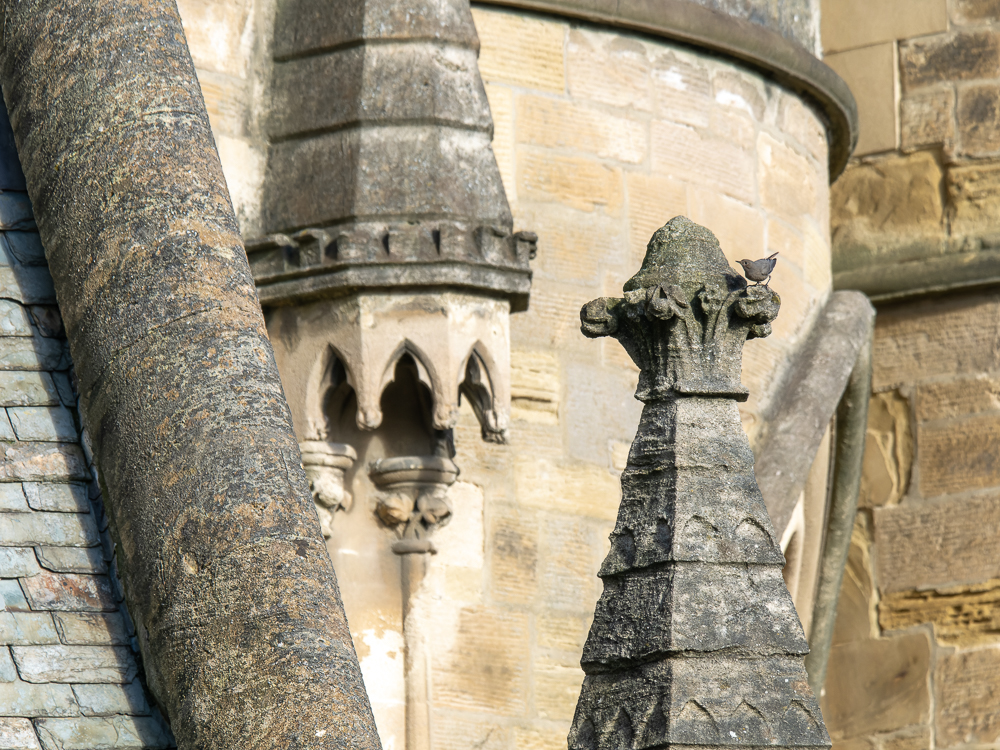
Black redstart at Aberystwyth
In the book she uses encounters with birds to explore many issues which are barely related to wildlife. The misogyny, racism and colonialism apparently inherent in the world of nature writing, ornithology and landscape appreciation all come under her scrutiny, as do some intensely personal topics. I don’t think it is unfair to say that men get a pretty bad press in the book. In one chapter she complains that “a man in a pink jumper” was showing a corncrake to visitors to the isle of Iona as she (and they) left the ferry. Does she not realise that most people would have been grateful to be shown such an elusive bird? She also has a pop at bird photographers, who are all men as well, apparently.
But back to field guides. In “Birdsplaining” Donahaye describes how the field guides of her childhood had detailed illustrations of male birds, while the females were relegated to being crouching or half-hidden figures in the background. Or not illustrated at all. In the text females were often described as slightly duller or browner variations of the males. I’ve never had a field guide like this but I can understand why this format might have been used. In many cases the males actually are brighter or more colourful, and there is probably a good reason for it. A well-camouflaged female would probably have greater success in rearing young than a brightly coloured one. And which birder wouldn’t prefer to see a male hen harrier than a female? Yet the author believes that as a child, from the evidence in these field guides, she decided that females of the human species should also be subordinate to their male counterparts.
“Birdsplaining” is a challenging read and I would recommend it for that reason. Just don’t expect to agree with everything in it!
To illustrate this article I’m adding some photographs of birds in their landscapes at Aberystwyth, all taken during the winter.
Edit: When I say in the third paragraph that the latest Collins Bird Guide contains well over 400 pages of information about Europe’s birds, I should say it contains information about identifying those birds, and precious little about the birds themselves. But I suppose that is the purpose of a field guide.
To read more Tales from Wild Wales as they are published, please click the Follow button.


 Tales from Wild Wales