For many years I have been inspired by the work of the photographer Fay Godwin, who died in 2005 (see this post in particular). This is not the place to fully discuss her life or work. But to summarise the trajectory of her career she was a self-taught photographer who progressed from portraits of authors through traditional landscapes to documentary work out in the landscape, in which environmental issues were prominent. She worked in black-and-white throughout until her last years when she made abstract colour still lives in the studio.
Perhaps “inspired” is the wrong word. Without the advantages she had had (her husband worked in publishing……*) I feel that I have been ploughing the same furrow as she did. The sequence of photographs in my first book – “Wales – The Lie of the Land” (published in 1996) – moved from the “unspoilt” uplands through the industrialised lowlands to the “unspoilt” coastline. Hell, it even included a photograph of Snowdon with someone’s clothes line (complete with washing) in the foreground! No, over the years I suppose I have often felt comforted to know that my vision was shared with her. But I never copied her work.
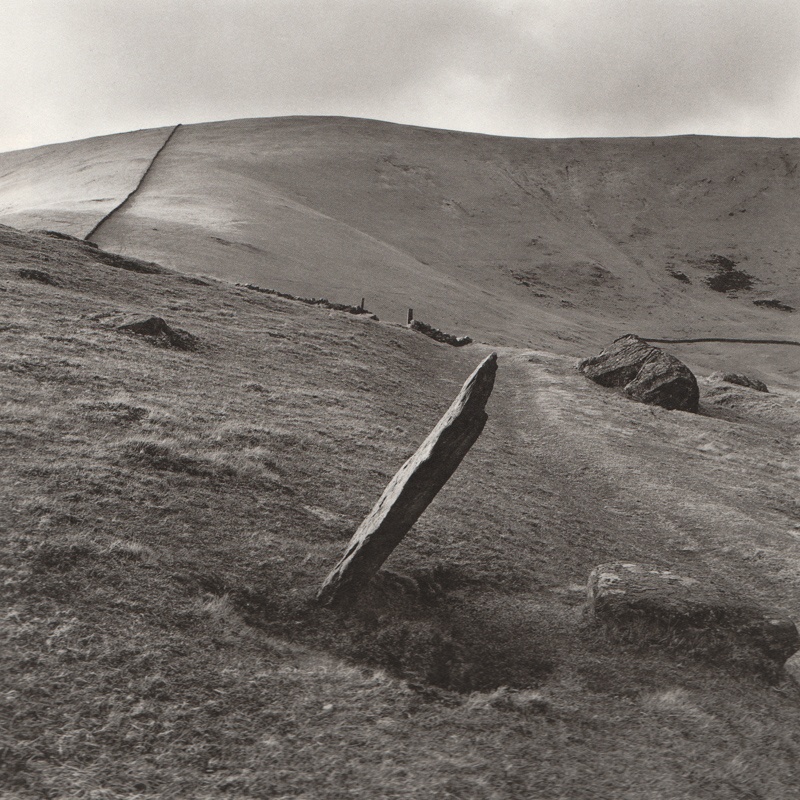
Until now. I was intrigued by one of her most iconic images, “Marker stone, Harlech to London road”, which first appeared in the book The Drovers’ Roads of Wales (1977) by Godwin and the author Shirley Toulson. It is brilliantly seen and geometrically composed, perhaps more exactly than most of her images. The wall on the hillside in the background is exactly parallel to the angle of the stone and the two are linked by another wall almost at ninety degrees to both. But the exact location was not mentioned and I wondered if Godwin had taken the photograph but couldn’t remember exactly where it had been. I decided I would track the location down and replicate the image.

The route of the old Harlech to London drovers’ road is mapped in Toulson/Godwin and I wrongly assumed that the stone would be marked on the current 1:25000 Ordnance Survey map. At the Royal Commission for Ancient and Historic Monuments in Aberystwyth I was told that marker stones were commonplace, not necessarily ancient, and as a rule not catalogued. I studied the ancient road’s route on an old OS map online in their library. Marker stones were plotted at regular intervals and by carefully relating one of them to a gate in a wall (visible in the Godwin image) and the wall up the hillside in the background I came up with the prime suspect.
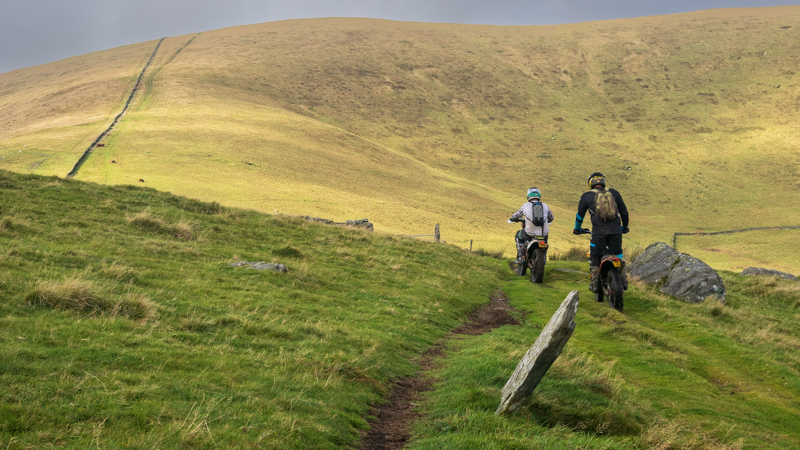
It was an exciting walk up from the roadhead towards the uplands. The closer I got the more confident I became that my guess was correct. The drovers’ road is what would now be described as a “green lane” and was suffering the same fate as many others – offroad bikers churning up the grassy surface into a rutted mess. Then I began to lose faith; none of the other marker stones were visible, and the far “vertical” wall seemed to be pivoting around to the wrong angle. But I needn’t have worried.
I was just getting acclimatised to the place when I heard the (unfortunately) familiar sound of scramble bikes heading towards me. My heart sank but I quickly realised it would be an opportunity to add value to the image I was visualising. I took a series as they headed past the stone towards the gap in the wall. I then got down to the task in hand – finding the exact location where Godwin had stood, sat or kneeled to make her image.
It proved to be impossible. The stone was smaller than it appeared from her photograph and it looked as if it might have sunk or toppled slightly over the last 48 years. The left/right wall was invisible unless I stood up, in which case the tip of the stone was well below its position in the original. I also came to the conclusion that since 1976 grazing pressure on the grassland had become less intense, allowing the turf to spring up and hide the wall and most of the gateway.
An obvious new route has been created to the left of the stone by offroad bikers. On the far hillside, parallel to the wall, a network of illegal scramble bike tracks can be seen; in fact the two offroaders that passed me carried on and added to them – up to the ridge……turn around……slither down again….. The final difference between the two images being a substantial flat rock lying to the right of the marker stone which is missing in the 2024 images.
So would Fay Godwin have approved of my pilgrimage? Quite possibly not. Would she have approved of the new image complete with bikers? I’d like to think so, particularly later in her life.
*Chief editor at Penguin Books and later Managing Director of Weidenfield and Nicholson. It all helps……
To read more Tales from Wild Wales as they are published, please click the Follow button.
My website –http://www.wild-wales.com





 Tales from Wild Wales