Pipsqueaks.

Bardsey Island (Ynys Enlli in Welsh) is situated off the tip of the Lleyn Peninsula (Penllyn), separated from the Welsh mainland (Y Tir Fawr) by only a short sea crossing, but it could be many miles away. With its remote location, the island tends to attract rare migrants; it also has a manx shearwater colony and a bird observatory. Together with Jane (my partner) and three good friends, I spent last week there. It was actually my seventh stay on the island; each week has been quite different and I well my remember my first. I picked up an infection, probably from the spring water supplied to the houses, which laid me low for a few days. Alone in my accommodation, I felt very ill indeed and believed I could have died there without anyone knowing! Fortunately in recent years a water purification system has been installed.

After another visit I was chatting to a Welsh-speaking neighbour and told her I had just spent a week on Enlli. She looked at me very strangely, and then explained that Enlli is the name of the psychiatric ward at the local hospital. I’ve always used the name Bardsey since then…….

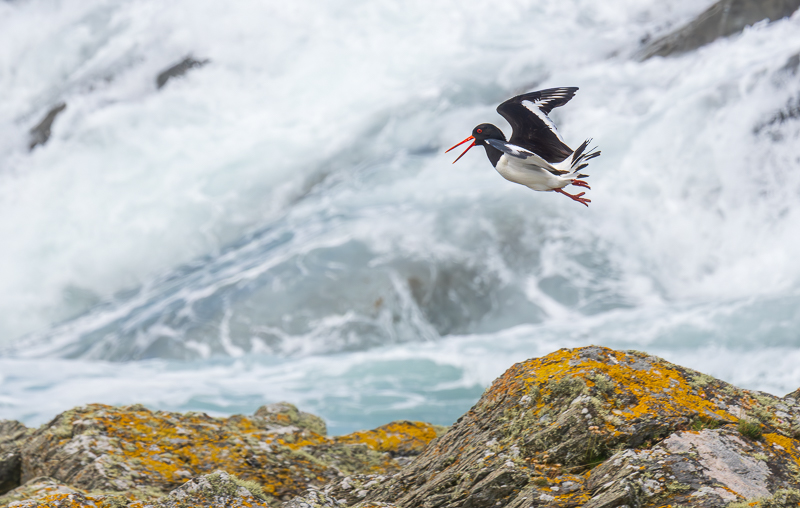
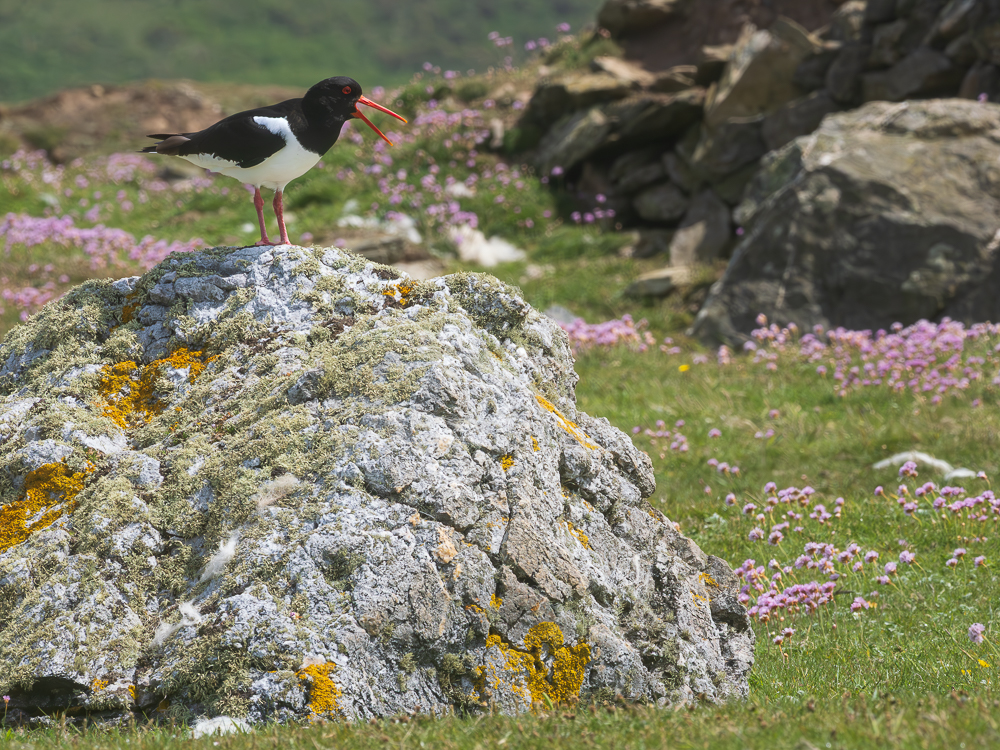
I don’t usually resort to cliches such as “bird of the week” but just this once I’m going to. It could have been the (scarlet) rosefinch which my friend Jonathan first identified, and whose song could be clearly heard from our kitchen table for a couple of days. The island has a large population of my favourite bird, the chough, and their calls could frequently be heard wherever you were. But the chough is a Schedule One (specially protected) species during the breeding season so I tended to avoid them. So I’m going to plump for something much more familiar – the oystercatcher. As you walked around the island you would pass from one oystercatcher territory to the next, and you would be subject to a new tirade of raucous high-pitched screeching. One bird was particularly aggressive, repeatedly flying noisily towards me at eye-level and only veering away at the last second. I believe on one occasion its wing tip brushed my arm as it flew past.

Their behaviour and alarm-calling is designed to alert their youngsters of the presence of a potential predator (in this case me) and it is obviously very successful. No matter how hard I tried I never managed to locate a single chick. They leave the nest as soon as they hatch and must hide amongst the pebbles and boulders amongst which they are feeding. But I wondered how intelligent the adults actually are. I found that while I was standing upright I was fair game for all the aggression that they could muster. But if I made a half-hearted attempt to “hide” or lower my profile their behaviour became calmer and their calling quieter. It was during these moments that I was able to photograph them in a more relaxed fashion. I ended up with hundreds of oystercatcher images, and have spent many hours deleting and processing them since I returned home.

It was during these lulls in activity that also I coined a new name for the species – “pipsqueaks”. After all, they don’t actually eat oysters ………….

Enjoy…….

Please click the Follow button if you would like to receive more Tales from Wild Wales as they are published.

My website : www.wild-wales.com

A tricky one…..

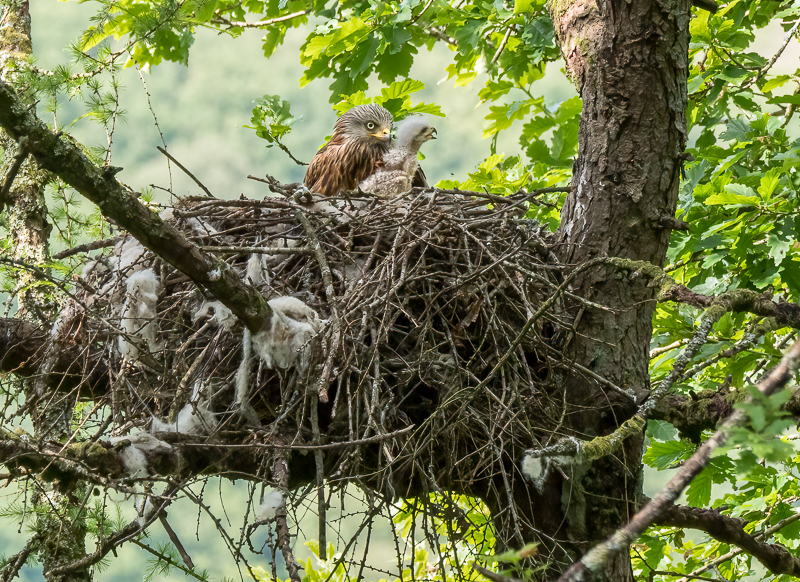
In spring 2020 we were all locked down in our homes. On my daily walk (well, one of them….), I discovered a red kite nest just five minutes away. It was easily visible from the track running through the wood and the female didn’t bat an eyelid as you walked past. When she was ‘off duty’ her mate took over and it was panic stations as soon as he saw anyone. The owners of the woodland, both red kite lovers, were managing it for firewood and wildlife and noticed exactly the same thing. They were happy to let me take my kit just inside the wood where I could be slightly closer . And the female carried on incubating as if nothing untoward was happening. It seemed like too good an opportunity to miss. Red kite is a Schedule One species in the UK, meaning that it is illegal to disturb nesting birds at any time during the breeding cycle – from nest-building to post fledging. But was I disturbing her? It didn’t look like it but it was rather a grey area legally.

Beauty is in the eye of the beholder……….

I waited until the chick had hatched and then visited the wood several times during late May. By the 21st the chick was strong enough to raise its head over the rim of the nest and I was able to photograph it with its mum looking on adoringly ( I may be anthropomorphising here ….). By the 25th it was stronger and its white down had become largely brown, with just a few tufts of white on its head. On the 30th the female was leaving the nest for short periods of time and on one occasion, while she was away, a magpie crept unseen close to the nest. As soon as she saw it she was back like a shot. I did not believe a kite could look so threatening! I was set up with the camera and long lens on the tripod, focussed on the nest, so was able to quickly take a few frames of the action. I was thrilled…… and the magpie made a hasty retreat.

You may recall that spring and early summer of 2020 were warm and sunny for long periods, often with no cloud at all, which made lockdown quite bearable. It also meant that for long periods of time photography was difficult with harsh sunlight throughout the middle of the day. Photographing in woodland in these conditions involves dark leaf and branch shadows and bright highlights, with massive contrast differences. The red kite nest was no exception. I decided to give it a break until some more photographer-friendly conditions came along. When I returned about a week later I discovered something tragic had happened to the kite chick. My friends had just discovered that it had disappeared and the parents were flying around in an anxious and agitated fashion. That was the end of the kites’ nesting attempt and they drifted off fairly soon afterwards. What had happened was a mystery, and the nest disintegrated and disappeared over the next couple of years.

Is this the same female?

So why am I recounting this story in April 2025? Well…. the kites are back! A pair has built a new nest in a different tree only about ten yards from the 2020 nest, in a very similar position, right out in the open, below eye level as seen from the track, and the female doesn’t bat an eyelid as you walk past. My guess is that she is the same bird that I photographed in 2020.

I am currently monitoring red kites in the area surrounding my home and have a licence to disturb the birds at the nest for this purpose. However it doesn’t include photography, unless incidental to the monitoring. I did inquire about a photography licence but the paperwork looked like it would take forever to complete. So I’m wondering if I can photograph the chick’s development at this nest in particular, with the very confiding female, without breaking the law. It’s a tricky one.

To read more Tales from Wild Wales as they are published, please click the Follow button.

My website : http://www.wild-wales.com

Do you know your willow tit from your marsh tit?

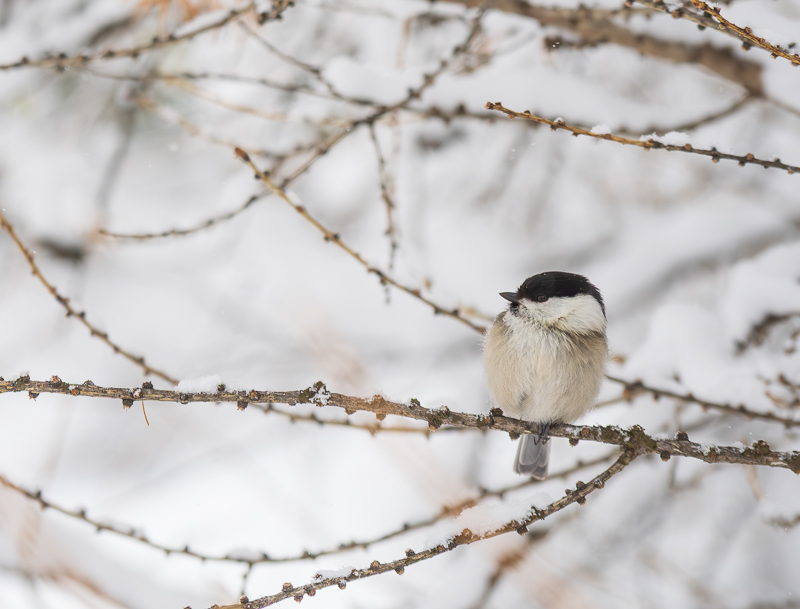
Willow tit……..

There can be no more difficult bird i-d challenge in the UK than distinguishing willow tit from marsh tit. According to ‘Birds in Wales’ willow tit was not even proven to occur in the UK until 1897, and for several decades following that “…its distinct identification from marsh tit was not universally accepted”. The Collins Bird Guide suggests various subtle differences; for example marsh tit has a glossy black cap while the willow’s is matt. The white cheek is more extensive on the willow than the marsh, and one (the willow tit) has a pale panel on its wing while the marsh doesn’t. The black bib is “usually” larger in the willow than the marsh. However a video from the British Trust for Ornithology now suggests that it is not safe to distinguish one from the other on any of these characteristics. The only reliable difference is a pale grey spot at the base of the upper mandible (the beak) which the marsh has but the willow doesn’t. This conclusion would have been reached following the close examination in the hand of large numbers of individuals by bird ringers, so is likely to be correct. But no wonder there was such a long period of doubt over whether both species existed in the UK.

Along with the willow tits came crested tits………

It is widely agreed that the safest way of telling one from the other is by voice. I’m not confident that I’ve ever definitively seen or heard either species, but during the winter I heard a new (to me) bird song on a regular walk in some woodland below the house. I believed it was either a willow tit or a marsh tit. It sounded very like a wood warbler, which, being a summer visitor, could not have been present. My Collins Bird Guide specifically mentions a “series of pensive, melancholy, wood warbler-like notes”, under willow tit. I hadn’t actually seen the bird but this was about as good an i-d feature as I was likely to get. I announced my record on the Ceredigion Bird Blog, with the caveat that Ian Morris – the county’s resident willow tit expert – might have an opinion on it. A few days later I had an interesting email from another Ceredigion birder who had had a similar experience to mine. Over a period of some weeks he had re-visited his location and played back a recording of the willow tit song. On every occasion he had attracted a pair of nuthatches! It’s enough to make you tear your hair out!

A few weeks later Ian Morris visited and we walked down to the location where I had heard my mystery bird. He played back the song but there was no response. It was a long shot really but he didn’t believe the habitat was right for willow tit anyway…..much more suitable for marsh …………

…………and a few nuthatches………..

One reason I recount this cautionary tale is that during March I spent a couple of days quite high in the Swiss Alps. It still being deep mid-winter some lovely conifer woodland there was blanketed with fresh snow and almost completely devoid of of birdlife. The main exceptions were flocks of tits roaming around waiting for hand-outs from folks like me. Among them were “poecile montanus” (according to the interpretation boards) which were so bold as to perch on people’s hands to grab a seed or two. This, of course, is the willow tit, which, according to the bird books, rarely even visits bird tables in winter ……..

To read more Tales from Wild Wales as they are published please click the Follow button.

Remembering Bill and Penny Condry (Part two)

In 2024 I was asked to introduce the main speaker, David Elias, at the Condry Memorial Lecture in Machynlleth in October. This event takes place every year to commemorate the life and work of William Condry, pioneering Welsh conservationist, author and warden of the nearby Ynyshir RSPB reserve. My role was to talk a little about Bill and my connection with him and read some of his work, before introducing the main speaker. This is what I came up with.

“Although I can’t claim to have known Bill well, I first met him in 1980 when he was warden of Ynyshir RSPB reserve. I had read his New Naturalist guide to the Snowdonia National Park, and was anxious to meet him, so I offered to do some voluntary work on the reserve. On my first visit he took me to listen to the reed warblers which had recently arrived on the Dyfi, and then left me to work with a billhook on some conifers. Within minutes I had sliced my thumb open and had to find my own way to hospital. I still have the scar to show for it!

Despite that inauspicious beginning I met Bill occasionally at Ynyshir and elsewhere. Although there was a huge gap in age, experience and knowledge between us, we seemed to speak the same language. If he disliked the human species on masse he had a rare ability to communicate on a personal level with humour, intelligence and respect.

During his life I was sadly not able to collaborate with Bill professionally as a photographer. But it was through his contacts at Gomer Press that my first book was published in 1996. “I strongly advise you to approach them with your ideas”, he told me. After his death in 1998 I selected a number of his Guardian “Country Diaries” and paired each one with a photograph, all published in another book for Gomer Press, “Heart of the Country”, which in many ways was a tribute to him. So I owe a debt to him personally, but far more than that we all owe a debt to him for his descriptions of Wales and its wildlife and the beauty of his writing. He was able to convey quite complex ideas in a deceptively simple style.

The reading I have chosen from The Guardian is perhaps not typical of his “Country Diaries” but it demonstrates Bill’s powers of observation and patience. It could almost have been written by a photographer!

The other day following a tip-off from a friend I went to a north Wales mountain in the hope of seeing that rarest of our mammals, a pine marten. I chose a high perch among the rocks, across the valley from a spot where my friend claimed to have seen the animal. I settled down to a day-long watch from dawn onwards.

At first the mountain before me was a simple black shape against the sky. Then the sun rose behind me, lighting up the hillside’s many folds. I began to see clefts, scars, crags and all these I searched carefully through with my telescope. As the sun moved slowly round, probing the mountain from new angles, I could see new hollows and new buttresses being revealed by the play of light with shadow. But no marten.

By afternoon, though I was still the same side of the mountain, it seemed a totally different place from the one I looked at in the morning. For now the lowering sun had discovered an entirely new series of ridges and hollows. It is now – of course- that I should reveal triumphantly how, just as I was giving up, I saw my pine marten coming through the evening shadows. But no, I saw nothing.

So was this day thrown away? I think not. At least I learned that there is more to a simple mountain shape than at first meets the eye.”

We are constantly reminded of losses to our wildlife. Bill would have seen the corncrake, woodlark and red-backed shrike, among others, become extinct in Wales. The red squirrel was driven to extinction in most of Wales during Bill’s lifetime by the spread of the non-native greys. In our own times turtle dove and corn bunting can be added to the list of missing species, while we are close to losing others like the curlew, yellowhammer, willow tit, and whinchat.

But the picture is more complex than a continuous series of losses. I have already mentioned the reed warbler, which was first seen on the Dyfi in 1980. In 1962 Bill wrote of the “splendid and rare red kite”, and how he treasured the kite’s feather that he had found in a Welsh oak wood. Although splendid still the red kite is now so abundant that most of us barely notice them as we go about our daily lives.

In “Wildlife, My Life” Bill describes the excitement caused by a vagrant little egret that spent two months on the Dyfi estuary in 1970. Little egrets first bred in Wales in 1996 but are now present in astonishing numbers on some parts of the Welsh coastline. I guarantee that he never saw a great white egret in Wales yet a flock of sixteen was recently seen on the Dyfi estuary. He could never have imagined that there would now be about fifteen pairs of ospreys in Wales. Or that they would be nesting every year within sight of Ynyshir.

We don’t know what Bill would have thought of re-introducing lost species into Wales because during his lifetime this wasn’t the done thing. In the “Country Diary” that I read earlier Bill was searching for a pine marten, which was then exceptionally rare in Wales or possibly extinct. But it has now been successfully re-introduced and is now widespread. And after many years of hesitation the Welsh government has finally just approved (in theory) the re-introduction of beavers into Welsh rivers. Would Bill have welcomed the re-introduction of white-tailed eagles into Wales? We don’t know. Yet this seems to be close to becoming a reality in the not too distant future.

It is impossible to discuss wildlife in Wales without talking about agriculture. In “The Natural History of Wales”, published in 1981, Bill wrote the following-

Bird numbers rise and fall naturally and it is often hard to decide whether a particular fluctuation is due to changes in farming practices or not.”

But in a “Country Diary” published three years later he wrote –

Some of us fail to see the point of increasing upland sheep production because on such poor land it can never be successful without vast subsidies”

There is now abundant evidence that the intensification of agriculture has been responsible for the loss of wildlife in most parts of the country and this continues to be the case. One can walk through Welsh farmland for long periods of time with barely sight nor sound of wildlife. Green deserts indeed! Nevertheless the farming unions continue to deny that their members may have been responsible for these losses, and continue to protest loudly if any changes are proposed that might benefit wildlife on farmland.

So what future for Welsh wildlife? There can be no doubt that financial support for agriculture needs to be radically re-designed, so that wildlife can begin to return to farmland in Wales. And the power of the farming lobby needs to tamed.”

I then handed over to David Elias, who spoke about his experiences on an exceptional farm in north Wales which unusually has retained much of its wildlife interest into the present day.

These are clearly less personal memories of Bill than the ones I posted recently about Penny. There are several reasons for this. For one thing my piece was aimed at a particular audience. Secondly, my memories of Bill are now quite hazy, as he died over twenty-five years ago. I do remember, though, how much I respected him for his work, his writing, his lifestyle, his knowledge and his generous attitude to a mere pretender like me. And I also remember becoming very emotional at his memorial service and had to leave before it finished.

Between them Bill and Penny were quite a ‘power couple’ in their own way. How lucky they were to have found each other!

NB: There is more about Bill in my introduction to my book ‘Heart of the Country‘ ; still available, secondhand –https://www.abebooks.co.uk/9781843232032/Heart-Country-Photographic-Diary-Wales-1843232030/plp)

and new –

https://www.ylolfa.com/products/9781843232766/heart-of-the-country-(hb))

To read more Tales from Wild Wales as they are published, please click on the Follow button.

Remembering Bill and Penny Condry (Part one)

Bill and Penny in the 1950’s (photographer unknown)

Friday’s memorial service for Penny Condry was a sombre occasion. It took place in the beautifully restored chapel – Y Tabernacl – part of the Museum of Modern Art in Machynlleth. To my surprise, it took the form of a Quaker meeting, where attenders sat in silence. Over a period of an hour, individuals rose to read short prepared pieces about Penny, or spoke spontaneously of their memories or feelings about her – many being close to tears, including myself. The silence between each contribution allowed everyone present to process the memories that the speakers had evoked, even if they themselves did not speak.

Penny was 102 years old when she died last month. I had known her since the 1980’s when I first visited her husband Bill, who was the warden of the RSPB’s reserve at Ynyshir, between Machynlleth and Aberystwyth. He was also a writer of some renown, about whom I will say more later. I’m not going to pretend that I was close to the Condrys at that time. My memories of Penny on those first visits are limited to her being someone who brought forth pots of tea and home-made cakes. She had devoted her life to supporting him in his career as teacher, author and pioneer in the field of conservation. She had been there while the environmental issues in Wales of the day were being discussed by Bill and his friends, wildlife enthusiasts all. I was then able to sit in the same rather gracious sitting room where these discussions had taken place. In their personal lives, Bill and Penny had put their green ideals into practice long before it became commonplace to do so. But Penny was not a woman who enjoyed the limelight.

That did change somewhat after Bill died in 1998. He had written a “Country Diary” for the Guardian every fortnight for over forty years. I came up with the idea of selecting some of these pieces and combining each one with one of my own photographs, and my publisher (Bill’s also) liked the idea. This could never have gone ahead without Penny’s approval and she gave it without hesitation. This proved to be the beginning of a closer relationship, which probably deepened when I wrote in my introduction to the book that I had been more affected by Bill’s life and death than my own father’s. I sometimes wondered if she saw me as the son that she had never had. She missed Bill deeply and would often talk about him on my visits, sometimes as if he was still there. She recalled the nitty gritty of the world of conservation in Wales which Bill never talked about in his books. How I wish I had been able to record those conversations for posterity, because all those insights will now be lost forever. Bill himself wrote that “the story of my unadventurous life would not be of the slightest interest to anybody…” How wrong he was.

Penny was not one to bother herself with trivia. She loved her garden, was very knowledgeable about natural history, and genuinely interested in other people. Her opening gambit was often “How are you ???” and it felt like she really wanted and needed to know. Another was “Are you happy???” or “Is Jane happy???” referring to my partner in later years. At the memorial others spoke of her becoming a Quaker and her dedication to the Merched y Wawr (Women’s Institute) in her local village of Eglwysfach. As her health slowly deteriorated she became increasingly anxious. She wondered how long she would be able to survive on her own in a rambling and isolated house at the end of a half mile long track. But she had some very good friends who kept an eye on her and did the heavy lifting in the garden. Arthur Chater, for many years the botanical recorder for Ceredigion, and lifelong friend of the Condrys, took her shopping on market day in Machynlleth every week. I sometimes met them there.

Inevitably the time came when she became too frail to live on her own. She moved into a nursing home near Aberystwyth, but it didn’t suit her. It was never likely to suit someone so much of whose life was spent outdoors. I visited her there a few times and she told me she hoped death would soon come and take her away. But there was one final surprise in store. During the decades I had known them neither Bill nor Penny had let me take their photograph. They were both camera-shy but particularly Penny. (I can identify with them in that respect……) On the wall of her room was a framed portrait of both of them taken many years ago. I showed an interest in it and out of the blue Penny just gave it to me! This was very thoughtful but, on reflection, I thought she might regret it. So I re-photographed it, processed it and returned it. It’s the photograph at the top of this post. I shall treasure it for the rest of my life.

There’s just one more thing. In Penny’s time the role of most women was to support their husbands, and she did this very effectively, allowing Bill to fully reach his potential. But I can’t help wondering what Penny might have become had she been born, say, fifty years later, by which time women were encouraged and expected to have lives and careers of their own. She certainly had the potential to go far.

I will talk about more about Bill in Part two..

To read more Tales from Wild Wales as they are published, please click the Follow button

A walk along the beach.

Just after the New Year we went for a low tide walk along the beach at Ynyslas. It was stunning …… blue skies, no wind….everything you could want from a winter’s day. We walked from the golf club car park, round the end of the dunes to the visitor centre (soon to be closed); then after a cup of coffee back along the board walk to return to the car park along the beach. By this time lengths of the peat underlying the sand had been exposed. As I walked along, Jane drew my attention to a small flock (21 birds) of sanderling which had alighted on the peat just behind me. I hesitated for a while before extracting my camera from my backpack. I expected them to fly off immediately, but they stayed put, probing in the peat for food, and running backwards and forwards as the waves washed in and out. I had two minutes with them before they flew off as quickly and mysteriously as they had arrived.

Enjoy the photographs!

To read more Tales from Wild Wales as they are published, please click on the Follow button

A close encounter.

Play-fighting stoats, July 2020.

In an earlier post I explained how I had been unable to sharpen a particularly good (……. I thought) image in Lightroom. Under normal circumstances Lightroom does everything I need, including sharpening, but it is not designed for more extreme situations. In my post I explained that I had successfully sharpened the image in Topaz Sharpen AI, but that my trial version added a watermark. Unfortunately it was no longer available and its successor, Photo AI, costs close on $200. How much was a I willing to pay for such specialised software?

Luminar Neo also has built-in AI sharpening and is available for a more reasonable price. The marketing spiel for this software suggests that it is aimed mainly at those who wished to replace skies in their images, which is anathema to me. But I swallowed my pride and signed up for a trial. It seemed to sharpen my problem file but I could not get it to work as a plug-in to Lightroom, which was a pain. It seemed there must have been a bug in the software and their technical people were using me as a guinea pig to trouble-shoot it. I gave up. Then Photo AI appeared at a “sale” price and I took the plunge.

I have recently been going through my files from the last decade for a potential sale to a rewilding charity. In some ways this is a tedious chore involving making countless decisions between images differing only by minutiae. However at the same time I was able to re-discover some that I had completely forgotten about. The one above is a case in point.

It was taken during lockdown in July 2020. I visited a local pond a number of times during that spring and summer, as it was within walking or easy cycling distance of my home. On one visit a family of stoats appeared out of the vegetation and began playing on the road. There was probably a mother and three kits. I was treated to a close encounter with this lovely group of animals which lasted about ten minutes. The youngsters were aware of me but didn’t seem to recognise me as a threat. It was the sort of encounter that wildlife watchers dream about. There was plenty of action which was quite a challenge for me with my slow reflexes. Much of the activity seemed to be play-fighting; the sequence from which the main image was taken ending up with the right-hand animal appearing to be “playing dead” on the ground.

I came away with quite a selection of images but many were below par in some way, mainly due to the narrow depth of field that long lenses produce. In the main image the left-hand animal was perfectly sharp but the one on the right just wasn’t. Fortunately Photo AI has worked wonders on the out of focus animal and I have a photograph I can feel very proud of. One for the Countryfile calendar, perhaps………*

*Or possibly not…..I’m still a professional. But you see what I mean?

To read more Tales of Wild Wales as they are published, please click the Follow button.

With seasons greetings.

This last year has been a humdinger for seeing the Aurora Borealis, with two stunning displays here in mid-Wales on May 10th (see this post) and October 10th. But on September 12th, which happened to be my birthday, I was just about enter a restaurant in Tywyn for my birthday meal when an aurora red alert arrived on my phone. Eek…..what a dilemma!

I decided to go ahead with the meal and not let Jane (my partner) down. An hour and a half later, the meal over, we headed down to the mouth of the Afon Dysynni , a couple of miles away, where we planned to spend the night in the camper. It is here that the railway line and coastal footpath cross the river just before it reaches the sea. At high tide the river water backs up into a lagoon known as Broadwater; and as it happened there was no wind, the water was still and the sky was clear. Would there still be any sign of the aurora?

I could immediately see that the northern sky looked “unusual”, so I set up the camera on a tripod, and began taking a series of images. I wouldn’t say I’d perfected my technique by any means but I had learned from some mistakes I have previously made with long exposures. Despite it being pitch black I could see that the silhouettes of the bridges set against the night sky would make an excellent composition. It wasn’t until I examined the files on my PC that I could see what the sensor had recorded and after some judicious processing came up with an image I’m really pleased with.

To the naked eye very little could be seen but if only our (my?) vision was more sensitive to low light levels it would have looked something like this. Even the version you can see above is drab in comparison to the sparkling processed original viewed on my monitor. I could write a book – well maybe an essay – on aurora photography and what it tells us about our own vision, but that will have to wait until another day.

On a lighter note, I usually make marmalade in the run-up to Christmas and give a few jars away as presents. This morning I left a jar by the recycling bags for the bin-men to collect. I heard the lorry drawing away so rushed outside to see if they had taken it. It was still there. I ran after them and held the jar up. “Ow, thees ees resoyclin, we down’t tek glass” he said in his brummie accent. I handed the jar over and wished him a happy Christmas.

So thanks for continuing to read my ramblings and with best wishes, seasons greetings and a virtual jar of marmalade to you all.

To read more Tales from Wild Wales as they are published please click on the follow button.

Compliments.

It is always nice to receive a compliment and this is one of the nicest I’ve ever had:

I am very grateful for the photograph, which arrived safely today. I think it’s really fantastic ……,. showing clearly the bungalow, Uwch y cwm, (of) which we as a family have fond memories. I am going to get it framed. Diolch yn fawr iawn, Tec

The image concerned (above) dates back to the 2000’s and was used on the front cover of my book Blaenau Ffestiniog. The original was on a transparency, and although I do have a good quality scanner, it had developed a fault. The sale of a single print didn’t actually cover the cost of the repair but the knowledge that the buyer was happy more than makes up for it! And of course I’ve now got a scanner that works.

Satisfying in a different way was the recent sale of ten ‘works’ from my Bird/land exhibition (click to view) to the National Library of Wales in Aberystwyth. The Library has been buying my work intermittently for nearly thirty years and now has well over 300 of my prints in its collection. It was interesting to look my name up in their catalogue and discover how many bits and bobs relating to my life as a photographer are stored away in their vaults. It is an honour and a compliment that the library chose to collect my work and continues to do so. It is also satisfying to know that some of it will outlive me.

To read more Tales from Wild Wales as they are published, please click the Follow button.

My website – www.wild-wales.com

I think I’ve cracked it……

I ended my post of January 20th this year by saying “One of these days I’ll get a decent picture of a water rail.“. On October 10th I mentioned water rails again and said “My record with them is pretty sketchy. They are nimble and fast moving and tend to appear only close to dusk or dawn.

On another visit to the Teifi Marshes at Cardigan early one morning last week all that changed. No sooner had I entered the mallard hide and sat down, than one of the little blighters started squealing from the tiny island just in front of the hide. Soon the bird appeared, quickly followed by another. It seemed as if there was some kind of dispute going on between them. This wasn’t the shy and retiring species of the text books. About nine thirty one emerged from the island’s reeds , walked towards the hide, immersed itself for a short swim, and disappeared again. A few minutes later it re-emerged and swam most of the way towards the reeds to the left-hand side, only to decide that it preferred being on the island after all, and returning. This was brazen!

I took several hundred images altogether, and it has to be said that entire sequences were either out of focus or just generally mushy. I’ve never understood why this happens. But there were enough sharp and well-lit images for me to be able to say ” When it comes to water rails, I think I’ve cracked it.”

Given that the species is renowned for being more often heard than seen, let alone photographed, I can’t imagine there is anywhere better for getting to grips with them than the Teifi Marshes.

To read more Tales from Wild Wales as they are published, please click the Follow button.

My website : http://www.wild-wales.com