Whatever happened to fieldcraft? (Part one)

Curlew sandpiper, Ynyslas

There have been some very high spring tides this week. At low tide, wading birds feed in the sand and mud of our estuaries and are more or less invisible. But at high tide they are forced onshore by rising waters. During the hour or two their feeding grounds are inaccessible they tend to rest and sleep, and can be quite approachable. This is particularly the case in autumn, when large numbers of juvenile birds are pausing on their long migratory journeys southwards. They seem to have less fear of humans than their parents. So on a visit to the high tide roost at Ynyslas, mid-Wales, on Wednesday I took advantage of these conditions to get some close-up images.

Ornithologists these days all seem to have telescopes and their preferred method of bird-watching is to stand well back above the tide-line and watch the birds as they arrive. This allows reasonably accurate counts to be made and population trends can be identified over a period of years. Photographers prefer to be nearer the action, and we do run the risk of flushing the birds from time to time as we attempt to get that bit closer. There is a certain amount of tension between the needs of one group and the other. So I let the birders do their counts before edging closer to the birds which were resting amongst areas of cobbles on the beach.

Over a period of time I gently approached them until the nearest bird was less than five metres from me! At first they appeared to be absolutely exhausted. They nearly all had head beneath wing and I watched one dunlin’s head and beak visibly drooping is it nodded off. Gradually they become more active and preened, stretched their wings and chattered amongst themselves. It was marvellous to be up close and this personal with these delightful wild creatures. One doesn’t know how much one’s own presence affected their behaviour. Were they excited to see me? It’s impossible to know. When the time came for me to leave, however, I just stood up and walked away without disturbing them in the slightest. I had been completely accepted by them.

As it happened the bird that remained closest to me was a curlew sandpiper. This species is very similar to a dunlin but a little taller and more elegant. There are minor plumage differences in autumn but the white rump is distinctive. It is an annual passage migrant to our shores in small numbers and is usually found amongst large flocks of dunlin. It can provide quite an identification challenge unless one is quite close; in the picture above the white rump can just be seen between the folded wings.

To follow Tales from Wild Wales please scroll right to the bottom of the page and click Follow

More from Sizewell

Great black-backed gull, Sizewell (click to enlarge)

After an hour or so I turned my attention away from the kittiwakes offshore (see previous post) and re-assessed my surroundings. There was only one landscape feature to be seen – the brilliant white reactor dome of Sizewell B and the extensive blue-painted steel clad building upon which it rested. Red railings ran along the edge of the latter. Whatever your opinion on nuclear power,  the clean lines and simple colour scheme of the power plant gave it a modernist and surreal splendour. Far more attractive than the crumbling and filthy concrete of Sizewell A alongside it.

And wait, there was a black-backed gull resting on the railings in front of the dome! This was an opportunity not to be missed! I grabbed my tripod and stumbled across the shingle: the bird could leave at any time. I left the focal length at 600 mm to isolate the scene from its few surroundings and took a small selection of exposures over the next minute or so until the bird flew. Such an extreme focal length would flatten the scene substantially and result in a very limited depth of field, so I set apertures of f13 or f16 and added a stop or two of exposure to correct for the largely white subject.

Until this moment I wasn’t sure I would return from this trip with any worthwhile results.  It had been quite a while since I had been “in the zone” but I felt I was there now. I remembered a comment from the late lamented landscape photographer Fay Godwin after she had spent ten days in northern Scotland. She thought she might have returned with “one very good photograph”. I could identify with that. As I left I felt sure I would be approached by power station security; after all – who but a terrorist would want to photograph a nuclear power plant? But as it happened my imagination was running amok.

Sizewell landscape (click to enlarge)

I returned to Sizewell the next morning in the hope that I could repeat the image. Almost all the kittiwakes had left the tower and it was over two hours before a gull landed on the railings again. But while I waited I began to see the structure without the bird as pure landscape.  A security camera on a post took the place of the gull and gave the image a focal point. Not everyone will like it but I think it works.

So rather than the one good image that I thought I might come back with there are actually several. It’s funny how the most inspiring photography sessions can be the most unexpected.


To follow Tales from Wild Wales, scroll right down to the bottom of the page and click Follow


A decisive moment

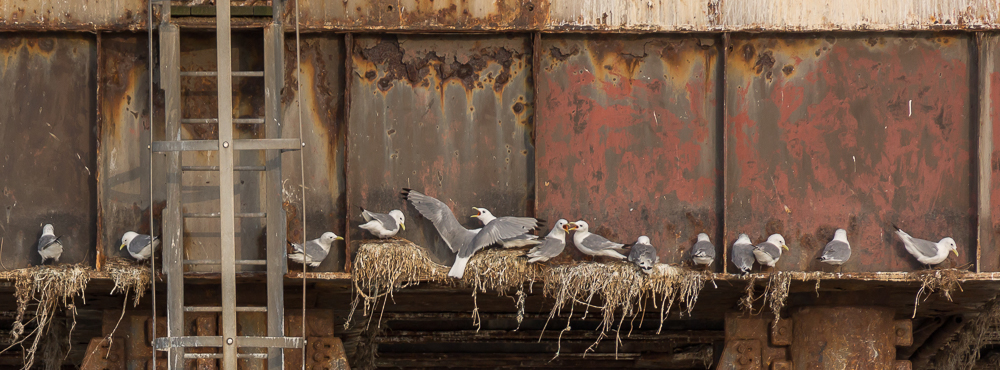
Kittiwakes, Sizewell.

After what turned out to be a slightly disappointing day at Minsmere (see  this post) I moved on to Sizewell, a couple of miles down the coast. The nuclear power station forms the backdrop to any view of Minsmere from the north, and is perhaps not what you might expect in a rural area like Suffolk. But I remembered an item on Springwatch which showed kittiwakes nesting on a rusty old cooling water outfall from the power station. I thought it might be a good subject for my ‘birds in the landscape’ series.

Conditions were ideal for the subject at hand. It was evening by this time and partly cloudy, so there was a choice of bright but cloudy or pale sunlight. There would be little or no disruptive shadow. Kittiwakes were lined up along the metal framework of the tower  in some numbers. There were a few abandoned nests and rather more part-built ones which I suppose could have been practice nests built by inexperienced adults. I played around for quite some time, trying different viewpoints, focal lengths and crops, uncertain really how to best tackle the subject. Every so often a bird would land on the “ledge” and there would be a flurry of activity amongst nearby birds. It proved to be one of these images that to me was the most successful, taken at 600mm and cropped quite heavily again.

On my way over to Suffolk I had spent the day at Birdfair, the rather overwhelmingly massive bird-themed extravanganza at Rutland Water. During the morning I happened to come across the Canon stand where David Clapp was giving a talk on travel photography. Amongst the selection of really excellent images that he showed there was one of a group of young people lined up along the bank of the river Seine in Paris. One of the figures, he explained, was absolutely key to the composition.  He hadn’t noticed it at the time but by virtue of their posture and behaviour this person linked up all the other human elements in the image.

In the kittiwake picture above the bird just to the right of the ladder is equivalent to that person (click on the image to enlarge it). The species and the setting might be completely different but the principle is the same. It was the decisive moment. This concept was linked to the renowned street photographer and photojournalist Henri Cartier-Bresson, who told the Washington Post in 1957:

“Photography is not like painting. There is a creative fraction of a second when you are taking a picture. Your eye must see a composition or an expression that life itself offers you, and you must know with intuition when to click the camera.”

He was able to predict when all the elements of his images would come together. We all do this to some extent but during his fraction of a second our motor-driven cameras are able to fire off several separate frames. He would only have been able to manage one before having to wind the film on manually. In the calm environment of our office, studio or spare room it is now so much easier to select one image from a sequence that portrays that instant.

To follow Tales from Wild Wales, please scroll right to the bottom and click follow.

The dog days of summer.

Little grebe, Minsmere


The phrase “dog days of summer” has come to mind recently. It refers to a period during mid-summer, roughly from July 3rd until August 11th, when the northern hemisphere tends to experience sultry and muggy weather. The phrase dates from ancient times when it was noticed that Sirius, the Dog Star, rises and sets in conjunction with the sun between these dates. Although we now know this cannot possibly be true, it was believed that the heat emitted by Sirius added to that from the sun to raise temperatures in our latitudes. Interestingly the phrase has also come to mean the period of stagnation or indolence which may also occur during mid-summer. That kind of rang a bell with me.

There will be other ways in which the dog days of summer can trouble the nature photographer. Green is the predominant colour in the landscape which tends…….well…..to be a bit monotonous. So a July day with a cloudless blue sky can be one of the most challenging of the year. It may look and feel lovely but the results will usually be flat and uninspiring. That wonderful burst of energy and activity which characterises wildlife in spring and early summer is over. Most bird species will have finished rearing their young and will be lurking in the undergrowth, moulting their feathers and growing new ones.

Personally I need to visit all my postcard stockists during late July and early August. My priorities tend to be focussed on dealing with customers and making sales. I find it less and less easy to change my mindset from doing that to doing anything creative. Nevertheless on my recent Pembrokeshire circuit I planned to overnight close to the Elegug Stacks near Pembroke so that I could photograph the nesting seabirds. I should have known better but with the exception of a handful of kittiwakes the season was over and the birds had already left. The night I spent on a hilltop in north Wales, close to what I thought might be a chough roost in old quarry buildings, was fruitless. I knew it was a long shot but I had found them roosting there in the past. And so it went.

The lack of inspiration I tend to experience during midsummer is partly due to external factors such as those mentioned above, I feel sure.  But I was so fascinated to discover that the dog days of summer can be experienced internally too. The feeling of stagnation might not be so intense or long-lasting as that commonly felt and widely recognised  as occurring in mid-winter, but it does exist. It’s not just me! This year I hadn’t taken a decent photograph for six weeks and it was beginning to feel a little bit more than temporary.

Through many years of observing and photographing the seasons I have felt that there is a turning point in the year around the middle of August.  The change seems to happen quite suddenly. In an average year here in Wales the vegetation starts to die back and autumn colours start to appear. The nights are that much longer and there is more time for fog to form overnight. And there is a chance to get a decent nights sleep between sunrise and sunset!. It is also worth noting that the ancient Taoist philosophers identified a fifth season: “late summer”, lying between true summer and autumn . It is strongly associated with harvest and the bountiful produce that nature bestows upon us. Blackberry jam anyone?

It is also worth noting that at this time of year sunset is two minutes earlier each day than the previous one with a corresponding change at sunrise. The day is almost half-an-hour shorter altogether than it was one week earlier. I find this an astonishing fact, and of course the change would be even greater the closer to the poles one is situated.

Well, last week I headed over to Suffolk to do some bird photography. I had a nagging feeling that it might not be a profitable time of year, but off I went anyway. My day at Minsmere was a disappointment. Birds were largely noticeable by their absence. Bearing in mind that twelve “pairs” of bitterns had reared young there this year, and that there might have been something in the region of 40 or 50 individuals present, I saw just one. There was hardly a whisper of birdsong in the air. There were a few migrant waders to be seen but nothing like the numbers or variety that would be present later in the year. The reedbed – the whole place really –  had a tiredness about it that was hard to put into words. Late summer? Perhaps. But  it is no surprise that the BBC broadcasts “Springwatch” from there and not “Augustwatch”!


To follow Tales from Wild Wales, please scroll right to the bottom and click follow.


Urban peregrines

Urban peregrines in Derby

It is no secret that peregrine falcons have been nesting on Derby Cathedral tower for a number of years. A nesting platform was provided for them in 2006 and the same two adults have reared young every year since then. Progress of the breeding attempt can be followed on the internet, so I knew that this year the youngsters had fledged during the middle of June. Nevertheless young peregrines stay in the vicinity of the nest for some time after fledging so I thought a visit might still be worthwhile.

Last Wednesday I arrived in Derby to find no sign of the birds in the vicinity of the Cathedral. I spent a while recce-ing the area for a future visit. A good location would not be easy to find. But during my wandering I had noticed a bird perched on the lettering about fifteen stories up on the side of the Jury’s Inn Hotel not far away. Without binoculars it was not possible to tell if it was a peregrine or a feral pigeon, but I knew the peregrines sometimes perched or roosted there.

By early afternoon I had found my own perch – jammed in between  the bridge railings and the eight-lane Derby Inner ring road as it crossed the River Derwent. Traffic screamed past just a couple of feet away from me. But I was exactly at right-angles to the side of the hotel where the bird was perching, and at about the optimum distance away. I spent an interesting afternoon there.

Sleeping peregrine
Sleeping peregrine (click to enlarge)

At one point a juvenile flew from the lettering to meet one of its parents about 150 feet above my head. The adult was carrying prey – a whole bird complete with two trailing legs – and the youngster turned over underneath him/her and took the prey in mid-air. I could just hear them screaming at each other above the roar of the traffic. The youngster took the prey on to the roof of a nearby block of flats to eat it. A few minutes later a peregrine (probably the same one) arrived, carrying the remains of a bird, and circled over my head, eating from its talons like a hobby does. As an ex-RSPB species protection warden I’ve spent many weeks (months!) watching peregrines but couldn’t remember ever seeing that before.

For long periods nothing at all happened.  Every so often a yell would come from the passenger seat of a van as it flew past. There was a little to-ing and fro-ing as adult peregrine replaced juvenile on the lettering and vice versa. At one point the juvenile appeared to fall asleep with its chin on the letter “r” and its feet stretched out behind it! I pondered over the thought that these young peregrines would regard their urban surroundings as completely normal while their coastal cousins might find them absolutely abhorrent if they were to encounter them.

It was not a particularly challenging scene to photograph. I wanted to include the lettering as the environment within which these urban raptors lived their lives, so I set up the Canon 5d3 with long telephoto on a tripod and trained it on the side of the hotel. I would need to use the perspective control tools in Lightroom to try to disguise the upwards angle at which the images were taken, so I zoomed out a fair way to allow for the cropping that would come with it.  I also needed to remember that the meter reading would need to be over-ridden to account for the largely white subject matter – in this case by about one stop, although had the side of the building been lit by the sun at least two stops would have been required. Probably the most important thing I needed was a great deal of patience, and in this case, by the side of the Derby inner ring-road – a slightly thicker skin than normal.

Postscript:

For information on the Derby Cathedral Peregrine Project, click  here


To follow Tales from Wild Wales scroll right down to the bottom of the page and click Follow.


Close to perfection – photographing puffins on Skomer

Puffins at the Wick, Skomer Island
On Tuesday I took the boat over to Skomer Island to photograph puffins. It wasn’t my first visit but this time the intention was to photograph them within the landscape. It is easy – all too easy, really – to get frame-filling close-ups of these approachable and entirely charming little creatures. The discipline for me would be to stand back and let the landscape speak as well.

It wasn’t a great start, to be honest. I woke early with the unmistakeable signs of a developing feverish cold. Arriving at Lockley Lodge about 7.30 am. I discovered that a significant queue had already formed. By the time I had checked in at West Hook Farm campsite and returned to Lockley Lodge there were already more than 60 people waiting. So, in the unlikely event that each person was queuing for themselves only, I still wouldn’t get the first boat. In fact I had to wait for the third, leaving at 11 a.m. I consoled myself with the knowledge that Martins Haven wasn’t exactly the worst place in the world to be waiting for public transport!

But taking into account the crossing, disembarkation, a long haul up steps with heavy gear, the obligatory welcome talk from the island warden, and then another mile’s trudge, it was nearly noon before I arrived at the Wick. The sun was almost at its highest already, and I hadn’t even started. Fellow photographer Andy Davies was there with one of his puffin photography workshop groups and I told him my heart just wasn’t in it. Occasionally puffins would fly in with beakfuls of sand eels. This was the “money shot”, the classic puffin image that everyone wanted; yes – even me! I swapped lenses several times, from long zoom to standard zoom, to medium telephoto, each time in reaction what had just happened, and in the hope and expectation that it would happen again. Not a healthy state of affairs. I wasn’t “seeing” anything.

It is difficult to describe the way puffins are at their colonies to those that have never experienced it. There is barely a hint of fear in their attitude to human onlookers. When one flies in with a beakful of fish it sometimes makes a rush for its burrow. But puffins are heavily predated on by herring gulls, which patrol the colony on a regular basis or stand back, just waiting for the opportunity to grab a load of fish. (In fact, research is taking place at the moment to discover if a crowd of people standing within the colony actually improves puffin productivity by discouraging the gulls.) At other times single puffins stand outside their burrows. One disappears underground and another pops up somewhere. One flies in and a couple fly off. One walks over to join its neighbours in a companionable manner. It looked as if they were having a good old gossip. Apart from an occasional argument with its flurry of clashing beaks and flailing wings it is all very relaxed.

Slowly and gradually I began to recognise the way the birds were part of the island landscape. I settled on my medium telephoto zoom lens and began watching as these small gaggles of puffins gathered and parted against the stunning background of the Wick, its aquamarine waters and rocky shores.  I repeatedly walked backwards and forwards along the footpath to set bird against background.  I felt that one puffin was just a distant portrait and had already been done a million times, two puffins together looked like a co-incidence, but groups of three, four and five….. now we’re talking! My main problem was depth of field and I sometimes made the mistake of estimating (well….guessing…) the hyperfocal distance and using that, rather than focussing on the birds. At the shorter end of the zoom at least I got back-to front sharpness in some cases. Elsewhere I planned to create panoramic images anyway so a sharp background wasn’t always important.

It was soon time to pack up my kit and begin the walk back to the jetty in time for the 4 p.m boat back to Martins Haven. My fever had continued to develop during the day and eight hours (altogether) out in the hot sun was definitely not what the doctor would have ordered. I must have looked far from cool in any possible sense of the word – laden with gear, wearing badly fitting sunshades and a wally-style sun hat. Nor was my mood any better. I managed to negotiate an extra hour on the island but was too knackered to take advantage of it. Fortunately I did not need to go anywhere that evening.

The next day I was too ill (man-flu, definitely…..) to do any more photography, unfortunately, so I drove home – a seemingly never-ending series of hold-ups, roadworks and traffic lights. I had a quick look at some of the images before going to bed and I was disgusted. They were all out of focus and I never, ever wanted to see another puffin again in my life! But it was the illness talking and on closer examination I seem to have covered most bases. Having said that a beakful of sandeels somewhere would have been perfection!

To follow Tales from Wild Wales, please scroll right down to the bottom and click the follow button


Hawfinches in a Welsh churchyard

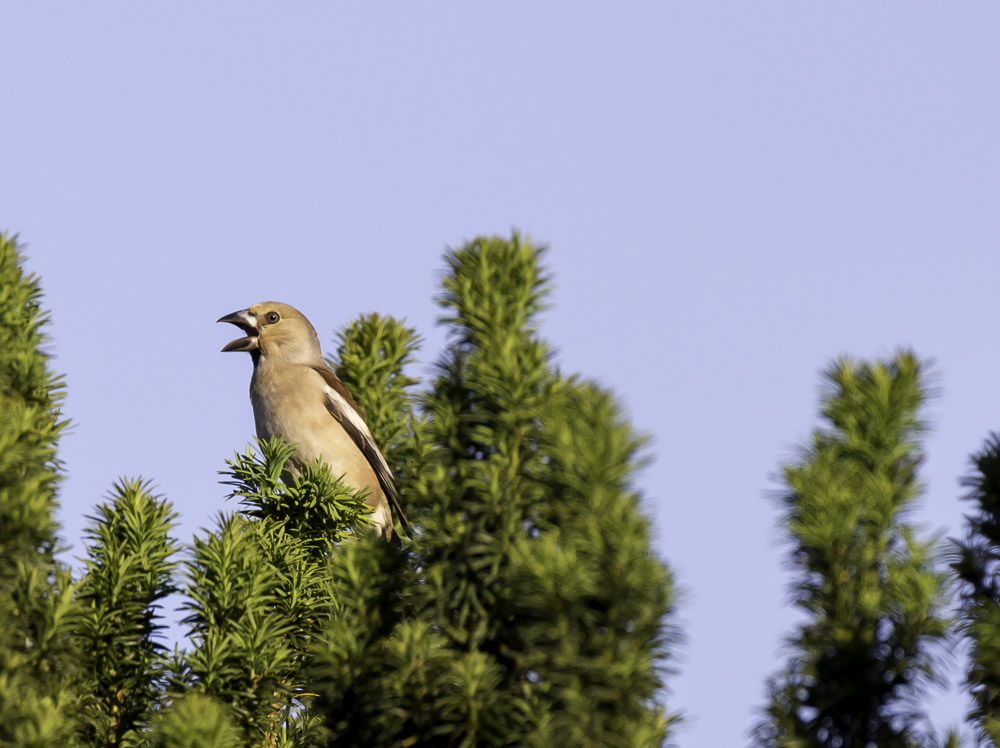
Hawfinch on yew.
Hawfinch on yew.

On a Friday afternoon recently I was on my way to a 5 p.m. appointment with a customer when I encountered a traffic hold-up in a mid-Wales town.  I soon realised there was no chance of making the appointment so I phoned up to re-arrange it. It took 55 minutes altogether to get through the bottleneck (a set of three-way traffic lights at some roadworks already abandoned for the weekend!) so I had plenty of opportunity to reassess the rest of my day. Would the evening be an opportunity for some landscape photography as I had originally planned? And, if so, where …….. ?

Another interesting possibility suddenly entered my consciousness. Some ten years ago I had been told that hawfinches could be seen at a particular churchyard during June. It wasn’t that far away! It might be worth a shot. Half an hour later I was there.

At first the churchyard was ominously quiet. Then a stocky bird flew behind a yew tree and disappeared. Hmmmm…..what was that? Before long a series of these apparently random bird movements began to build into a picture. And then a hawfinch perched for a few seconds on top of one of the yews. The churchyard was heaving with them! Well, I’m exaggerating, but these birds are so rarely seen, let alone photographed, and I felt that with patience I might have a chance to do the latter. Long after the sun had vanished behind cloud a hawfinch perched right out in the open on a gravestone.

The next morning one was present when I arrived about 7.30 a.m.; it flew immediately, landing briefly in a cherry tree (where I photographed it) before joining a group of others a few hundred yards away. It was to be my last opportunity for several hours. I searched for a position where I could observe as many of the yew trees as possible, eventually settling (literally) on a tomb by the main door of the church. Single hawfinches came and went, disappearing low into the yews, or dropping in from the top. A bird would fly behind a yew and not reappear from the other side. Birds flew behind the church. They flew into a sparsely-leaved holly tree and disappeared. It was as if they were wearing an invisibility cloak. On the odd occasion when a bird did perch out in the open it was silhouetted against an excessively bright sky. The sun was still behind the dark foliage of the yew trees so metering was difficult and a correct exposure virtually impossible. I tried to estimate an optimum exposure and use manual metering but that didn’t help. It wasn’t going too well.

More of the same followed during the afternoon. At one point a party of four (presumably a family) appeared from nowhere, flew a few yards above my head and went who knows where. I did manage to identify their redwing- or robin- like song/call but these were so high-pitched as to be almost “not there”. Enigmatic really is the best adjective to describe the hawfinch. To pass the time between their visits I photographed other species – house sparrow and jackdaw – images which, apart from their lack of rarity value, I prefer to those of the hawfinches that I did eventually manage.

Meanwhile passers by came and went. I felt rather self-conscious with my paparazzi-style lens. One young woman asked me what I was doing and I told her I was trying to photograph some unusual birds. What birds were they? “Hawfinches” I said. “Are they like magpies?” she asked….. Later she walked through without speaking and I got the feeling she had decided that the strange man lurking around the churchyard was up to no good. If you had a suspicious mind, read the wrong sort of newspaper, and knew nothing about birds, it would be easy to believe I was taking the ****. Hawfinches indeed……..

As the hours passed the sun gradually swung around to the west and sank lower in the sky. The light was getting better! There was a flurry of hawfinch activity during the evening and I managed the most successful images of the day. Phew! It had been worth the wait!

Welcome to Pembrokeshire

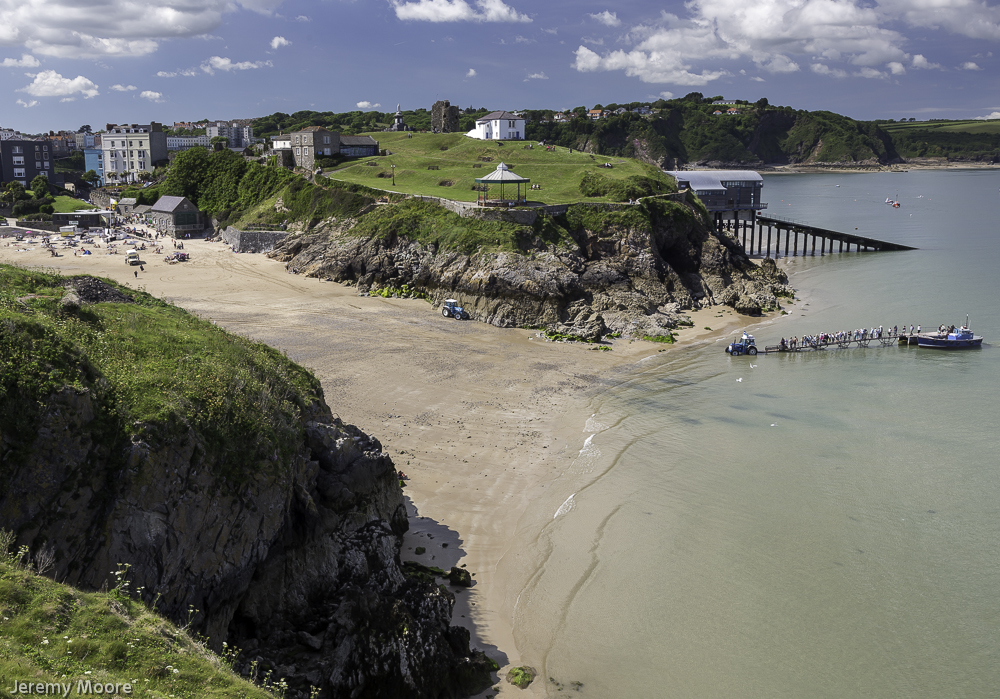
Tenby from St. Catherine's Island
Tenby from St. Catherine’s Island

This recent fine spell of weather has seen me rushing from one corner of Wales to another. The south-east for peregrines (see previous post), the north west for more peregrines , and earlier this week the south west. I ended up feeling like a headless chicken with the law of diminishing returns becoming more and more operative!

My last trip was to Tenby. I am about to put in my summer order for postcards and was hoping to include one new design of the town, surely one of the loveliest in Britain. After many years of inaccessibility the island of St. Catherines (just off Tenby)  is now open to visitors, and I guessed that it would provide a novel viewpoint. Looking at the OS map and consulting the local tide tables suggested that late afternoon on Tuesday would be the ideal time to visit. It would be low tide, ensuring that the widest expanse of sandy beach would be uncovered. My angle of vision across to Tenby would be exactly at right-angles to the sun’s rays, such that a polarising filter would be at its most effective. And the weather! Perfect!

I handed over my £3.50 and climbed the steps up to the island. A “tour guide” said it would be absolutely fine to do some photography while I waited for him to return with his next group. I scrambled up a low rocky slope to get a better viewpoint and set up my tripod. I had taken just one image when I heard a voice bellowing at me. “Oi….what are you doing up there?…this is absolutely ridiculous….get down from there immediately….what if you fell down the cliff?….. what if someone followed you and fell down the cliff?…..what if a child fell down the cliff?….. what if someone on the mainland sees you and reports it to the Council? It went on and on. He slowly calmed down and told me that he was the new owner and I could be putting at risk his £2 million investment. I apologised for not noticing the “keep to the path” signs and inadvertently finding myself beyond the railings (I suppose you don’t see what you don’t want to see…..), and returned to the beach. As far as the owner is concerned, I last saw him up to his knees in seawater, apparently berating an angler who had clambered across the rocks at the base of “his island”. I fear a heart attack awaits him…….

The following day, after some early morning photography around Tenby in sparkling conditions yet again, I wasn’t quite sure what to do. The sun quickly rises too high for landscape photography in mid-summer, and you don’t get much closer to mid-summer than this. But cloud was developing and spreading and I decide to head for the Elegug Stacks (Stack Rocks) on the Castlemartin peninsula, about 15 miles away. These conditions (cloudy but bright) would be ideal for photographing the seabird colony there. About a mile short of my destination, however, signs told me that the road was closed. Live firing was taking place on the Castlemartin tank ranges. The Stacks would be inaccessible until 5pm, and possibly later. Curses……

As I turned back I remembered that the Bosherston Lily Ponds, owned by the National Trust, were only a few miles away. Perhaps they would be worth a visit? While I am a supporter in various ways of several conservation organisations, I’m afraid to say that the National Trust is not among them. Suffice to say that I believe their car park charges for non-members are extortionate. The National Trust car-parks around Bosherston all charge £5 per vehicle, but I knew an unofficial one, probably mainly used by local people, which was free of charge, so I headed for it. It was too late. It now cost £5 to park there as well, even on the unmade approach road. I wonder how locals feel when suddenly they are required to fork out a significant sum of money when they bring the dog down for a walk, for example? The National Trust owns SO many of our treasured landscapes, especially around the coast. Many are inaccessible except by car and unless you are a member you have to pay through the nose to visit them. So much for holding land “on behalf of the nation……..”

Anyway, I digress. I parked nearby on the grass verge of a public road and walked a short distance down to the nearest pool. Here I discovered that, inadvertently or otherwise, the original owners of the estate had created a “mirror pool” similar to those built by bird photographers to take images of birds and their reflections. By dropping down a few feet below the dam I could get the water surface very close to eye level. I set up my long lens on the tripod and began photographing the dancing clouds of blue damselflies which were egg-laying into submerged vegetation in the pool. It was a gorgeous sight, albeit set to a soundtrack of explosions and machine gun fire from the Range a couple of miles away.

Postscript: The one image I did manage on St Catherine’s (see above)  is fine for a postcard. While things did not turn out as I hoped, the planning I did for this shot was enough to ensure success. Even with more time I doubt I could have done better.

First flight


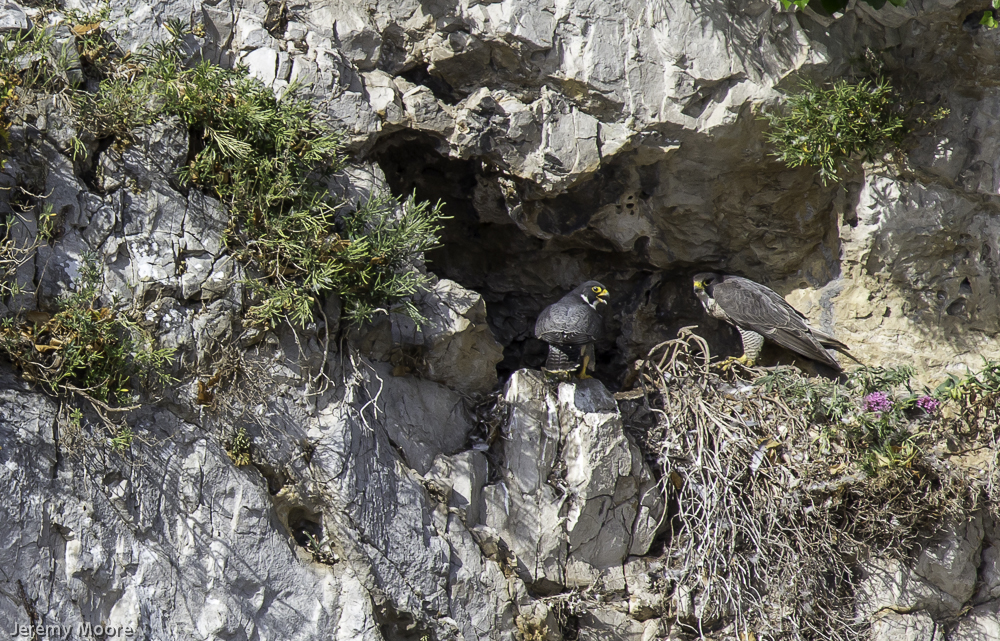
Peregrines at the eyrie - south Wales
Peregrines at the eyrie – south Wales


Earlier this week I whizzed down to south Wales in the hope of photographing peregrines at their nest site on a limestone cliff-face. It did not take me long to find another photographer with long lens and tripod and I knew I had come to the right place. He told me that the peregrine “chick” was about to leave the nest. It had been jumping around on the ledge and flapping its wings powerfully. Had I arrived just in time?

Over the next few hours a real drama unfolded. This was Springwatch in real time! The “chick” did indeed appear to be ready to go. Its parents were using various tactics to entice it off the ledge. An adult brought food in but instead of taking it to the youngster circled in front of the cliff-face with it. Food was brought to a ledge a few yards from the youngster and the parent stood there with it. The whole cliff-face was raucous with the sounds of peregrines calling.

After a while the latter tactic succeeded. The youngster scrambled and flapped its way to its parent where it was given a few scraps of meat. The adult flew off. The chick was then left with the dilemma of what to do next. “I’ll scream and flap” it must have thought – because that is what it did. There was some concern among the assembled throng – now numbering four birders with long lenses – that it would fly before it was ready and tumble into the river below. One had been rescued from the mud a few years ago. But the cliff was perhaps not quite as sheer as it seemed because the youngster flapped and tumbled a few more ledges downwards until it was perhaps twelve feet below its nest.

It eventually found what appeared to be a pinnacle almost surrounded by sheer drops. There was surely no going back now…… It flapped and lurched. Almost! This was the biggest moment in its short life but one could almost imagine what it was going through. More flapping and another lurch or two.

Then it was away. It swept confidently down over the river then up and back to an oak tree on the cliff-top. It landed tidily – no crash-landing for me, thank you very much! – and stayed there. Meanwhile the parents had taken separate stances on the cliff and appeared very relaxed. Doing what peregrines do so well most of the time – nothing. There will still be plenty for them to do, of course; the youngster will be unable to catch its own prey for weeks and will need further lessons from mum and dad on how to go about it. But by the time I left about 9pm that was still the state of play.

It was a case of excellent timing (for once!) on my part and a thrilling chance to watch what can normally only be seen on television. The photograph – showing both adults, with the stunningly handsome male on the left – illustrates what excellent results the new Tamron 150-600 “superzoom” is capable of. I may have bought one of the early batch of this lens which needs a return to the importers for a “fix” before it can operate to its fullest potential. Nevertheless I consider myself very lucky to have got one when they were (and still are) in such short supply. It has brought my bird photography up to a new level.

What a little hero!

Arctic tern - the Skerries
Arctic tern – the Skerries

There’s no doubt about it – terns are among my favourite birds. In Wales, the place to be for the tern-watcher is the Isle of Anglesey, and it was here that I headed late last week. There are a number of colonies on the island, and – with the exception of the little tern – all the British species can, with good fortune, be found there.  Common terns are present near Menai Bridge, and they are a delightful sight above the sheltered waters of the Straits between the two bridges. There a number of mixed colonies elsewhere. Perhaps the most well-known is at Cemlyn, on the north coast, where sandwich tern is in the majority together with common and arctics. This is also an ancestral breeding site of the very rare roseate tern, and very occasional birds may still be seen there, including – to my delight – last Friday, when I visited.   Not that I would have picked it out amongst the throng of other terns without the assistance of the Wildlife Trust wardens!

The tern island par excellence is/are the  Skerries, with its lighthouse and colony of several thousand arctic and common terns. For the last few years a roseate tern has paired with a common tern on the island as well and produced hybrid young. During spring and summer the colony is wardened by the RSPB, and it was thanks to them that I was able to visit the island on Friday evening on their regular supply vessel. Visiting a tern colony really is an experience. Arctic terns are stunningly beautiful little birds and can be exceptionally approachable. With their bright red beaks and legs a bird can recall a woman decked out in red lipstick and boots. But move one inch too close and that bird can become a tiny raging little monster, metaphorically spitting blood. They have no hesitation in striking a human intruder on the head so wearing a hat is a necessity.

On a previous visit in June 2010 I found that a telephoto lens was unnecessary as the birds were so close. I stuck to my standard zoom, and told myself at first to be selective when pressing the shutter; still thinking ‘film’ I suppose. After a while I remembered that I had just one hour on the island and how desperate it would be to get back to the mainland with nothing, so I relaxed a little. I got some great images of angry terns in flight at the wide-angle end of the zoom; and one of these featured in the book and exhibition Wales at Waters Edge.

On last week’s visit conditions were slightly different. Weather conditions were excellent but much of the closest section of the colony was in the shadow of the lighthouse. It was about two weeks earlier than my previous visit and the birds seemed slightly less territorial than I remembered. Every few minutes, it seemed, the whole colony rose up together and swept across the island before quickly returning.  I stuck the Tamron long zoom on my 5d3 and concentrated on close-ups of individual birds, and – despite  the incredible experience of being there – my photographic efforts felt strangely uninspired. The warden asked us all if we could be ready to leave in five minutes, so I swapped lenses and packed my gear away. Turning around,  I saw a perfectly-lit bird perched on a rock with a sand-eel in its beak – a cracking image if only I had seen it earlier! Unless…………..

To my surprise it continued to pose for me as I re-fitted the long zoom and took a few images. What a little hero!