Hawfinches in a Welsh churchyard

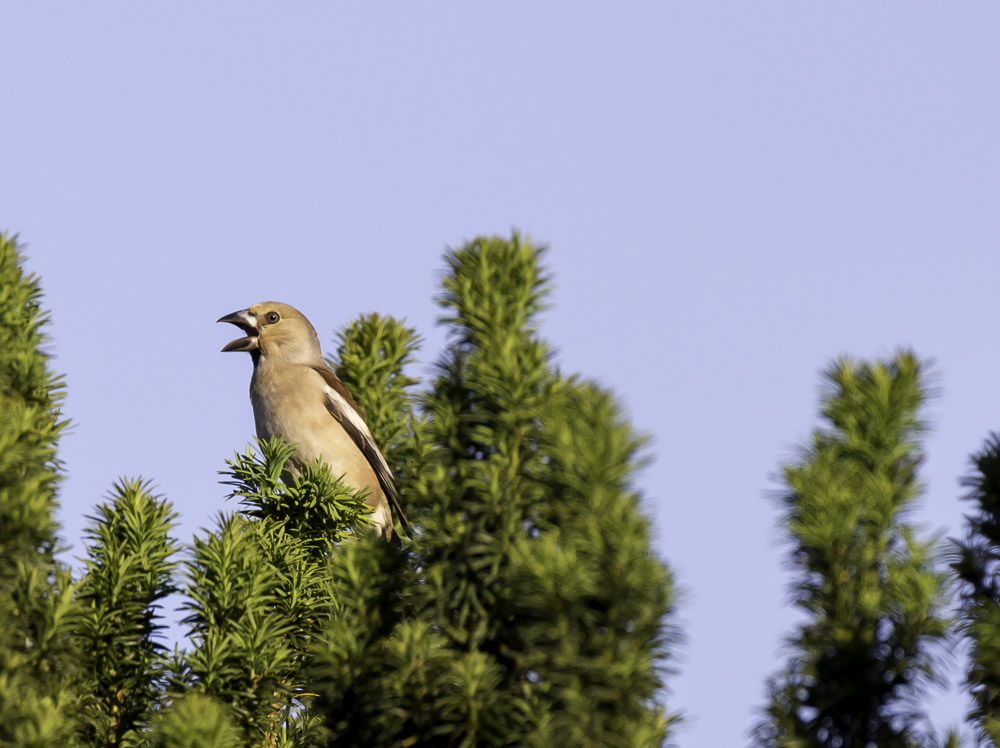
Hawfinch on yew.
Hawfinch on yew.

On a Friday afternoon recently I was on my way to a 5 p.m. appointment with a customer when I encountered a traffic hold-up in a mid-Wales town.  I soon realised there was no chance of making the appointment so I phoned up to re-arrange it. It took 55 minutes altogether to get through the bottleneck (a set of three-way traffic lights at some roadworks already abandoned for the weekend!) so I had plenty of opportunity to reassess the rest of my day. Would the evening be an opportunity for some landscape photography as I had originally planned? And, if so, where …….. ?

Another interesting possibility suddenly entered my consciousness. Some ten years ago I had been told that hawfinches could be seen at a particular churchyard during June. It wasn’t that far away! It might be worth a shot. Half an hour later I was there.

At first the churchyard was ominously quiet. Then a stocky bird flew behind a yew tree and disappeared. Hmmmm…..what was that? Before long a series of these apparently random bird movements began to build into a picture. And then a hawfinch perched for a few seconds on top of one of the yews. The churchyard was heaving with them! Well, I’m exaggerating, but these birds are so rarely seen, let alone photographed, and I felt that with patience I might have a chance to do the latter. Long after the sun had vanished behind cloud a hawfinch perched right out in the open on a gravestone.

The next morning one was present when I arrived about 7.30 a.m.; it flew immediately, landing briefly in a cherry tree (where I photographed it) before joining a group of others a few hundred yards away. It was to be my last opportunity for several hours. I searched for a position where I could observe as many of the yew trees as possible, eventually settling (literally) on a tomb by the main door of the church. Single hawfinches came and went, disappearing low into the yews, or dropping in from the top. A bird would fly behind a yew and not reappear from the other side. Birds flew behind the church. They flew into a sparsely-leaved holly tree and disappeared. It was as if they were wearing an invisibility cloak. On the odd occasion when a bird did perch out in the open it was silhouetted against an excessively bright sky. The sun was still behind the dark foliage of the yew trees so metering was difficult and a correct exposure virtually impossible. I tried to estimate an optimum exposure and use manual metering but that didn’t help. It wasn’t going too well.

More of the same followed during the afternoon. At one point a party of four (presumably a family) appeared from nowhere, flew a few yards above my head and went who knows where. I did manage to identify their redwing- or robin- like song/call but these were so high-pitched as to be almost “not there”. Enigmatic really is the best adjective to describe the hawfinch. To pass the time between their visits I photographed other species – house sparrow and jackdaw – images which, apart from their lack of rarity value, I prefer to those of the hawfinches that I did eventually manage.

Meanwhile passers by came and went. I felt rather self-conscious with my paparazzi-style lens. One young woman asked me what I was doing and I told her I was trying to photograph some unusual birds. What birds were they? “Hawfinches” I said. “Are they like magpies?” she asked….. Later she walked through without speaking and I got the feeling she had decided that the strange man lurking around the churchyard was up to no good. If you had a suspicious mind, read the wrong sort of newspaper, and knew nothing about birds, it would be easy to believe I was taking the ****. Hawfinches indeed……..

As the hours passed the sun gradually swung around to the west and sank lower in the sky. The light was getting better! There was a flurry of hawfinch activity during the evening and I managed the most successful images of the day. Phew! It had been worth the wait!

Welcome to Pembrokeshire

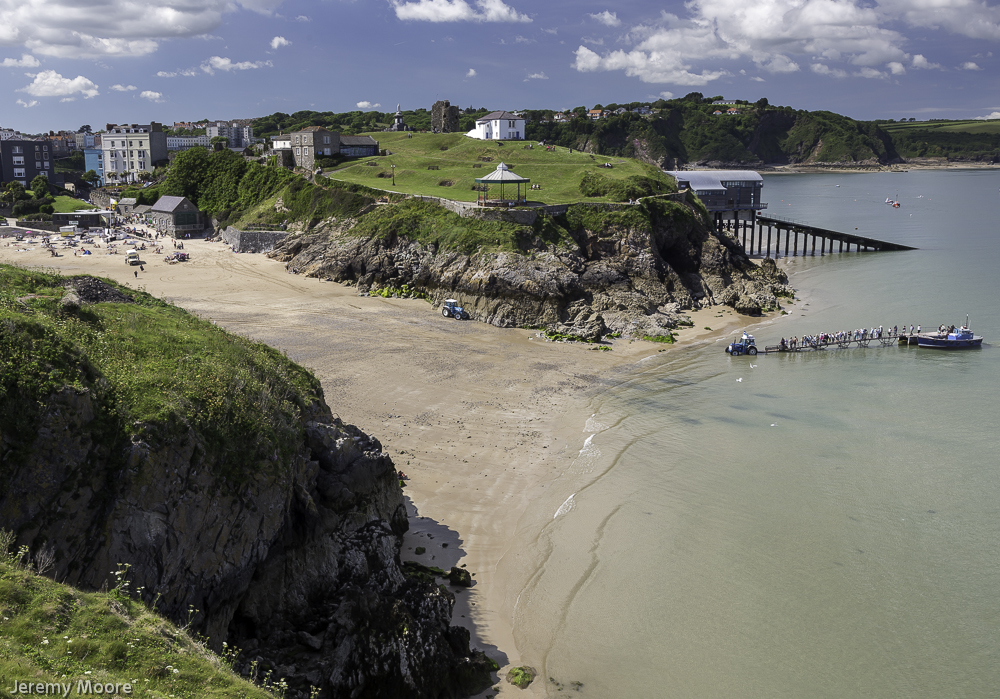
Tenby from St. Catherine's Island
Tenby from St. Catherine’s Island

This recent fine spell of weather has seen me rushing from one corner of Wales to another. The south-east for peregrines (see previous post), the north west for more peregrines , and earlier this week the south west. I ended up feeling like a headless chicken with the law of diminishing returns becoming more and more operative!

My last trip was to Tenby. I am about to put in my summer order for postcards and was hoping to include one new design of the town, surely one of the loveliest in Britain. After many years of inaccessibility the island of St. Catherines (just off Tenby)  is now open to visitors, and I guessed that it would provide a novel viewpoint. Looking at the OS map and consulting the local tide tables suggested that late afternoon on Tuesday would be the ideal time to visit. It would be low tide, ensuring that the widest expanse of sandy beach would be uncovered. My angle of vision across to Tenby would be exactly at right-angles to the sun’s rays, such that a polarising filter would be at its most effective. And the weather! Perfect!

I handed over my £3.50 and climbed the steps up to the island. A “tour guide” said it would be absolutely fine to do some photography while I waited for him to return with his next group. I scrambled up a low rocky slope to get a better viewpoint and set up my tripod. I had taken just one image when I heard a voice bellowing at me. “Oi….what are you doing up there?…this is absolutely ridiculous….get down from there immediately….what if you fell down the cliff?….. what if someone followed you and fell down the cliff?…..what if a child fell down the cliff?….. what if someone on the mainland sees you and reports it to the Council? It went on and on. He slowly calmed down and told me that he was the new owner and I could be putting at risk his £2 million investment. I apologised for not noticing the “keep to the path” signs and inadvertently finding myself beyond the railings (I suppose you don’t see what you don’t want to see…..), and returned to the beach. As far as the owner is concerned, I last saw him up to his knees in seawater, apparently berating an angler who had clambered across the rocks at the base of “his island”. I fear a heart attack awaits him…….

The following day, after some early morning photography around Tenby in sparkling conditions yet again, I wasn’t quite sure what to do. The sun quickly rises too high for landscape photography in mid-summer, and you don’t get much closer to mid-summer than this. But cloud was developing and spreading and I decide to head for the Elegug Stacks (Stack Rocks) on the Castlemartin peninsula, about 15 miles away. These conditions (cloudy but bright) would be ideal for photographing the seabird colony there. About a mile short of my destination, however, signs told me that the road was closed. Live firing was taking place on the Castlemartin tank ranges. The Stacks would be inaccessible until 5pm, and possibly later. Curses……

As I turned back I remembered that the Bosherston Lily Ponds, owned by the National Trust, were only a few miles away. Perhaps they would be worth a visit? While I am a supporter in various ways of several conservation organisations, I’m afraid to say that the National Trust is not among them. Suffice to say that I believe their car park charges for non-members are extortionate. The National Trust car-parks around Bosherston all charge £5 per vehicle, but I knew an unofficial one, probably mainly used by local people, which was free of charge, so I headed for it. It was too late. It now cost £5 to park there as well, even on the unmade approach road. I wonder how locals feel when suddenly they are required to fork out a significant sum of money when they bring the dog down for a walk, for example? The National Trust owns SO many of our treasured landscapes, especially around the coast. Many are inaccessible except by car and unless you are a member you have to pay through the nose to visit them. So much for holding land “on behalf of the nation……..”

Anyway, I digress. I parked nearby on the grass verge of a public road and walked a short distance down to the nearest pool. Here I discovered that, inadvertently or otherwise, the original owners of the estate had created a “mirror pool” similar to those built by bird photographers to take images of birds and their reflections. By dropping down a few feet below the dam I could get the water surface very close to eye level. I set up my long lens on the tripod and began photographing the dancing clouds of blue damselflies which were egg-laying into submerged vegetation in the pool. It was a gorgeous sight, albeit set to a soundtrack of explosions and machine gun fire from the Range a couple of miles away.

Postscript: The one image I did manage on St Catherine’s (see above)  is fine for a postcard. While things did not turn out as I hoped, the planning I did for this shot was enough to ensure success. Even with more time I doubt I could have done better.

First flight


Peregrines at the eyrie - south Wales
Peregrines at the eyrie – south Wales


Earlier this week I whizzed down to south Wales in the hope of photographing peregrines at their nest site on a limestone cliff-face. It did not take me long to find another photographer with long lens and tripod and I knew I had come to the right place. He told me that the peregrine “chick” was about to leave the nest. It had been jumping around on the ledge and flapping its wings powerfully. Had I arrived just in time?

Over the next few hours a real drama unfolded. This was Springwatch in real time! The “chick” did indeed appear to be ready to go. Its parents were using various tactics to entice it off the ledge. An adult brought food in but instead of taking it to the youngster circled in front of the cliff-face with it. Food was brought to a ledge a few yards from the youngster and the parent stood there with it. The whole cliff-face was raucous with the sounds of peregrines calling.

After a while the latter tactic succeeded. The youngster scrambled and flapped its way to its parent where it was given a few scraps of meat. The adult flew off. The chick was then left with the dilemma of what to do next. “I’ll scream and flap” it must have thought – because that is what it did. There was some concern among the assembled throng – now numbering four birders with long lenses – that it would fly before it was ready and tumble into the river below. One had been rescued from the mud a few years ago. But the cliff was perhaps not quite as sheer as it seemed because the youngster flapped and tumbled a few more ledges downwards until it was perhaps twelve feet below its nest.

It eventually found what appeared to be a pinnacle almost surrounded by sheer drops. There was surely no going back now…… It flapped and lurched. Almost! This was the biggest moment in its short life but one could almost imagine what it was going through. More flapping and another lurch or two.

Then it was away. It swept confidently down over the river then up and back to an oak tree on the cliff-top. It landed tidily – no crash-landing for me, thank you very much! – and stayed there. Meanwhile the parents had taken separate stances on the cliff and appeared very relaxed. Doing what peregrines do so well most of the time – nothing. There will still be plenty for them to do, of course; the youngster will be unable to catch its own prey for weeks and will need further lessons from mum and dad on how to go about it. But by the time I left about 9pm that was still the state of play.

It was a case of excellent timing (for once!) on my part and a thrilling chance to watch what can normally only be seen on television. The photograph – showing both adults, with the stunningly handsome male on the left – illustrates what excellent results the new Tamron 150-600 “superzoom” is capable of. I may have bought one of the early batch of this lens which needs a return to the importers for a “fix” before it can operate to its fullest potential. Nevertheless I consider myself very lucky to have got one when they were (and still are) in such short supply. It has brought my bird photography up to a new level.

What a little hero!

Arctic tern - the Skerries
Arctic tern – the Skerries

There’s no doubt about it – terns are among my favourite birds. In Wales, the place to be for the tern-watcher is the Isle of Anglesey, and it was here that I headed late last week. There are a number of colonies on the island, and – with the exception of the little tern – all the British species can, with good fortune, be found there.  Common terns are present near Menai Bridge, and they are a delightful sight above the sheltered waters of the Straits between the two bridges. There a number of mixed colonies elsewhere. Perhaps the most well-known is at Cemlyn, on the north coast, where sandwich tern is in the majority together with common and arctics. This is also an ancestral breeding site of the very rare roseate tern, and very occasional birds may still be seen there, including – to my delight – last Friday, when I visited.   Not that I would have picked it out amongst the throng of other terns without the assistance of the Wildlife Trust wardens!

The tern island par excellence is/are the  Skerries, with its lighthouse and colony of several thousand arctic and common terns. For the last few years a roseate tern has paired with a common tern on the island as well and produced hybrid young. During spring and summer the colony is wardened by the RSPB, and it was thanks to them that I was able to visit the island on Friday evening on their regular supply vessel. Visiting a tern colony really is an experience. Arctic terns are stunningly beautiful little birds and can be exceptionally approachable. With their bright red beaks and legs a bird can recall a woman decked out in red lipstick and boots. But move one inch too close and that bird can become a tiny raging little monster, metaphorically spitting blood. They have no hesitation in striking a human intruder on the head so wearing a hat is a necessity.

On a previous visit in June 2010 I found that a telephoto lens was unnecessary as the birds were so close. I stuck to my standard zoom, and told myself at first to be selective when pressing the shutter; still thinking ‘film’ I suppose. After a while I remembered that I had just one hour on the island and how desperate it would be to get back to the mainland with nothing, so I relaxed a little. I got some great images of angry terns in flight at the wide-angle end of the zoom; and one of these featured in the book and exhibition Wales at Waters Edge.

On last week’s visit conditions were slightly different. Weather conditions were excellent but much of the closest section of the colony was in the shadow of the lighthouse. It was about two weeks earlier than my previous visit and the birds seemed slightly less territorial than I remembered. Every few minutes, it seemed, the whole colony rose up together and swept across the island before quickly returning.  I stuck the Tamron long zoom on my 5d3 and concentrated on close-ups of individual birds, and – despite  the incredible experience of being there – my photographic efforts felt strangely uninspired. The warden asked us all if we could be ready to leave in five minutes, so I swapped lenses and packed my gear away. Turning around,  I saw a perfectly-lit bird perched on a rock with a sand-eel in its beak – a cracking image if only I had seen it earlier! Unless…………..

To my surprise it continued to pose for me as I re-fitted the long zoom and took a few images. What a little hero!


Who’s a pretty boy, then?

Pied flycatcher - Ynyshir
Pied flycatcher – Ynyshir

Sitting staring out of my window at sullen grey cloud and the branches of the ash tree in the garden whipping backwards and forwards, it is difficult to recall the delightful conditions we experienced during April.

In this part of the world the last week in April is a critical one for photographing small woodland birds. Most of the migrants will have arrived but the leaves are not fully open, meaning that those birds are still visible. During several visits to Ynyshir RSPB reserve during late April there’s no doubt that the most prominent of those attractive summer visitors was the pied flycatcher. I spent many hours with two males which were both energetically defending small territories around their chosen nest-boxes. For hour after hour they flew from bare twig to bare twig and uttered their simple sweet song. When you see the determination with which they do this it is worth remembering that each bird had probably completed its journey from Africa only a day or two – or possibly just hours – previously. And not only that, but it is quite likely to have been the same nest box they had used last year. By the time of my last visit one bird had attracted a female – again possibly his mate from last year – and they were visiting the box together. Who knows what they got up to in there! (discussing the colour scheme, I should think…..). By that time he was also noticeably less inclined to sing.

Who's a pretty boy, then.......
Who’s a pretty boy, then…….

One bird was easily visible from the Ynyshir hide, which in theory should have made photography easier. But a constant stream of other human visitors to the hide was a distraction for both bird and photographer. How dare they! The other bird was quite approachable out in the open. Over a period of a couple of days altogether I came back with hundreds of pied flycatcher images, many almost identical, and it has been quite an ordeal processing and sifting through them. It was easy to pick out one classic bird portrait, but as far as “pied flycatcher in the landscape” goes I still haven’t come up with an absolute favourite. The birds’ surroundings were usually a jumble of oak twigs and branches, some in focus and some out, with a few leaves, but little regular structure. In any event I plan eventually to show three images together so (in theory) that should make life a little easier when the time comes to make final decisions.

As far as the technicalities were concerned modern equipment makes bird photography SO much easier. At 1000 ASA (equivalent) I was getting lovely clean results with my Canon 5d3, and any noise is easily removed in Lightroom.  Such high sensitivities  allow fast shutter speeds to be used, with lower risk of subject movement or camera shake. Thanks once more to the 5d3 it has been possible to crop down quite deeply into an image to obtain a pleasing composition.  My lens is the new Tamron 150-600 zoom. The Canon version was released several months ago and I was lucky to get hold of one of the first batch. It has received generally favourable reviews – with the proviso that there may be “issues” when focusing on moving subjects, and particularly with older bodies. I can’t comment on that but in general I’m very pleased with the results. The results are certainly sharper and more consistent than the Canon 100-400/1.4x TC combination that I was previously using. As always a black and white bird presents contrast problems in strong sunshine so slightly subdued lighting was helpful

The other birds I had hoped to photograph were redstart and wood warbler. The former was present but difficult to get to grips with; I’ve never found Ynyshir to be the best of places to connect with this species. The latter just hadn’t arrived by the end of the month. Oddly, if one left the reserve and went a short distance inland several wood warblers were holding forth in tall beech trees on the side of the Einion valley. They were impossible to photograph, however, so I wonder if the Ynyshir birds are back yet. And I wonder if this awful weather will relent for a while before I leave for the Camargue on Tuesday?

The Welsh government and its copyright grab

During the late 1990’s and early years of this century I did a fair bit of freelance work for the Wales Tourist Board. The agreement involved handing over copyright with the images but there was a “nudge, nudge….” understanding with staff at the WTB that any out-takes from the shoot could be retained by the photographer. I wasn’t happy about the loss of copyright but felt that being able to retain identical images (in some cases) was adequate recompense.

Wales Tourist Board commissioned photographers to shoot landscapes and events in Wales. as well as using them itself it would also loan them to tourism-related businesses (free of charge) in order to promote Wales as a holiday destination. It became apparent that almost any business could be on the receiving end of the WTB’s generosity, however.

In the late 1990’s most of the WTB photographers got together to present a case to the WTB for a fairer contract. This initiative was led by a former photographer, Steve Benbow, who had by then started a commercial picture library specialising in Welsh subject matter. This was a direct competitor to the WTB in many instances so he found himself on an very uneven playing field indeed.

Letters and meetings with WTB staff followed. It was suggested that the WTB followed the Scottish Tourist Board’s example by themselves setting up a commercial picture library which would pay the photographers a percentage of the income from the images. But the WTB refused to listen. They were determined to retain copyright, come what may. When asked to explain why, they claimed, for example, that the photographer might use an image to show Wales in a poor light while the WTB used the same image to show it in a good light! Hardly likely at all.

This went on for a couple of years with no solution being found. I began a commission for the WTB one summer assuming the contract would be unchanged. When it arrived I discovered that the WTB had further tightened it up to their advantage. The photographer had to agree to hand over EVERY piece of film from the shoot, rejects and all. The loophole was closed. I was particularly irate about this because it showed that the WTB had no intention of working alongside its photographers; instead, it had every intention of dominating them. Despite being half way through a lengthy commission, and knowing that I wouldn’t get paid, I told them I would not sign the new contract.

The letter writing campaign continued when the WTB was absorbed into the Welsh Assembly Government, but to no avail. In fact the WAG adopted the WTB methods of dealing with photographers for all its departments. For me it was a matter of principle – I would not work under these terms. It was particularly galling that one part of the UK government was bypassing the 1989 Copyright, Designs and Patents Act, set in stone by the UK government to protect the rights of the freelance. And the Welsh Government (as it now calls itself) continually encourages other businesses to protect their intellectual property and profit from it whenever possible. Talk about hypocrisy!

Over the years the economic climate has changed and I feel myself reluctantly considering whether to work for the Welsh Government again. The copyright grab continues, and the photographer must still hand over every single image. In the digital age it would be easy for them to identify exactly when an image was taken or if one was missing from a sequence. They do seem to have it all sown up.

But in one respect they have softened. There is now a “fair use” clause in the contract. It states –

“Contractors have limited permission to use copies of imagery produced in the execution of assignments for the Client in order to promote them, using a portfolio or similar promotional tool.

Such use will in no way contravene the Client’s copyright. However fair use rights do not extend to the commercial sale or licensing of such imagery, either directly, or via a third party (e.g. a stock library or photo agency).

In all instances, written permission to use Client imagery for promotion should be obtained from the Contract Manager prior to the use of that imagery.”

This might seem to be an improvement but looked at in another way the WG has still turned copyright on its head. Rather than the photographer giving the client a licence to use the images in return for a fee, it is now the client that offers permission to the photographer – if they feel like it!

I thought I would float this situation for comments in the “Talk Business” section of an online photographers forum. I thought there might be a range of opinions, including some backing me up. But not a bit of it. The overwhelming view was that the client (Welsh Government) is making the terms and conditions of the contract quite clear so it is then up to the photographer to decide whether to go for it or not.

It is probably too late to do anything about it now but with the benefit of experience one does have a different perspective. If, over the past twenty years, photographers had taken a principled position and refused to work on these terms, clients would soon learn not to offer them! Because most did not it is increasingly becoming accepted that unless copyright is handed over, a photographer will not get the work. We called that a copyright grab in the 1990’s and in my opinion, it still is.

Does everyone do this now but me?

Avocet, titchwell
Avocet, Titchwell

On a recent trip to Norfolk I spent a day at Titchwell RSPB reserve. It was one of those misty/hazy days where atmospheric pollution led to disappointing long-distance visibility. But with variable layers of cloud – often thin – and with no great contrast between light and shade – and little wind, it was ideal for bird photography, I spent many hours in the Parrinder hide, focusing my attention on the waders, ducks and gulls on the freshwater lagoon. When the cloud was at its thinnest birds and background were illuminated by bright, silvery light which was exquisite and close to perfection. The image above is one of my favourites from the day.

At lunchtime I left the hide and walked back towards the visitor centre. A cluster of photographers were stationed on the embankment with long lenses pointing into the reedbed. Alert to what other people may already have seen, I heard a distinctive “pinging” call emerging from the reeds – a bearded tit. This is one of the most stunning and sought-after of British birds, and one of the rarest. Further calls followed and it became apparent that a pair of “beardies” was moving through the reeds parallel to the path. Then I heard another “ping” to my left and quickly turned to find its source. Another birder was fiddling with his phone and saying …”Oh, that was me”. The penny dropped – he was broadcasting bearded tit calls in order to entice the birds out of the reeds and into visibility. Over the next few minutes a male perched high in the reeds several times to investigate whether a rival was in his territory. It was an ideal photographic opportunity and despite forgetting to re-adjust my camera settings for this new situation I obtained a few decent images of the bird.

But I couldn’t help expressing my surprise over his methods to the birder. Many people believe that using tape lures such as this is unethical, and the British Birds Code of Practice for bird photographers states the following –

The use of playback vocalisations should be employed sparingly, if at all; if a reaction is not forthcoming immediately, then playback is unlikely to work and should not be repeated in a given territory. It should be noted that the use of playback for species protected under Schedule 1 [like the bearded tit] of the Wildlife & Countryside Act may be considered illegal.

He was unconcerned. He got the recording from the RSPB website, he said, and also did it at home in Birmingham to attract woodpeckers. It reminded me of a friend who, many years ago, and despite being a committed insect conservationist, threw branches into trees to dislodge tree-dwelling butterflies. A scouser with a drier than dry sense of humour, he called it “science”, because it “got results”.

In the greater scheme of things the occasional use of tape lures may cause little more than irritation to a bird, rather than actual disturbance. But it appears to be a growing trend. A columnist in the current edition of “Outdoor Photographer” magazine, Steve Young, recalls an incident at a lesser spotted woodpecker nest site where he berated a bird-watcher for doing the same thing. I consoled myself with the fact that in this instance the birds genuinely WERE there before the use of the recording, and, rather selfishly, that any bearded tit images I managed would have been obtained without any unethical behaviour on my own part. Under other circumstances I would have been thrilled with this image, but in fact it just feels a little bit flat.

Bearded tit, Titchwell

The birder moved on and another took his place. I couldn’t help recounting to him what had happened just a few minutes earlier. “Oh,” he said brightly, “I’ve got a bearded tit on mine.” He retrieved the phone from a pocket, turned it on, and hey presto – “…..ping…. ping…..”. Does everyone have a damned bearded tit on their phone but me?


To follow “Tales from Wild Wales” scroll down to the bottom of the page and click “Follow”

More from the submerged forest.

Submerged forest, Borth - receding tide.
Submerged forest, Borth – receding wave.
Submerged forest, Borth - incoming wave.
Submerged forest, Borth – incoming wave.

A few weeks ago I wrote about the submerged forest which had been exposed by January storms between Borth and Ynyslas – see this post. Since then I’ve been back several times in different conditions, with mixed results. I’ve been plagued by camera shake problems using a ten-stop ND filter. On one visit, during the middle of the day, I came away with virtually no useable images at all, even with exposures of just a few seconds. I decided to forget about the filter and rely on natural light (or the lack of it) to create the conditions I was looking for.

My intention had anyway been to capture waves moving through the tree stumps at sunset. Until the sun dropped below the horizon light levels were still too high, but after sunset conditions became almost perfect. On a recent visit I eventually found a photogenic-looking arrangement of stumps, set the camera on the tripod and waited. For a period of just a few minutes the incoming tide washed in and out through the stumps before covering them completely. Sunset colours in the western sky formed the backdrop. Having found “the moment” it was actually quite easy to make the images. I chatted to a fellow photographer, breaking off to press the shutter button every now and again as waves came in and receded! I returned home with dozens of almost identical images to wade through, however, and so far I’ve only processed a few of them. It hadn’t been a particularly intense sunset so I’ve processed them quite hard to give them a little more impact. I’m quite pleased with the results.

The beach seems to be returning to normal slowly but steadily. The upper part of the very distinctive tree stump pictured in my first post is still visible but sand is building up around it. There’s no sign of the rather remarkable peat cutting shown in the second picture, which must have been filled in with sand. Perhaps within a few months there will be no sign at all of what the winter storms of 2014 left behind.

To read more Tales from Wild Wales as they are published, please click the Follow button.

Because I’m worth it……

Grey Heron fishing for eels, Betws-y-coed

About three years ago I made a difficult decision. It is not like me to blow my own trumpet and I have usually preferred my photographs to do the talking. But I began to describe myself as “a leading Welsh photographer”. I was working on the photographs for my sixth book – Wales at Waters’ Edge – which had been sponsored by the Countryside Council for Wales. It was therefore the best paid project I had ever worked on. There was a good prospect that I would be able to exhibit the photographs, too. It is difficult to be objective about one’s own work but after about twenty years as a professional, and knowing what other Welsh photographers had achieved, it seemed like a reasonable claim to make.

At the same time I could see that difficult times lay ahead. The funding for the book would only last two years. Sales of my self-published postcards and calendar were still reasonable, but in economic terms Wales lags a couple of years behind the south-east of England, and the recession was just beginning to bite. The number of independent book- and gift-shops was declining and has continued to do so. Most local authorities across Wales have been forced to close tourist information centres. So I began to lose more and more outlets for my products. And my ‘business model’ (if it can be called that) was that my commercial activities subsidised my more personal work – the books and exhibitions that I worked on on a fairly regular basis.

I began publishing postcards in 1987 and it would be many years before the mobile phone was widely available, let alone Facebook and Twitter. I never believed that people would stop sending postcards, and thought they would provide an income for the rest of my working life. How wrong I was. One has to accept that times have changed and that a little rectangle of quality imagery dropping through the letterbox of a friend or relative is no longer the event that it used to be. The punitive increase in the price of postage in 2012 seemed like a particularly long nail in the postcard’s coffin.

There is no doubt that for me 2012 marked a career highpoint. Wales at Waters Edge was published in May and I was asked to speak at the Hay Festival during the summer alongside the book’s author, Jon Gower. Photographs from the book were exhibited for the first time, and were very well received. I ran a successful photography workshop in the autumn. But there was this nagging doubt about what I was going to do next. There was, in fact, a bit of a void.

The exhibition continued to tour in Wales during 2013, and gained more excellent feedback from gallery directors. But a book project fell through, and my recession-hit publisher seemed unwilling to take on any further proposals (from me anyway!). Despite undertaking a lengthy landscape commission during the summer, I felt that public spending cuts would hit further work of this kind quite hard. Sales of the 2014 calendar have been so poor that I can no longer justify publishing it. The future started to look quite bleak. I would be happy to retire on my own terms but not to be forced out of work by circumstances. In any case retirement really isn’t an option for a few years yet! Could I still be ‘a leading Welsh photographer’? It is a question which has haunted me over the last few months.

For many years I considered myself ‘a landscape photographer’ but during work on Wales at Waters Edge I began move away in other directions. Hell, I even photographed people! But I seriously started to shift my focus towards wildlife. It made sense because I had been interested in wildlife for as long as I had owned a camera. I just hadn’t put the two together. There are some brilliant wildlife photographers around and I know I don’t have their mastery of technique or their dedication. But what I do have after half a lifetime of photographing the landscape is a sense of how a bird relates to its surroundings – in a visual sense, that is. And in an ecological sense – well, I don’t have the qualifications but I’ve certainly picked up a great deal of experience over the years. And that should help me as a photographer.

So last summer I approached MOMA Wales (Museum of Modern Art) in Machynlleth with an exhibition proposal. Machynlleth is only a small town in mid-Wales, but it is a lovely venue and they have always been very supportive of my work. An exhibition there would now have to be be dependent on me obtaining external funding, however. So I put in an application to the Arts Council of Wales, and I am absolutely delighted to say that it was successful. It will fund the cost of printing and framing the work and a proportion of my time and expenses in preparing it.

The exhibition is provisionally entitled ‘Birdland’ and will show over July – September 2015. It is an ambitious project and I certainly hope it will be seen more widely than the one venue already agreed. So watch this space. And as for ‘leading Welsh photographer’, I think I can justify that for a little longer.

To follow Tales from Wild Wales please scroll right to the bottom and click the follow button

A winter visit to the Camargue.

Flamingos, the Camargue

Mid-winter might not seem to be the obvious time of year for the bird photographer to visit the Camargue – well known for its nesting herons, other brightly coloured summer visitors and phenomenal spring and autumn passage migration. But I wanted to have a crack at some of the reedbed specialities which are so difficult to find here in the UK. And small numbers of several species of eagle are known to winter there, although I knew I would be lucky to even see them. As it turned out the bitterns and the bearded tits were just as elusive there as they are in the UK. I may also have seen a distant glimpse of a booted eagle as it flew away in the rain.

As far as the practicalities are concerned I will summarise them first. Travel down to Nimes was by train to minimise my carbon footprint. Some nature photographers must believe their carbon emissions do not count, but that seems an irresponsible attitude in my opinion. It is quite feasible to do the journey in a day by train, even from Aberystwyth, although it seemed sensible to book a  room in Nimes in advance to avoid the risk of spending my first night on a park bench. Train fares are quite reasonable especially if they are booked in advance; London to Nimes was £110 return. I picked up a hire car at Nimes train station on my first morning and spent five of the next six nights at Salin de Badon, a “gite” right in the heart of the Camargue, owned and operated by the Societe National pour la Protection de la Nature.

Previously a hunting lodge, this old stone house is correctly described as “rustique” by its owners, although characterful would be another way of putting it! Accommodation is self-catering, there is no drinking water, and rooms are shared. But on the positive side, it has hot and cold running water and central heating, and access to three nearby hides is included. For me another big positive was getting to meet other French visitors with interests in common, and to practice my French on them! In particular I met two bird photographers there. Having asked if they could help me with French bird names, I was so knocked out by the quality of the images one showed me on his phone that the bird names largely passed me by. I can’t imagine any meeting of minds at the quite characterless hotel by the motorway outside Arles, where I spent my sixth night. You can find Salin de Badon on the internet or contact me for further information.

Great white egrets, the Camargue

As far as birds were concerned, on my first morning I discovered some large congregations of great white egrets, grey herons and cormorants on agricultural land outside the protected area. The egrets, in particular, were staring intently into a ditch, although what there was to see I have no idea. Another egret gathering nearby contained 73 of these spectacular birds (with about 50 others in nearby fields), I was able to photograph some of these using the car as a hide. I was surprised at the number of this species wintering in the Camargue – as well as this group, individuals birds could be widely seen.

Another species which has increased rapidly in recent years is the common crane. About ten years ago I felt lucky to see a flock of ten wintering birds, but now they have reached an incredible four thousand. Apparently they have discovered a new food source in spilt grain on the agricultural land surrounding the Camargue wetlands – ironic really as so much natural habitat was lost in land reclamation for rice growing. Who says nature is not adaptable? The birds roost in the reserve and commute between it and their feeding areas at sunrise and sunset. During the day, with some good fortune, they can be photographed from local roads from your car.

The flamingo is another conspicuous bird with which I spent some time. It seems an impossibly exotic species to be seen anywhere in Europe, but they are fairly widespread around the western Mediterranean in winter; their only French breeding site is in the Camargue. I managed some images of them on lagoons close to the sea, against a backdrop of the heavy industry at Fos-sur-mer, across the river Rhone. On  a more tranquil afternoon I photographed them and their reflections in still water at the same location. Despite a rather limited range of species, then, and some distinctly changeable weather, it proved a fairly profitable visit, and I’m thinking of going back in May.

To follow Tales from Wild Wales, please scroll right down to the bottom and click Follow