A bit late this year, I know……. but I’ve been suffering from a particularly unpleasant winter lurgy for the last few days, and am only beginning to see the light at the end of the tunnel. I hope!
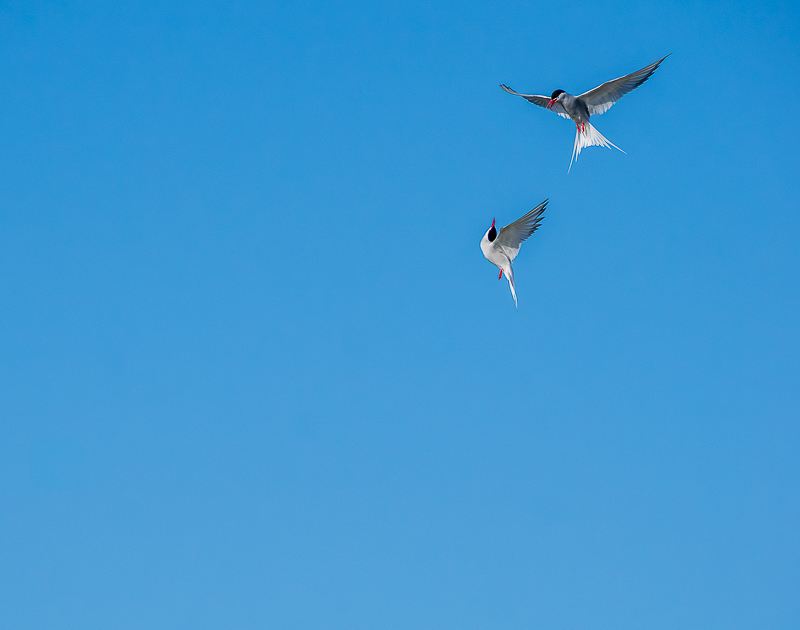
This photo was taken at Cemlyn Bay, Anglesey, during my annual visit to the tern colony there this year. I’ve always had difficulties separating arctic and common terns, and I’m going to have to come clean…. I don’t know if these are one or the other! What appear to be long red bills suggest common, but the lack of black tips suggest arctics. If anyone can put out of my identification misery, please let me know!
So, many thanks for reading my posts and I hope you have enjoyed them. May there be blue skies ahead!
To read more Tales from Wild Wales as they are published, please click the Follow button.
I might be a raptor nut but I love terns too. Wales is a bit of a “tern desert” and with one exception (little terns near Prestatyn) one must visit Anglesey to connect with them. Cemlyn Bay on the north coast is the Welsh tern H.Q. with its large sandwich tern colony, alongside smaller numbers of arctics and commons. On a good day one might see a roseate as well. I can confidently say that a visit to Cemlyn is one of the finest wildlife experiences in Wales. But your timing needs to be carefully judged.
The ideal time is just after the tern chicks have fledged because their parents then guide them to the shingle spit which divides the lagoon from the sea, away from the chaos of the nesting islands. But leave it too late and the whole damn lot of them will have left altogether! Last year I arrived on July 23rd to find that most had already gone, whereas in 2020, August 1st was just perfect.
This year I discovered that the North Wales Wildlife Trust helpfully posts updates on the progress of the colony on its website. It suggested that a visit sooner rather than later would be advisable. So I headed north late on July 12th. The following morning I was there bright and early for the full tern colony experience. Immaculate birds, constant activity, and plenty of noise! Despite nearly 50 years of birding experience I have never totally got to grips with the differences between arctic and common terns. Many birders refer to them as “comics” because they are so difficult to separate. However after this visit I think I’m getting there! Sandwich terns are comparatively easy, and I have so rarely come across roseates that identifying one would be a real adventure (but see this post…..).
Roseate tern (r.) with three sandwich terns. Note its long black bill and long-ish red legs..
As it happened I picked up my first roseate quite quickly. It was visible on and off on the near edge of the main nesting island during the morning, and around lunchtime there were two together. I was able to get a few (rather poor) photographs of them. One of the tern wardens arrived soon afterwards and I was able to point them out to him. How about that for confidence! But as he had been seeing them throughout the breeding season he wasn’t too excited. He told me that one pair had attempted to breed early on but had failed, while he was still hoping that another pair would soon appear from the denser vegetation on the island with a youngster.*
For some time prior to that I was in “spray and pray” (or point and hope) mode. In other words: point your camera at a bird in flight, press the shutter button and try to follow it. This seems to me to be rather a technical task more dependent on luck than anything else, and I find it rather unsatisfying.
Arctic tern …………probably………
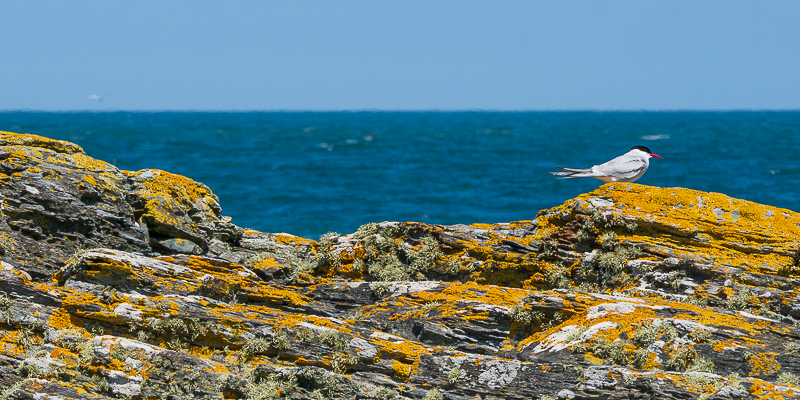
What I found more challenging was to place the terns within the landscape to give them some kind of context. At low tide, during the middle of the day, many roosted on the beach or on rocky outcrops along the foreshore. One could thus place them within an unspoiled landscape, suggesting that all is well with the world, which is perfectly valid. Alternatively, shooting from a different angle, one could set them against the massive hulk of Wylfa nuclear power station , now disused, only a couple of miles away. The viewer can then make up their own mind about the state of the world.
With ……… or without ……..?
As I mentioned this was during the middle of the day when the sun was at its highest. This is never a good time to take photographs of anything in summer so one does one’s best to compensate for it at the processing stage. Some of the newer features in Lightroom are excellent for this – in particular the ease with which “objects” can be selected and processed individually without affecting the rest of the image. And “denoise” is excellent, although rather slow on my PC.
Another thing I noticed very clearly was how the apparent colour of the power station changed during the course of the day. Its colour scheme at breakfast time matches the colour of the lichen covered rocks on the foreshore very well, and it would be uncanny if this had not been part of its design. I included a photograph illustrating this in my book “Wales at Waters Edge”; I wonder if anyone noticed….? But by early afternoon the plant was naturally bathed in blue light and looked quite different. To put it more technically, the colour of sunlight is towards the blue end of the colour spectrum (“cooler”) during the middle of the day, while it is “warmer” earlier and later. This is well known among photographers but I have never known it being demonstrated so clearly as it was that day.
Arriving as early as July 13th was, in the event, quite a close shave. A note on Facebook from the tern wardens on the 18th said that most of the terns (95% of them) had already left the area. I wish them good luck on their travels and hope they make it back to Cemlyn next year.
*N.B. : The second pair also failed …..
To read more Tales from Wild Wales as they are published, please click the Follow button.
About thirty years ago I was part of a team of volunteers who spent a week on Ynys Enlli (Bardsey Island) looking out for Risso’s dolphins. We stayed at the lighthouse (reserved for researchers) and kept a dawn-to dusk watch for these lively cetaceans using a telescope. There were a number of sightings but all were pretty distant. One day I was on observation duty when I spotted what appeared to be a cetacean “blow” (exhalation) in the far distance. It was angled at 45 degrees to the vertical and may have been a sperm whale. I called the others out but it was just a one-off sighting.
Since then I have drifted away from marine conservation but was aware that risso’s dolphins could be seen from certain locations along the Welsh coast. As well as Enlli there were sightings from Strumble Head in Pembrokeshire, and Point Lynas on the north coast of Anglesey. In fact the latter has become a regular and almost guaranteed location at the right time of year. Many excellent photographs of risso’s have appeared on the internet in the last few years. My first visit was on September 28th 2022, when animals were certainly present and very active, but were too distant to allow successful photography. I decided to try again one day last week.
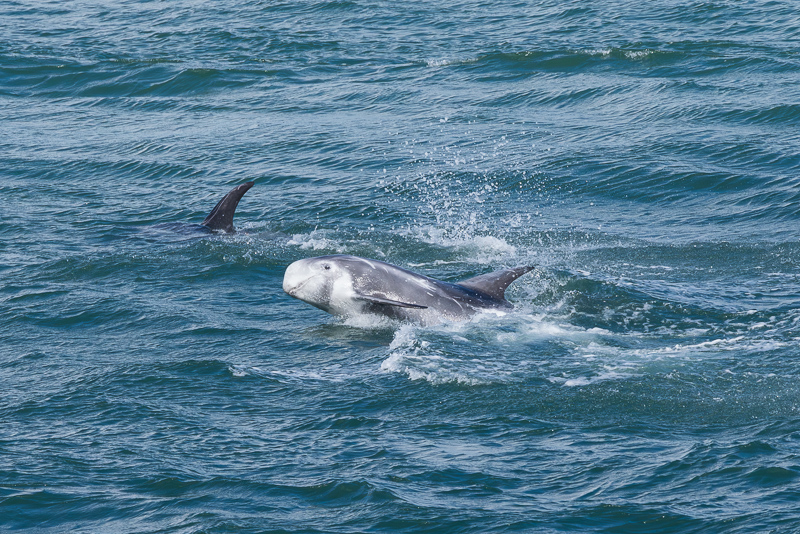
I stayed overnight with my friend Jonathan in Nantlle, about an hour’s drive on a good day from Point Lynas. We aimed to be there by high tide at 12.20 pm, but for various reasons set off far too late. Further delayed by road works and the remnants of summer holiday traffic it was actually 12.45 before we arrived at the lighthouse. A small group of Sea Watch Foundation volunteers with binoculars and clipboards were just leaving. This was not a good sign! I tentatively enquired if they had seen any dolphins and one girl told me they were “just around the corner”. A woman sitting on the rocks below the lighthouse said she had been watching them for an hour and a half. I took a quick snap as one individual disappeared beneath the waves but another small group weren’t far away. There was a sudden burst of activity from one individual in this group with vigorous tail slaps and much sea-spray, and they disappeared. It all went very quiet. I said to Jonathan “I hope it wasn’t saying to the others “Come on lads, it’s time we were off……”” But it was.
There was a fair bit of porpoise activity in the rough water off the point, and at least one more distant risso’s and a probable bottlenose dolphin or two on the walk back to the car, but that was it. What a lost opportunity!
All was not completely lost, however. I managed one sharp and pleasing image from a couple of bursts before the group disappeared (see above). It made me determined to go back to Point Lynas before the month of September was over.
For many years I used a Magicball tripod head which I thought was a brilliant and very versatile piece of kit. I had two, in fact, with a Mini-Magicball on my lightweight “walking” tripod. The secret of the design was that it was “upside down” and screwed directly into the base of the camera or lens plate. It wasn’t until I started using long, heavy lenses to photograph wildlife that I began to see the weakness in the Magicball design. It was VERY stable when the lens (even a heavy one) was aligned along the main axis of the head. When it was at 90 degrees for a portrait format image it tended to slip out position very easily. So it was time for a rethink…..
Then I discovered the Uniqball, as its name suggested another unique design this time with one ball inside another. The outer ball was first locked to fix the horizontal axis; the inner ball then behaving like a pan-and-tilt head for an exact composition. About a year ago I got hold of one of the very first UBH35P models in the UK, and I really, really wanted to like it. Over a period of a few weeks I got to know it reasonably well and concluded that it was a qualified success as a piece of equipment. It had two weaknesses, but I thought I would get to grips with them over a period of time (to read the full review click here). The problem was, I just couldn’t. While using the head in “landscape” mode I found it incredibly frustrating to have to re-set the outer ball every time I moved the tripod. This was particularly annoying on uneven and/or sloping ground, and I found myself cursing over and over again in such situations. The photographer should never have this kind of relationship with their equipment so I retired it and dug out a rather cruddy old ball-and-socket head while I decided what to do next.
Poseur? Moi?
After many hours of browsing the internet I came across an American brand called Acratech. Their ball-and-socket heads are distinctive in several ways, including their very light weight, and their astronomical price in the UK, but what really grabbed my attention was the claim that they could also be used as a gimbal head. I’ve never used one myself but actual gimbals are very specialised and bulky heads used by bird photographers. With a well-balanced camera/lens combination, all the locks can be slackened off to allow movement in all directions using only fingertip pressure. I was sceptical that a lightweight ball-and-socket head could also include this functionality. I worried particularly that with a heavy camera/lens combo tipped over to one side, the tripod would become unbalanced and tip over. Manufacturers continually claim that their new gadget will solve all your photographic problems, and it may solve some. But at the same time it may have disadvantages which only become apparent when you get one in the field……. however, I digress: my b&s head was getting stickier and stickier and I was cursing it more and more. Things were looking desperate. I saw one final positive Acratech review and my mind was made up. It was time to click “buy”.
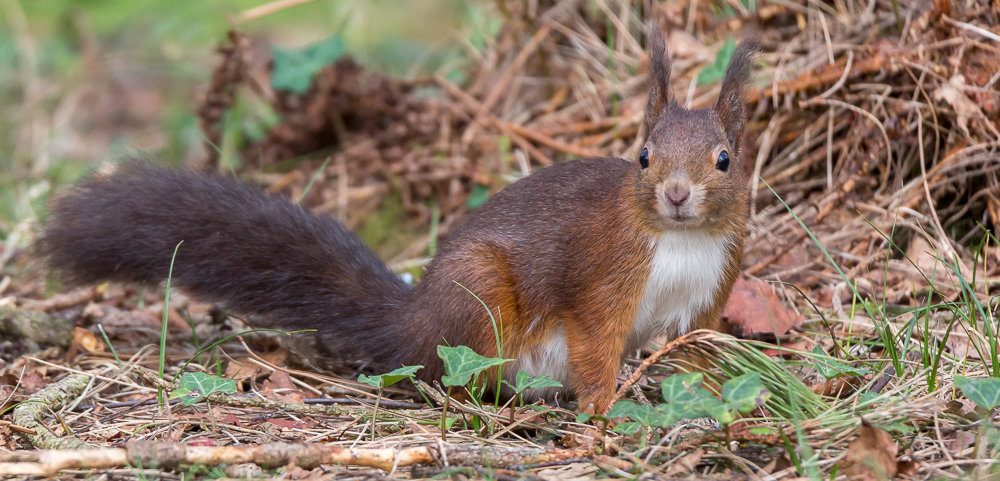
Last weekend saw the first outing of the new head (model code GPss) when I headed off up to Anglesey to have a go at photographing red squirrels. This lovely mammal was close to extinction on Anglesey in the late 1990’s when the Red Squirrel Trust Wales was set up. Its aim was through education and conservation measures – including the release of captive bred animals – to re-create a thriving population of red squirrels on the island. Grey squirrels had already arrived by using the bridges across the Menai Strait (or by swimming) but it was thought to be relatively easy to keep Anglesey free of them. The project has been a real success and it is thought there is now a population of about 700 on the island. They are beginning to re-colonise the area around Bangor on the mainland from this stronghold, and extermination of greys there will help to encourage this process. I had been told that the Newborough Forest – where there are some feeders – was the place to see them, although I failed to do so on my first visit last November. This time, however, I was more successful and I spent several happy hours in their company over a couple of days.
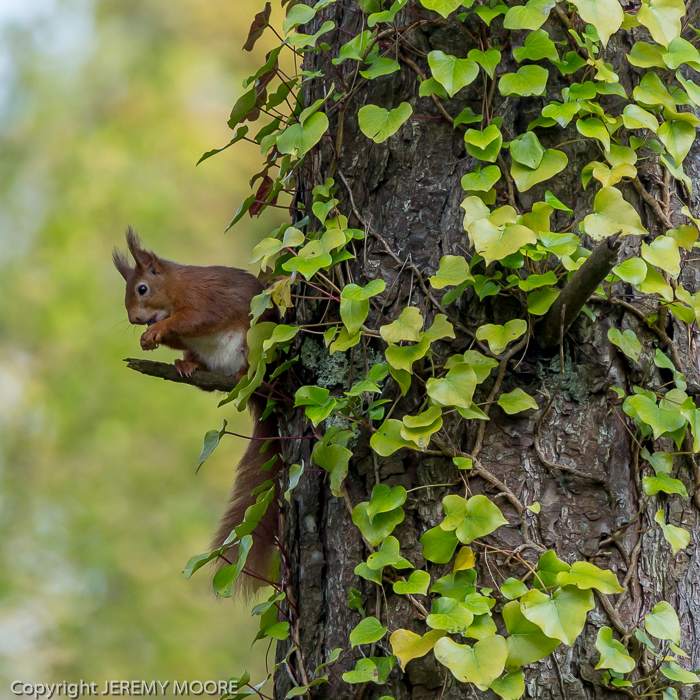
Another red squirrel……
What lovely creatures they are! On a cuteness scale of one to ten, they must be at least eleven! They proved pretty elusive during the day but around breakfast time and before dusk up to five visited the area around the feeders. They are also kept well-fed with treats there by nature lovers and wildlife photographers. They are partial to all sorts of nuts and seeds and at quieter times of the day will sit calmly feeding (and looking really, really, cute) just a few yards away from people sitting at nearby picnic tables. When more nervous they might scamper up a nearby tree-trunk and then stop, posing for all their worth for the photographer. Problems included trying to keep up with their erratic movements within the trees and occasionally high levels of contrast when stray sunbeams found their way through the tree trunks into the feeding area. It was sometimes difficult to expose correctly when an individual moved from a dark background to a light one, or vice versa.
And how did the new tripod head cope? I have to say very well. I was pleasantly surprised at how easy it was to use the head as a gimbal; there was no real threat that the tripod was about to overbalance although one would always need to keep an eye on this. And even with shutter speeds down to 1/125th second due to the low light levels within the woodland I managed a high percentage of sharp images. This suggests the tripod and head combo was keeping the lens pretty stable, even at 600mm.
There was a steady stream of other photographers and wildlife lovers visiting the site over the couple of days I was there, and I enjoyed some interesting conversations. On Sunday morning I shared a long session of red squirrel fun with Martin and Jayne from Rhos-on-Sea. We were entranced by the animals’ antics and, as our shutters clicked away busily, it felt quite special to share the experience with other like-minded people. But the thought remains that if it wasn’t for those dedicated people, often volunteers, who worked on this conservation project we would have had no red squirrels to photograph and enjoy. So my thanks go to all of them.
UPDATE: A fter using the Acratech GPss for a couple of months, I exchanged it for the larger model – the GP – which holds the ball more firmly, although not always firmly enough……. However, I am otherwise very pleased with it. Many thanks to the importer, Bob Rigby, for the exchange.
To follow Tales from Wild Wales, please scroll right to the bottom and click Follow.
There’s no doubt about it – terns are among my favourite birds. In Wales, the place to be for the tern-watcher is the Isle of Anglesey, and it was here that I headed late last week. There are a number of colonies on the island, and – with the exception of the little tern – all the British species can, with good fortune, be found there. Common terns are present near Menai Bridge, and they are a delightful sight above the sheltered waters of the Straits between the two bridges. There a number of mixed colonies elsewhere. Perhaps the most well-known is at Cemlyn, on the north coast, where sandwich tern is in the majority together with common and arctics. This is also an ancestral breeding site of the very rare roseate tern, and very occasional birds may still be seen there, including – to my delight – last Friday, when I visited. Not that I would have picked it out amongst the throng of other terns without the assistance of the Wildlife Trust wardens!
The tern island par excellence is/are the Skerries, with its lighthouse and colony of several thousand arctic and common terns. For the last few years a roseate tern has paired with a common tern on the island as well and produced hybrid young. During spring and summer the colony is wardened by the RSPB, and it was thanks to them that I was able to visit the island on Friday evening on their regular supply vessel. Visiting a tern colony really is an experience. Arctic terns are stunningly beautiful little birds and can be exceptionally approachable. With their bright red beaks and legs a bird can recall a woman decked out in red lipstick and boots. But move one inch too close and that bird can become a tiny raging little monster, metaphorically spitting blood. They have no hesitation in striking a human intruder on the head so wearing a hat is a necessity.
On a previous visit in June 2010 I found that a telephoto lens was unnecessary as the birds were so close. I stuck to my standard zoom, and told myself at first to be selective when pressing the shutter; still thinking ‘film’ I suppose. After a while I remembered that I had just one hour on the island and how desperate it would be to get back to the mainland with nothing, so I relaxed a little. I got some great images of angry terns in flight at the wide-angle end of the zoom; and one of these featured in the book and exhibition Wales at Waters Edge.
On last week’s visit conditions were slightly different. Weather conditions were excellent but much of the closest section of the colony was in the shadow of the lighthouse. It was about two weeks earlier than my previous visit and the birds seemed slightly less territorial than I remembered. Every few minutes, it seemed, the whole colony rose up together and swept across the island before quickly returning. I stuck the Tamron long zoom on my 5d3 and concentrated on close-ups of individual birds, and – despite the incredible experience of being there – my photographic efforts felt strangely uninspired. The warden asked us all if we could be ready to leave in five minutes, so I swapped lenses and packed my gear away. Turning around, I saw a perfectly-lit bird perched on a rock with a sand-eel in its beak – a cracking image if only I had seen it earlier! Unless…………..
To my surprise it continued to pose for me as I re-fitted the long zoom and took a few images. What a little hero!





 Tales from Wild Wales