An inscrutable visitor from the Arctic

Snowy Owl, St Davids Head.

This snowy owl was first reported from St. Davids Head on the Pembrokeshire bird blog on Good Friday, and then again on April 3rd. It seemed to be elusive, to say the least. But the forecast for April 5th was good, and I overcame my usual inertia and decided to go for it.  It wouldn’t be the first snowy owl I have ever seen. The first was on Fetlar (Shetland) in 1985, one of the last birds from the breeding pair present there for a number of years. The second was on moorland in North Uist a few summers ago which may actually have been a plastic sack full of peat turves, so white was it and so little did it move! But a snowy owl in Wales! And (almost) on my home patch……

I arrived at Whitesands about 8.45 am and began the walk across to St Davids Head. After about half a mile I met a birder coming the other way. It was Mike Young-Powell, a local man whose patch I knew St Davids Head was. Obviously excited, he borrowed my phone to get the news out. He had seen the bird on a rocky outcrop just a few minutes previously. I headed back with him to relocate it, and it suddenly took flight from maybe twenty yards away from us. For such a large white creature it could be surprisingly inconspicuous.

It settled amongst tussocks in the valley bottom, with only its top half showing, unfortunately. We watched it from a distance while Mike waited for his wife and friends to arrive, and then he gave me the go-ahead to get closer. I apologised in advance in case I disturbed it……

I soon got to a point on the other side of the valley where the light was better and began to creep closer, stage by stage. The owl clearly knew I was there but didn’t seem at all anxious. At each point I watched her for a few minutes and took a few pictures. I peeped over a clump of brambles and bracken, and just watched. It was quite an intimate moment, and I felt truly honoured to be in her presence.  She seemed quite relaxed, blinking in the sunshine and looking around from time to time. When closed her eyes looked like little smiley black slits in a round white face. Talk about inscrutable! There was something about a sumo wrestler about it. Much too soon, however, my presence became too much and she flew off.

I expected some flack from the other birders when I returned to the path but they were fine.  Continuing up valley I rounded a corner and the owl exploded away from her perch on the ground about twenty yards away. She flew some distance and landed on a rock, where she was harrased angrily by a raven and chased back towards us. She landed on the hillside opposite, about half way up Carn Llidi, much too far away for a binocular user like myself. From this distance and with only 10×40’s, she appeared grey all over with a white face. I settled down and waited for her to make a move. Seven hours later she was still there.

During that time she shifted around a bit, and those with a scope would have found the minor details of her resting period fascinating, I’m sure. For me the most interesting thing was the behaviour of two ravens. One made a sudden right angle turn and flew over to the owl, landing briefly on a rock about ten yards away. Another inspected the owl carefully from above. Neither of them could ever have seen a snowy owl before, and probably didn’t know what to make of it. Perhaps the owl was too near to the nest of the angry bird mentioned earlier.

Eventually I got too cold to wait around any longer and drove home. I downloaded the pictures into Lightroom yesterday and found to my relief that one of the closest pics was sharp. I cloned out two grass stems which fell across the birds face, and cropped the image fairly drastically for the above portrait. The quality at 100% is still pretty impressive! It is noticeable how brown the barring is on its upper breast compared to that on its crown. The afternoon had been pretty frustrating, but what a morning! This has to be one of the most amazing birds I have ever seen.

PS : Many thanks to Alastair and Jill Proud for the sandwich and Welsh cakes…..

To follow Tales from Wild Wales please scroll down to the bottom and click Follow.
Highly Commended image in the 2017 BWPA competition

Hawfinch in cherry tree.


At long last I can announce that one of my images – Hawthorn in a Cherry Tree – has been Highly Commended in the “Habitat” section of the 2017 British Wildlife Photography Awards. That makes three Highly Commended awards, one each time I have entered! Not bad for a landscape photographer. (Removes tongue from cheek……….)

For further information about the image and the background to it, please click here.

To follow Tales from Wild Wales, please scroll to the bottom and click Follow


Role reversal

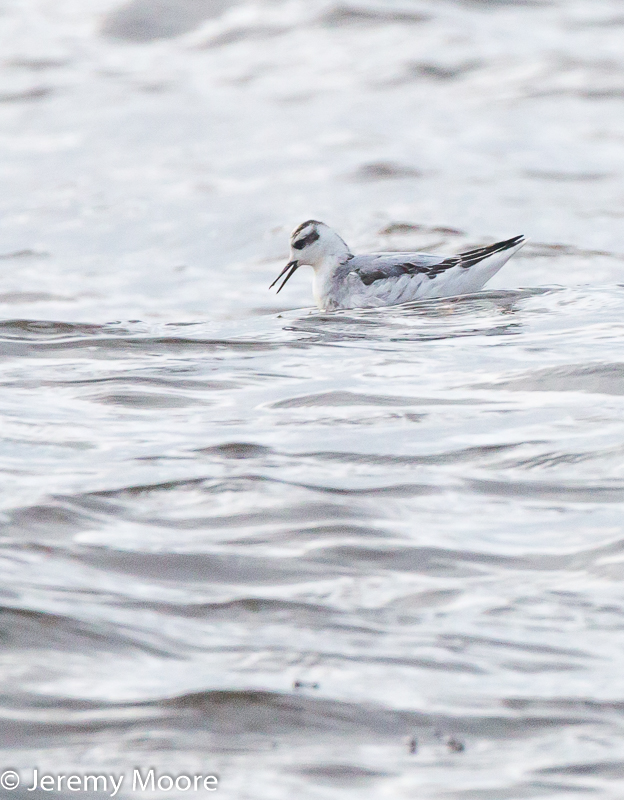
Grey phalarope, Aberystwyth

I had some reading to do this week, so rather than stay at home to do it – with all the consequent risks of coffee, biscuit and chocolate consumption, I decided to take myself off into Aberystwyth, sit in the van, and do it there. It was one of the many recent showery days and I thought there might be a chance – just a teeny chance – that sun and shower might conspire to produce a rainbow, and that I might be in the right place at the right time. As an additional incentive, there was the possibility of finding migratory seabirds blown onshore by recent winds. In particular, I was keen to see a grey phalarope – one of which species had been seen in a ditch behind Tan-y-bwlch beach a few days earlier.  During the breeding season male phalaropes incubate eggs and care for the young, while females then seek another male with whom to have more offspring. Any phalarope seen here, however, will be on migration; but even then they are a rare visitor.

Parking by the harbour I took a walk along said beach, had a look at the ditch and saw nothing. No surprise there then……. I decided to wait in the van and scan the harbour for new bird arrivals every so often while I read. If the sun emerged I could walk out along the concrete jetty for a more open vista. The afternoon passed uneventfully; several times it looked there might be a rainbow but my optimism was misplaced. By about 5 pm I had had enough and scanned the birds in the harbour again before I headed off. Some black-headed gulls had flown in and…..oh….what was that tiny white and grey bird on the edge of the flock? A little gull? No, it was a grey phalarope! For once, I felt, my luck was in. I must have had a huge grin on my face.

I grabbed my long lens and rushed round to photograph this scarce visitor. As I crossed a narrow gravel beach towards it I looked up and to my surprise ALL the birds had gone!  At that moment a yell of “You did that!” came from a woman on the road with binoculars. She was right. Phalaropes are well-known for their approachability but the gulls must have been spooked and the phalarope went with them. I was crest-fallen and climbed back up to apologise for my clumsiness.

Fortunately the phalarope did not go far and was soon back on exactly the same stretch of water. I had another go at a closer approach but it was very skittish. In between flights I got a few reasonable photographs of the bird before it got too dark. During the evening I posted the sighting (with picture) on the Ceredigion Bird Blog.

The next evening I had a phone call from one of the most experienced local birders – a chap called Chris Bird (really…) . He wanted to know more about the phalarope sighting. Not that he doubted my word : the photograph was conclusive. No, he had been on the other side of the harbour at exactly the same time and hadn’t seen the phalarope. He had spent some time that afternoon carefully searching amongst all the boats in the inner harbour for a phalarope. During the mini-drama of my attempt to get a photograph of the phalarope he was talking to another wildlife photographer about phalaropes. I couldn’t help smiling to myself. It cannot be denied that there is an element of competitiveness involved in birding, and it would normally be me who was looking the other way when the rare bird flew past.

To follow Tales from Wild Wales, scroll to the bottom and click Follow.


Bird/land rides again

Bird/land is showing again this summer, at Plas Brondanw, between Penrhyndeudraeth and Beddgelert in the heart of the Snowdonia National Park.

Set in a stunning location, Plas Brondanw was the home of the late Clough Williams Ellis – creator of Portmeirion,  the surreal Italian-style village on the Dwyryd estuary. The gardens at Plas Brondanw have been open to the public for many years but this is the first year the house has opened its doors. It is a very different venue to those at Machynlleth and Aberystwyth. Each room contains maybe 6 or 8 works, punctuated by windows which overlook the gardens and the surrounding landscape. But I think they work well there.

The official opening is on Sunday 30th – details above – and I will be giving a talk on Sunday August 13th, at 2.30 pm. Places for both events genuinely are limited. Opening hours for the exhibition are Wednesday to Sunday, 10.30 am until 4 pm. The exhibition closes on August 28th.

Edit: In the first paragraph I wrote that Plas Brondanw is in the heart of the National Park. It certainly feels as if it is, but in fact it’s on its edge. North and east of Porthmadog the National Park boundary diverts inland to exclude the village of Penrhyndeudraeth and the low-lying farmland drained when the Cob (the causeway to Porthmadog) was built just over two hundred years ago. One can only imagine the exquisite beauty of the area before it was drained. Even now at big spring tides on still days the mountains are reflected beautifully in the flooded Glaslyn River. And who knows, in these times of sea-level rise and “managed retreat” the day could come again when this land is fully tidal again.


To follow Tales from Wild Wales, scroll down to the bottom and click Follow

As seen on Springwatch…..

Swallow’s nest (with flash)

Last week we hurtled down to Pembrokeshire in the heat. Jane had an event to attend in Haverforwest and I wanted to do some bird photography in the Marloes area. We had an evening boat trip lined up too, which took us into the bays on the north and south coasts of Skomer Island amongst all the seabirds.

I headed out with my long lens on Wednesday morning and spent some time around the Deer Park. There were two family parties of chough in the area and a group of adult non-breeders. After a couple of hours I headed back to Lockley Lodge for some coffee, and then into the nearby Marine Nature Reserve building with its illuminated displays and pilot whale skeleton. The main attraction for me here was the swallow’s nest built into the eye socket of the skull, which had earlier been featured on Springwatch. I was delighted to find four large, bouncing, baby swallows being fed frequently by their parents, despite regular interruptions by human visitors. There was another swallow’s nest in the ladies toilets next door, apparently, and I had previously seen a couple in the gents; so I guess this particular pair was more discerning than some of the others……

Adult leaving swallows’ nest (no flash).

Unless the doorway was almost blocked the adults took no notice of people at all; and with the nest at little more than head height this was an opportunity not to be missed. I set up the tripod in the corner of the room and attached the camera and long lens. But boy, was it dark! Even at 3200 ASA I was exposing at slower than 1/100th second. It would be nice to think that I could capture the young gaping excitedly (but without moving) on the nest while the adult hovered artistically beside them with food but it just wasn’t going to happen. Time for Plan B.

Flash.

I never use flash. I don’t have a flash gun and my 5d3 definitely doesn’t have one built in. Maybe the 6d (back in the van) had a built in flash? It was worth a try; but no joy. Then there was the little Panasonic GX7 which I carry around with me when I can. Yessss! I was in luck. After a long time fiddling around with menus I finally worked out how to use it. You press the button and the flash pops up. Surely it can’t be that easy…..?

With the 5D3 and other SLR’s (I imagine) you press the shutter and keep pressing – the result being a burst of images which capture the action at up to 12 frames a second – although the 5d3 is rated at 6 fps and seems slower than that. With the GX7 it’s one frame at a time; that is, in this situation, one frame each time the parent brought food for the young. Fortunately the feeding visits were coming thick and fast and I never had long to wait. I wouldn’t say I’m totally happy about any of the results, however. Technically those with flash are much better, but I didn’t quite get the composition right on any of them. Those without might be artistically more pleasing but those conditions were really was pushing the camera beyond its limits, even one as capable as a 5D3. It was difficult to process any of the images to any meaningful extent without degrading the image even further into unusability.

Nevertheless it was lovely just to watch the young begging enthusiastically for food, and the adults bringing it in so fearlessly. I love swallows and it is a source of sadness that they no longer nest in our garden shed.


To follow Tales from Wild Wales, scroll right down to the bottom and click Follow.
Birding at Heron H.Q.

Glastonbury Tor from Ham Wall at sunrise.

Only twenty years ago one could reasonably expect to see a grey heron or two at a wetland in southern England and possibly the one of the first little egrets to arrive on these shores. How things have changed! Little egrets can now be seen all over the south, and several other heron species have arrived in Britain since then. Spoonbills nest in Norfolk and probably elsewhere, and it cannot be long before glossy ibis nests in the UK. The great white egret, previously a rare vagrant, has been breeding on the Somerset Levels (a.k.a. the Avalon Marshes) for several years, and may well do so elsewhere. Cattle egrets have nested there and even little bitterns. To avoid confusion it is now necessary to refer to its larger relative as the “greater bittern” instead of plain “bittern”; and  there are now more of them in the Avalon Marshes than there were in the whole of Britain at the end of the last century.  The conversion of large areas of redundant peat cuttings into reedbeds has created what could accurately be described as U.K. Heron H.Q. The RSPB has a fabulous reserve (Ham Wall) there and is constantly adding new areas of land to its holding. It might be a massive corporate behemoth beset by unpleasant internal practices but, boy, does the RSPB do a good job when it comes to habitat creation!

Great white egret over the Avalon marshes.

In a previous post I wrote about a trip to the Somerset Levels in winter, where I photographed starlings and great white egrets. Earlier this week I spent a couple of days around Ham Wall and what a great place it is!  My internal clock woke me about 4 a.m on the first morning and from the van I could see wisps of low fog in the air.  I wasted no time (well, maybe a little….) in getting myself up and on to the reserve. It was a gorgeous, atmospheric morning, with misty conditions throughout;  the iconic shape of Glastonbury Tor, with its tower, was often visible, and this was my first photographic objective (see above). It was soon sunrise and birds were leaving roost sites and moving to feeding areas in the marshes.  I tried to include over-flying birds in these early morning landscapes even if they were quite small in the viewfinder. It was particularly noticeable how many great white egrets there were, and I saw several greater bitterns in flight. Despite being extraordinary birds in themselves I can’t get too excited about the appearance of the latter in flight, while the former are delightful.

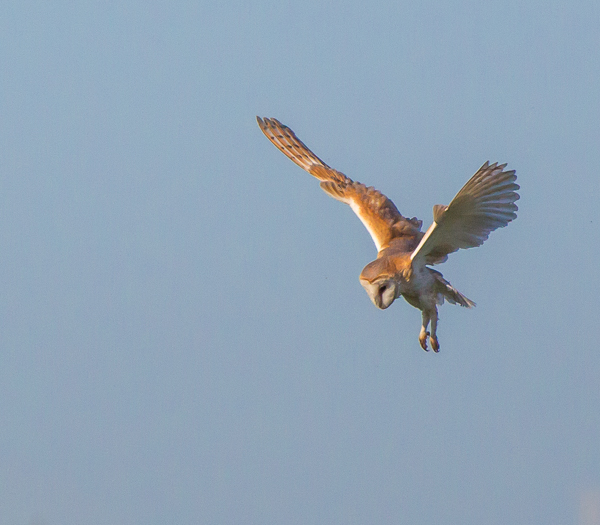
Barn owl.

As the morning sun rose and burned away the mist the landscape began to look a little more ordinary. Mid-June is not the greatest time of year for landscape photography but there was still plenty of interest bird-wise. A barn owl was hunting in broad daylight near one of the hides and flying past with prey – a nest nearby, no doubt. I’ve never been that good at birds-in-flight so it was a bonus to find that a few images I took of it are reasonably sharp!

It is usually possible to have an exchange of information with other birders and I think most enjoy it.  But with rare species, especially if they are nesting, there’s so much misinformation around. You just don’t know who or what to believe. Was the guy in the welcome hut – no doubt anxious to keep visitor numbers up – being honest about the red-footed falcon that had apparently been seen earlier?   The Ham Wall recent sightings blog made no mention of little bitterns, but despite that were they back again this year? So after a well-deserved (I thought) and rather lengthy siesta I headed back on to the reserve in the late afternoon from the Glastonbury end. It wasn’t long before I came across a gaggle of birders standing by the main track looking into the reeds. This looked like a gathering. Had I stumbled onto the location of the legendary little bittern? At first my attempts to ascertain this were met with a rather frosty silence. But soon it emerged that yes, I had. It had been heard there earlier in the day and seen briefly. I waited around for an hour or more but all was quiet; it was time to move on.

Greater bitterns had been booming on and off all day and it was the first time I had heard the “in-breath” and really got to grips with the sound.  If all else failed I was also hoping to hear the “bark” of the little bittern; sometimes the sound of an elusive bird’s song can be enough; you know it is there somewhere and it all adds to the sum of one’s knowledge of wildlife. So I stopped at the same section of reedbed on the way back to the van and listened. And there it was – a regular, nay, monotonous single note repeated every two seconds exactly. After half an hour of listening I saw a movement low over the reeds – a stunning male little bittern. The sighting lasted just about second, but I was elated. The barking resumed from the reeds in the direction the bird had disappeared in.

Marsh harrier at dawn, Ham Wall

My second morning at Ham Wall was similar. Misty, still, and full of birds.  Below the Avalon Hide marsh harriers were just arising and stretching their  wings. (In fact, I later discovered that the three birds I saw together were probably one male and his two females…..) The barn owl was still hunting the same area. A cuckoo was very active. The little bittern was still calling, and there seemed to be assorted other heron species everywhere. What a sight and sound!


To Follow Tales from Wild Wales, scroll right down to the bottom and click Follow


The Green Flash and another starling story.

Starlings at Aberystwyth yet again)
Starlings at Aberystwyth (yet again)

Several more visits to Aberystwyth seafront at sunset have elapsed since my last post. You can’t believe how frustrating it is to witness another damp squib, then go home, turn on the TV to watch Countryfile and see video of amazing displays from somewhere in the Midlands and then somewhere in Cumbria! Last Wednesday was a bit of an exception, in a way. I arrived in good time and got chatting with a photographer who had driven over from the West Midlands to see the famous Aberystwyth starling murmation.  He must have thought I was a gloomy old so-and-so when I told him it hardly ever happens!

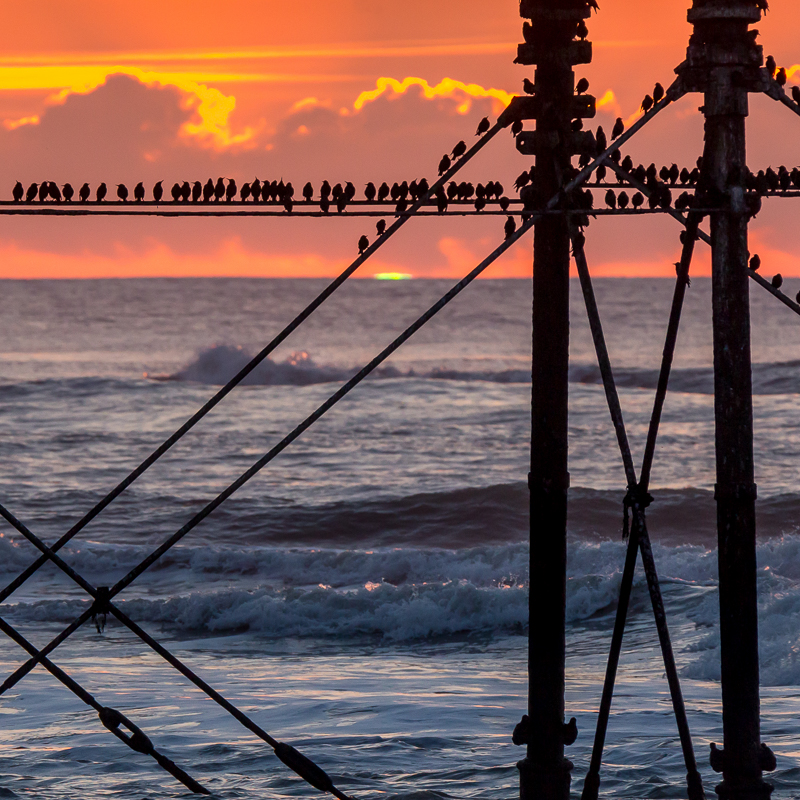
Once any possibility of a display seems to have evaporated I swap lenses from the standard zoom to the long zoom. I set it up on the tripod and head down the wooden jetty as far as sea level will allow, and focus on the starlings as they perch on the metal framework under the pier. This area seems to serve as a ‘waiting room’,  as later – or perhaps younger / less dominant birds – await their turn to squeeze in under cover. There is constant movement as they re-arrange themselves.

On Wednesday, the sun was setting dramatically, the tide was high and there was quite a swell. The crests of big waves fizzed with orange light as they broke against the shore. I took a long series of images in really exciting conditions, although I knew I would be deleting most of them later! As it happens I did manage a few that I am pleased with such as the one above (click on it to enlarge it.)  In the nick of time I then remembered the Green Flash. The very last sliver of the sun’s disc can turn green as it disappears below the horizon, especially if the atmosphere is clear and crisp. It’s not an uncommon phenomenon; I’ve seen it a number of times while down at the starling roost,  but never managed to photograph it. I alerted my new pal from Brummidgem, who had joined me on the jetty, pointed the camera at the setting sun and quickly pressed the shutter.

Reviewing the images on the screen I could see I’d captured the Green Flash successfully behind the framework of the pier. Exposure is always a problem at sunset and I’m not sure why this image works when previous ones haven’t. It was very much a grab shot and a reflex reaction to the situation. But it so happened that the exposure was good (ie – it was underexposed) and the light levels elsewhere in the image were compatible with that of the sun’s disc; and of course, digital processing helps.

The Green Flash, Aberystwyth, 11/02/17.
The Green Flash, Aberystwyth, 08/02/17.

After sunset a gaggle of photographers tends to gather on the prom to have a moan (er….discuss the afternoon’s events…..). Our Brummie pal joined us as we muttered. He was elated! “That was amoizeen!”  he enthused; “absoluteloy moind-blaween!” He loved watching the starlings and had never seen the Green Flash before….never even heard of it, in fact.  It was lovely to encounter someone being SO excited about something which many of us locals now take for granted.


To follow Tales from Wild Wales, scroll right down to the bottom and click Follow


Twice bittern.

Kingfisher in the rain, Teifi Marshes

A few days before Christmas I headed down to the Teifi Marshes near Cardigan with high hopes of seeing a bittern. It is a regular winter haunt for this extraordinary but elusive species and I had photographed one there in January 2015 (see this post). Furthermore there had recently been reports in the local bird blog of one by the Kingfisher Pool. It all seemed very promising. But after six hours in a very cold hide without a single sighting I felt somewhat deflated……and I’m sure the bad cold I suffered over Christmas was not a coincidence.

But they do say that every cloud has a silver lining, though, and in this case it was the kingfisher which made a circular tour of its perches around the pool at lunch time. Various sticks and branches have been provided here for kingfishers by the Wildlife Trust, but they result in rather conventional “bird on a stick” type images. I think the perch shown above shows the bird in a more natural setting and the falling rain gives the photograph a rather painterly feel.

Bittern at Teifi Marshees, Cardigan
Bittern at Teifi Marshes, Cardigan

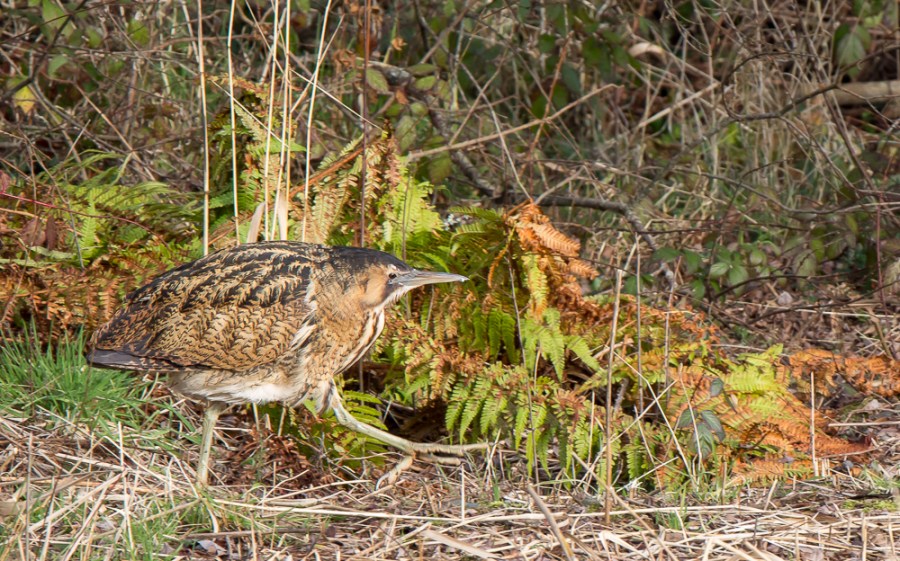
The bittern was reported (and photographed) again on Tuesday so it seemed like another attempt might produce results. Another photographer was already in the hide when I arrived about 9.30 a.m. yesterday and we were soon joined by several others. One told us that the bird had spent two full days wedged between branches in a nearby willow. Local birders and conservationists became concerned for its welfare so reserve staff had climbed up towards it and poked it with a stick, whereupon it flew back down to the reeds!

The bittern was first seen not long afterwards. It was crouched low to the ground, fluffed up like a big round feather duster, and appeared quite immobile. It did not look like a healthy or a happy creature. But after a while it began to walk slowly towards the hide, its weight breaking the ice at one point. It came closer and closer and motor drives began to rattle away in earnest. Over the next hour it was hardly hidden at all. It walked slowly, and then more quickly, around, pausing to take the sun from time to time. The light was lovely, either bright sunshine or light cloud. Either was excellent for this large, cryptically patterned bird. It can’t eventually have been further than 20 yards from the hide. Then there was a crouch, a pause, another crouch, and it launched itself into the air, flying away quite powerfully low above the reeds and blackthorn crub.

Bittern in flight
Bittern in flight

It had been a truly exhilarating hour for everyone in the hide. One always opens oneself to disappointment by a making a tightly focussed photography expedition like this. Without the bittern it would have been a rather dismal morning – dismal and cold. So we were all happy, although we all knew we would have many hours of file processing to look forward to. Let’s just hope that the bird itself stays well and finds enough food to get through the winter.

To follow Tales from Wild Wales, please scroll down to the bottom and click Follow

A visit to woodpecker HQ.

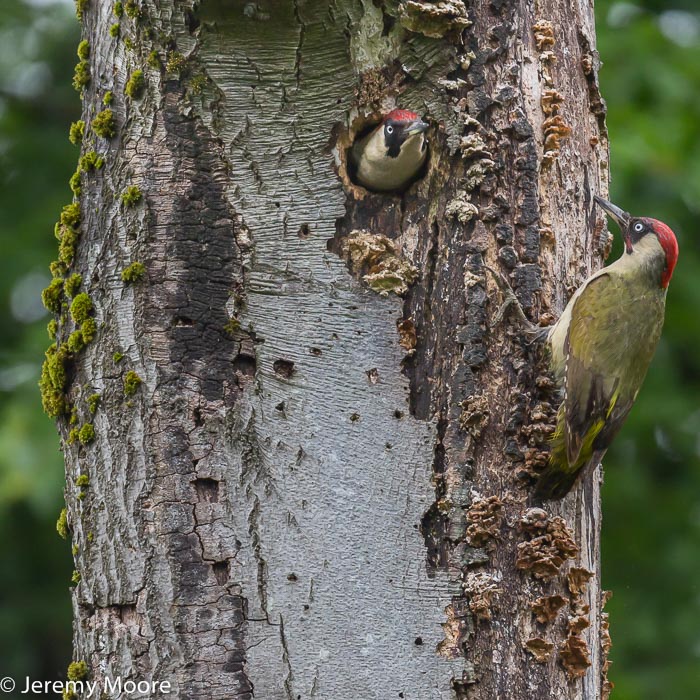
Green woodpeckers at the nest, near Abergavenny.

Beech woodland is normally associated with the south-east of England; Burnham Beeches and Epping Forest are fine and well-known examples. But here in Wales native beech woodland extends into the south-east corner of the country, around Abergavenny, for example. It can be found as far west as Castell Coch, just to the north of Cardiff. It is what the writer and naturalist William Condry called “the district’s most distinguished calcicole” referring to its association with a narrow band of limestone rock which runs along the northern rim of the south Wales coalfield.

It is for oak woodland that most of Wales is renowned but in a forthcoming book I want to open people’s eyes to the presence and stunning beauty of beech woodland. This spring I visited Cwm Clydach, where the Heads of the Valleys main road squeezes through a narrow defile alongside the river between steep valley sides. I had first photographed here in the mid-1990’s and an  image of the polluted watercourse complete with dumped debris was used in my first book “Wales  – The Lie of The Land” (published in 1996). The gorge’s steep and rugged southern flank is clothed with native beech, but it is a far cry from the expansive woodland of southeast England. Here it is largely inaccessible but a public right of way descends to the valley bottom from the A465 and then climbs steeply through the trees to reach scattered houses, narrow lanes and an abandoned railway track.

Walking back to my van on this year’s first visit I heard the familiar laughing call of a green woodpecker, which I tracked down to the branches of an venerable but dead beech tree right by the side of the road. What’s more the tree’s branches were riddled with woodpecker holes large and small. One bird visited one particular hole which I took to be a potential nest-site. This looked like a photo-opportunity!

Anyone at home?
Anyone at home?

I spent many hours on three visits sitting in my van watching the woodpeckers going to and from the hole. The off-duty bird would call from a distance and its mate would appear in the entrance to the hole. They would then swap over. I was surprised at how late their breeding season was – there was no sign of food being brought to the nest even as late as June 11th. On one occasion a great spotted woodpecker peered in, and I believe I may have seen a lesser spotted on the same tree as well.  This really was Woodpecker HQ! Green woodpeckers seem to be quite wary birds at the nest and they are apparently very difficult to photograph there. So I was really thrilled when I managed to get what seems to me the perfect image of a pair at the nest.


To follow Tales from Wild Wales, please scroll right to the bottom and click Follow.


In hawfinch nirvana.

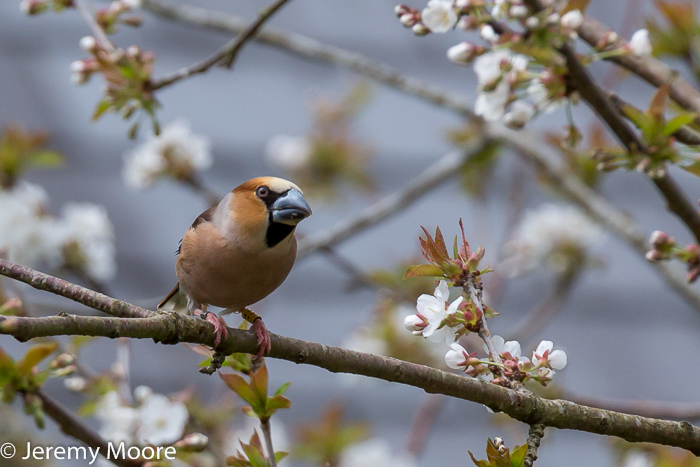
Hawfinch in cherry tree, Dolgellau
Hawfinch in cherry tree, north Wales

A couple of years ago I posted about photographing hawfinches in a Welsh churchyard. (See this post). While it was exciting to come back with something usable it was not really the image of my dreams. So I kept my ear to the ground about other possible locations.

The hawfinch has always been an uncommon bird in the UK and has become increasingly scarce in recent years. In 2013 the maximum number of breeding pairs remaining in the UK was estimated to be one thousand. The 2013 BTO Bird Atlas noted that the Welsh population was becoming increasingly significant in a UK context. And – unlikely as it may seem – it has become more and more apparent over the last few years that one north Wales town is the British hawfinch hot-spot. The first hint of this came in 2004, when research published  in “Welsh Birds” suggested a breeding population of about fifty pairs in the area, and a wintering population of more than a hundred birds. The increasing scarcity of the species and its growing presence in the  area has resulted in further ringing and other studies being undertaken there. Both the BTO and the RSPB have become involved. The results have shown how numerous the species actually is there and how little we knew about the hawfinch!

Ornithologist Dave Smith and bird-ringer extraordinaire Tony Cross  have set up a feeding station in woodland nearby which is kept well-stocked with sunflower seeds. Hawfinches can rely on this food source all year round and there they can be netted,  ringed and released. The yellow plastic leg-rings, each with an individual letter and number combination, can be read relatively easily in the field. Perhaps the most astonishing information has come from just one garden in the leafy outskirts of the town. Shortly after moving into the house, inexperienced bird-watchers Trevor and Chris ******** began to notice some unusual-looking birds on their feeders. Delving into their field guide they realised they were hawfinches. Their garden has since developed into a hub of hawfinch-related activity. Trevor and Chris themselves have become, by their own admission, obsessed with the species. They sit in their kitchen and read ring numbers with a telescope. To date they have identified 185 different birds, with probably an equal number of un-ringed individuals. It really is hawfinch nirvana.

Thanks to my contacts in BTO Cymru Trevor and Chris very kindly agreed to let me visit their garden to do some photography. Trevor has himself taken many excellent photographs of the hawfinches through their kitchen window and posted them on Flickr. But there is no mistaking the fact that they are all taken at bird feeders. Not really the type of setting I felt they deserved. Tony Cross generously took me to his feeding site but the setting there is, if anything, less attractive. It is an extensive carpet of sunflower seed shells surrounded by ringing paraphernalia. We tried scattering seeds on the woodland floor around the “feeding table” but the birds just weren’t interested. Perhaps I should have been more patient……..

But there is a cherry tree in the ********s’ garden and the hawfinches sometimes perch in it before heading for the feeders. That sounded more promising! There followed a wait of several weeks for it to come into bloom and leaf. The strong northerlies of late April and early May held back flowering even longer than usual. Last Sunday the tree finally began to show some colour and it was amazing how much change there was in the following 24 hours. I chose a position in the garden where I could look across to the cherry tree against a dark background. For the first time in my life I  set up the tripod, brought out the camping chair,  sat down and draped a bag hide over myself and all my gear.

It took a bit of getting used to. Apart from the issue of physical comfort, tunnel vision was a problem. I could hear birds all around but often not see them. The lower branches of the cherry tree were visible but the lawn and bird-tables were out of sight. But when a hawfinch lands it has the tendency to sit tight for a few seconds and survey its surroundings. There is sometimes an air of deliberation about their activities. They seem to take their time and think things through. So on the few occasions when one did perch in the cherry tree I had the chance to catch it in a variety of postures and compositions before it dropped down onto the feeders. Light cloud was preferable to bright sunshine as it tended to illuminate tree, flowers and bird in a gentle, even light, and cast no shadows. I’m absolutely thrilled by this image.

NB I have removed Trevor and Chris’s surname to maintain their privacy, and also the name of the town.

To follow Tales from Wild Wales, scroll down to the bottom and click Follow