These are exciting times as my exhibition Bird/land opens at Aberystwyth Arts Centre. It’s in the Photography Gallery (Gallery 2) on the top floor and is showing until August 27th. Opening hours are as follows:
It’s an expanded version of the original exhibition, with eight new small single images and nine new triptychs. I must say it looks very tasteful in there. So if you’re in mid-Wales in the next couple months do drop in and have a look around!
I’ll be giving a talk in the Arts Centre’s cinema at 5.30 pm on Thursday July 14th. Entry is free of charge.
For a sneak preview of the work, go to my website and click on the Bird/land gallery, or click on this link.
For background to the exhibition click here to link to my Blog.
To follow Tales from Wild Wales please scroll right down to the bottom and click Follow
Last week I posted about my eventually successful visit to Cwm Idwal in Snowdonia. But alongside the story of the photographs there was a quite different narrative running in parallel.
On my first visit to the Cwm, amongst the huge boulders below Twll Du, I came across some small brown birds. I quickly twigged that they were twite, which, strangely enough, I had been reading about the previous evening. As far as British birds go they are probably the supreme example of the “little brown job”. Visually there are no distinguishing features at all unless you can see the pale pink rump patch, but they do have a distinctive twanging call, which confirms their identity. At first it was just a couple of birds, then a juvenile begging food from a parent, then a bird leaving a possible nest site and finally a flock of 15 – 20 birds.
On my return to Idwal Cottage I looked around for someone to report my sightings to. There was no-one but a girl from the National Trust, who “thought she had heard of twite” but that was it. While I drank my coffee I noticed the nearby organic burger van, whose owner, Gwyn Thomas, the local farmer, was conversing with customers. My partner has worked with him so I went over for a chat. Eventually I brought up the subject of my sightings. To my surprise and delight he is quite an authority on twite! Along with several other farmers in Nant Ffrancon he grows a seed crop for them to feed on during the autumn before they move down to the coast for the winter. I’m sometimes not a great admirer of farmers but this man is a star!
During our conversation a car drew up alongside and the driver came over. I recognised him but couldn’t put a name to the face. Gwyn left me with him and a tentative conversation began. I wondered aloud if I had seen him on TV. “No, I work on radio…” he replied. Not really a great help! “I did a book with you!” he added. It came to me in a flash. It was Dei Tomos, the author with whom I had worked on the Welsh version of “Wales at Waters Edge”. I buried my head in my hands in embarrassment! To be fair though, it was hardly a collaboration and we had only met once, and he couldn’t place me at first either.
The social aspect of my weekend continued the following morning. Back at Ogwen Cottage after a third unsuccessful visit to the Cwm, I was drinking coffee by my van. A familiar figure appeared. It was Martin Ashby, owner of Ystwyth Books in Aberystwyth, and one oldest and most valued friends. He was with his mate Nigel Dudley and just about to set off on a long walk up in to the Carneddau. I reluctantly turned down their invitation to join them.
On my return home I reported my twite records to the BTO Officer for Wales, Kelvin Jones. He told me that twite are declining steeply in Wales, and there is a project going to try to reverse this. Apart from the feeding project mentioned above birds are being ringed on the coast in winter in the hope that sightings in summer of ringed birds can reveal more about their movements. Although I had not seen any rings it seems my sightings had been the first this summer! The rarest breeding bird in Wales may actually now be twite, he said. (Does that make them rarer than osprey, I wonder……)
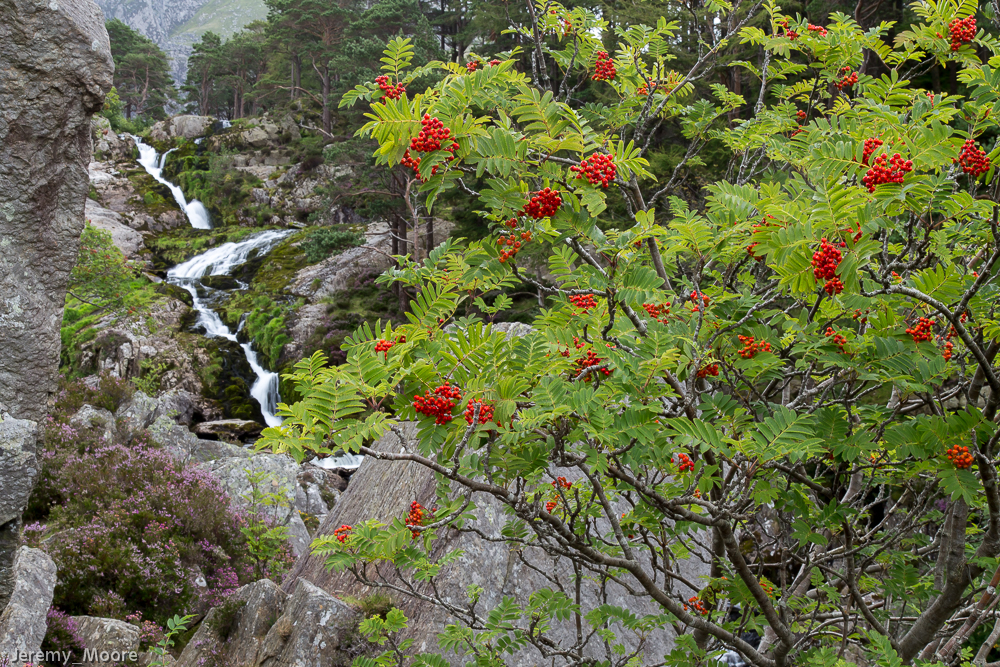
Just a note on the photograph above. While dull, cloudy conditions are usually the kiss of death for most “big” landscapes, they can be ideal for details within the landscape. This lovely rowan tree was just below Ogwen Cottage.
To read more about Gwyn Thomas and his work in Cwm Idwal, click here.
To follow Tales from Wild Wales, scroll down to the bottom and click Follow
Over the winter I’ve seen a couple of episodes of the TV series entitled “What do artists do all day?”. Each programme featured a particular artist and showed them doing the sorts of things an artist might do. Like, well, painting, for instance. But what about photographers?
I’ve spent quite some time this week trying to get my PC to work more smoothly, with some success, I think I dare to say. It certainly wouldn’t make good TV but I spend so much time at the computer, and I imagine the same is now probably true for most photographers. A far cry from the days when you exposed a few rolls of film, put them in an envelope, and waited for the transparencies to come back. Oh, then there’s updating the website, writing the blog, invoicing customers, emailing contacts…..the list is endless.
How come I found myself, yesterday, pulling the vacuum cleaner apart and putting it together again, of all things? One of my most crucial pieces of equipment is the camper van. It’s my home from home and enables me to be on location first thing in the morning when so much top quality wildlife and landscape photography is done. And with the passage of time you just have to do a bit of spring cleaning. Banal, I know, but true……. and one thing leads to another……..
To give an example of how indispensable the camper van is, though, a couple of weeks ago I had another go at photographing the black grouse lek which I also wrote about here and here. I drove up the previous evening, parked up nearby and settled down for the night. It was clear and frosty so by sunrise a thick layer of ice had formed on the inside of the windscreen! At 5.15 am I could hear the birds’ bubbling and hissing calls as they began displaying nearby. But it was still more or less dark, and I had plenty of time to make some tea and observe the birds with binoculars while the day gradually dawned.
It became apparent that there were more birds present than on any previous visit, and they were taking up stances over a wider area. Having said that the amount of activity was rather variable. Some birds actively jousted with their neighbours, while others looked a bit bored. It was as if they may have been young birds which knew where they needed to be, but didn’t know what to do when they got there. As a whole the birds seemed to be rather nervous and at one point all suddenly swept away. A couple of seconds later a sparrowhawk briefly landed on the deserted lek site. One wonders if the grouse would be less easily distracted at the peak of the breeding season in a couple of weeks time. A little later two greyhens (female black grouse) also flew in, which provoked an extra burst of activity from the lekking males.
It was inevitable that on a still morning such as this extraneous noises like the rapid firing of a shutter would be heard by the birds. In anticipation of the “action shot”a shutter burst would begin just as two birds sized each other up. One could imagine how strange, and possibly distracting, this might be from the bird’s point of view. On the other hand it was also noticeable that during a lull in activity a car engine starting (for example) might provoke the birds into briefly displaying more vigorously.
This was my seventh visit altogether to the lek site and it was probably the best. Being a weekday there wasn’t too much disturbance as impatient birders and other photographers came and went. Despite bright sunshine the light had a soft quality to it thanks to some atmospheric mistiness, and this was ideal for photographing these high-contrast, black-and-white subjects. The winter yellows and ochres of the vegetation and a layer of hoar-frost made for an attractive landscape in which to set the birds; so much so that I’m planning to include a set of three images from this visit in my forthcoming exhibition. It was also a pleasure and a privelege to be able to watch this fascinating spectacle.
So what do photographers do all day? It can really be almost anything from the sublime to the ridiculous.
To follow Tales from Wild Wales scroll right down to the bottom and click Follow