Coed Tamsin – an Introduction

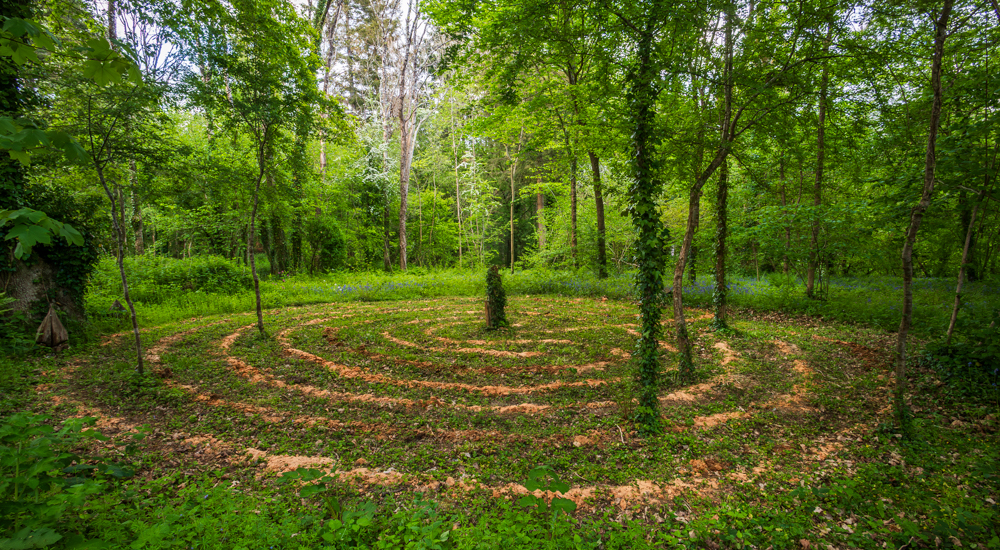
Maze by Bob Shaw, Coed Tamsin

It’s always good to have a photographic project on the go and since May last year I’ve been documenting a woodland near Aberystwyth. This has involved numerous visits during the course of the year which will culminate on Mayday 2026, the spring festival of Beltaine. I’ve been very lucky in that the National Library in Aberystwyth has agreed to purchase a set of prints of their choosing so that a permanent record will exist of the woodland and the activities taking place there. The following paragraphs have been written for the library as an introduction to the prints.

Coed Tamsin is a woodland a few miles from Aberystwyth belonging to Felicia Jervis, and managed by her partner Bob Shaw, a woodsman (and philosopher….) of many years experience. It was bought in 1987 as a memorial to Felicia’s daughter Tamsin, who had died the previous year in a road accident, at the age of 21. Tamsin’s father was John Jervis of Bryneithin Hall, Llanfarian, then a privately owned museum of Welsh country tools, other artifacts and techniques. Bob and Felicia’s intention was to manage the woodland for wildlife, people and timber, whilst also acknowledging John’s legacy.

Previously known as Flat Covert, Coed Tamsin was originally part of the Nanteos Estate. Prior to the purchase the woodland consisted largely of conifers and had long been neglected. Under new ownership the conifers were thinned or removed altogether, and broad-leaves planted using locally derived seed. Trees have been managed to produce good quality timber, coppice products, and material for woodland skills training. Alongside these aims, the enhancement of biodiversity has been a primary objective. In recent years the arrival of ash dieback and the consequent felling of mature trees has led to an explosion of woodland ground flora in spring.

Coed Tamsin has been used extensively over the years by groups of disadvantaged children and adults, for example, those excluded from school, or with learning disabilities, and recovering alcoholics. Groups from the Centre for Alternative Technology and elsewhere in the community received training in woodland management and green woodworking there. The changing seasons have regularly been celebrated at Coed Tamsin, with music, food and fire; notably at Beltaine, the Gaelic May Day festival.

During 2025/26 the wood has been a meeting place for “Meini Hirion / Elders for Wales” – a project of the Welsh Government’s internal Culture Change Service which forms a core element of Wales’ response to the UN Convention on Biological Diversity.

At the time of writing the long-term future of Coed Tamsin is uncertain. There is no guarantee that ownership of the woodland will pass to someone sympathetic to the aims of the current owner and manager.

Photographer Jeremy Moore first visited Coed Tamsin in 1989 when working on his exhibition ‘After the Wildwood’. A photograph taken there appears in the exhibition catalogue. As a friend of Bob and Felicia he has visited the woodland on many occasions since then. However it was not until spring 2025 that he realised how important it was that Coed Tamsin and the activities taking place there should be documented before it was too late. He has since visited the wood many times in an attempt to present a picture of Coed Tamsin in perhaps its finest hour.

It’s impossible to choose one photograph to illustrate the whole project. So many photographic approaches have been involved…… landscape, documentary, portraiture and nature…….. But the one above goes some way to illustrate the links between nature and people which have been so important at Coed Tamsin over the last thirty-nine years. I’ll add some more images in separate posts over the next few weeks. So watch this space!

To read more Tales from Wild Wales as they are published, please click on the Follow button.
Definitely not the Boy Scouts…….

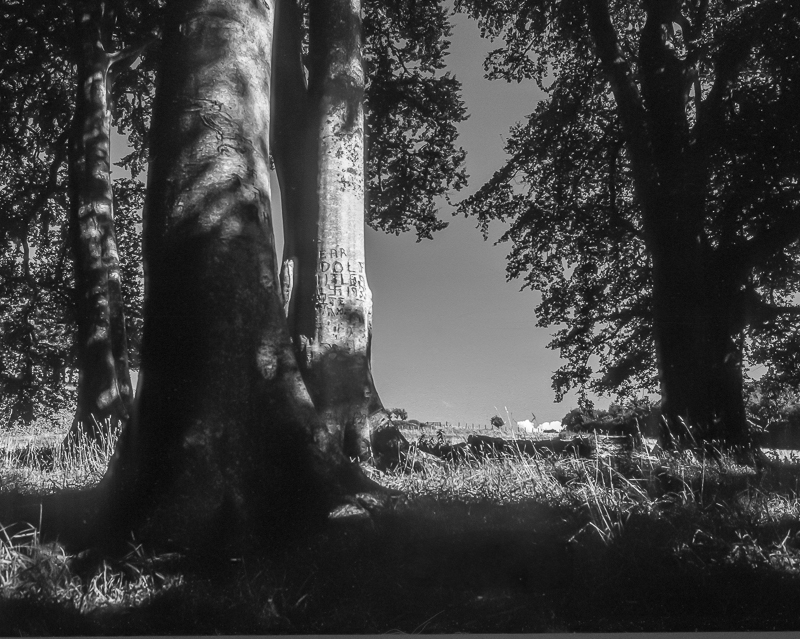
This photograph, originally in colour, was taken about thirty years ago, and appeared in my first book Wales – the Lie of the Land. The location is the Nanteos Estate near Aberystwyth, which contains some fine clumps of beech trees planted as landscape features. During an exploration there I met the farmer and he showed me this graffiti, which he claimed he had carved himself. In case you can’t decipher it, it reads HERR ADOLF HITLER 1933, and includes a Swastika. It is dated 1937, so probably 58 years prior to my taking the photograph. I don’t remember how old the farmer was but the graffiti was carved to last and it seems unlikely that a child, or even a teenager, could have been responsible for it.

Over the years I have pondered over the origin of the graffiti. History has never been my strong point but the most likely explanation, it seemed to me, was that prior to the second world war, a party of Germans had camped on the estate and left a memorial of their visit. And it looks like I may have been correct.

Last week I visited the Ceredigion Archive to enquire about the graffiti. Did they know anything about its origin? The archivist didn’t but a visitor overheard my question and told me that there were some reports in the Cambrian News of the day about a visit from Hitler Youth to Wales in July 1937. That was my lucky break. At the National Library I discovered in the July 30th edition of the paper that “twenty-one members of the Hitler Jugend (Nazi Youth Movement) camped at Aberdyfi on Thursday week“. The report continued :

…..”owing to the inclement weather (they) were allowed the use of the Pavilion. They had spent one week of their British tour as guests of the Rydal Boys School at Colwyn Bay and had marched through Snowdonia, Beddgelert, Harlech and Towyn, and on to Aberdyfi.

They were, apparently, warmly received wherever they went and enjoyed the wonderful scenery and the friendliness of the local people. “They continued their route marching on Saturday morning and before leaving were presented with a specially inscribed souvenir copy of the Aberdovey Guide by Mr Owen Jones, of the Publicity Bureau”, said the Cambrian News.

More searching on the internet led me to an opinion piece in NATION.CYMRU (15/9/25) which quoted the Cambrian News as saying that in July 1937 twenty-one members (plus three adults) of this movement [Hitler Youth] arrived in Aberystwyth on Saturday “and made the Scout Hall their headquarters“. It claimed that rather than marching, they were actually cycling, which seems far more likely and corroborates with other reports of their activities in the UK. The well-meaning hosts all over Wales must have believed that these charming, clean-living, visitors were the German equivalent of the Boy Scouts – but this was far from the truth. The oath taken by all 10 year olds on entering the Hitler Youth included the following statement:

“In the presence of this blood banner which represents the Fuhrer, I swear to devote all my energies and my strength to the saviour of our country, Adolf Hitler. I am willing and ready to give up my life for him, so help me God”

and “I promise to do my duty in love and loyalty to the Fuhrer and our Flag“.

It has been said that the purpose of the Hitler Youth was to indoctrinate those children into Fascist ideology before they had a chance to learn anything else.

These cycling trips were not unusual in the mid- to late- 1930’s and they made links and stayed with Boy Scout groups and ‘public’ (actually private) schools. The Nazis were very impressed by the British ‘public’ school system, and cultivated links with Robert Baden-Powell, founder of the Boy Scouts, who is known to have had Nazi sympathies. But the British secret service became suspicious of them and for good reason: behind the healthy outdoor living activities of these young people lay a more sinister purpose. They were instructed to make notes on and memorise the location of towns and villages and landmarks such as church towers.

Make a note of the names of places, rivers, seas and mountains. Perhaps you may be able to utilise these sometime for the benefit of the Fatherland”, they were told.

So did the Hitler Youth who arrived in Aberystwyth in late July 1937 actually camp on the Nanteos Estate? It would certainly have been suitable, should the owner and occupier – a certain Margaret Powell – have been naive enough to have allowed it.