Do you know your willow tit from your marsh tit?

Willow tit……..

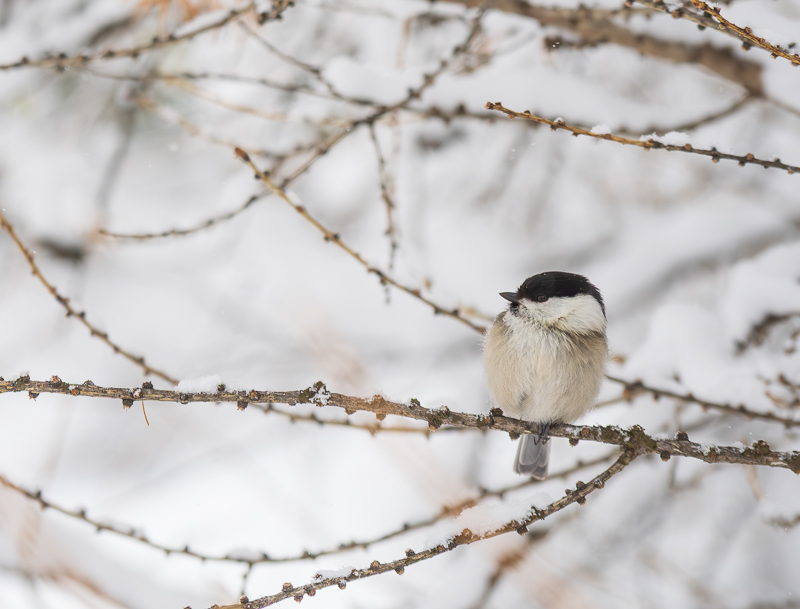
There can be no more difficult bird i-d challenge in the UK than distinguishing willow tit from marsh tit. According to ‘Birds in Wales’ willow tit was not even proven to occur in the UK until 1897, and for several decades following that “…its distinct identification from marsh tit was not universally accepted”. The Collins Bird Guide suggests various subtle differences; for example marsh tit has a glossy black cap while the willow’s is matt. The white cheek is more extensive on the willow than the marsh, and one (the willow tit) has a pale panel on its wing while the marsh doesn’t. The black bib is “usually” larger in the willow than the marsh. However a video from the British Trust for Ornithology now suggests that it is not safe to distinguish one from the other on any of these characteristics. The only reliable difference is a pale grey spot at the base of the upper mandible (the beak) which the marsh has but the willow doesn’t. This conclusion would have been reached following the close examination in the hand of large numbers of individuals by bird ringers, so is likely to be correct. But no wonder there was such a long period of doubt over whether both species existed in the UK.

Along with the willow tits came crested tits………

It is widely agreed that the safest way of telling one from the other is by voice. I’m not confident that I’ve ever definitively seen or heard either species, but during the winter I heard a new (to me) bird song on a regular walk in some woodland below the house. I believed it was either a willow tit or a marsh tit. It sounded very like a wood warbler, which, being a summer visitor, could not have been present. My Collins Bird Guide specifically mentions a “series of pensive, melancholy, wood warbler-like notes”, under willow tit. I hadn’t actually seen the bird but this was about as good an i-d feature as I was likely to get. I announced my record on the Ceredigion Bird Blog, with the caveat that Ian Morris – the county’s resident willow tit expert – might have an opinion on it. A few days later I had an interesting email from another Ceredigion birder who had had a similar experience to mine. Over a period of some weeks he had re-visited his location and played back a recording of the willow tit song. On every occasion he had attracted a pair of nuthatches! It’s enough to make you tear your hair out!

A few weeks later Ian Morris visited and we walked down to the location where I had heard my mystery bird. He played back the song but there was no response. It was a long shot really but he didn’t believe the habitat was right for willow tit anyway…..much more suitable for marsh …………

…………and a few nuthatches………..

One reason I recount this cautionary tale is that during March I spent a couple of days quite high in the Swiss Alps. It still being deep mid-winter some lovely conifer woodland there was blanketed with fresh snow and almost completely devoid of of birdlife. The main exceptions were flocks of tits roaming around waiting for hand-outs from folks like me. Among them were “poecile montanus” (according to the interpretation boards) which were so bold as to perch on people’s hands to grab a seed or two. This, of course, is the willow tit, which, according to the bird books, rarely even visits bird tables in winter ……..

To read more Tales from Wild Wales as they are published please click the Follow button.

One good tern deserves another.

Arctic tern

One of my favourite places in Wales is Cemlyn Bay, on the north coast of Anglesey. It is a brackish lagoon separated from the sea by a curving shingle spit. Within the lagoon are a couple of islands on which very large numbers of terns raise their young every year. Commonest is the sandwich tern, with large numbers of common and arctic terns as well; it has held roseate terns in the past and occasional birds are seen every year, although they do not now breed.

Several roseates were reported earlier this summer, which encouraged me to plan a visit for later in the year; I had never knowingly seen one before. Then in July an elegant tern took up residence within the colony; this is a very rare visitor to the UK and is normally found on the western coast of northern and central America. I decided to bring forward my visit to try to catch both species together.

Tern identification has never been my strongpoint. Sandwich terns are pretty unmistakeable but I tend to lump most arctic and commons (let alone roseates) – unless seen very well – as “comics”. However, Cemlyn Bay is one place in the UK where with a little bit of time and patience one can get to grips with this tricky ID problem. From the safety of the shingle ridge it is possible to get excellent views of the terns on the islands even without a telescope.

A sandwich tern on steroids……..

It wasn’t difficult to locate the elegant tern. It has a massive bill the colour of a banana and over a period of a couple of weeks it had established a “territory” centred on one of the unoccupied roseate tern nesting shelters. It would perch there and display to any passing sandwich tern. It is basically a sandwich tern on steroids and in my opinion has been badly mis-named. It is large and chunky, with a backward-pointing crest, but ‘elegant’? Sorry but no!

The roseate terns were another matter altogether. One of the Wildlife Trust wardens pointed one out and yes…… I could see it. But would I be able to pick one out in a crowd (of other terns)? Probably not. Every so often a “dread” would take place : the whole colony took flight and swirled around overhead for a couple of minutes before returning. On a couple of occasions the dread occurred when a hunting peregrine flew through the colony but often there was no apparent reason for it. On my first evening there it happened over and over again. I’m not sure if anybody knows why they do it but they do, and after one of them the roseate tern disappeared.

A dread…….

I was under no time constraints and particularly enjoyed the delightful approachability of the arctic terns. They would alight just a few yards away on the shingle without batting an eyelid, or fly from the colony past the observer to the sea at a similar distance. Fledglings lay prone on the ridge waiting to be fed and their parents would bring them sandeels no matter how close you were. It must be one of the best birding (and bird photography) experiences in the British Isles. Everybody should visit Cemlyn at least once!

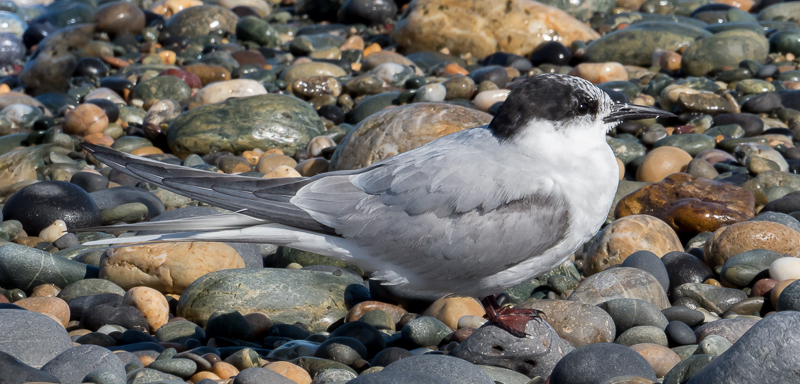
Roseate tern (or is it…..?)
Spot the difference…….

During the afternoon, as the tide receded, more and more terns rested on the beach, sometimes no more than ten yards away. It gave me the chance to examine them in detail. I picked out one individual with a black bill, one of the most noticeable features of a roseate tern. The more I looked, the more black bills I found, perhaps half a dozen of them altogether. Were they ALL roseates? Another birder examined them with a telescope and confidently told me that they were; I wasn’t convinced. Another said they were, in fact, first-summer arctics – despite the fact that they normally spend their entire first year in the Antarctic and are scarce in the UK. The secret is in the colour of their legs – roseates have (relatively) long bright red legs while those of the arctics are very dark red or black and very short.

Examining the images at home I picked out one which looked good for a roseate, and sent it for confirmation to the tern wardens. They agreed. But there’s a snag; the tail streamers on a roseate are exceptionally long and this bird’s just aren’t. So there’s one final possibility. On the Skerries, an offshore tern colony just a few miles away, very occasionally a roseate tern has mated with a common and reared young. So could this be a hybrid? We will probably never know.

N.B. Apologies for the terrible pun in the post title, and to many of you whose interest in the minuteae of tern identification is………err………limited…..! But I’m sure you’ll agree, they’re stunning little birds.

To read more Tales from Wild Wales as they are published, please click the Follow button.