Pipsqueaks.

Bardsey Island (Ynys Enlli in Welsh) is situated off the tip of the Lleyn Peninsula (Penllyn), separated from the Welsh mainland (Y Tir Fawr) by only a short sea crossing, but it could be many miles away. With its remote location, the island tends to attract rare migrants; it also has a manx shearwater colony and a bird observatory. Together with Jane (my partner) and three good friends, I spent last week there. It was actually my seventh stay on the island; each week has been quite different and I well my remember my first. I picked up an infection, probably from the spring water supplied to the houses, which laid me low for a few days. Alone in my accommodation, I felt very ill indeed and believed I could have died there without anyone knowing! Fortunately in recent years a water purification system has been installed.

After another visit I was chatting to a Welsh-speaking neighbour and told her I had just spent a week on Enlli. She looked at me very strangely, and then explained that Enlli is the name of the psychiatric ward at the local hospital. I’ve always used the name Bardsey since then…….

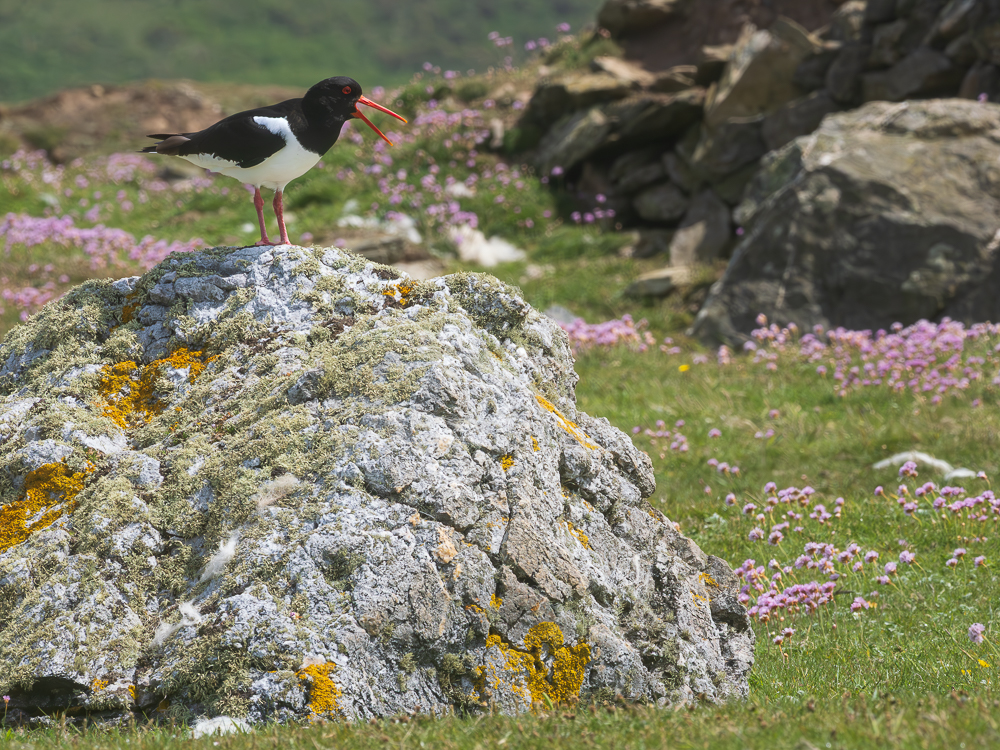
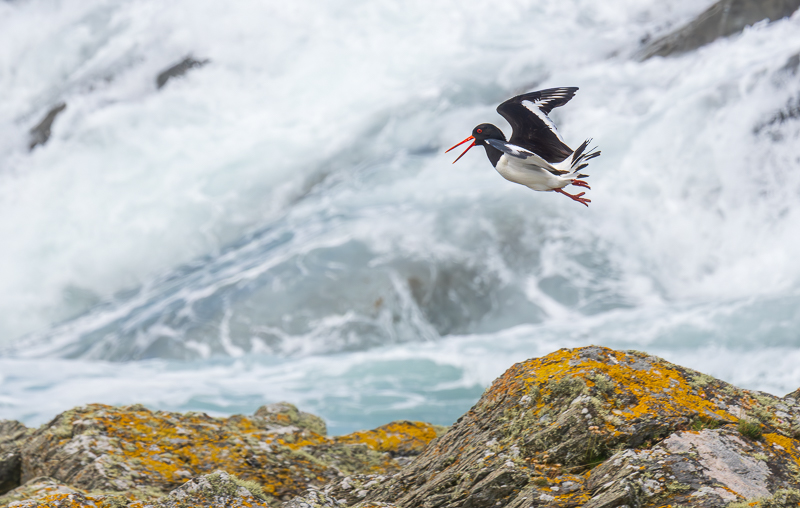
I don’t usually resort to cliches such as “bird of the week” but just this once I’m going to. It could have been the (scarlet) rosefinch which my friend Jonathan first identified, and whose song could be clearly heard from our kitchen table for a couple of days. The island has a large population of my favourite bird, the chough, and their calls could frequently be heard wherever you were. But the chough is a Schedule One (specially protected) species during the breeding season so I tended to avoid them. So I’m going to plump for something much more familiar – the oystercatcher. As you walked around the island you would pass from one oystercatcher territory to the next, and you would be subject to a new tirade of raucous high-pitched screeching. One bird was particularly aggressive, repeatedly flying noisily towards me at eye-level and only veering away at the last second. I believe on one occasion its wing tip brushed my arm as it flew past.

Their behaviour and alarm-calling is designed to alert their youngsters of the presence of a potential predator (in this case me) and it is obviously very successful. No matter how hard I tried I never managed to locate a single chick. They leave the nest as soon as they hatch and must hide amongst the pebbles and boulders amongst which they are feeding. But I wondered how intelligent the adults actually are. I found that while I was standing upright I was fair game for all the aggression that they could muster. But if I made a half-hearted attempt to “hide” or lower my profile their behaviour became calmer and their calling quieter. It was during these moments that I was able to photograph them in a more relaxed fashion. I ended up with hundreds of oystercatcher images, and have spent many hours deleting and processing them since I returned home.

It was during these lulls in activity that also I coined a new name for the species – “pipsqueaks”. After all, they don’t actually eat oysters ………….

Enjoy…….
Please click the Follow button if you would like to receive more Tales from Wild Wales as they are published.

My website : www.wild-wales.com

Serendipity

I’ve just got back from a trip around Scotland with Jane, my partner. We spent a week on Mull and then went cross country to Perthshire where we visited some great friends. Photography-wise there’s no doubt that the highlight was a boat trip from Fionnphort on Mull to the islands of Lunga and Staffa. Here’s how it happened.

I have an unfortunate tendency to arrive early or late for appointments by either an hour, a day, or even a month. Yes, the latter has happened! We were staying in the campervan most of the time but I had booked one night’s accomodation in a “pod” on Iona, just a short ferry ride from Fionnphort. Not unexpectedly I got my days mixed up and found that we had a free day on Mull before the Pod was available. Our neighbour on the campsite had booked a boat trip to Staffa and Lunga on our free day so on the spur of the moment I looked online to search for spare places. To my surprise there were, and I booked them right away. A few minutes later I checked the booking and noticed that it was for the wrong day – the day we were booked in on Iona. Cue mega-panic! Late night messages to the boat company followed, and they got back straight away with the news that they would re-arrange it for the correct day. Phew……

The forecast was great for the trip with unbroken sunshine and light winds. We cruised northwards among the Inner Hebrides in perfect conditions for an hour or so before arriving on Lunga. This island was an unknown quantity to me but a few minutes after landing puffins could easily be seen amongst their burrows on its grassy edge. I didn’t realise what was to come a little higher and further along the coast.

The path wound up through broken rock and grassy slopes dotted with bluebells and other spring flowers. Puffins seemed to be everywhere and were more approachable than they are on the Pembrokeshire islands. Some were quite oblivious to any human presence. Two visitors ahead of me seemed to be photographing a low rock-face but there was actually a pair of puffins pottering in and out of their nest in a crevice just behind it. I could easily have reached out and touched them. They are absolutely enchanting birds and I make no apologies for presenting a photograph of them in all their cuteness. Perhaps we love them so much because they remind us of ourselves? (See the main pic)

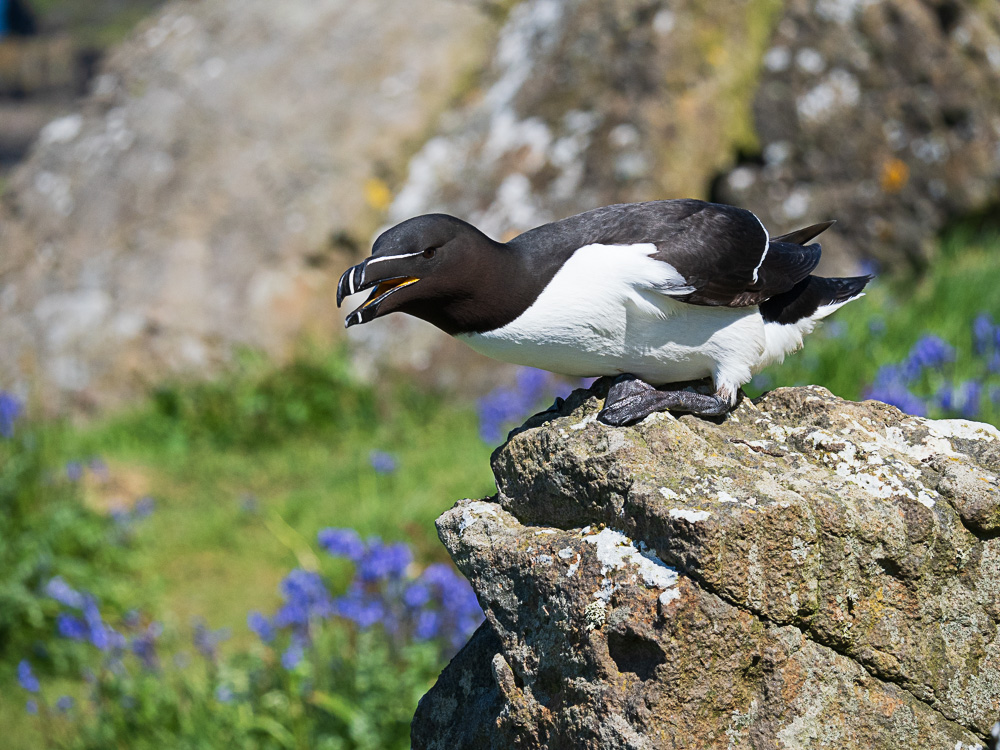
Reluctantly dragging myself away I soon came to the end of the main path close to an auk colony. While the huge majority of the birds were on the far side of a precipice that didn’t stop individuals landing this side of it close to me and the other human visitors. I’ve never been in close proximity to a shag before but one landed nearby and stayed, allowing me to photograph it at length. One young woman was sitting on a rock outcrop and a razorbill landed next to her as if she wasn’t there. It was astonishing! I reflected on how easy it would have been for the early sailors to plunder these seabird islands for food as they explored the oceans. And no wonder the great auk became extinct – it didn’t even have the advantage of flight.

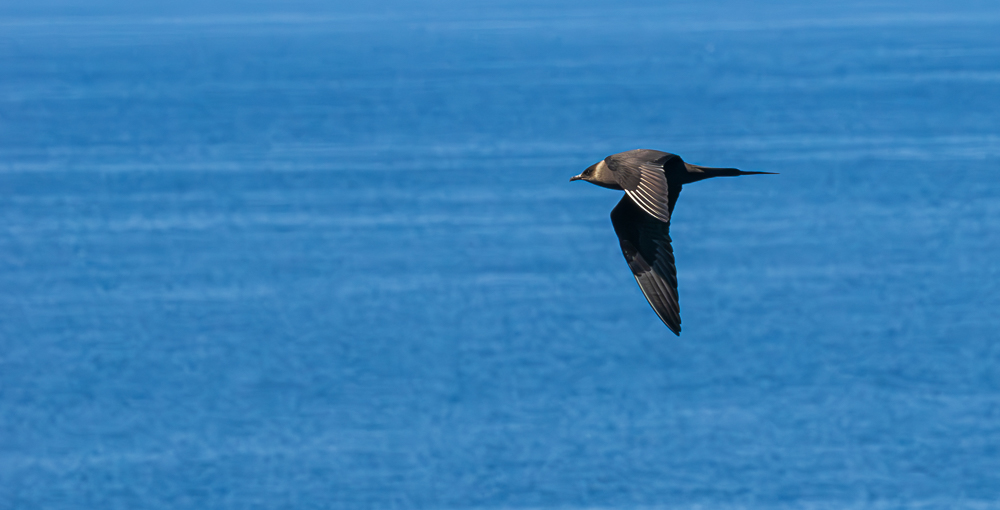
Most of these bird portraits were taken with my 24 – 100 mm zoom lens, not the long zoom that is normally obligatory for bird photography. I did, however, swap lenses to capture one of two arctic skuas which were patrolling around just offshore in an attempt to make unwary seabirds disgorge their food.

Arctic skua – much reduced in numbers following the avian flu outbreak.
Basalt columns on Staffa

We only had two hours on Lunga and before long it was time to return to the boat. I was exhilarated; it had been one of the best mornings of my life. By contrast, the island of Staffa, inspiration for Mendelsohn’s piece “Fingal’s Cave” and our second port of call, was rather a disappointment. The geology was extraordinary but time was very limited and visiting the cave was like being on a production line. Boat after boat was disgorging its passengers for half an hour and then leaving.

It was only through the series of mistakes I made that we actually got to Lunga at all. If I had had time to do some research I would probably have taken the shorter and cheaper trip to Staffa only. And if it hadn’t been for our neighbour at the campsite we might never been able to appreciate the wonders of this astonishing seabird colony. Serendipity indeed!

To read more Tales from Wild Wales as they are published, please click the Follow button.

My website – http://www.wild-wales.com

As seen on Springwatch…..

Swallow’s nest (with flash)

Last week we hurtled down to Pembrokeshire in the heat. Jane had an event to attend in Haverforwest and I wanted to do some bird photography in the Marloes area. We had an evening boat trip lined up too, which took us into the bays on the north and south coasts of Skomer Island amongst all the seabirds.

I headed out with my long lens on Wednesday morning and spent some time around the Deer Park. There were two family parties of chough in the area and a group of adult non-breeders. After a couple of hours I headed back to Lockley Lodge for some coffee, and then into the nearby Marine Nature Reserve building with its illuminated displays and pilot whale skeleton. The main attraction for me here was the swallow’s nest built into the eye socket of the skull, which had earlier been featured on Springwatch. I was delighted to find four large, bouncing, baby swallows being fed frequently by their parents, despite regular interruptions by human visitors. There was another swallow’s nest in the ladies toilets next door, apparently, and I had previously seen a couple in the gents; so I guess this particular pair was more discerning than some of the others……

Adult leaving swallows’ nest (no flash).

Unless the doorway was almost blocked the adults took no notice of people at all; and with the nest at little more than head height this was an opportunity not to be missed. I set up the tripod in the corner of the room and attached the camera and long lens. But boy, was it dark! Even at 3200 ASA I was exposing at slower than 1/100th second. It would be nice to think that I could capture the young gaping excitedly (but without moving) on the nest while the adult hovered artistically beside them with food but it just wasn’t going to happen. Time for Plan B.

Flash.

I never use flash. I don’t have a flash gun and my 5d3 definitely doesn’t have one built in. Maybe the 6d (back in the van) had a built in flash? It was worth a try; but no joy. Then there was the little Panasonic GX7 which I carry around with me when I can. Yessss! I was in luck. After a long time fiddling around with menus I finally worked out how to use it. You press the button and the flash pops up. Surely it can’t be that easy…..?

With the 5D3 and other SLR’s (I imagine) you press the shutter and keep pressing – the result being a burst of images which capture the action at up to 12 frames a second – although the 5d3 is rated at 6 fps and seems slower than that. With the GX7 it’s one frame at a time; that is, in this situation, one frame each time the parent brought food for the young. Fortunately the feeding visits were coming thick and fast and I never had long to wait. I wouldn’t say I’m totally happy about any of the results, however. Technically those with flash are much better, but I didn’t quite get the composition right on any of them. Those without might be artistically more pleasing but those conditions were really was pushing the camera beyond its limits, even one as capable as a 5D3. It was difficult to process any of the images to any meaningful extent without degrading the image even further into unusability.

Nevertheless it was lovely just to watch the young begging enthusiastically for food, and the adults bringing it in so fearlessly. I love swallows and it is a source of sadness that they no longer nest in our garden shed.


To follow Tales from Wild Wales, scroll right down to the bottom and click Follow.