As seen in the Game of Thrones (apparently)….

My partner Jane works at the Dyfi Biosphere reserve in Machynlleth, which has links to the Urdaibai Biosphere near Bilbao, in the Basque Country. So we decided to have a short holiday there in September. We’re both keen on train travel and it was a chance for me to use the Interrail pass which I had bought last December and which expired this month. So we took the sleeper train to Bayonne in France and then onward to Hendaye on the Spanish border. From there we transferred onto the narrow gauge (but electrified) line towards Bilbao. I can’t say I would recommend the latter. It took three hours and stopped at fifty-one stations! At each one the doors slid open and clanged shut, with numerous accompanying beeps. Think a three hour journey on the Tube and you’ve just about got it. But arrive we did, eventually. There is a very good network of local trains and buses in the Bilbao area so we used public transport exclusively while were there.

I knew little about the Basque Country before leaving and even less about the language. It’s fair to say that the distribution of letters in a Basque edition of Scrabble would be very different to the UK version……. X, Z and K would only score one point each, for starters! It is hilly and heavily wooded country with a dramatic coastline. One of the most well-known features of the latter is the islet of Gaztelugatxe – complete with a chapel dedicated to San Juan on its summit – linked to the mainland by a stone bridge. It is considered to be a pilgrimage site, and has always been a popular destination for visitors. It was used as a location in The Game of Thrones, and now, at busy periods, you need to book a ticket online before visiting. And there can still be queues. I knew nothing about this, of course, and was disappointed to discover that no passes were available for the day that I could visit. It took me a while to discover that in late September there were no longer any restrictions. Lucky me!

My visit started with a bus journey from Bermeo (the nearest town) well before dawn on a showery morning. It was still dark when the bus left me at the side of the road above the island. By the time I had reached the coastline it was light but no sun lit the island. A passing break in the clouds allowed a few sunbeams to hit the chapel but the camera was still in my bag. I then discovered that I had left my polariser in the hotel. This was becoming a habit!

3.2 seconds at f8.
2.5 seconds at f8

However, when I got to the bridge and looked along the coastline things started took a turn for the better. Talk about moody! Stormy skies, rock stacks, skerries with white water breaking over them, and rain showers passing across the landscape. I decided that long exposures using a neutral density filter would make the best of the conditions. Without a tripod I had to brace the camera carefully against a stone wall and rely on the image stabilisation for which Olympus kit is renowned. I took a series of exposures in the region of 1.6 to 4 seconds long and hoped for the best. Short breaks in the cloud even allowed the sun to illuminate the most prominent stack, leaving everything else in shadow. All my extremities were crossed at this moment! And the islet with its chapel was illuminated for short periods of time too.

I spent hours processing some of these photographs on my return home to the UK. Most of the long exposures needed some serious sharpening, but taking into consideration how long they actually were, that’s not surprising. Without the latest technology they would have been virtually impossible (without a tripod), say, ten years ago. Thank goodness I had arrived early because by mid-morning the area was thronged by visitors. And thank goodness it hadn’t been a blue sky day!

To read more Tales from Wild Wales as they are published, please click the Follow button.

Some reflections on my Pembrokeshire trip.

After a session trying to photograph St Davids Cathedral (click to read), I decided to go for a coffee. It was while I drank it that I had a brain wave. Why not take a wildlife cruise out from St Justinians later in the day? Conditions seemed perfect. So I compared the options available from the various boat operators in St Davids and chose a ninety minute “evening shearwater cruise” leaving at 6.30 p.m. I was so sure I would have some great photographic opportunities from the boat that I slouched around the St. Davids area for most of the day. I suppose some measure of complacency had crept in.

Come 6.30pm I boarded the boat. It was a RIB with fixed seats and once seated the punters were expected to stay in place. The boatman told us that “every seat is a front row seat”. The company owner was on board with four of her friends; needless to say they had the best seats – at the front. We were then informed that – actually – there were very few shearwaters around at the moment. Once underway we did a clockwise half-circuit of Ramsey Island: this meant that those in the seats on the starboard (right-hand) side of the boat (and the front…..) had uninterrupted views of the few seals in the caves and coves. I was on the port side – and it was very frustrating. Then we headed a couple of miles offshore to search for shearwaters, and there were a few, but all very distant. It also occurred to me that there were hardly ANY seabirds around at all. I should have known better than to book a wildlife cruise at the end of August when most of the seabirds would have left the cliffs several weeks earlier.

But the boat company should have warned potential passengers that this would be the case. Falcon Boats was the culprit in this instance but I’m sure they all do it. I’ll certainly be far more careful before going out on a tourist boat again.

I recounted in this post how I managed to get some good photographs of an osprey from the Curlew hide at the Teifi Marshes on the journey down. There were other photographers in the hide and a few visitors popped in and out. The “locals” engaged in conversations with each other over the heads of other people in the hide. On the way back I called in there again and inside was another bunch of local photographers in there. They talked very loudly to each other about some incident in a car park that one of them had experienced. It was as if they owned the place. How must other people in the hide have felt about this? It was so rude. I left suddenly and shut the door after me. I wished I had slammed it harder to make my feelings known.

The problem with the Teifi Marshes is that access to the hides is via a multi-use path from Cardigan to Cilgerran that is frequently used by non-birders, including families with small children and dogs. In fact, judging by some of the vehicles I have seen in the car park, the path is also popular with commercial dog-walking and child-minding operators. Some of these people have no idea of how to behave in a hide. Several years ago one of the latter, complete with toddlers and a pram, crammed themselves into one of the hides and began chattering away to her friend. I asked her to keep the noise down and was met with a mouthful of the foulest language you can imagine.

Hide etiquette can be tricky. I’ve often enjoyed conversations with fellow birders in hides and the exchange of information there can be useful. I’m happy to help less experienced visitors with bird ID as well. Sometimes a position in the front row of a hide is a very valuable asset and the photographer is reluctant to give it away. I’ve done it myself – at the Snettisham wader roost, for example. My thinking went something like this: “I got up really early, walked two miles to get here, waited for my turn and I’m damn well going to take my time.” But there is no excuse for the rudeness I experienced that day in Cardigan.

Well, I know this post has been a bit of a moan. We all like a moan sometimes but sometimes there are good grounds for it. Just don’t get me started on the dog-owners who don’t control their pets while out in the landscape!

To read more Tales from Wild Wales as they are published, please click the Follow button.

Watching me, watching you.

Following a successful and worthwhile visit to the Teifi Marshes, culminating in a stunning photograph of an osprey carrying a fish (click to view) , I continued towards St Davids. One of my very best postcard customers has a shop there and I had been asked to do some more designs of the area. I have to consciously think “postcard” when this is the objective. I suppose I expect other people to have the same visual sense as I do. It was a sunny day with little cloud and a rather dusty atmosphere – not surprising considering all the dry weather we have had this summer. Long distance visibility was not great.

And I couldn’t find my polarising filter. I had “mislaid” (not quite officially “lost”) my first choice polariser and could mentally picture my spare sitting on the desk at home. I don’t use one for bird photography but find it indispensible for landscapes. Without it, what would I actually do on this trip? I decided to concentrate on the area around the Cathedral and Bishops Palace, both situated in the shallow valley of the River Alun, west of the main built up area. I was on the edge of the woodland overlooking the Bishops Palace when I happened to glance upwards – and there was a fox calmly looking down on me as I went about my business.

First sight of the fox (ISO 1600, 1/13 sec at f4)

The only lens I had with me (a 12-100 mm zoom) was long enough. I had time to adjust various settings for optimal quality, but I was grateful for the image stabilisation built in to the lens. By this time light levels were rather low.

Eventually the fox carried on its way. I quietly followed it on a parallel path and then, reaching a track, went upwards. The fox re-appeared from the vegetation and looked at me silently again. I took another burst of images, including the main photo above. I’m going to have to admit here that there was some extraneous and out-of-focus vegetation around the animal but I found it was easy enough to remove it using Lightroom’s AI Removal tool. (Almost too easy, really: where will it end?) None of these images would win the Wildlife Photographer of the Year for that reason , but I’m contented enough. What do you think?

Would this make a good postcard, I wonder?
Or perhaps this?

I had a fitful night’s sleep, waking about 4 a.m. and frantically ransacking the van again for my polariser, but to no avail. Come the morning I looked through my bag again and there was the polariser. It was just sitting there in one of the pockets. How could I have missed it?? So it was over to the Cathedral with a spring in my step. As well as being a crucial photographic tool for me I think it must also be a comfort blanket. The Cathedral has surely been photographed a million times and it was difficult to envisage anything different, especially with a postcard in mind. I spent a while around the Cathedral grounds trying to find something new but I’m not sure I succeeded.

To read more Tales from Wild Wales as they are published, please click the Follow button.

Into the ice cave……

Inside the ice cave

Earlier in the year in a post about willow/marsh tits I happened to mention that I had been in the Swiss Alps during March. How did that come about? Well, if I had had a bucket list it would have contained two must-do’s ; revisit Venice and travel across the Alps by train on the route of the Bernina Express. Using the indispensible “Man in Seat 61” website* I discovered that I could do both on one trip – travel out to Venice on a sleeper train, and back over the Alps via the Bernina Express. Talk about killing two birds with one stone!

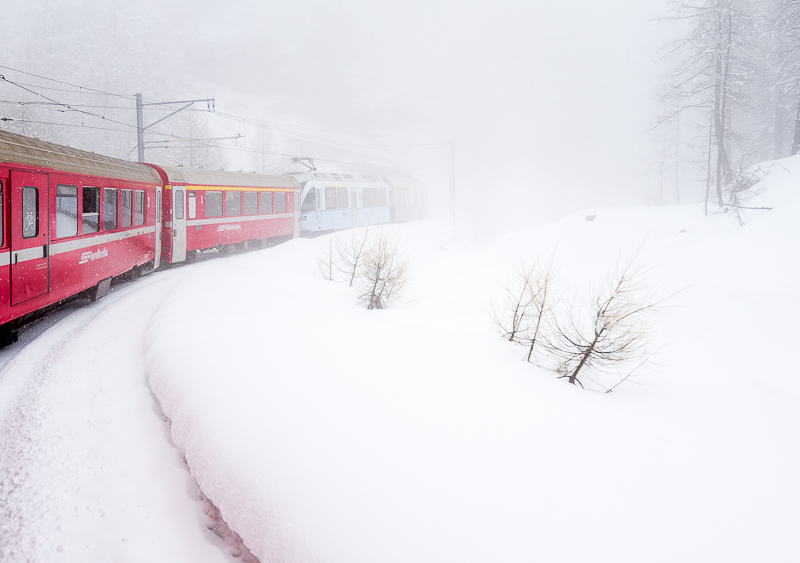
I had four days in Venice followed by three elsewhere on “The Lagoon”, and then made my way to the Swiss border for the start of the scenic route. And scenic it certainly was, but not in the way I was expecting. For most of the three days I was in and around the Alps the cloud was well below mountain top level and fine snow fell almost continuously. Think hill fog and drizzle at 6000 feet altitude and temperatures around zero. While in some ways this was disappointing, it was very atmospheric.

I stayed in Pontresina, a resort not far from St Moritz. Winter sports are very big there, as you can imagine, particularly cross-country ski-ing. There is a network of XC trails which are apparently swept every morning to make sure conditions are just-so for the skiers. Walkers are also well catered for; there are two low level, easily do-able (even in complete snow cover) walks from Pontresina; one up Val Roseg to a mountain hotel famous for its cakes (I had cheesecake) ; the other involving a short train ride then an uphill walk towards the ice-cave at the mouth of the Morteratsch Glacier. I say ‘towards’ because the first section is easy enough but then you need to go off-piste, upwards and cross-country. I doubted whether I would be capable of it. For one thing my walking boots were completely unsuitable for deep snow. I decided to go for it anyway and see what might happen.

My Swiss friend inside the ice cave

Shortly after leaving the railway station I fell in with another man who was going my way. He was from a town not far away, a proper mountaineer and a photographer to boot, and kitted out for the occasion with camera bag, tripod, heavy duty footwear and XC skis. He was heading for the glacier. We talked photography and landscape non-stop and in what seemed like no time at all had arrived at the end of the marked trail. Here he persuaded me – in the nicest possible way – to accompany him to the ice cave. I couldn’t say no! So he jammed his skis into the snow, left them there, and we set off. When progress got more difficult he loaned me his walking poles, and even carried my camera bag for me in the trickiest sections. How kind of him!

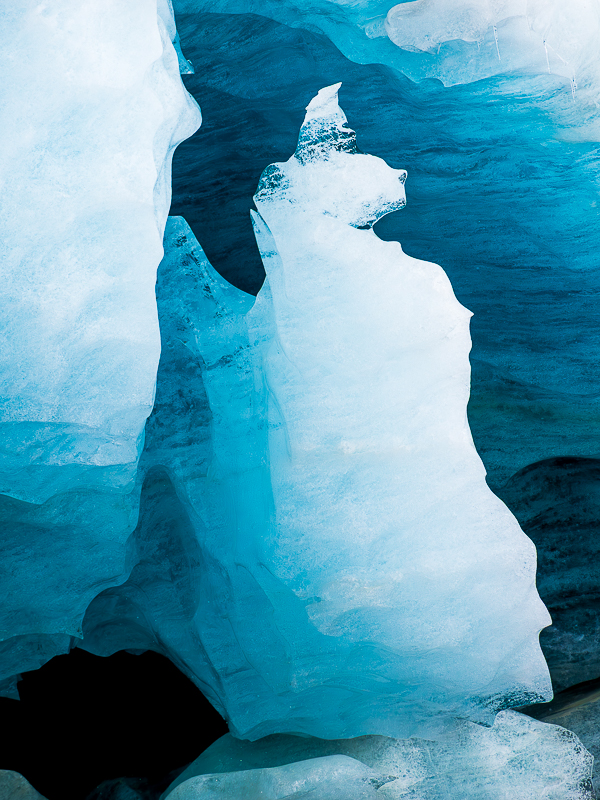
I can’t say it was easy even with his help, in some places wading through deep drifts of soft snow overlying boulder scree, but we did eventually arrive. At that point we did our own thing, he with his heavyweight full frame Nikon gear including a clutch of prime lenses and me with my puny (but effective) micro 4/3rds set-up. A guided walking group arrived before we left and they formed a nice contrast to the primeval scenes within the cave. I found myself particularly visually drawn to a ribbed ice formation just outside the cave entrance, which allowed some nice abstract images..

Glacial ice outside the cave.

It was soon time to leave as I had a train to catch – the first stage in my journey home. I slithered and slid down to the trail where we parted ways again. He had been so patient with me! We said our goodbyes, he fitted his skis and was soon whizzing away downhill. I walked quickly back to the station and ….. surprise, surprise ….. there was a restaurant with a fine selection of cakes! Earl Grey tea and a slice of apricot tart for me please!

* NB : For anyone considering long distance rail travel to or in Europe or elsewhere I cannot recommend The Man in Seat 61 website highly enough.

www.seat61.com

To read more Tales from Wild Wales as they are published, please click the Follow button.

Immaculate birds, constant activity and plenty of noise!

I might be a raptor nut but I love terns too. Wales is a bit of a “tern desert” and with one exception (little terns near Prestatyn) one must visit Anglesey to connect with them. Cemlyn Bay on the north coast is the Welsh tern H.Q. with its large sandwich tern colony, alongside smaller numbers of arctics and commons. On a good day one might see a roseate as well. I can confidently say that a visit to Cemlyn is one of the finest wildlife experiences in Wales. But your timing needs to be carefully judged.

The ideal time is just after the tern chicks have fledged because their parents then guide them to the shingle spit which divides the lagoon from the sea, away from the chaos of the nesting islands. But leave it too late and the whole damn lot of them will have left altogether! Last year I arrived on July 23rd to find that most had already gone, whereas in 2020, August 1st was just perfect.

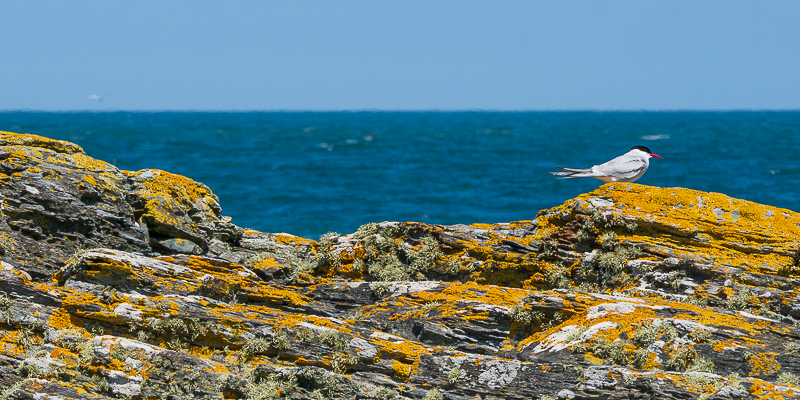
This year I discovered that the North Wales Wildlife Trust helpfully posts updates on the progress of the colony on its website. It suggested that a visit sooner rather than later would be advisable. So I headed north late on July 12th. The following morning I was there bright and early for the full tern colony experience. Immaculate birds, constant activity, and plenty of noise! Despite nearly 50 years of birding experience I have never totally got to grips with the differences between arctic and common terns. Many birders refer to them as “comics” because they are so difficult to separate. However after this visit I think I’m getting there! Sandwich terns are comparatively easy, and I have so rarely come across roseates that identifying one would be a real adventure (but see this post…..).

Roseate tern (r.) with three sandwich terns. Note its long black bill and long-ish red legs..

As it happened I picked up my first roseate quite quickly. It was visible on and off on the near edge of the main nesting island during the morning, and around lunchtime there were two together. I was able to get a few (rather poor) photographs of them. One of the tern wardens arrived soon afterwards and I was able to point them out to him. How about that for confidence! But as he had been seeing them throughout the breeding season he wasn’t too excited. He told me that one pair had attempted to breed early on but had failed, while he was still hoping that another pair would soon appear from the denser vegetation on the island with a youngster.*

For some time prior to that I was in “spray and pray” (or point and hope) mode. In other words: point your camera at a bird in flight, press the shutter button and try to follow it. This seems to me to be rather a technical task more dependent on luck than anything else, and I find it rather unsatisfying.

Arctic tern …………probably………

What I found more challenging was to place the terns within the landscape to give them some kind of context. At low tide, during the middle of the day, many roosted on the beach or on rocky outcrops along the foreshore. One could thus place them within an unspoiled landscape, suggesting that all is well with the world, which is perfectly valid. Alternatively, shooting from a different angle, one could set them against the massive hulk of Wylfa nuclear power station , now disused, only a couple of miles away. The viewer can then make up their own mind about the state of the world.

With ……… or without ……..?

As I mentioned this was during the middle of the day when the sun was at its highest. This is never a good time to take photographs of anything in summer so one does one’s best to compensate for it at the processing stage. Some of the newer features in Lightroom are excellent for this – in particular the ease with which “objects” can be selected and processed individually without affecting the rest of the image. And “denoise” is excellent, although rather slow on my PC.

Another thing I noticed very clearly was how the apparent colour of the power station changed during the course of the day. Its colour scheme at breakfast time matches the colour of the lichen covered rocks on the foreshore very well, and it would be uncanny if this had not been part of its design. I included a photograph illustrating this in my book “Wales at Waters Edge”; I wonder if anyone noticed….? But by early afternoon the plant was naturally bathed in blue light and looked quite different. To put it more technically, the colour of sunlight is towards the blue end of the colour spectrum (“cooler”) during the middle of the day, while it is “warmer” earlier and later. This is well known among photographers but I have never known it being demonstrated so clearly as it was that day.

Arriving as early as July 13th was, in the event, quite a close shave. A note on Facebook from the tern wardens on the 18th said that most of the terns (95% of them) had already left the area. I wish them good luck on their travels and hope they make it back to Cemlyn next year.

*N.B. : The second pair also failed …..

To read more Tales from Wild Wales as they are published, please click the Follow button.

My website : www.wild-wales.com

Compliments.

It is always nice to receive a compliment and this is one of the nicest I’ve ever had:

I am very grateful for the photograph, which arrived safely today. I think it’s really fantastic ……,. showing clearly the bungalow, Uwch y cwm, (of) which we as a family have fond memories. I am going to get it framed. Diolch yn fawr iawn, Tec

The image concerned (above) dates back to the 2000’s and was used on the front cover of my book Blaenau Ffestiniog. The original was on a transparency, and although I do have a good quality scanner, it had developed a fault. The sale of a single print didn’t actually cover the cost of the repair but the knowledge that the buyer was happy more than makes up for it! And of course I’ve now got a scanner that works.

Satisfying in a different way was the recent sale of ten ‘works’ from my Bird/land exhibition (click to view) to the National Library of Wales in Aberystwyth. The Library has been buying my work intermittently for nearly thirty years and now has well over 300 of my prints in its collection. It was interesting to look my name up in their catalogue and discover how many bits and bobs relating to my life as a photographer are stored away in their vaults. It is an honour and a compliment that the library chose to collect my work and continues to do so. It is also satisfying to know that some of it will outlive me.

To read more Tales from Wild Wales as they are published, please click the Follow button.
My website – www.wild-wales.com

In the footsteps of Fay Godwin.

For many years I have been inspired by the work of the photographer Fay Godwin, who died in 2005 (see this post in particular). This is not the place to fully discuss her life or work. But to summarise the trajectory of her career she was a self-taught photographer who progressed from portraits of authors through traditional landscapes to documentary work out in the landscape, in which environmental issues were prominent. She worked in black-and-white throughout until her last years when she made abstract colour still lives in the studio.

Perhaps “inspired” is the wrong word. Without the advantages she had had (her husband worked in publishing……*) I feel that I have been ploughing the same furrow as she did. The sequence of photographs in my first book – “Wales – The Lie of the Land” (published in 1996) – moved from the “unspoilt” uplands through the industrialised lowlands to the “unspoilt” coastline. Hell, it even included a photograph of Snowdon with someone’s clothes line (complete with washing) in the foreground! No, over the years I suppose I have often felt comforted to know that my vision was shared with her. But I never copied her work.

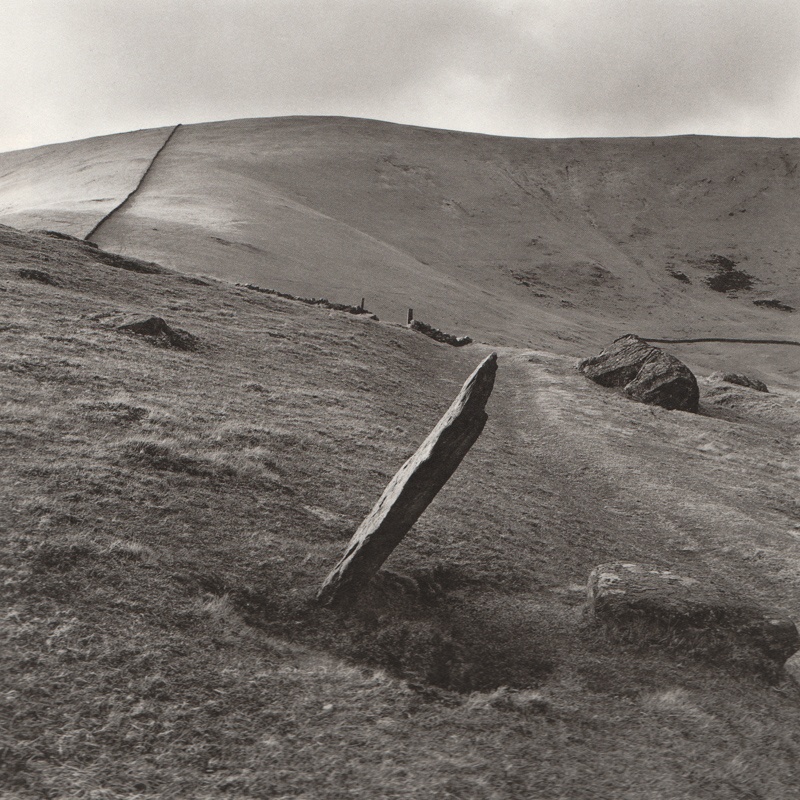
Until now. I was intrigued by one of her most iconic images, “Marker stone, Harlech to London road”, which first appeared in the book The Drovers’ Roads of Wales (1977) by Godwin and the author Shirley Toulson. It is brilliantly seen and geometrically composed, perhaps more exactly than most of her images. The wall on the hillside in the background is exactly parallel to the angle of the stone and the two are linked by another wall almost at ninety degrees to both. But the exact location was not mentioned and I wondered if Godwin had taken the photograph but couldn’t remember exactly where it had been. I decided I would track the location down and replicate the image.

Godwin (1976)
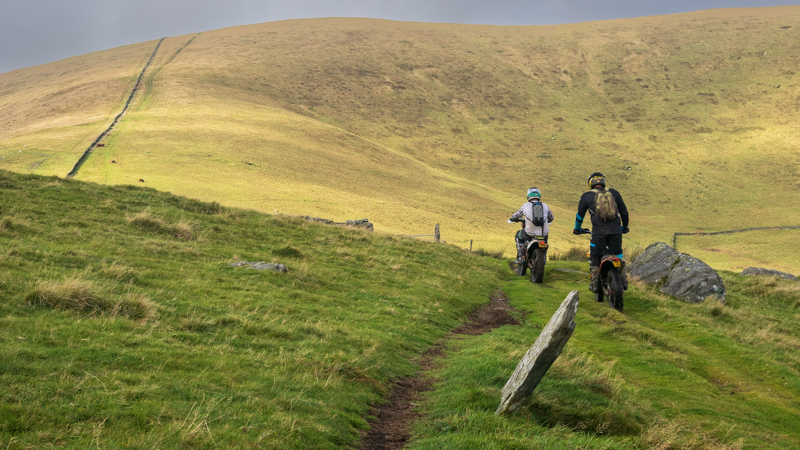
Moore (2024)

The route of the old Harlech to London drovers’ road is mapped in Toulson/Godwin and I wrongly assumed that the stone would be marked on the current 1:25000 Ordnance Survey map. At the Royal Commission for Ancient and Historic Monuments in Aberystwyth I was told that marker stones were commonplace, not necessarily ancient, and as a rule not catalogued. I studied the ancient road’s route on an old OS map online in their library. Marker stones were plotted at regular intervals and by carefully relating one of them to a gate in a wall (visible in the Godwin image) and the wall up the hillside in the background I came up with the prime suspect.

It was an exciting walk up from the roadhead towards the uplands. The closer I got the more confident I became that my guess was correct. The drovers’ road is what would now be described as a “green lane” and was suffering the same fate as many others – offroad bikers churning up the grassy surface into a rutted mess. Then I began to lose faith; none of the other marker stones were visible, and the far “vertical” wall seemed to be pivoting around to the wrong angle. But I needn’t have worried.

I was just getting acclimatised to the place when I heard the (unfortunately) familiar sound of scramble bikes heading towards me. My heart sank but I quickly realised it would be an opportunity to add value to the image I was visualising. I took a series as they headed past the stone towards the gap in the wall. I then got down to the task in hand – finding the exact location where Godwin had stood, sat or kneeled to make her image.

It proved to be impossible. The stone was smaller than it appeared from her photograph and it looked as if it might have sunk or toppled slightly over the last 48 years. The left/right wall was invisible unless I stood up, in which case the tip of the stone was well below its position in the original. I also came to the conclusion that since 1976 grazing pressure on the grassland had become less intense, allowing the turf to spring up and hide the wall and most of the gateway.

An obvious new route has been created to the left of the stone by offroad bikers. On the far hillside, parallel to the wall, a network of illegal scramble bike tracks can be seen; in fact the two offroaders that passed me carried on and added to them – up to the ridge……turn around……slither down again….. The final difference between the two images being a substantial flat rock lying to the right of the marker stone which is missing in the 2024 images.

So would Fay Godwin have approved of my pilgrimage? Quite possibly not. Would she have approved of the new image complete with bikers? I’d like to think so, particularly later in her life.

*Chief editor at Penguin Books and later Managing Director of Weidenfield and Nicholson. It all helps……

To read more Tales from Wild Wales as they are published, please click the Follow button.

My website –http://www.wild-wales.com

The Isle of Dogs.

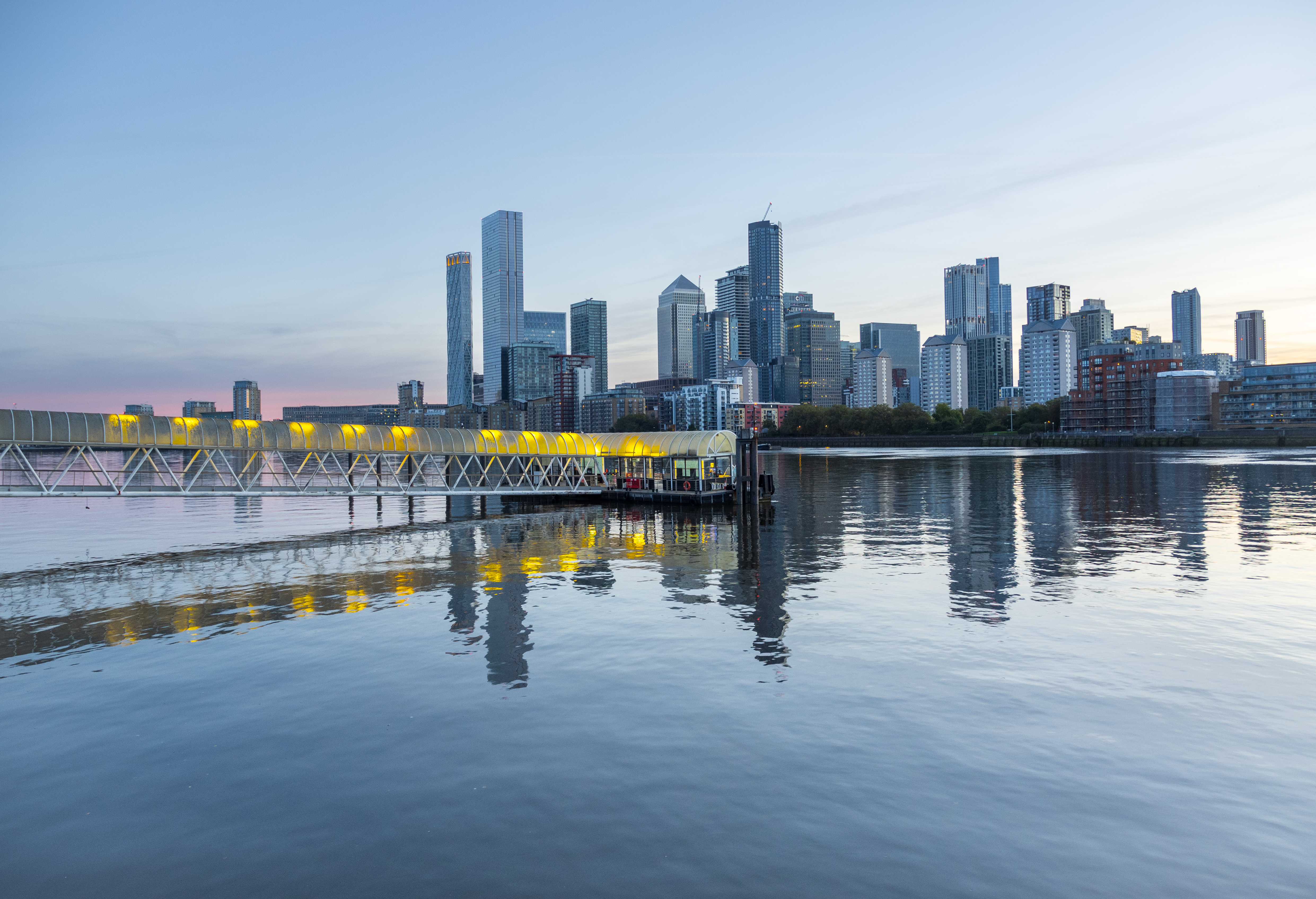
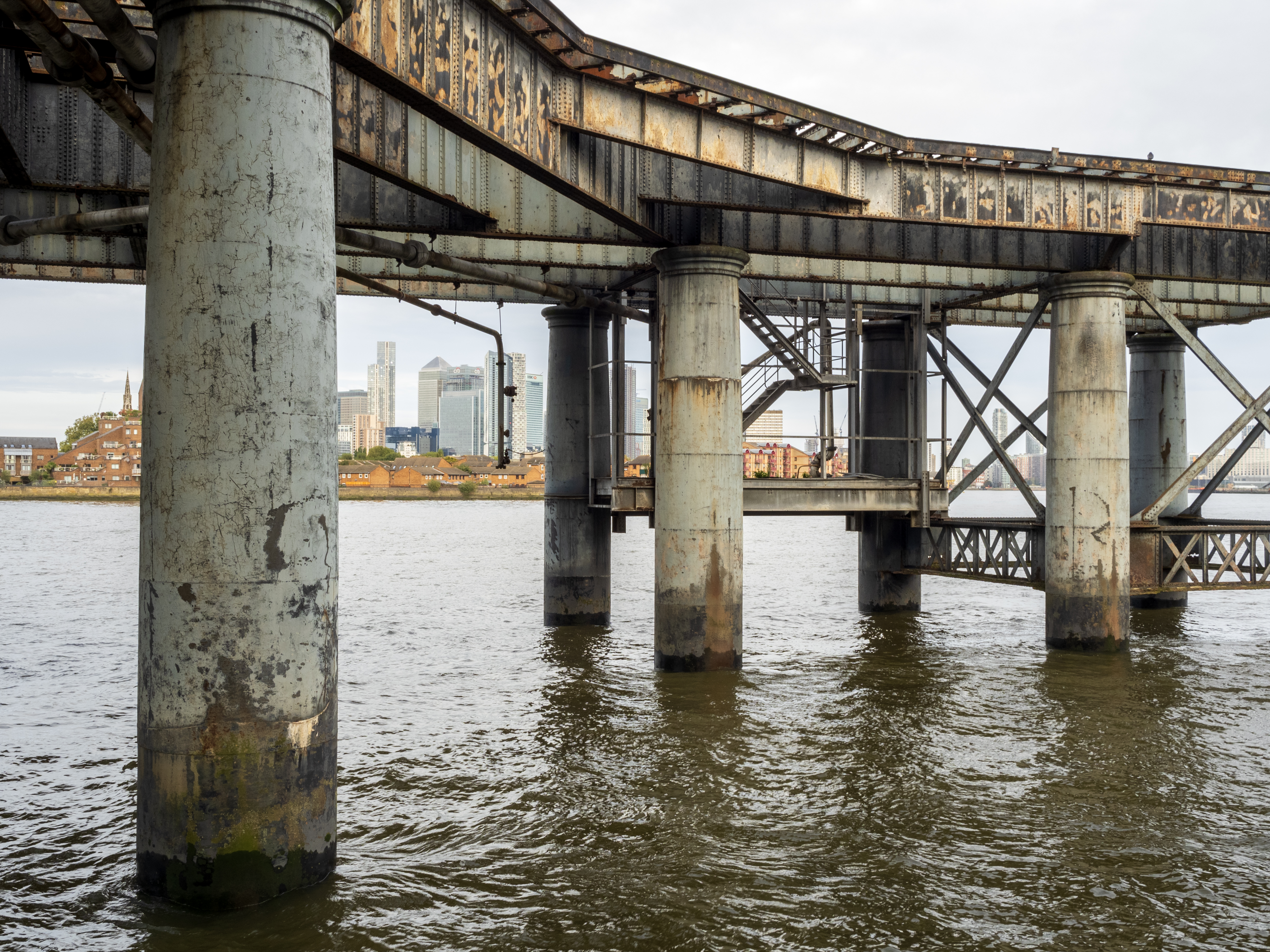
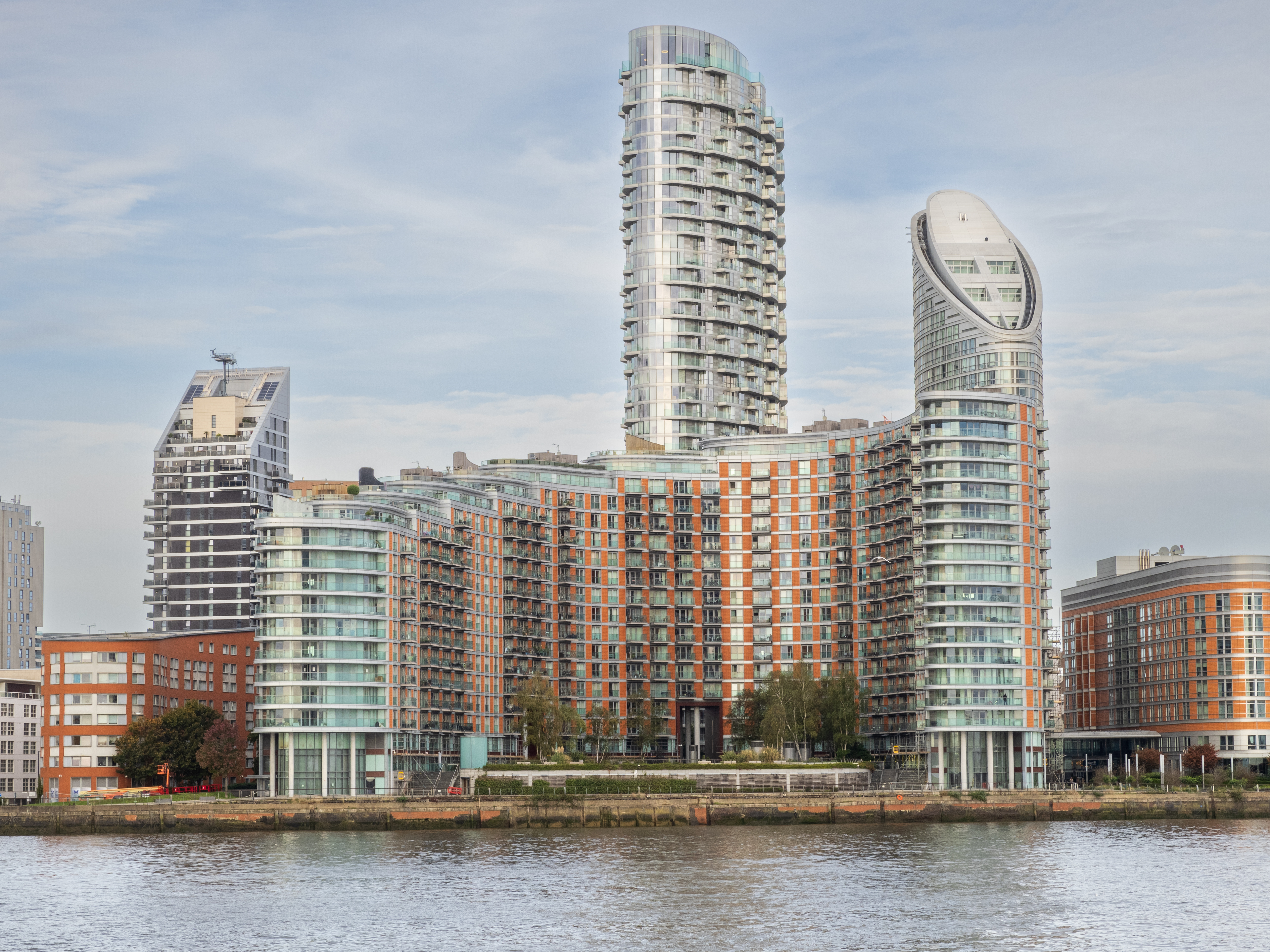
Last weekend Jane and I had a couple of days in London. From our room near Greenwich it was just a couple of minutes walk to the Thames Path which more or less follows the riverbank. All very ordinary really. But across the water rose the massive tower blocks of Canary Wharf on the Isle of Dogs. It was about as far removed from Wild Wales as you can imagine. For a country bumpkin like myself these monsters reaching for the sky were impossible to ignore. The architecture of Canary Wharf is extraordinary from a distance. However I also spent a couple of hours amongst the tower blocks and I don’t think I have ever experienced a landscape so de-humanising. No soul at all. And no dogs.

I just had my little Olympus OM5 with me and a standard zoom, so photography-wise the trip was somewhat limited. Nevertheless I’m pleased with what I achieved, so enjoy the pictures!

Emerging from Greenwich village onto the riverbank I was knocked out by this panorama
I love the cool blue tones of this pre-sunrise image, which contrast so strongly with the yellow lights on the pier footway.
Virtually every vestige of the industrial Thames around here has been removed, so this jetty is a rare reminder of the not-too-distant past.

Not what you might think. This is one of a series of artworks on the Greenwich peninsula. The artist Richard Wilson bought the sand-dredger “Arco Trent” and installed a slice of it on a sandbank in the Thames.

Extraordinary architecture……..

To read more Tales from Wild Wales as they are published, please click the Follow button.
My website: www.wild-wales.com

The Llanberis lone tree

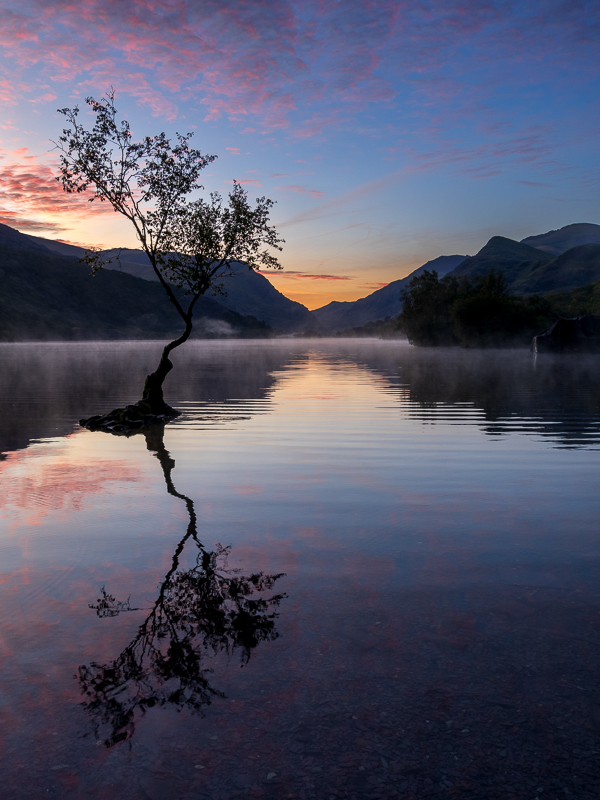
I was vaguely aware that it existed, and I think I may have visited the area many moons ago. But I’d never taken any photographs of it. I had no idea that there were countless zillions of photos on the internet of the Llanberis lonely tree. It even has its own Facebook page (well sort of…..). So last week I decided it was time I put this situation to rights.

Sunday it had rained all day but the forecast was for a clearance overnight with sunshine throughout the following day. It sounded perfect! I had a pretty good idea where the tree was so the plan was to arrive about 10pm, shortly afterwards falling into a deep and restful sleep in my van, and waking gently just before dawn. What I hadn’t allowed for was the fact that a Netflix movie was being filmed there, and barriers were up everywhere. The nearby car parking had also been “improved” with a long list of restrictions, including “no overnight parking”. This is now typical at honeypot locations throughout Wales and probably elsewhere, but I wondered how many parking attendants would be active between 10 pm and 6am. I had a good chat with a very helpful security guard from the location company who reassured me that my presence nearby would be tolerated.

The next morning I did wake fully rested and brewed myself a quick paned*. I found the tree quickly enough although to get there I had to sidestep one security barrier. Everything was set up perfectly. It was flat calm, the sun was just about to rise and there was enough cloud in the sky to make it interesting. About 6.45 the clouds reddened up. Oh joy! I started with a portrait format image and then began a series of landscapes. The reflections were perfect. And then the first security guard noticed me. She came over and asked me how I had got there. Perhaps I had arrived by helicopter? “Well,” I told her, “I walked.” It had been dark and I couldn’t really remember in any detail. I eventually explained that I had walked round a security barrier. It all ended amicably enough, with me reassuring her that I would soon be finished and would then leave. Two more security guards arrived in the next few minutes. All three seemed to surprised to see me there. One was rather officious, telling me he would have to contact his superiors. We both knew it was all bluff. But shortly after 7 am, it was “mission accomplished”. It had given me extra satisfaction to know that I had outwitted “security”, but if they really wanted to exclude visitors they would really have to try harder! I packed up and left.

When I arrived home a few days later I was very pleased with the results, especially the earliest images with the pink clouds. Very soon this gorgeous colouration had disappeared and the later images look better in monochrome. Photography can often be about moments and this moment had lasted about fifteen minutes.

This was the first stop on a whistle stop tour of north Wales and I may write more later.

* Welsh for “Cuppa”……..

My website www.wild-wales.com

To read more Tales from Wild Wales as they are published, please click the Follow button.

Once you’ve seen it…….

……… it’s difficult not see it.

I don’t know how many times I had walked to St Davids Head along the undulating coastal path without seeing Coetan Arthur, the neolithic burial chamber. I had walked around it, possibly crawled under it and definitely photographed it in close up but never noticed how clearly it was visible from some distance away. Then one day I must have seen it and now I cannot walk along that section of the path without seeing it. It draws the eye. I don’t believe this a coincidence either; the coastal path presumably follows an ancient route to the promontory fort on the headland itself. The burial chamber must have been sited so prominently for good reason.

I realised on one visit that the burial chamber would be an excellent foreground against which to photograph the sunset – even if it was but a small feature in a big landscape. So, weather permitting, I have now walked there late in the evening several times to see what the sunset would bring. A few days ago I was in St Davids, exhausted after a day on the road visiting my postcard customers. The weather hadn’t been great but I could see a hint of something interesting in the sky as the evening drew on. I grabbed my camera bag and set off.

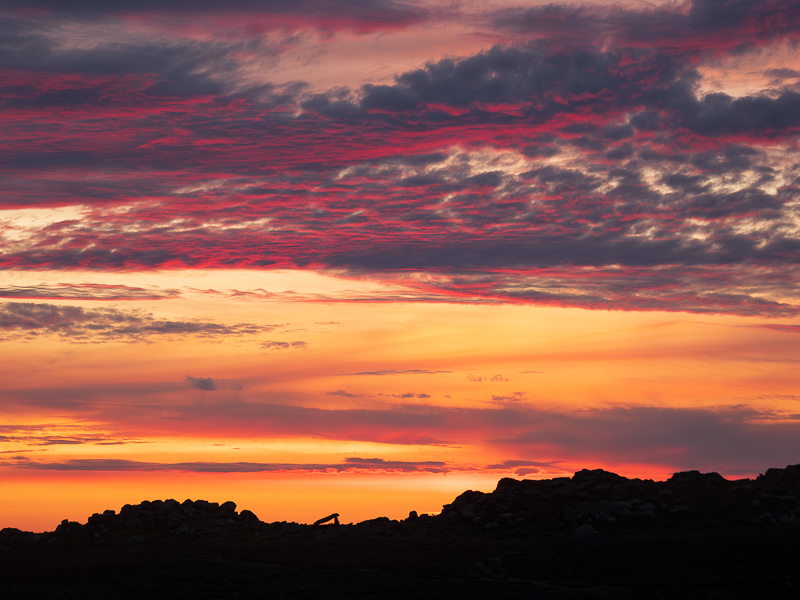
It turned out be a rather wonderful sunset. After the sun disappeared behind the headland all sorts of oranges and reds appeared in the clouds above it. The burial chamber was silhouetted nicely against this stunning backdrop. So, for a photographer who doesn’t really “do” sunsets, I seemed to have struck lucky again.

To read more Tales from Wild Wales as they are published, please click on the Follow button.