Not quite a dartford warbler…….

Arne, Dorset
Arne, Dorset

Easter week found Jane and I down in the Isle of Purbeck in Dorset. It was a part of the world I’d never seen and it also seemed to be a good chance to see, and possibly even photograph, a dartford warbler. We treated ourselves to the luxury (cough……) of a holiday flatlet in Swanage. Our first full day we decided to do a cycle ride, and, not being the hardcore types, it was soon time for a coffee stop.

We arrived at the village of Corfe Castle. Talk about picture postcard pretty! The restored Swanage railway passes through the village too, and the steam engines gave it a real flavour of the past. Purbeck has a very strong Enid Blyton connection and one could imagine the Famous Five still fitting in quite easily. However the women dressed up as wenches were, I felt, taking Heritage Britain a little too far. The Castle itself is owned by the National Trust, with an entry fee of £9.00. We decided to give that a miss. It is a spectacular ruin, however, and the National Trust tea shop nearby provided a fabulous view of it from its back garden.

Relaxing with coffee and cake, I noticed that house sparrows were popping in and out of a severely pruned privet hedge. They were using conveniently positioned twigs as lookout posts in their search for crumbs. Although I wasn’t in photography mode that day I could see an opportunity to add some “birds in the landscape” images to my collection. I filed the idea away in my memory banks.

Jane may not have my perhaps obsessive interest in birds and/or photography but she can be very tolerant. So a couple of days later I spent the night alone in the camper van close to the Arne RSPB reserve not far from Corfe Castle. It was a fabulous still and misty morning, with the sun rising like a crimson ball though a layer of fog. I confidently set out in search of a dartford warbler. Maybe a pair. Or two. It would be easy to find them. Two hours later I still hadn’t seen or heard one and I walked back towards the van. I began to think that dartford warblers were a figment of other people’s imaginations. Then I heard an unfamiliar sound and located one of these elusive birds on the topmost twig of a gorse bush not far away. But it flew very quickly and proved impossible to track down. The same thing happened with a second bird I found a few minutes later. So I gave up.
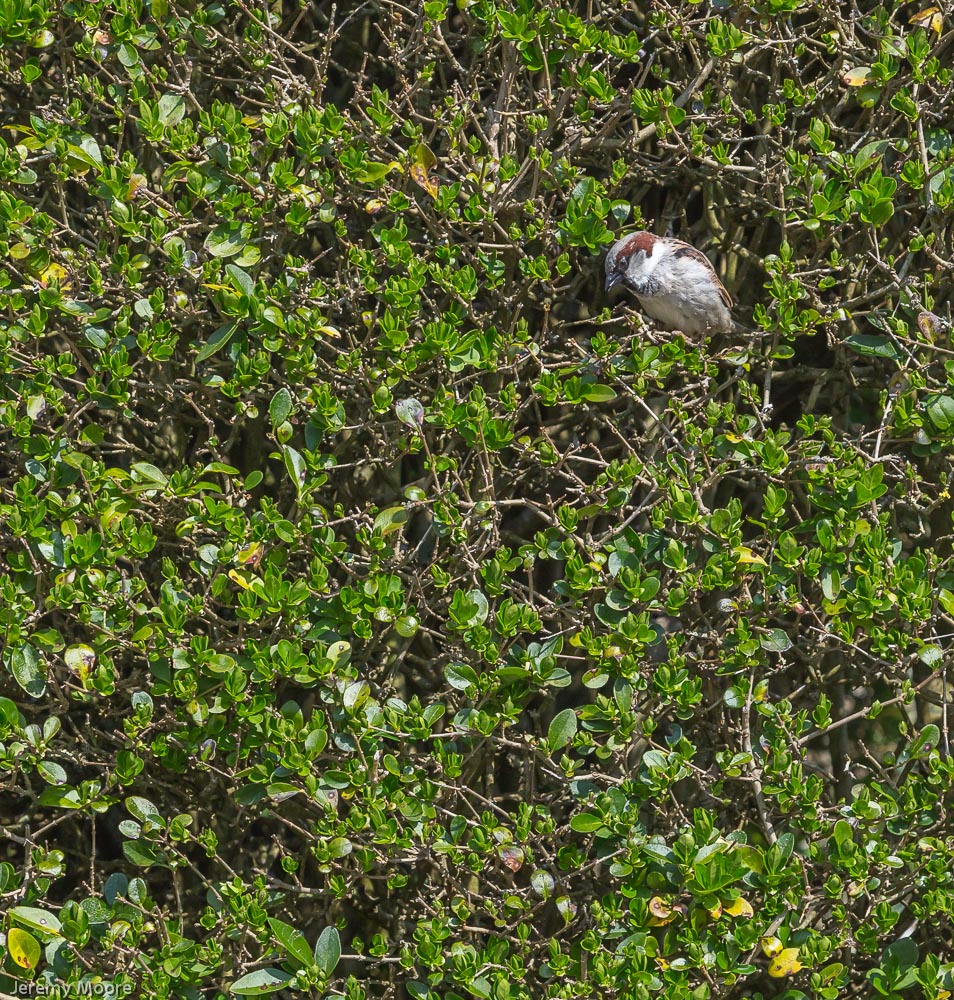
House sparrow, Corfe Castle (click to enlarge)

After such an early start coffee was now calling and the memory of those house sparrows was getting stronger and stronger. It was time visit the Corfe Castle tea shop again. I introduced myself, told them about the project I was working on, and asked if it was OK to take some photographs in the garden. No problem.  I spent an hour there taking as many different compositions as the birds would allow.  Being at such close quarters to them I was only using the standard zoom on my Canon 5d3, so I didn’t look too conspicuous.  Ideally I would have had more time but the images have an interesting graphic quality to them, and who bothers taking photographs of house sparrows! I think there’s enough variety overall to create one triptych for the exhibition.

Not quite a dartford warbler…….but hey!


To follow Tales from Wild Wales, scroll right down to the bottom and click Follow.

Some thoughts on the Cwm Dyli pipeline.

Snowdon and Cwm Dyli, showing the pipeline

The weather has been almost unremittingly cloudy for the past few weeks but there was one exceptional day recently. A cold front had slowly moved southwards overnight and then stalled, leaving the north Wales peaks beneath blue skies in sparkling sunshine, while further south Aberystwyth remained amid the gloom. In the expectation of a good day I travelled up the previous evening and spent the night in my camper van by the shores of Llyn Dinas, near Beddgelert.

It wasn’t a terribly promising start to the day. There was still a veil of cirrus covering large areas of the sky and enough breeze to prevent a reflection in the waters of the lake. But gradually the clearance came and by mid-morning I had clambered high up on a crag above the layby overlooking Llyn Gwynant. Most visitors to north Wales will know it …… everybody stops there and takes a snap. The light was fabulous by that time and one image taken there will be suitable for a postcard at some stage.

A little higher up the valley there is a roadside viewpoint to the summit of Snowdon constructed at some expense by the National Park Authority. It would be a spectacular natural landscape if the Cwm Dyli pipeline had never been built, but it was, and I have always passed it by. But on this occasion wisps of cloud were extending westwards from the summit of Crib Goch and passing above and below Yr Wyddfa itself. Despite the pipeline I couldn’t miss this opportunity.

Thomas Pennant describes “a very fine cataract” at “the upper end of this romantic valley, Nanthwynant” in the account of his visit in 1770. Now there is also a pipeline. It was built in 1905/6 to carry water from Llyn Llydaw, beneath Yr Wyddfa, to the then new hydro-electric power station at the head of Nant Gwynant. This was the first of its type in the UK,  built primarily to supply power to the slate quarries at Blaenau Ffestiniog,  five miles away over the hills. Despite the demise of the slate industry, the power station – by now a listed building – was re-equipped in 1990 and the pipeline renewed. There was a campaign to have it buried but in spite of the spectacular location at the very heart of the National Park, it was unsuccessful.  One cannot help but believe that if the pipeline had been proposed more recently, it would never have got planning permission.

So what does the landscape photographer do? As I had done for many years,  drive on by. But not on such a day as this……. A continual stream of cars was arriving and departing the car park so I climbed up the hillside on the opposite side of the road. As I gained height, the landscape opened up, revealing, unfortunately, another length of  pipeline. Most of the landscape action was in the top half of the frame, and I knew that I would be cropping  the image at the bottom to remove the main section of pipeline. The big dilemma would come later, at the processing stage, when I had to decide whether or not to remove the upper section digitally. I spent a while on the hillside, taking a selection of images with different cloud formations. Then the wind direction changed and the wisps of cloud began to move eastwards from Crib Goch, away from Yr Wyddfa, and the magic was gone. It was time to leave.

Actually, I’m pretty hardline about cloning landscape images. In my opinion landscape images have documentary as well as artistic value. Unless an extraneous item is present only temporarily, it stays. So a crisp packet, a post van or a walker in a red cagoule can go, but a telegraph pole or an electricity pylon stays…….. or a pipeline. There are always going to be grey areas, but it really is stretching the distinction to breaking point to claim, as some people do, that any of the three latter features are also “only temporary.” . When it comes down to removing whole landscape features such as these (or adding them….) in order to make an image more superficially “attractive” it creates a false picture of our surroundings. And as far as I’m concerned, that matters.  For more on image manipulation, see this post.

So I thought I would post the above image online and seek out comments, particularly with reference to the pipeline. It  started a discussion about the pipeline, why it was there and what it was for. The photograph’s documentary element tells us all sorts of things about the landscape and how much we respect it. I was also expecting a barrage of “clone it out” suggestions, but in fact there was only one, and a big majority for “leave it in”, despite the fact that in some ways it spoils the picture.  There was quite a consensus and I must admit that I was relieved. The rise and rise of the cloning tool has not gone as far as I thought it had done.

Just out of interest I thought I’d add an uncropped version of the image which shows the course of the pipeline. I find it disruptive even though it is largely hidden in deep shadow.

Cwm Dyli - uncropped
Cwm Dyli – uncropped


To follow Tales from Wild Wales, please scroll right to the bottom and click follow.


Wild Wales / Cymru Wyllt 2013 calendar

Wild Wales / Cymru Wyllt 2013 calendar (front cover)
Wild Wales 2013 calendar (back cover)

Just a little plug for my Wild Wales / Cymru Wyllt  calendar, now (2012) in its eighth year of publication. At 330mm x 245mm in size (opening to double), thick card cover and quality paper inside, and twelve seasonal image by me, it really is fantastic value at £6.50 (inc p&p in UK). An ideal Christmas gift, especially if you love Wales, or good nature photography wherever it might be found!

To order direct visit www.wildwalespostcards.co.uk ,  or phone me on 01970 828164 to arrange the purchase.

STOP PRESS – BUY NOW AT ONLY £5.00 PER COPY (INCLUDING POSTAGE)

To follow Tales from Wild Wales, please scroll right to the bottom and click the Follow button.