As seen in the Game of Thrones (apparently)….

My partner Jane works at the Dyfi Biosphere reserve in Machynlleth, which has links to the Urdaibai Biosphere near Bilbao, in the Basque Country. So we decided to have a short holiday there in September. We’re both keen on train travel and it was a chance for me to use the Interrail pass which I had bought last December and which expired this month. So we took the sleeper train to Bayonne in France and then onward to Hendaye on the Spanish border. From there we transferred onto the narrow gauge (but electrified) line towards Bilbao. I can’t say I would recommend the latter. It took three hours and stopped at fifty-one stations! At each one the doors slid open and clanged shut, with numerous accompanying beeps. Think a three hour journey on the Tube and you’ve just about got it. But arrive we did, eventually. There is a very good network of local trains and buses in the Bilbao area so we used public transport exclusively while were there.

I knew little about the Basque Country before leaving and even less about the language. It’s fair to say that the distribution of letters in a Basque edition of Scrabble would be very different to the UK version……. X, Z and K would only score one point each, for starters! It is hilly and heavily wooded country with a dramatic coastline. One of the most well-known features of the latter is the islet of Gaztelugatxe – complete with a chapel dedicated to San Juan on its summit – linked to the mainland by a stone bridge. It is considered to be a pilgrimage site, and has always been a popular destination for visitors. It was used as a location in The Game of Thrones, and now, at busy periods, you need to book a ticket online before visiting. And there can still be queues. I knew nothing about this, of course, and was disappointed to discover that no passes were available for the day that I could visit. It took me a while to discover that in late September there were no longer any restrictions. Lucky me!

My visit started with a bus journey from Bermeo (the nearest town) well before dawn on a showery morning. It was still dark when the bus left me at the side of the road above the island. By the time I had reached the coastline it was light but no sun lit the island. A passing break in the clouds allowed a few sunbeams to hit the chapel but the camera was still in my bag. I then discovered that I had left my polariser in the hotel. This was becoming a habit!

3.2 seconds at f8.
2.5 seconds at f8

However, when I got to the bridge and looked along the coastline things started took a turn for the better. Talk about moody! Stormy skies, rock stacks, skerries with white water breaking over them, and rain showers passing across the landscape. I decided that long exposures using a neutral density filter would make the best of the conditions. Without a tripod I had to brace the camera carefully against a stone wall and rely on the image stabilisation for which Olympus kit is renowned. I took a series of exposures in the region of 1.6 to 4 seconds long and hoped for the best. Short breaks in the cloud even allowed the sun to illuminate the most prominent stack, leaving everything else in shadow. All my extremities were crossed at this moment! And the islet with its chapel was illuminated for short periods of time too.

I spent hours processing some of these photographs on my return home to the UK. Most of the long exposures needed some serious sharpening, but taking into consideration how long they actually were, that’s not surprising. Without the latest technology they would have been virtually impossible (without a tripod), say, ten years ago. Thank goodness I had arrived early because by mid-morning the area was thronged by visitors. And thank goodness it hadn’t been a blue sky day!

To read more Tales from Wild Wales as they are published, please click the Follow button.
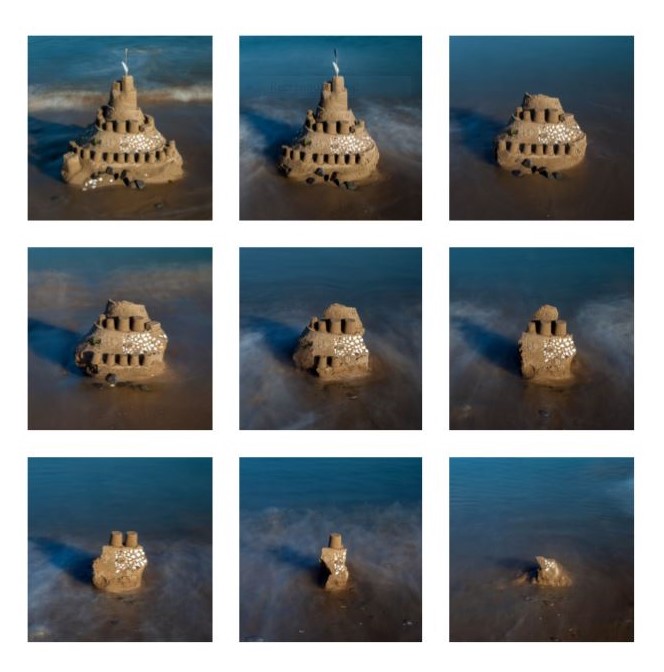
Nine and a half years later.

Back in 2011 I was exploring the country taking photographs for a book – Wales at Waters Edge – about the Welsh coastline. It wasn’t landscape, or wildlife, or documentary; rather a combination of all three. It took me a long while to realise it, but what I was doing was creating a natural and social history of the coast of Wales. On 2nd July I found myself in Tenby and discovered that there was a sandcastle-building contest on South Beach that afternoon. It sounded like a good photo opportunity.

So I duly turned up and took a series of photographs of the event. As it happened none of them was used in the book and most have long since been deleted. But a more interesting idea was forming in my imagination – to come back after the contest was over as the tide was rising. I thought a series of images of disintegrating sandcastles might illustrate sea-level rise and the consequences of global warming. So I returned to the beach about six in the evening – armed with my tripod – for some long exposures. It was deserted and the waves were beginning to lap around the first row of sandcastles. I quickly selected one, set up the tripod, and took a series of images as it collapsed. Focal length was set at 50 mm and exposures ranged between 1.6 and 4 seconds at about f11. I must have been using a neutral density filter as it was still broad daylight. I ended up with 35 images taken over a period of 11 minutes.

They then sat on my hard drive for nine and a half years! But in January I discovered that the Mid-Wales Art Gallery (near Caersws) was inviting entries for an open exhibition on the subject of global warming. I went back to my Tenby long exposures, selected ten of them with a view to making a sequence and began processing them. I made a whole series of minor changes to them all in an attempt to standardise the colour saturation, and cropped them all square. I sent a preliminary set to the gallery, who approved the idea, and suggested that I should have them printed on aluminium. Although this is an expensive medium to print on it avoids the need for framing.

I found a printing company online who do aluminium prints and provide layouts for dropping images into, including a 3 x 3 grid. Arguably a horizontal or vertical strip of single images might make the message clearer but the square format is much easier to deal with for both me and the gallery. I’ve just sent the work away for printing.

The exhibition will be at Mid Wales Arts, Caersws, Powys; provisionally from April 2nd > May 17th. Tel: 01686 688369

To read more Tales from Wild Wales, please click the blue Follow button

Repeat until it gets dark……

Porth Ysgo (recent)

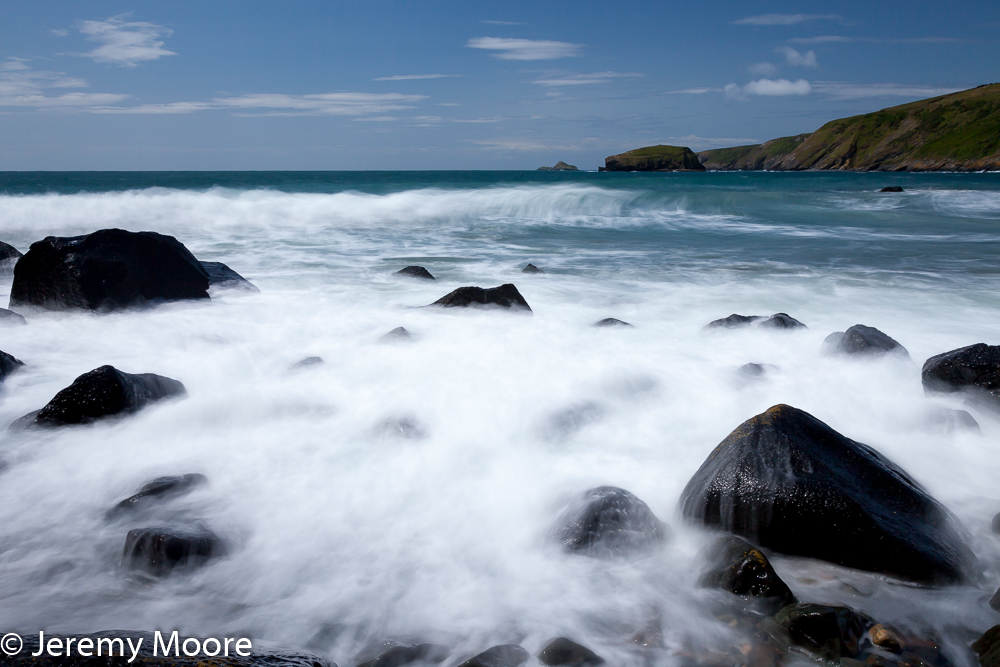
In summer 2011 I discovered Porth Ysgo, a tiny cove near Aberdaron at the tip of the Lleyn peninsula. I was working on Wales at Waters Edge, my book about the Welsh coastline. It took me a while but eventually I noticed that the beach was littered with extraordinary rocks. It wasn’t so much their shape – although there were some interesting ones – but their colour; when wet they were pitch black. I used a heavy ND filter to slow down the wave motion and create a frothy foam which contrasted strongly with the solidity of the rocks. One picture appeared in the book and I vowed that one day I would go back.

Porth Ysgo (from Wales at Waters Edge)

Well it took more than six years but I finally made a return visit last week. I met up with my old friend Brian Boothby, a very fine musician and photographer, and it was with a growing sense of excitement that I descended the steep steps down to the beach. Conditions were just about right – a receding tide with a fresh onshore wind.  On this occasion I didn’t mind the cloud cover. I put the camera on the tripod immediately, fitted the ND filter and started shooting long exposures. I very rarely use it otherwise but live-view is brilliant in this situation. It gives an “actual exposure” simulation while the image in the viewfinder is virtually invisible thanks to the heavy filtration.  It all went well for a while until I noticed that I was getting some massively under-exposed images. I checked all the settings but still no joy. Then I realised what the problem was. Having set a two-second self timer to prevent camera shake, I then took my eye away from the viewfinder. Light entering the viewfinder during an exposure of several seconds was affecting the automatic meter reading by about two stops. In other words, it was cutting the exposure to something like a quarter of the correct one. It seems odd that this should be possible. Can someone explain it?

So the solution was simple. Once you have found your location and accepted that it is usually pot luck with long exposures, this type of image is actually quite easy to create:

Use live-view to compose the image.  Set the self-timer. Wait until a likely looking wave begins to enter the frame. Place the thumb over the viewfinder. Press the shutter. Repeat until it gets dark.

In fact, Brian had been exploring and found another tiny cove nearby with more extraordinary black rocks.  This time they were larger, more sculptural, and placed randomly on the shore, almost like surreal chess pieces. There were also some massive square-ish blocks, each the size of a small car, piled on top of each other well above the waterline. But salt spray was filling the air.  I managed a few more long exposures, then began to enjoy the sheer exhilaration of the conditions as darkness began to fall. Who needs photography on an evening like this?

Edit: but it’s always nice to come back with a trophy or two………


To follow Tales from Wild Wales, scroll down to the bottom and click Follow