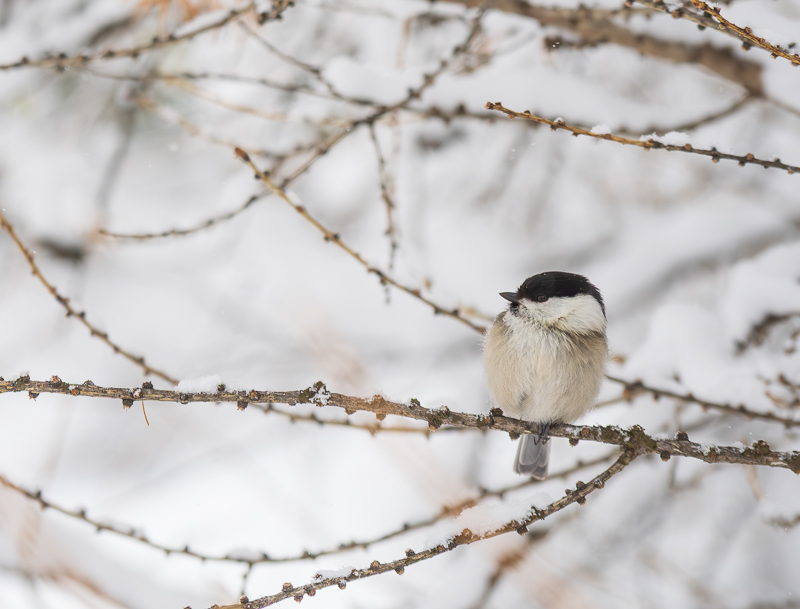
There can be no more difficult bird i-d challenge in the UK than distinguishing willow tit from marsh tit. According to ‘Birds in Wales’ willow tit was not even proven to occur in the UK until 1897, and for several decades following that “…its distinct identification from marsh tit was not universally accepted”. The Collins Bird Guide suggests various subtle differences; for example marsh tit has a glossy black cap while the willow’s is matt. The white cheek is more extensive on the willow than the marsh, and one (the willow tit) has a pale panel on its wing while the marsh doesn’t. The black bib is “usually” larger in the willow than the marsh. However a video from the British Trust for Ornithology now suggests that it is not safe to distinguish one from the other on any of these characteristics. The only reliable difference is a pale grey spot at the base of the upper mandible (the beak) which the marsh has but the willow doesn’t. This conclusion would have been reached following the close examination in the hand of large numbers of individuals by bird ringers, so is likely to be correct. But no wonder there was such a long period of doubt over whether both species existed in the UK.

It is widely agreed that the safest way of telling one from the other is by voice. I’m not confident that I’ve ever definitively seen or heard either species, but during the winter I heard a new (to me) bird song on a regular walk in some woodland below the house. I believed it was either a willow tit or a marsh tit. It sounded very like a wood warbler, which, being a summer visitor, could not have been present. My Collins Bird Guide specifically mentions a “series of pensive, melancholy, wood warbler-like notes”, under willow tit. I hadn’t actually seen the bird but this was about as good an i-d feature as I was likely to get. I announced my record on the Ceredigion Bird Blog, with the caveat that Ian Morris – the county’s resident willow tit expert – might have an opinion on it. A few days later I had an interesting email from another Ceredigion birder who had had a similar experience to mine. Over a period of some weeks he had re-visited his location and played back a recording of the willow tit song. On every occasion he had attracted a pair of nuthatches! It’s enough to make you tear your hair out!
A few weeks later Ian Morris visited and we walked down to the location where I had heard my mystery bird. He played back the song but there was no response. It was a long shot really but he didn’t believe the habitat was right for willow tit anyway…..much more suitable for marsh …………

One reason I recount this cautionary tale is that during March I spent a couple of days quite high in the Swiss Alps. It still being deep mid-winter some lovely conifer woodland there was blanketed with fresh snow and almost completely devoid of of birdlife. The main exceptions were flocks of tits roaming around waiting for hand-outs from folks like me. Among them were “poecile montanus” (according to the interpretation boards) which were so bold as to perch on people’s hands to grab a seed or two. This, of course, is the willow tit, which, according to the bird books, rarely even visits bird tables in winter ……..
To read more Tales from Wild Wales as they are published please click the Follow button.


 Tales from Wild Wales