Mulling it over……..

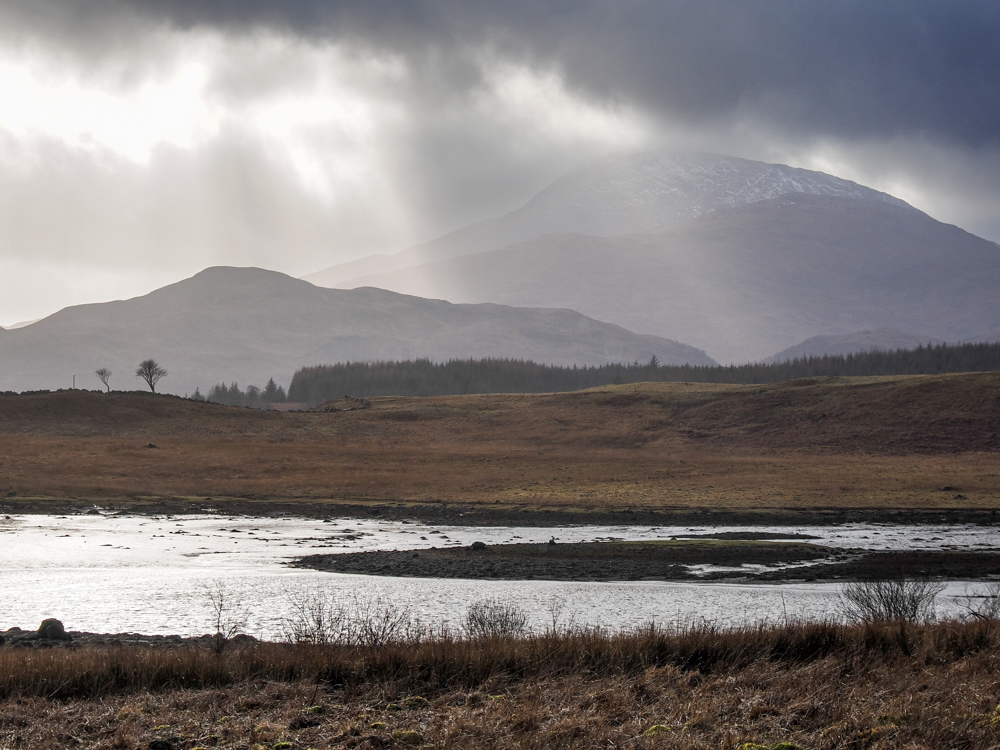
Near Lochdon, Isle of Mull

It was always going to be a bit of a punt, visiting the Isle of Mull at the end of February. I’m not going to tell a lie, the weather was pretty poor. While we were able to get outside every day, even if just for an hour in the evening, I can’t remember a single moment when the sun shone from a clear blue sky. Maybe a peek through thin cloud now and again on a good day…….

At that time of year we hoped to see eagles (golden and white-tailed) and…yes… we did. I surveyed eagles on Mull for the RSPB in 1981, before sea eagles became established. It became apparent that the island was just bursting with golden eagles. Where a territory had no suitable tree- or cliff nesting sites, they would nest more or less on the ground. I’m sure I didn’t find them all but it was thought that there were probably 25 pairs on the island.

There has been a school of thought that during the following decades, as white-tailed eagles successfully colonised the island, golden eagles might be driven out of their territories, especially along the coast. But on the evidence of our visit that did not seem to be the case. Most of our eagle sightings were of birds high in the sky a quarter of a mile away or more and nearly all of them were goldens. While we did see some white-tails they tended to be closer to ‘civilisation’ and thus easier to see. I know this is very poor evidence to support any kind of theory but it was interesting. I’d love to know the truth.
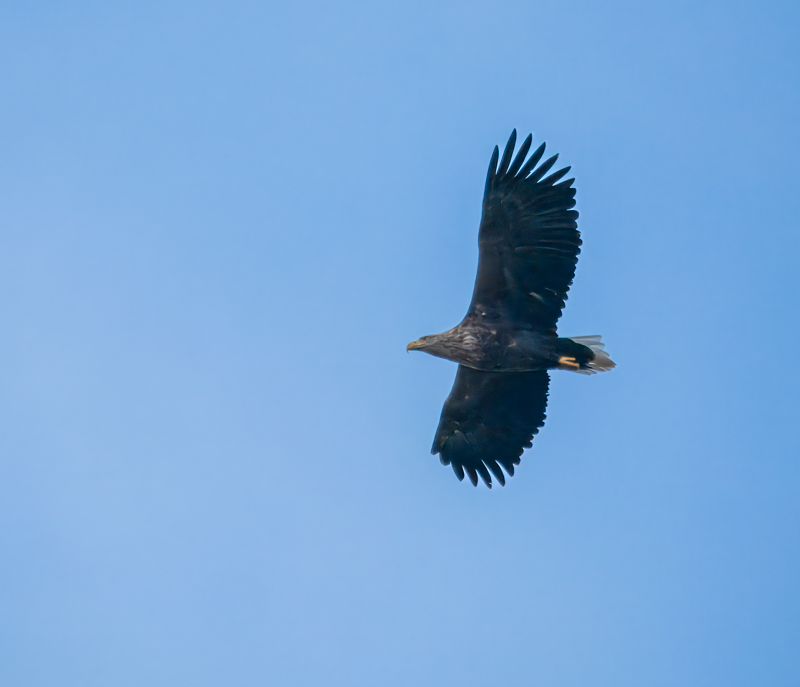
This white-tailed eagle drifted across to take a look at us on our first evening.

But the eagles were by no means the only highlight of the week. Our last morning was wonderful, with little wind and blue skies. From the Oban ferry I picked out what I first thought was a group of small cetaceans. Further observation suggested they were probably blue-fin tuna; I’ve searched online for ID pointers but most websites are far more concerned with catching them than identifying them! Wintering great northern divers were common and the chocolate shop at Craignure was wonderful! Perhaps my most enduring memory was of an otter at the narrow mouth of a sea-loch, Loch Spelve. Sitting onshore and looking across the water I noticed a disturbance mid-channel and it turned out to be an otter, heading inland from the ocean. Every so often it would appear for a few seconds, then dive, its conical tail being the last part of its body to be visible. It came onshore briefly and I managed to get some photographs of it before it headed off again.
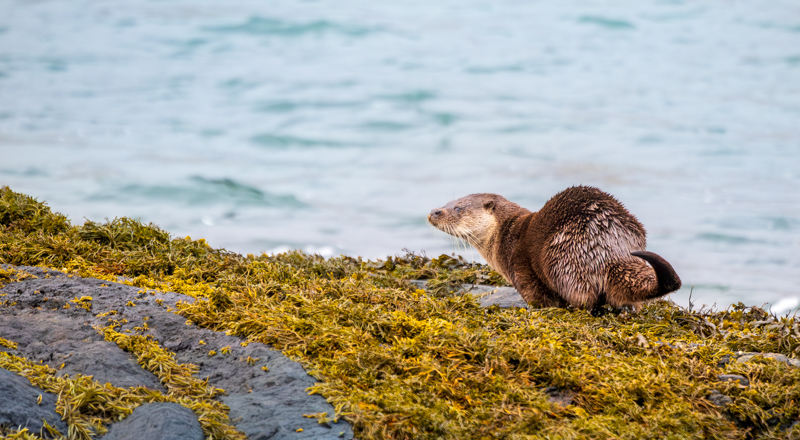
Otter , probably sprainting, Loch Spelve.

I’m trying to get in touch with Dave Sexton, the RSPB’s “man on the ground” on Mull (now retired) for some thoughts on the relationships between golden and white-tailed eagles on the island. If I get a reply, I’ll update this.

For more “Tales from Wild Wales” as they are published, please click the follow button.

Serendipity

I’ve just got back from a trip around Scotland with Jane, my partner. We spent a week on Mull and then went cross country to Perthshire where we visited some great friends. Photography-wise there’s no doubt that the highlight was a boat trip from Fionnphort on Mull to the islands of Lunga and Staffa. Here’s how it happened.

I have an unfortunate tendency to arrive early or late for appointments by either an hour, a day, or even a month. Yes, the latter has happened! We were staying in the campervan most of the time but I had booked one night’s accomodation in a “pod” on Iona, just a short ferry ride from Fionnphort. Not unexpectedly I got my days mixed up and found that we had a free day on Mull before the Pod was available. Our neighbour on the campsite had booked a boat trip to Staffa and Lunga on our free day so on the spur of the moment I looked online to search for spare places. To my surprise there were, and I booked them right away. A few minutes later I checked the booking and noticed that it was for the wrong day – the day we were booked in on Iona. Cue mega-panic! Late night messages to the boat company followed, and they got back straight away with the news that they would re-arrange it for the correct day. Phew……

The forecast was great for the trip with unbroken sunshine and light winds. We cruised northwards among the Inner Hebrides in perfect conditions for an hour or so before arriving on Lunga. This island was an unknown quantity to me but a few minutes after landing puffins could easily be seen amongst their burrows on its grassy edge. I didn’t realise what was to come a little higher and further along the coast.

The path wound up through broken rock and grassy slopes dotted with bluebells and other spring flowers. Puffins seemed to be everywhere and were more approachable than they are on the Pembrokeshire islands. Some were quite oblivious to any human presence. Two visitors ahead of me seemed to be photographing a low rock-face but there was actually a pair of puffins pottering in and out of their nest in a crevice just behind it. I could easily have reached out and touched them. They are absolutely enchanting birds and I make no apologies for presenting a photograph of them in all their cuteness. Perhaps we love them so much because they remind us of ourselves? (See the main pic)

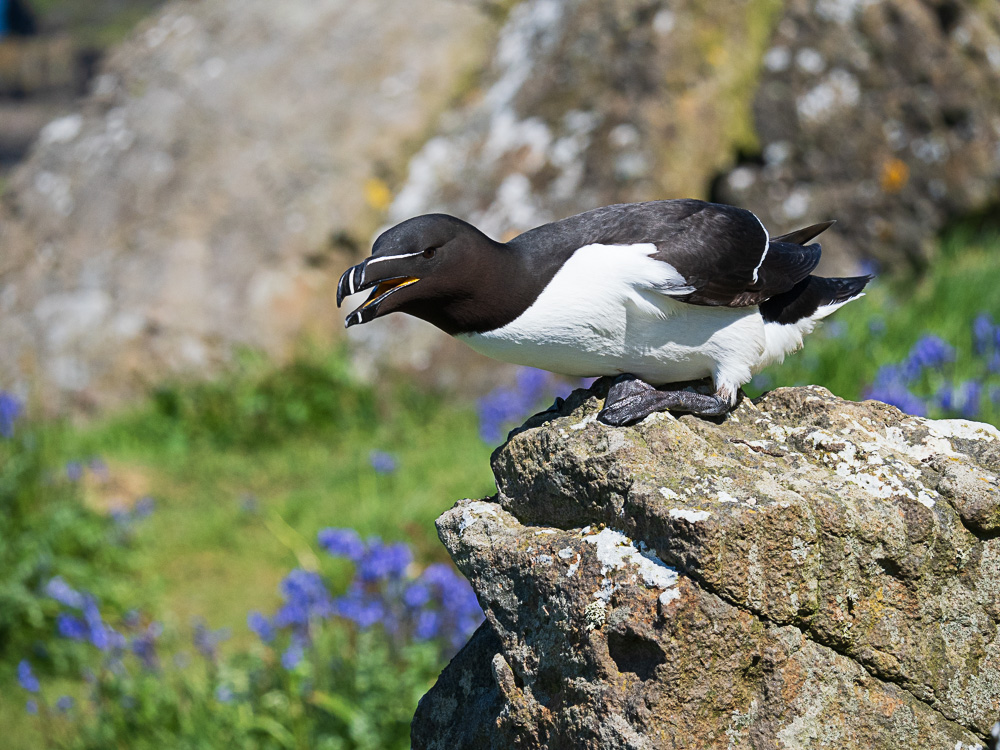
Reluctantly dragging myself away I soon came to the end of the main path close to an auk colony. While the huge majority of the birds were on the far side of a precipice that didn’t stop individuals landing this side of it close to me and the other human visitors. I’ve never been in close proximity to a shag before but one landed nearby and stayed, allowing me to photograph it at length. One young woman was sitting on a rock outcrop and a razorbill landed next to her as if she wasn’t there. It was astonishing! I reflected on how easy it would have been for the early sailors to plunder these seabird islands for food as they explored the oceans. And no wonder the great auk became extinct – it didn’t even have the advantage of flight.

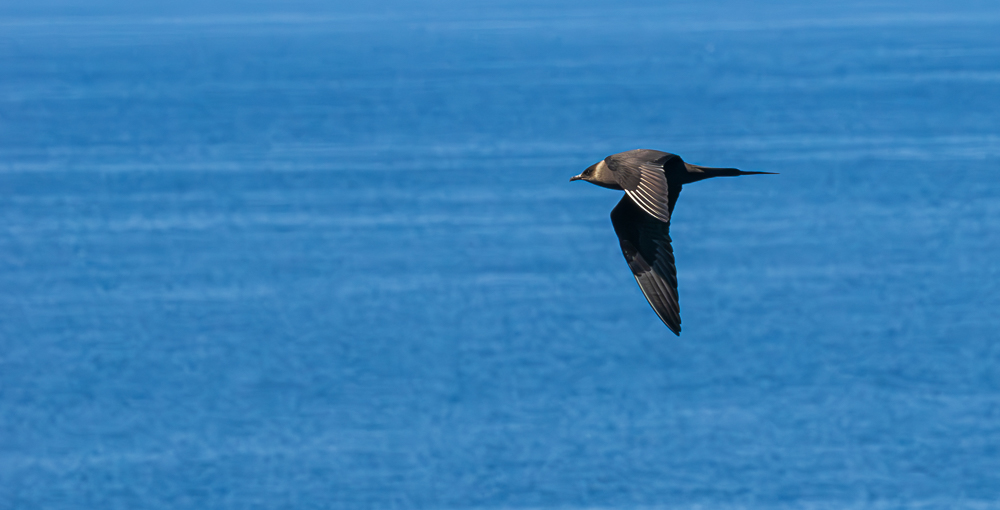
Most of these bird portraits were taken with my 24 – 100 mm zoom lens, not the long zoom that is normally obligatory for bird photography. I did, however, swap lenses to capture one of two arctic skuas which were patrolling around just offshore in an attempt to make unwary seabirds disgorge their food.

Arctic skua – much reduced in numbers following the avian flu outbreak.
Basalt columns on Staffa

We only had two hours on Lunga and before long it was time to return to the boat. I was exhilarated; it had been one of the best mornings of my life. By contrast, the island of Staffa, inspiration for Mendelsohn’s piece “Fingal’s Cave” and our second port of call, was rather a disappointment. The geology was extraordinary but time was very limited and visiting the cave was like being on a production line. Boat after boat was disgorging its passengers for half an hour and then leaving.

It was only through the series of mistakes I made that we actually got to Lunga at all. If I had had time to do some research I would probably have taken the shorter and cheaper trip to Staffa only. And if it hadn’t been for our neighbour at the campsite we might never been able to appreciate the wonders of this astonishing seabird colony. Serendipity indeed!

To read more Tales from Wild Wales as they are published, please click the Follow button.

My website – http://www.wild-wales.com