Mulling it over……..

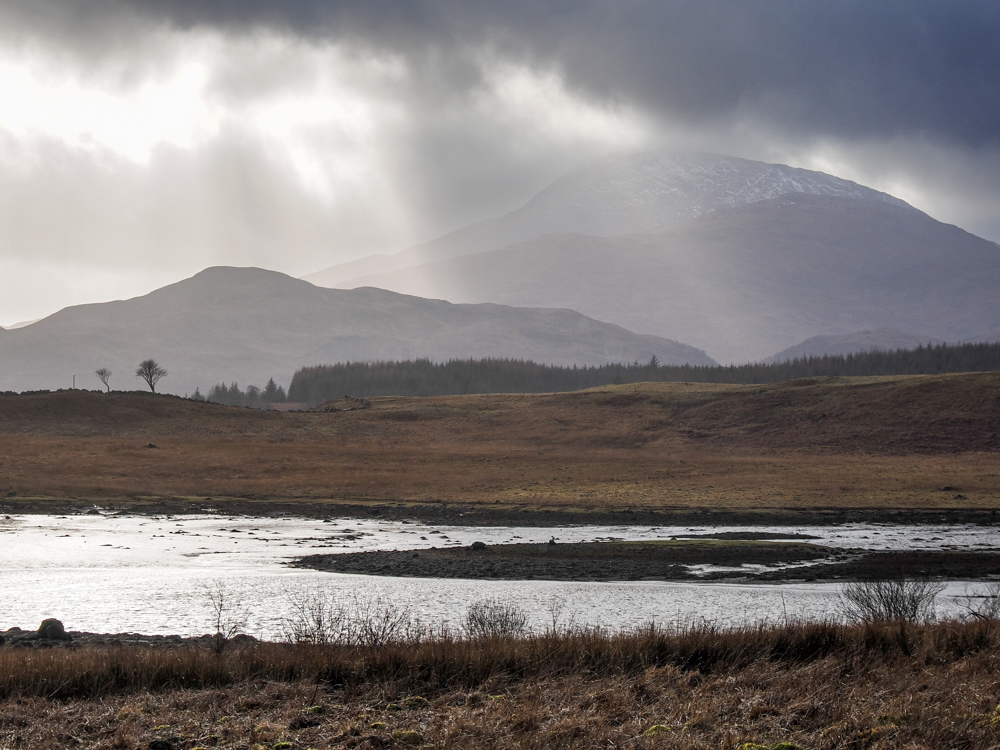
Near Lochdon, Isle of Mull

It was always going to be a bit of a punt, visiting the Isle of Mull at the end of February. I’m not going to tell a lie, the weather was pretty poor. While we were able to get outside every day, even if just for an hour in the evening, I can’t remember a single moment when the sun shone from a clear blue sky. Maybe a peek through thin cloud now and again on a good day…….

At that time of year we hoped to see eagles (golden and white-tailed) and…yes… we did. I surveyed eagles on Mull for the RSPB in 1981, before sea eagles became established. It became apparent that the island was just bursting with golden eagles. Where a territory had no suitable tree- or cliff nesting sites, they would nest more or less on the ground. I’m sure I didn’t find them all but it was thought that there were probably 25 pairs on the island.

There has been a school of thought that during the following decades, as white-tailed eagles successfully colonised the island, golden eagles might be driven out of their territories, especially along the coast. But on the evidence of our visit that did not seem to be the case. Most of our eagle sightings were of birds high in the sky a quarter of a mile away or more and nearly all of them were goldens. While we did see some white-tails they tended to be closer to ‘civilisation’ and thus easier to see. I know this is very poor evidence to support any kind of theory but it was interesting. I’d love to know the truth.
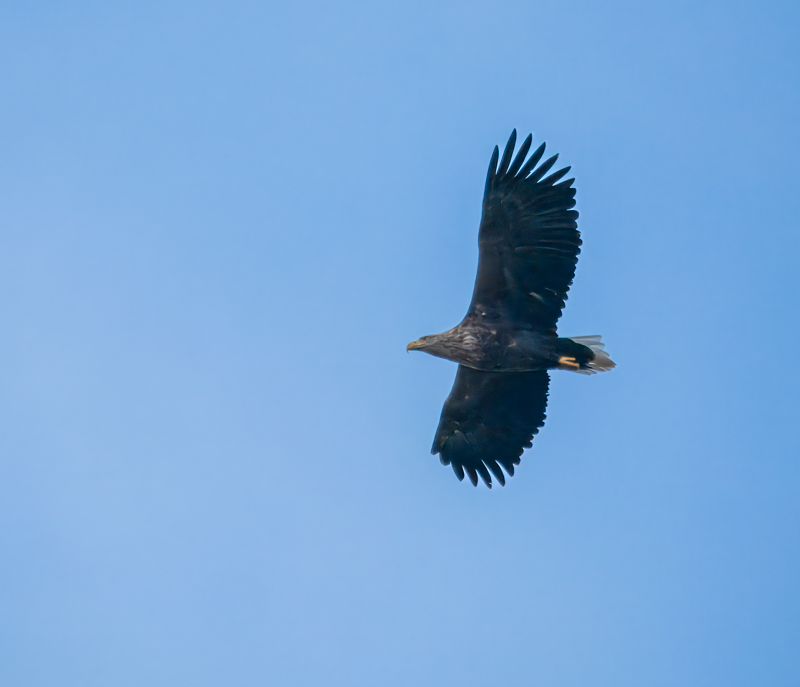
This white-tailed eagle drifted across to take a look at us on our first evening.

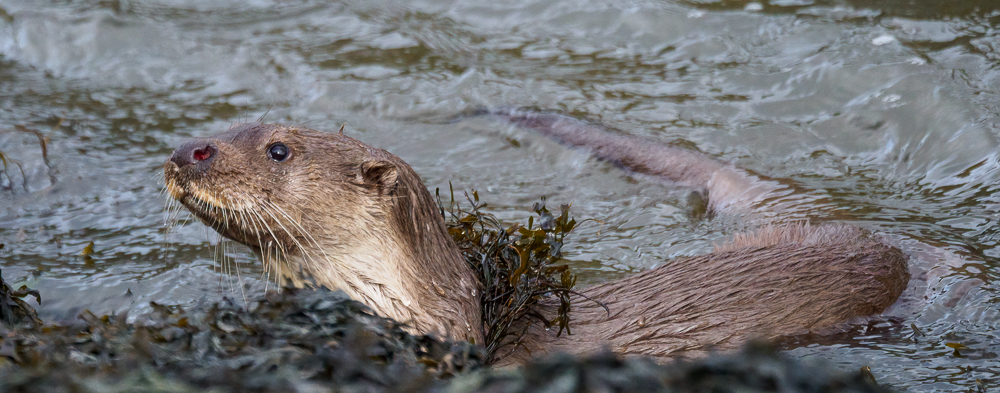
But the eagles were by no means the only highlight of the week. Our last morning was wonderful, with little wind and blue skies. From the Oban ferry I picked out what I first thought was a group of small cetaceans. Further observation suggested they were probably blue-fin tuna; I’ve searched online for ID pointers but most websites are far more concerned with catching them than identifying them! Wintering great northern divers were common and the chocolate shop at Craignure was wonderful! Perhaps my most enduring memory was of an otter at the narrow mouth of a sea-loch, Loch Spelve. Sitting onshore and looking across the water I noticed a disturbance mid-channel and it turned out to be an otter, heading inland from the ocean. Every so often it would appear for a few seconds, then dive, its conical tail being the last part of its body to be visible. It came onshore briefly and I managed to get some photographs of it before it headed off again.
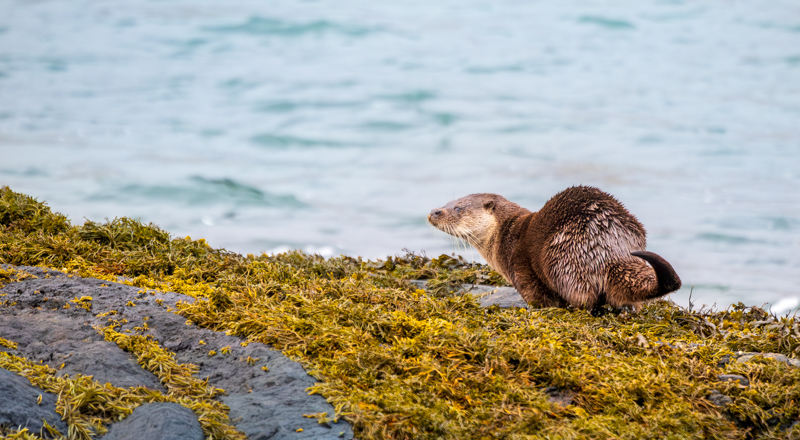
Otter , probably sprainting, Loch Spelve.

I’m trying to get in touch with Dave Sexton, the RSPB’s “man on the ground” on Mull (now retired) for some thoughts on the relationships between golden and white-tailed eagles on the island. If I get a reply, I’ll update this.

For more “Tales from Wild Wales” as they are published, please click the follow button.

Another visit to the Teifi Marshes.

Otters on the mallard pool

It almost always worth visiting the Teifi Marshes, a Wildlife Trust reserve near Cardigan (See this post as well). The big attraction for me is the reedbed which has three hides situated within it. Two are on the edge of small pools and the third overlooks a narrow creek draining into the River Teifi. Because the pools are small any wildlife using them tends to be pretty close, and all three hides are popular with wildlife photographers. It is an exceptionally good location to see and photograph kingfishers and even water rails – although my record with the latter is pretty sketchy. They are nimble and fast moving and tend to appear only close to dusk or dawn.

Last Saturday I arrived just after dawn and made my way along the old railway line (now a multi-use path) to the hides. Two otters visited the Kingfisher pool but all that could be seen of them was the top of one head and two trails of bubbles. Entering the Mallard hide I sneezed and a water rail immediately responded with its squealing call. It was on the water’s edge just below the hide but had disappeared by the time I got my gear set up. The same pool was full of activity later on with six squabbling moorhens present. There were also eight little grebes and at one point they all gathered in a semi-circle around the moorhens to watch the battle. Real school playground stuff!

Suddenly two otters appeared from the reeds. I tried to keep calm. My camera was set up correctly to photograph them as they swam slowly across the pool. I had the hide to myself and scrambled from one side to the other in an attempt to avoid having an out-of-focus kingfisher perch in the foreground. (In the end I was able to crop it out) After just one minute the otters disappeared back into the reeds as quickly and as mysteriously as they had arrived.

Unfortunately I didn’t have time to alter the aperture setting so while the otters are sharp the heron is just out of focus. Being a perfectionist this matters to me and I need some sharpening software to improve the image. Lightroom does almost everything I need my software to do but it does have its limitations. Topaz Sharpen AI does a very good job but I only have a trial version and the output has a watermark across it. I can’t get the same results from Photo AI, its successor. Shame!

If you visit the Teifi Marshes, here’s a few pointers. Coming from the south by car head for Cilgerran and take the main drive to the car park and visitor centre (parking fee payable). From the north, it is easier to park in the industrial estate south of the river, between the two bridges, and walk to the hides along the old railway track. For seeing and photographing wildlife dawn is best; by mid-morning the reserve will be the domain of dog walkers, child minders and families with limited interest in natural history. You have been warned!

To read more Tales from Wild Wales as they are published, please click the Follow button

My website : http://www.wild-wales.com

Edit: I have since found that Topaz PhotoAI DOES give a good sharp result when used on this image and I am considering purchasing it.

Taking your chances….

I recently heard about a very approachable otter not far from here. I assumed it was a one-off but later discovered it had already been attracting wildlife watchers and photographers for several weeks. Better late than never, of course, but my first visit offered two brief, unsatisfactory views and a few unusable photographs. I was more lucky on my second visit. I first noticed the otter mid-river; it then proceeded to hunt downstream towards me in the seaweed along the edge of the channel. It very quickly came up with an eel, brought it onshore and proceeded to crunch it down. It then resumed its hunt, moving back upstream in a similar manner. I quickly realised that if I could position myself beyond it, and my luck held, it would gradually get closer. And so it did! I was particularly fortunate in that there was no-one else around, so no there was jockeying for position or complaints that I might be too close.

I lay flat on my belly on the riverbank, the otter oblivious to my presence. I repeatedly reduced the focal length of my zoom lens as it got closer. At a certain point it stared directly at me at close range without really registering what I might be. After twenty minutes with this lovely animal I realised it was finally heading downstream. Meanwhile quite a crowd had built up on the bridge: the otter and I had had quite an audience! Back on dry land I felt like I was floating on air: one photographer friend said she thought I was in shock!

I hasten to add that I had already put plenty of hours in but when an opportunity like this presents itself you just have to grasp it with both hands and take it………..

To read more Tales from Wild Wales as they are published, please click on the blue Follow button.