Serendipity

I’ve just got back from a trip around Scotland with Jane, my partner. We spent a week on Mull and then went cross country to Perthshire where we visited some great friends. Photography-wise there’s no doubt that the highlight was a boat trip from Fionnphort on Mull to the islands of Lunga and Staffa. Here’s how it happened.

I have an unfortunate tendency to arrive early or late for appointments by either an hour, a day, or even a month. Yes, the latter has happened! We were staying in the campervan most of the time but I had booked one night’s accomodation in a “pod” on Iona, just a short ferry ride from Fionnphort. Not unexpectedly I got my days mixed up and found that we had a free day on Mull before the Pod was available. Our neighbour on the campsite had booked a boat trip to Staffa and Lunga on our free day so on the spur of the moment I looked online to search for spare places. To my surprise there were, and I booked them right away. A few minutes later I checked the booking and noticed that it was for the wrong day – the day we were booked in on Iona. Cue mega-panic! Late night messages to the boat company followed, and they got back straight away with the news that they would re-arrange it for the correct day. Phew……

The forecast was great for the trip with unbroken sunshine and light winds. We cruised northwards among the Inner Hebrides in perfect conditions for an hour or so before arriving on Lunga. This island was an unknown quantity to me but a few minutes after landing puffins could easily be seen amongst their burrows on its grassy edge. I didn’t realise what was to come a little higher and further along the coast.

The path wound up through broken rock and grassy slopes dotted with bluebells and other spring flowers. Puffins seemed to be everywhere and were more approachable than they are on the Pembrokeshire islands. Some were quite oblivious to any human presence. Two visitors ahead of me seemed to be photographing a low rock-face but there was actually a pair of puffins pottering in and out of their nest in a crevice just behind it. I could easily have reached out and touched them. They are absolutely enchanting birds and I make no apologies for presenting a photograph of them in all their cuteness. Perhaps we love them so much because they remind us of ourselves? (See the main pic)

Reluctantly dragging myself away I soon came to the end of the main path close to an auk colony. While the huge majority of the birds were on the far side of a precipice that didn’t stop individuals landing this side of it close to me and the other human visitors. I’ve never been in close proximity to a shag before but one landed nearby and stayed, allowing me to photograph it at length. One young woman was sitting on a rock outcrop and a razorbill landed next to her as if she wasn’t there. It was astonishing! I reflected on how easy it would have been for the early sailors to plunder these seabird islands for food as they explored the oceans. And no wonder the great auk became extinct – it didn’t even have the advantage of flight.
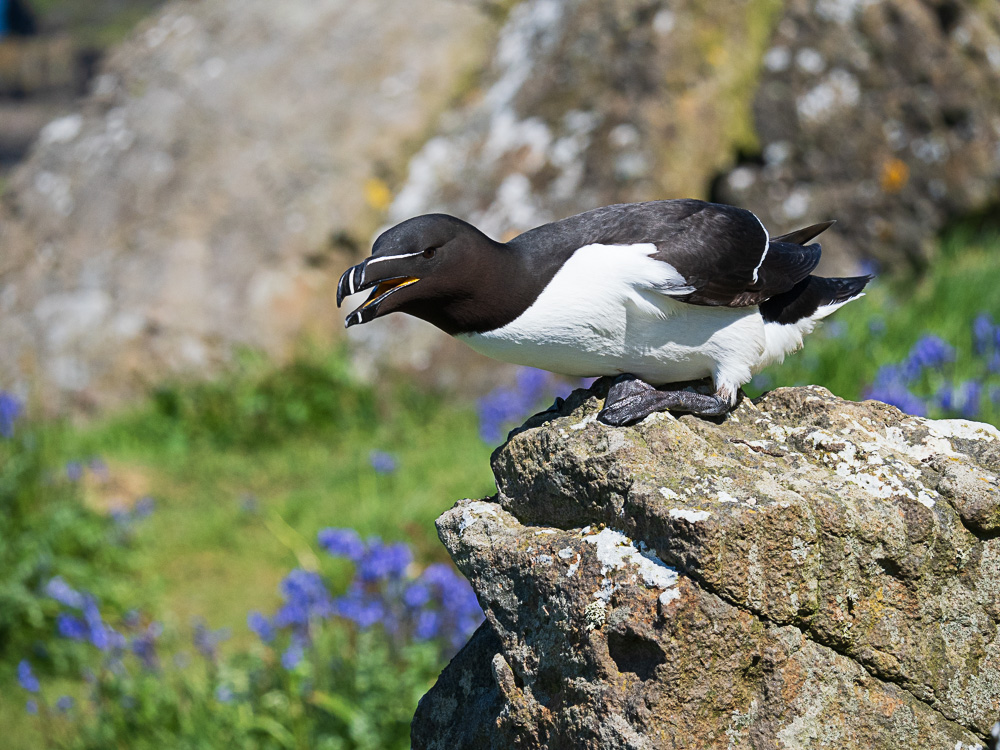
Most of these bird portraits were taken with my 24 – 100 mm zoom lens, not the long zoom that is normally obligatory for bird photography. I did, however, swap lenses to capture one of two arctic skuas which were patrolling around just offshore in an attempt to make unwary seabirds disgorge their food.
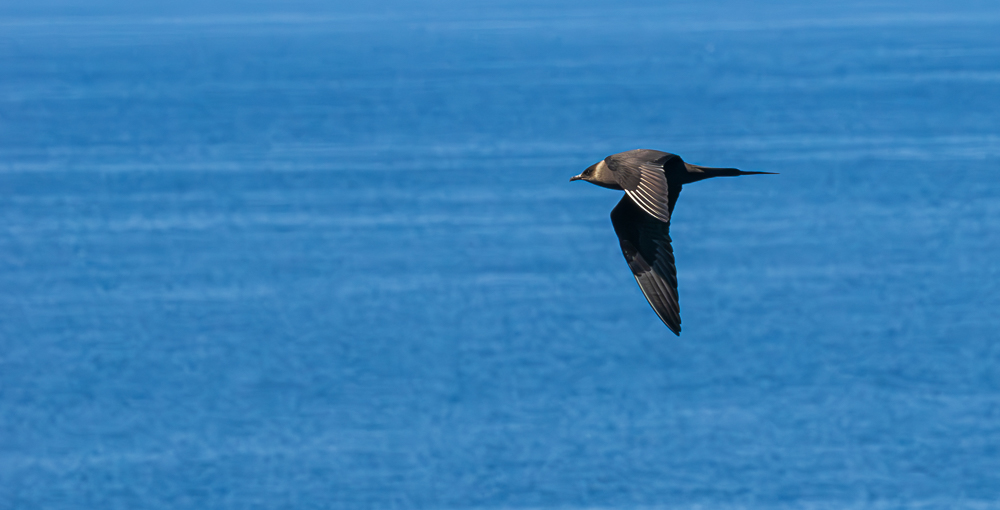
Arctic skua – much reduced in numbers following the avian flu outbreak.
Basalt columns on Staffa

We only had two hours on Lunga and before long it was time to return to the boat. I was exhilarated; it had been one of the best mornings of my life. By contrast, the island of Staffa, inspiration for Mendelsohn’s piece “Fingal’s Cave” and our second port of call, was rather a disappointment. The geology was extraordinary but time was very limited and visiting the cave was like being on a production line. Boat after boat was disgorging its passengers for half an hour and then leaving.

It was only through the series of mistakes I made that we actually got to Lunga at all. If I had had time to do some research I would probably have taken the shorter and cheaper trip to Staffa only. And if it hadn’t been for our neighbour at the campsite we might never been able to appreciate the wonders of this astonishing seabird colony. Serendipity indeed!

To read more Tales from Wild Wales as they are published, please click the Follow button.

My website – http://www.wild-wales.com

Close to perfection – photographing puffins on Skomer

Puffins at the Wick, Skomer Island
On Tuesday I took the boat over to Skomer Island to photograph puffins. It wasn’t my first visit but this time the intention was to photograph them within the landscape. It is easy – all too easy, really – to get frame-filling close-ups of these approachable and entirely charming little creatures. The discipline for me would be to stand back and let the landscape speak as well.

It wasn’t a great start, to be honest. I woke early with the unmistakeable signs of a developing feverish cold. Arriving at Lockley Lodge about 7.30 am. I discovered that a significant queue had already formed. By the time I had checked in at West Hook Farm campsite and returned to Lockley Lodge there were already more than 60 people waiting. So, in the unlikely event that each person was queuing for themselves only, I still wouldn’t get the first boat. In fact I had to wait for the third, leaving at 11 a.m. I consoled myself with the knowledge that Martins Haven wasn’t exactly the worst place in the world to be waiting for public transport!

But taking into account the crossing, disembarkation, a long haul up steps with heavy gear, the obligatory welcome talk from the island warden, and then another mile’s trudge, it was nearly noon before I arrived at the Wick. The sun was almost at its highest already, and I hadn’t even started. Fellow photographer Andy Davies was there with one of his puffin photography workshop groups and I told him my heart just wasn’t in it. Occasionally puffins would fly in with beakfuls of sand eels. This was the “money shot”, the classic puffin image that everyone wanted; yes – even me! I swapped lenses several times, from long zoom to standard zoom, to medium telephoto, each time in reaction what had just happened, and in the hope and expectation that it would happen again. Not a healthy state of affairs. I wasn’t “seeing” anything.

It is difficult to describe the way puffins are at their colonies to those that have never experienced it. There is barely a hint of fear in their attitude to human onlookers. When one flies in with a beakful of fish it sometimes makes a rush for its burrow. But puffins are heavily predated on by herring gulls, which patrol the colony on a regular basis or stand back, just waiting for the opportunity to grab a load of fish. (In fact, research is taking place at the moment to discover if a crowd of people standing within the colony actually improves puffin productivity by discouraging the gulls.) At other times single puffins stand outside their burrows. One disappears underground and another pops up somewhere. One flies in and a couple fly off. One walks over to join its neighbours in a companionable manner. It looked as if they were having a good old gossip. Apart from an occasional argument with its flurry of clashing beaks and flailing wings it is all very relaxed.

Slowly and gradually I began to recognise the way the birds were part of the island landscape. I settled on my medium telephoto zoom lens and began watching as these small gaggles of puffins gathered and parted against the stunning background of the Wick, its aquamarine waters and rocky shores.  I repeatedly walked backwards and forwards along the footpath to set bird against background.  I felt that one puffin was just a distant portrait and had already been done a million times, two puffins together looked like a co-incidence, but groups of three, four and five….. now we’re talking! My main problem was depth of field and I sometimes made the mistake of estimating (well….guessing…) the hyperfocal distance and using that, rather than focussing on the birds. At the shorter end of the zoom at least I got back-to front sharpness in some cases. Elsewhere I planned to create panoramic images anyway so a sharp background wasn’t always important.

It was soon time to pack up my kit and begin the walk back to the jetty in time for the 4 p.m boat back to Martins Haven. My fever had continued to develop during the day and eight hours (altogether) out in the hot sun was definitely not what the doctor would have ordered. I must have looked far from cool in any possible sense of the word – laden with gear, wearing badly fitting sunshades and a wally-style sun hat. Nor was my mood any better. I managed to negotiate an extra hour on the island but was too knackered to take advantage of it. Fortunately I did not need to go anywhere that evening.

The next day I was too ill (man-flu, definitely…..) to do any more photography, unfortunately, so I drove home – a seemingly never-ending series of hold-ups, roadworks and traffic lights. I had a quick look at some of the images before going to bed and I was disgusted. They were all out of focus and I never, ever wanted to see another puffin again in my life! But it was the illness talking and on closer examination I seem to have covered most bases. Having said that a beakful of sandeels somewhere would have been perfection!

To follow Tales from Wild Wales, please scroll right down to the bottom and click the follow button