
In spring 2020 we were all locked down in our homes. On my daily walk (well, one of them….), I discovered a red kite nest just five minutes away. It was easily visible from the track running through the wood and the female didn’t bat an eyelid as you walked past. When she was ‘off duty’ her mate took over and it was panic stations as soon as he saw anyone. The owners of the woodland, both red kite lovers, were managing it for firewood and wildlife and noticed exactly the same thing. They were happy to let me take my kit just inside the wood where I could be slightly closer . And the female carried on incubating as if nothing untoward was happening. It seemed like too good an opportunity to miss. Red kite is a Schedule One species in the UK, meaning that it is illegal to disturb nesting birds at any time during the breeding cycle – from nest-building to post fledging. But was I disturbing her? It didn’t look like it but it was rather a grey area legally.
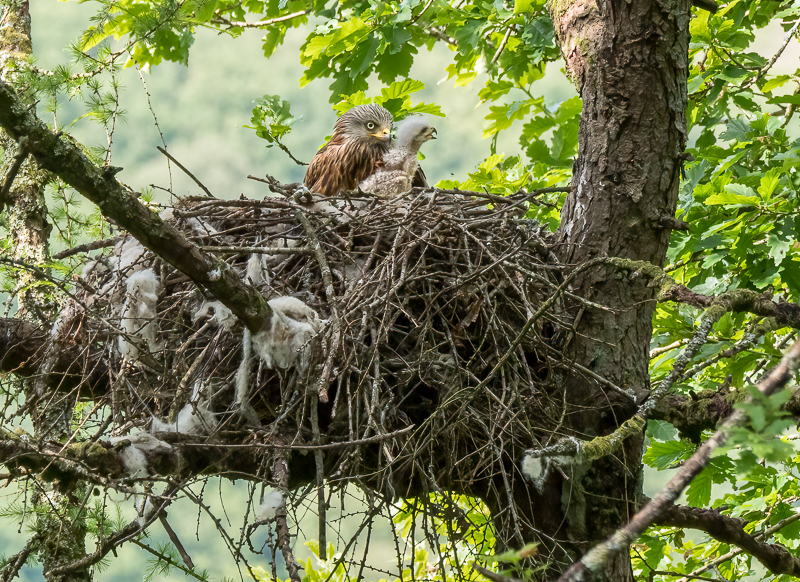
I waited until the chick had hatched and then visited the wood several times during late May. By the 21st the chick was strong enough to raise its head over the rim of the nest and I was able to photograph it with its mum looking on adoringly ( I may be anthropomorphising here ….). By the 25th it was stronger and its white down had become largely brown, with just a few tufts of white on its head. On the 30th the female was leaving the nest for short periods of time and on one occasion, while she was away, a magpie crept unseen close to the nest. As soon as she saw it she was back like a shot. I did not believe a kite could look so threatening! I was set up with the camera and long lens on the tripod, focussed on the nest, so was able to quickly take a few frames of the action. I was thrilled…… and the magpie made a hasty retreat.
You may recall that spring and early summer of 2020 were warm and sunny for long periods, often with no cloud at all, which made lockdown quite bearable. It also meant that for long periods of time photography was difficult with harsh sunlight throughout the middle of the day. Photographing in woodland in these conditions involves dark leaf and branch shadows and bright highlights, with massive contrast differences. The red kite nest was no exception. I decided to give it a break until some more photographer-friendly conditions came along. When I returned about a week later I discovered something tragic had happened to the kite chick. My friends had just discovered that it had disappeared and the parents were flying around in an anxious and agitated fashion. That was the end of the kites’ nesting attempt and they drifted off fairly soon afterwards. What had happened was a mystery, and the nest disintegrated and disappeared over the next couple of years.

So why am I recounting this story in April 2025? Well…. the kites are back! A pair has built a new nest in a different tree only about ten yards from the 2020 nest, in a very similar position, right out in the open, below eye level as seen from the track, and the female doesn’t bat an eyelid as you walk past. My guess is that she is the same bird that I photographed in 2020.
I am currently monitoring red kites in the area surrounding my home and have a licence to disturb the birds at the nest for this purpose. However it doesn’t include photography, unless incidental to the monitoring. I did inquire about a photography licence but the paperwork looked like it would take forever to complete. So I’m wondering if I can photograph the chick’s development at this nest in particular, with the very confiding female, without breaking the law. It’s a tricky one.
To read more Tales from Wild Wales as they are published, please click the Follow button.
My website : http://www.wild-wales.com







 Tales from Wild Wales