Earlier in June the birding media put out a “Mega Alert”. Forget the jargon, this meant that an exceptionally rare bird had been seen in the UK. It was, in fact, a Western Reef Heron, and it had been found near Penegroes, Gwynedd, where my friend Jonathan lives. I had been contemplating meeting up with him so this seemed to be an ideal chance to kill two birds with one stone – not literally of course. Fortunately he is also a birder. We met on the Monday and headed off straight away to Foryd Bay, on the coast just to the west of the village, and it wasn’t long before we saw a line of cars parked at the side of the coast road and then a gaggle of birders with tripods, telescopes and long lenses. We had arrived.
The western reef heron is clearly an elegant member of the heron family, very similar in structure and size to a little egret, with the exception of the bill, which is longer. In fact the two species can interbreed in areas where they occur together. The nearest population is in west Africa although the species is being seen more frequently these days in Spain and France. This individual is the first that has ever been seen in the UK; so perhaps it heralds the eventual colonisation of the UK by the species following the little, great white, and cattle egrets. Probably not in my lifetime, though…….
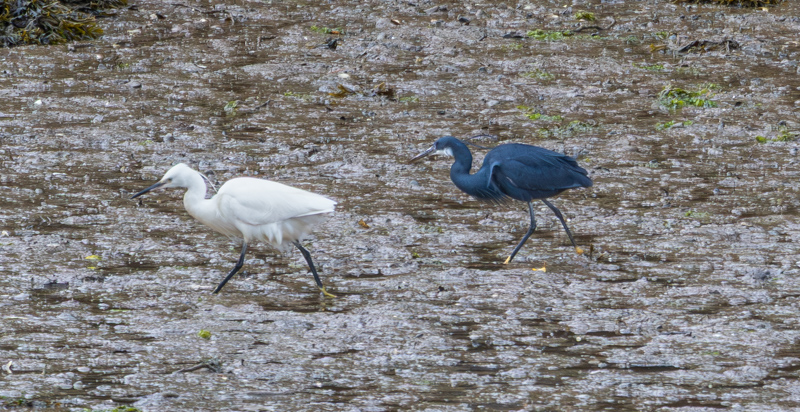
To use birders’ terminology the heron was “performing well”. I took a series of record shots but rather too soon the bird had flown and disappeared. It was refound roosting with grey herons at Caernarfon harbour, a few miles to the north. We were back on the coast the following morning, where it was feeding in exactly same muddy channel as the previous day. It flew again but was refound later in day at Caernarfon, roosting in the same tree. Obviously a creature of habit.
On the Wednesday morning we headed straight to Caernarfon where several dozen birders were already congregating on the harbour wall. The heron was feeding quite happily on the opposite side of the river, slowly walking along the muddy shoreline. I made a dash for the footbridge and walked a short distance upstream. Hiding amongst the boats pulled up on the mud I managed a series of fairly close-up images of the bird set against the colourful reflections of the town in the water. It was really a quite delightful experience!
What also impressed me was the behaviour of the other birders and photographers around the bird. It was all very good natured and there was none of the selfish behaviour sometimes (apparently) occurring at twitches. And the bird was not disturbed at all, as far as I could see.
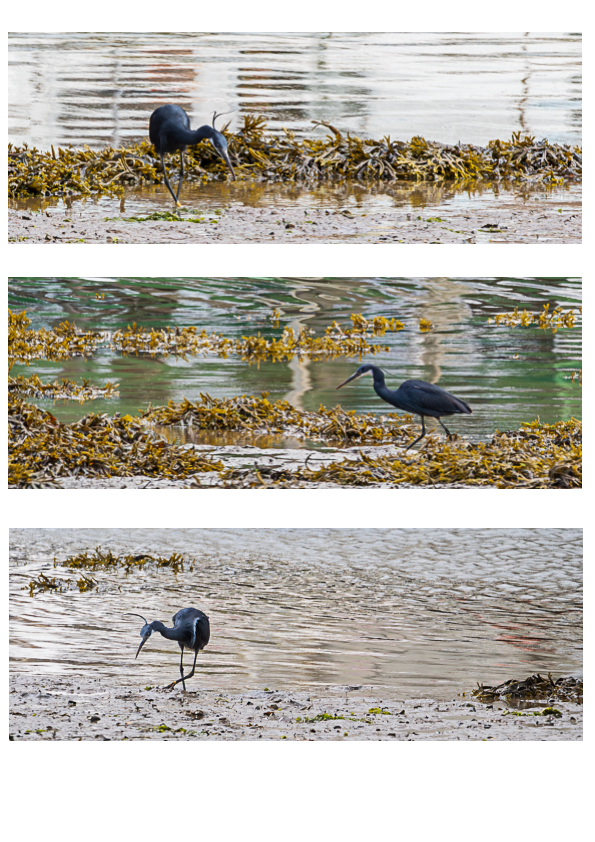
Returning home and processing the images I realised that some of them would work well “Bird/land” style (see here for an explanation). I selected three and put them into the Bird/land template. I think it works very well.
Over the last week or so the reef heron has been doing a tour of the north Wales coastline, visiting Deganwy and Conwy RSPB reserve among other places. It emerged that it had also been photographed in Pembrokeshire during May, without being identified. It must like the Welsh coast, but where did it hide away unseen for almost a month?
To read more Tales from Wild Wales as they are published, please click the Follow button
 Tales from Wild Wales