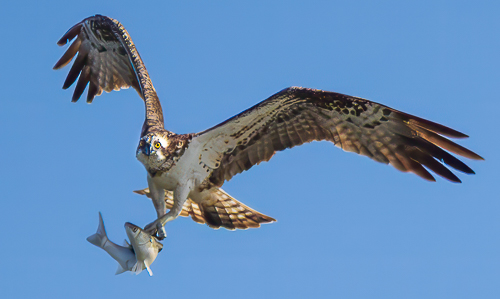
Oh the irony of it.

Osprey (unringed….) with prey

I’m a fairly regular visitor to the Teifi Marshes, at Cardigan, which has a selection of easily accessible hides allowing excellent views of interesting birds at close quarters. It must be one of the best places in the UK to photograph water rails, for example (see this post), and kingfisher. It is about fifty miles away from home, and I tend to visit the reserve if I am on my way down to Pembrokeshire for some reason. What I usually do is leave home the previous evening and sleep in the van, meaning that an early morning visit is easy. For a number of years I had a favourite park-up, about a mile away, in a very wide and deep farm gateway, where I had never seen any farming activity.

One such visit was late last winter. It was a cold and frosty night and I woke early to find the van enveloped in thick valley fog. I opened the rear doors to see a group of white ponies standing the other side of the gate in a white-out. It really was magical. I put the kettle on and began making my breakfast. Then I heard a vehicle arrive next to mine and its door opening. “Oi…. you can’t park there ….it’s private property!” came a voice (or words to that effect) . It was the farmer, coming to feed his animals. I hurriedly threw on some clothes and apologised profusely, switching off the kettle and moving into the driver’s seat. Turning the ignition key there was a click, and then silence. The battery had died overnight. I was so embarrassed! To his credit the farmer could see that I was harmless and was in an impossible situation. He easily carried his bales of hay the few extra yards from his trailer to the gate, and was away. I called the breakdown service and settled down to a long wait and a leisurely breakfast. I wouldn’t be visiting the Marshes that morning…….

Since then I’ve found another park-up not far away and have spent a few nights there. One such was last week, and I arrived at the reserve about 7 o’clock on Thursday morning; the tide was high, the river full and the hide overlooking the (tidal) creek seemed to be a good place to start. I spent some time there and saw a very good selection of species – kingfisher, water rail, greenshank, and curlew among others. The problem for the photographer is that both the Creek and Kingfisher hides face east; the light can be very difficult at both until at least mid-morning. Nevertheless I did manage some close-up images of a kingfisher from the latter; I also watched a water rail there fly to the island, and then swim back to the main reedbed a few minutes later! Returning to the Creek hide I photographed a small wader creeping around at the water’s edge. Although the photograph is nothing to write home about it was good enough to identify the bird as a green sandpiper.

It had been reported earlier in the week that three different ospreys had been seen fishing on the Teifi river alongside the marshes. They had been identified by the colour rings fitted to their legs as nestlings. One was unringed, another had been ringed in Germany and the third in Scotland. I returned to the Curlew hide on the river-bank in the hope that one would turn up. And turn up it did! Another photographer was droning away about all the birds he’d seen and where, when I noticed the gulls on the river had all flown and scattered. There was obviously “something about”. And sure enough, an osprey appeared over the river and, at its first attempt, proceeded to catch a fish right in front of the hide! During the minute it took the bird to gain enough height to fly away I was able to get a sequence of images of it with its prey. They weren’t all sharp but by judicious use of the denoise, selection and sharpening tools in Lightroom (and even a tweak in Topaz Photo AI) I was able to get several I am very pleased with.

I’m not sure if ironic is the correct word to use here but I chose the main photograph from the sequence because of the fish’s position. I doubt if the poor creature appreciated how this single split second (one four-thousandth to be exact) during its final moments of life in the osprey’s talons gave this meticulous photographer the most creative satisfaction.

NB. I’ve just cropped the main photo to enlarge the bird.

To read more Tales from Wild Wales as they are published please click the Follow button.

Cheep, cheep! Cheap chicken ain’t cheap. Part Two.

Subscribe to continue reading

Subscribe to get access to the rest of this post and other subscriber-only content.

Cheep, cheep! Cheap chicken ain’t cheap : Part One

Back in the 1990’s I was involved in a local environmental group – Friends of Cardigan Bay – whose focus was the bottlenose dolphins which frequented the Bay. One of our main campaigning issues was for the proper treatment of sewage. Until 1989 water supply and sewage disposal in the UK were both the responsibility of water authorities which ‘marked their own homework’. Britain was often described as “The Dirty Old Man of Europe” for its filthy beaches, rivers and coastal waters. It was only thanks to the UK’s membership of the EU that things did not get completely out of hand. European legislation led to Britain being prosecuted for water quality failings at our beaches and rivers.

It seemed sensible to me that water supply and disposal should become the responsibility of private companies while their activities should be regulated by a separate, publicly funded, body, the National Rivers Authority, later the Environment Agency, which in Wales morphed into Natural Resources Wales. I then took my eye off the ball, and, with so many other environmental problems to be dealt with, so, it seemed, did most activists. The assumption was that the system was working.

Perhaps the system did work for a while. But the Tory Party returned to power, and with it came austerity. The Conservatives believe in “light touch regulation” – or to put it another way – as little regulation as possible, preferably none – and rather than dismantle them completely, the regulatory bodies were starved of the funding they needed to function properly.

Privatisation of the water industry was never popular with the general public, and water quality has thankfully become a big political issue in the last few months. Thanks to high profile individuals like Feargal Sharkey, much criticism has appeared in the media over the polluted state of our rivers and beaches, the lack of investment, the huge salaries paid to company directors and the massive dividends paid out to shareholders. In Wales the River Teifi is so badly polluted by sewage and agricultural run-off that any housing developments in the river’s catchment have been put on hold. The river just can’t deal with any more nutrients.

A new threat has emerged in recent years – the proliferation of IPU’s (intensive poultry units), otherwise known as chicken factories. These are basically meat production units on family (and other) farms where upwards of 100,000 chickens (….. up to a million!) are reared in huge sheds at any one time. Typically there are seven or eight “crops” of birds per year, which means that each bird must reach its maximum weight by about six weeks old, to allow for cleaning and re-stocking. It is difficult to justify the use of the term agriculture to describe them; they are high-tech facilities in which heat, lighting and feed are controlled to a minute degree to maximise the birds’ growth rate. If they must exist, they would be more appropriately located in industrial units on the outskirts of our larger towns and cities. However, as long as they remain classified as agricultural developments, they largely fall outside the control of local authority planning system. This is described as a “planning void”. I am unsure of the exact business model underlying them but each individual farming business has little control of their operation other than the disposal of the waste products. And that is the big problem. Such huge numbers of birds produce massive quantities of excrement, and it is the farmer’s responsibility to dispose of it. Much of it is spread on land surrounding the farm. It is then washed into the nearest watercourse during periods of rain.

The River Wye is “protected” as a Special Area of Conservation from source to sea. Despite that, IPU’s are particularly common in its catchment on both sides of the English / Welsh border. It is said that there are 20 (or possibly up to 44….) million chickens in the area. The Wye and its tributaries are badly affected by the massive input of nutrients from chicken droppings spread on the land around the IPU’s. Notwithstanding its SAC status the river is in ecological decline (some say “crisis”) and has become prone to developing algal blooms. It is said that it is dying.

But why, oh why the Wye?

Here is my understanding of the situation in a nutshell. In 2013 the giant American multi-national agribusiness Cargill, through its newly formed subsidiary Avara, agreed with Tesco to process chicken meat on an industrial scale. As a result Avara invested £35 million in refurbishing and expanding its chicken processing plant at Hereford. Having done that it needed more birds to process, and farmers in the Wye valley were keen to sign up. Presumably each one has a contract agreeing to host a certain number of “crops” of birds every year, which remain the property of Avara, to buy all their feed and day-old chicks from specified suppliers, to supply only Avara, and use only labour supplied by Avara to remove dead stock and grown birds and clean the buildings out every seven weeks. Each IPU is, in effect, a satellite of Avara’s main processing facility, with one exception. Removing the chicken excrement is the farmers’ responsibility.

It’s funny that, because Cargill (Avara’s parent company) has faced court action in the USA over the last twenty years for polluting watercourses with chicken excrement. They have denied responsibility, placing the blame on individual farmers, but settled out of court. Avara would have known that their massive expansion of chicken production in the Wye catchment would lead to pollution problems, but carried on anyway. Throughout its history Cargill has been beset by scandal and controversy. Only this month (May 2023) it has been subject to a new legal challenge over deforestation and human rights violations in Brazil, where most of the soy used for chicken feed in Europe is grown. Cargill has been described as “the worst company in the world” and if you would like to read more about them click on the links below. But beware – it does not make pleasant reading.

For more information on Cargill see the following:

https://unearthed.greenpeace.org/2020/11/25/cargill-deforestation-agriculture-history-pollution/

and https://www.mightyearth.org/cargillreport

Part 2 will follow shortly.

To read more Tales from Wild Wales as they are published, please click the Follow button