A close encounter.

Play-fighting stoats, July 2020.

In an earlier post I explained how I had been unable to sharpen a particularly good (……. I thought) image in Lightroom. Under normal circumstances Lightroom does everything I need, including sharpening, but it is not designed for more extreme situations. In my post I explained that I had successfully sharpened the image in Topaz Sharpen AI, but that my trial version added a watermark. Unfortunately it was no longer available and its successor, Photo AI, costs close on $200. How much was a I willing to pay for such specialised software?

Luminar Neo also has built-in AI sharpening and is available for a more reasonable price. The marketing spiel for this software suggests that it is aimed mainly at those who wished to replace skies in their images, which is anathema to me. But I swallowed my pride and signed up for a trial. It seemed to sharpen my problem file but I could not get it to work as a plug-in to Lightroom, which was a pain. It seemed there must have been a bug in the software and their technical people were using me as a guinea pig to trouble-shoot it. I gave up. Then Photo AI appeared at a “sale” price and I took the plunge.

I have recently been going through my files from the last decade for a potential sale to a rewilding charity. In some ways this is a tedious chore involving making countless decisions between images differing only by minutiae. However at the same time I was able to re-discover some that I had completely forgotten about. The one above is a case in point.

It was taken during lockdown in July 2020. I visited a local pond a number of times during that spring and summer, as it was within walking or easy cycling distance of my home. On one visit a family of stoats appeared out of the vegetation and began playing on the road. There was probably a mother and three kits. I was treated to a close encounter with this lovely group of animals which lasted about ten minutes. The youngsters were aware of me but didn’t seem to recognise me as a threat. It was the sort of encounter that wildlife watchers dream about. There was plenty of action which was quite a challenge for me with my slow reflexes. Much of the activity seemed to be play-fighting; the sequence from which the main image was taken ending up with the right-hand animal appearing to be “playing dead” on the ground.

I came away with quite a selection of images but many were below par in some way, mainly due to the narrow depth of field that long lenses produce. In the main image the left-hand animal was perfectly sharp but the one on the right just wasn’t. Fortunately Photo AI has worked wonders on the out of focus animal and I have a photograph I can feel very proud of. One for the Countryfile calendar, perhaps………*

*Or possibly not…..I’m still a professional. But you see what I mean?

To read more Tales of Wild Wales as they are published, please click the Follow button.
Every picture tells a story.

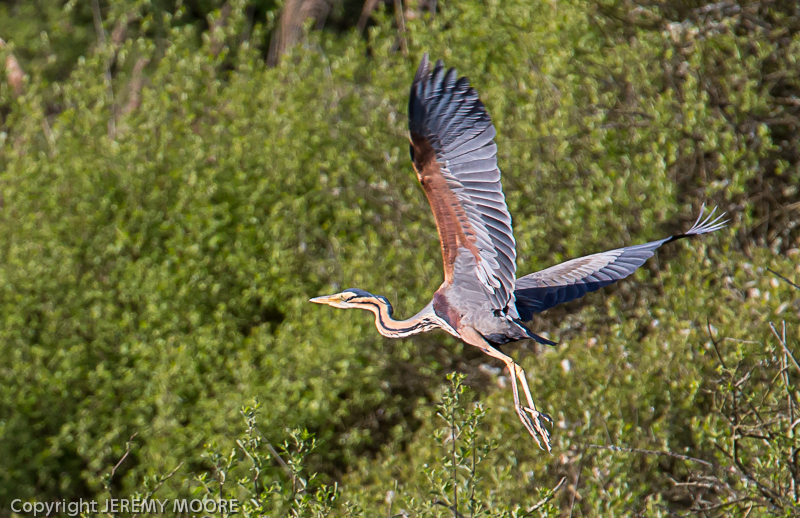
Purple heron : what an amazing creature!

I can’t have been the only photographer to have recently received junk email offering…..”Always have amazing skies!”. It goes on –

With the killer App for Sky Replacement and our new Skies and Clouds Collections

With […………..] sky replacement is no longer like Rocket Science

Add Skies III and our amazing new Drag and Drop Cloud Formations and the skies the limit on creativity!”

Two New Bundles to SAVE on so you’ll never have Dull Skies Again

It goes on and on in this vein.  I find it terribly depressing. The graphic designer could thus, for example, adapt a poor quality landscape image by adding a sky downloaded from a software package. No photographic skills required whatsoever! Likewise the amateur (or professional) landscape photographer wanting short-cuts to dramatic photographs. It has until recently been difficult to incorporate stunning skies into landscape images without stunning skies being present in reality. Doing so in the days of colour film would have involved a very high level of printing skills indeed and it is probably fairly safe to say that it had rarely been done successfully. In the brave new world of digital photography much of the work involved has been already been done by the software designer.

But this kind of approach does more than make life easier for those wanting short cuts to great landscape images. It devalues photography in its most basic sense. By its very nature a photograph has documentary qualities. I don’t mean to confuse “landscape photography” with “documentary photography” here. But a photograph – any photograph – is an interpretation of a slice of reality. It is rooted in what the photographer saw through his/her viewfinder. So a landscape photograph automatically has documentary values. The very best have both aesthetic and documentary qualities in shed loads. If the photographer has added a spectacular sky – even one of their own – that link between reality and image has been lost.

Many photographers argue that all photographs are “fake” to some extent and that therefore anything goes. In my opinion this just does not hold water. I agree that the photographer makes selections and interpretations at all stages of the process. They might use film or digital, a jpeg straight out of the camera or process a RAW file to their own satisfaction. They might use a 10stop ND filter on their DSLR, a smartphone or a pinhole camera, colour or black-and-white. By making these choices the photographer interprets their surroundings in different ways. But there is a quantum leap between that and getting a sky from elsewhere – their own library  or a software program – to combine with their own image to produce a result.

If it were possible (and necessary) the photographer would physically move a minor irritant (rubbish, for example) from the foreground of a landscape image before pressing the shutter. But if not I don’t really see a problem in cloning it out at the processing stage. I’m not that much of a purist. But it is at this point we enter a very grey area indeed. Where does one draw the line between “processing” and “manipulation” – the acceptable and the unacceptable? Personally I’m happy to clone out anything which on another day might not have been there: a walker in a red cagoule, or white van in the distance, for example. Others draw the line elsewhere. But there is a line. It may well be that advertising photography is artificial through and through, and maybe we should expect that. If there was a line of telegraph poles running through a landscape, though,  I badly need and want to know about it. Every picture tells a story and a manipulated one can tell quite a different story. It could be the difference between a real wilderness and an inhabited landscape in this example.

For more thoughts on this subject see this post.

On the other hand I have no philosophical problem with improving my images at the processing stage where necessary. The more I use Lightroom the more I learn what it is capable of. I was recently introduced to the adjustment brush by my correspondent David Clegg and how useful is that? How could I have managed without it, more like! During the latter stages of my Bird/land project I was able to use the adjustment brush (rather than the radial filter) to select the bird before making minor changes to its exposure or contrast, for example.  So much more effective! See the purple heron image above.

More on Bird/land very shortly, by the way……..


To follow Tales from Wild Wales please scroll right to the bottom and click Follow