Oh the irony of it.

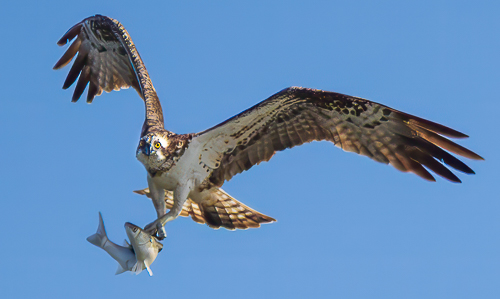
Osprey (unringed….) with prey

I’m a fairly regular visitor to the Teifi Marshes, at Cardigan, which has a selection of easily accessible hides allowing excellent views of interesting birds at close quarters. It must be one of the best places in the UK to photograph water rails, for example (see this post), and kingfisher. It is about fifty miles away from home, and I tend to visit the reserve if I am on my way down to Pembrokeshire for some reason. What I usually do is leave home the previous evening and sleep in the van, meaning that an early morning visit is easy. For a number of years I had a favourite park-up, about a mile away, in a very wide and deep farm gateway, where I had never seen any farming activity.

One such visit was late last winter. It was a cold and frosty night and I woke early to find the van enveloped in thick valley fog. I opened the rear doors to see a group of white ponies standing the other side of the gate in a white-out. It really was magical. I put the kettle on and began making my breakfast. Then I heard a vehicle arrive next to mine and its door opening. “Oi…. you can’t park there ….it’s private property!” came a voice (or words to that effect) . It was the farmer, coming to feed his animals. I hurriedly threw on some clothes and apologised profusely, switching off the kettle and moving into the driver’s seat. Turning the ignition key there was a click, and then silence. The battery had died overnight. I was so embarrassed! To his credit the farmer could see that I was harmless and was in an impossible situation. He easily carried his bales of hay the few extra yards from his trailer to the gate, and was away. I called the breakdown service and settled down to a long wait and a leisurely breakfast. I wouldn’t be visiting the Marshes that morning…….

Since then I’ve found another park-up not far away and have spent a few nights there. One such was last week, and I arrived at the reserve about 7 o’clock on Thursday morning; the tide was high, the river full and the hide overlooking the (tidal) creek seemed to be a good place to start. I spent some time there and saw a very good selection of species – kingfisher, water rail, greenshank, and curlew among others. The problem for the photographer is that both the Creek and Kingfisher hides face east; the light can be very difficult at both until at least mid-morning. Nevertheless I did manage some close-up images of a kingfisher from the latter; I also watched a water rail there fly to the island, and then swim back to the main reedbed a few minutes later! Returning to the Creek hide I photographed a small wader creeping around at the water’s edge. Although the photograph is nothing to write home about it was good enough to identify the bird as a green sandpiper.

It had been reported earlier in the week that three different ospreys had been seen fishing on the Teifi river alongside the marshes. They had been identified by the colour rings fitted to their legs as nestlings. One was unringed, another had been ringed in Germany and the third in Scotland. I returned to the Curlew hide on the river-bank in the hope that one would turn up. And turn up it did! Another photographer was droning away about all the birds he’d seen and where, when I noticed the gulls on the river had all flown and scattered. There was obviously “something about”. And sure enough, an osprey appeared over the river and, at its first attempt, proceeded to catch a fish right in front of the hide! During the minute it took the bird to gain enough height to fly away I was able to get a sequence of images of it with its prey. They weren’t all sharp but by judicious use of the denoise, selection and sharpening tools in Lightroom (and even a tweak in Topaz Photo AI) I was able to get several I am very pleased with.

I’m not sure if ironic is the correct word to use here but I chose the main photograph from the sequence because of the fish’s position. I doubt if the poor creature appreciated how this single split second (one four-thousandth to be exact) during its final moments of life in the osprey’s talons gave this meticulous photographer the most creative satisfaction.

NB. I’ve just cropped the main photo to enlarge the bird.

To read more Tales from Wild Wales as they are published please click the Follow button.

Immaculate birds, constant activity and plenty of noise!

I might be a raptor nut but I love terns too. Wales is a bit of a “tern desert” and with one exception (little terns near Prestatyn) one must visit Anglesey to connect with them. Cemlyn Bay on the north coast is the Welsh tern H.Q. with its large sandwich tern colony, alongside smaller numbers of arctics and commons. On a good day one might see a roseate as well. I can confidently say that a visit to Cemlyn is one of the finest wildlife experiences in Wales. But your timing needs to be carefully judged.

The ideal time is just after the tern chicks have fledged because their parents then guide them to the shingle spit which divides the lagoon from the sea, away from the chaos of the nesting islands. But leave it too late and the whole damn lot of them will have left altogether! Last year I arrived on July 23rd to find that most had already gone, whereas in 2020, August 1st was just perfect.

This year I discovered that the North Wales Wildlife Trust helpfully posts updates on the progress of the colony on its website. It suggested that a visit sooner rather than later would be advisable. So I headed north late on July 12th. The following morning I was there bright and early for the full tern colony experience. Immaculate birds, constant activity, and plenty of noise! Despite nearly 50 years of birding experience I have never totally got to grips with the differences between arctic and common terns. Many birders refer to them as “comics” because they are so difficult to separate. However after this visit I think I’m getting there! Sandwich terns are comparatively easy, and I have so rarely come across roseates that identifying one would be a real adventure (but see this post…..).

Roseate tern (r.) with three sandwich terns. Note its long black bill and long-ish red legs..

As it happened I picked up my first roseate quite quickly. It was visible on and off on the near edge of the main nesting island during the morning, and around lunchtime there were two together. I was able to get a few (rather poor) photographs of them. One of the tern wardens arrived soon afterwards and I was able to point them out to him. How about that for confidence! But as he had been seeing them throughout the breeding season he wasn’t too excited. He told me that one pair had attempted to breed early on but had failed, while he was still hoping that another pair would soon appear from the denser vegetation on the island with a youngster.*

For some time prior to that I was in “spray and pray” (or point and hope) mode. In other words: point your camera at a bird in flight, press the shutter button and try to follow it. This seems to me to be rather a technical task more dependent on luck than anything else, and I find it rather unsatisfying.

Arctic tern …………probably………

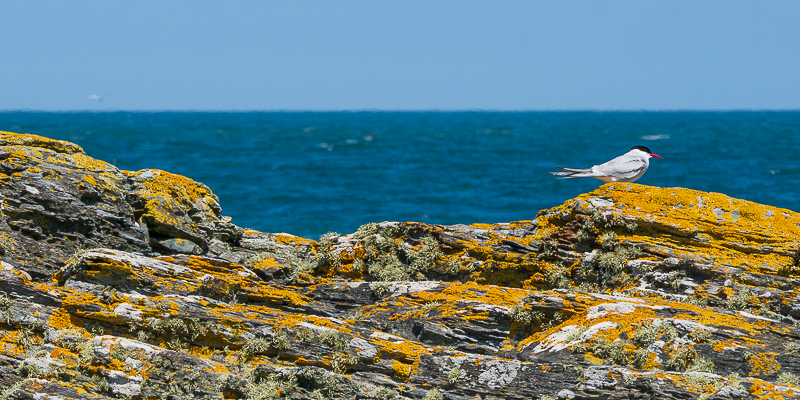
What I found more challenging was to place the terns within the landscape to give them some kind of context. At low tide, during the middle of the day, many roosted on the beach or on rocky outcrops along the foreshore. One could thus place them within an unspoiled landscape, suggesting that all is well with the world, which is perfectly valid. Alternatively, shooting from a different angle, one could set them against the massive hulk of Wylfa nuclear power station , now disused, only a couple of miles away. The viewer can then make up their own mind about the state of the world.

With ……… or without ……..?

As I mentioned this was during the middle of the day when the sun was at its highest. This is never a good time to take photographs of anything in summer so one does one’s best to compensate for it at the processing stage. Some of the newer features in Lightroom are excellent for this – in particular the ease with which “objects” can be selected and processed individually without affecting the rest of the image. And “denoise” is excellent, although rather slow on my PC.

Another thing I noticed very clearly was how the apparent colour of the power station changed during the course of the day. Its colour scheme at breakfast time matches the colour of the lichen covered rocks on the foreshore very well, and it would be uncanny if this had not been part of its design. I included a photograph illustrating this in my book “Wales at Waters Edge”; I wonder if anyone noticed….? But by early afternoon the plant was naturally bathed in blue light and looked quite different. To put it more technically, the colour of sunlight is towards the blue end of the colour spectrum (“cooler”) during the middle of the day, while it is “warmer” earlier and later. This is well known among photographers but I have never known it being demonstrated so clearly as it was that day.

Arriving as early as July 13th was, in the event, quite a close shave. A note on Facebook from the tern wardens on the 18th said that most of the terns (95% of them) had already left the area. I wish them good luck on their travels and hope they make it back to Cemlyn next year.

*N.B. : The second pair also failed …..

To read more Tales from Wild Wales as they are published, please click the Follow button.
My website : www.wild-wales.com

Little and Large

Unfledged youngster on the right, fledged bird eating prey brought in by adult on the left

As I may possibly have previously mentioned ( see this post, or this post for example) I’m a bit of a raptor nut. My favourite species is the peregrine. In 1979 I did my first species protection contract for the RSPB, keeping watch on two peregrine eyries in north Wales that were regularly robbed by falconers. The nesting sites were very distant and I barely saw the birds themselves! Most of my work consisted of driving a particular stretch of road looking for dodgy characters and checking off car registration plates against a list I was provided with. However things improved in the early 1980’s when I monitored peregrines (and other species) on the Isle of Mull and northern England for the RSPB; then in Ceredigion as a volunteer in 1983, and the following year just inside the Arctic Circle in Greenland. My activities then gradually shifted towards a full-time photography career and I soon had no time for birding. Now I have more time again and I’m spending more time watching and monitoring raptors.

Enough of the background! My point is that I know my peregrines.

I was surprised to discover in 2021 that peregrines had returned to nest in inland Ceredigion and I began occasionally visiting two cliff nesting sites near my home. In 2023, one pair reared three young and did so again in 2024. This year I visited the cliff at the beginning of May, then again at the end of the month. It was clear from the latter visit that they were using the usual ledge (an old raven nest) and probably had small young. By June 19th two young were visible and the interesting thing was that one appeared to be up to 14 days younger than the other. One looked full grown although it still had flecks of white down adhering to its body; it was exercising its wings vigorously. Comparing its appearance to the illustrations in “The Peregrine Falcon” (Derek Ratcliffe) it looked about five weeks old. The other was small and downy all over with stumpy little wings, and looked about 3 weeks old. .

My next visit was on June 30th. When I arrived both young were on the nest together; they were pretty much identical in appearance. It looked as if the younger bird had “caught up” with its sibling. Very soon one flew from the nest and landed clumsily in the ivy above the nest. After some time it flew and visited a number of different ledges before landing in full view of the other youngster, as seen in the main picture. In flight it looked confident and skilful. How long ago it had fledged I couldn’t tell. The nestling was clearly desperate to fly, standing on the edge of the nest, screaming and flapping its wings furiously. Several times it appeared to run from the back of the ledge to the front, and then slammed on the brakes. It just wasn’t confident enough to take the plunge into the outside world. After a while one of the adults arrived carrying prey, ready plucked and glistening bright crimson in the sunshine. It dumped the prey on the ledge next to the fledged youngster, leaving its poor sibling flapping and screaming even louder!

I was able to document this photographically, but I must emphasise that I was very distant from the cliff to avoid causing any disturbance. To have done so would have been illegal and also pointless, because natural behaviour patterns would have been disrupted. The photos themselves are not great, having been taken from afar and then cropped drastically. But they do the job.

Derek Ratcliffe’s masterwork “The Peregrine Falcon”, published in 1980, is a superb and comprehensive example of a monograph on a particular species. But there is no mention in it of such a wide age difference between peregrine youngsters, so I wonder how common this phenomenon might be and how it happened. This snapshot in the life of a peregrine family was absolutely fascinating. It might seem that the adult behaviour was cruel. But it is typical bird of prey behaviour designed to encourage the youngster to leave the nest if it wants food. The little thing was desperate to go but this most momentous event in its short life was yet to come.

NB. I haven’t added images of the nestlings individually or together (showing the age difference) as they would be too small. However if anyone would like to see them, just let me know.

To read more Tales of Wild Wales as they are published, please click Follow.

A tricky one…..

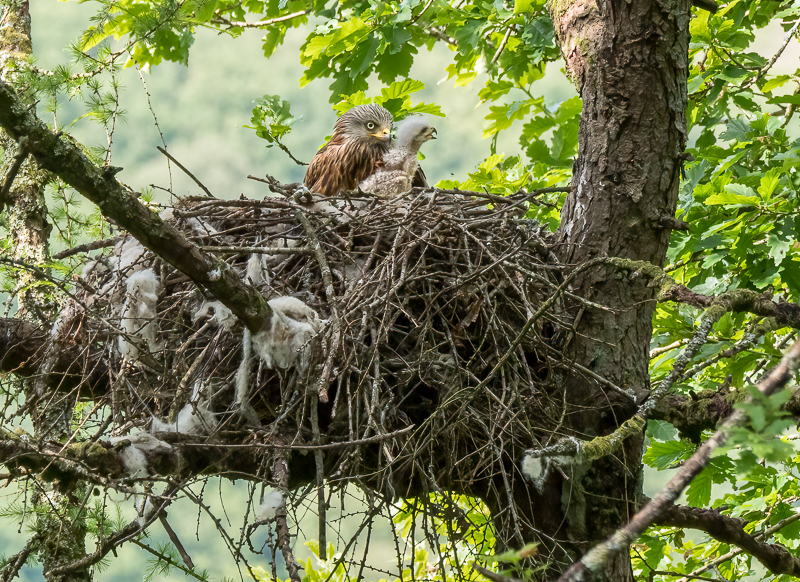
In spring 2020 we were all locked down in our homes. On my daily walk (well, one of them….), I discovered a red kite nest just five minutes away. It was easily visible from the track running through the wood and the female didn’t bat an eyelid as you walked past. When she was ‘off duty’ her mate took over and it was panic stations as soon as he saw anyone. The owners of the woodland, both red kite lovers, were managing it for firewood and wildlife and noticed exactly the same thing. They were happy to let me take my kit just inside the wood where I could be slightly closer . And the female carried on incubating as if nothing untoward was happening. It seemed like too good an opportunity to miss. Red kite is a Schedule One species in the UK, meaning that it is illegal to disturb nesting birds at any time during the breeding cycle – from nest-building to post fledging. But was I disturbing her? It didn’t look like it but it was rather a grey area legally.

Beauty is in the eye of the beholder……….

I waited until the chick had hatched and then visited the wood several times during late May. By the 21st the chick was strong enough to raise its head over the rim of the nest and I was able to photograph it with its mum looking on adoringly ( I may be anthropomorphising here ….). By the 25th it was stronger and its white down had become largely brown, with just a few tufts of white on its head. On the 30th the female was leaving the nest for short periods of time and on one occasion, while she was away, a magpie crept unseen close to the nest. As soon as she saw it she was back like a shot. I did not believe a kite could look so threatening! I was set up with the camera and long lens on the tripod, focussed on the nest, so was able to quickly take a few frames of the action. I was thrilled…… and the magpie made a hasty retreat.

You may recall that spring and early summer of 2020 were warm and sunny for long periods, often with no cloud at all, which made lockdown quite bearable. It also meant that for long periods of time photography was difficult with harsh sunlight throughout the middle of the day. Photographing in woodland in these conditions involves dark leaf and branch shadows and bright highlights, with massive contrast differences. The red kite nest was no exception. I decided to give it a break until some more photographer-friendly conditions came along. When I returned about a week later I discovered something tragic had happened to the kite chick. My friends had just discovered that it had disappeared and the parents were flying around in an anxious and agitated fashion. That was the end of the kites’ nesting attempt and they drifted off fairly soon afterwards. What had happened was a mystery, and the nest disintegrated and disappeared over the next couple of years.

Is this the same female?

So why am I recounting this story in April 2025? Well…. the kites are back! A pair has built a new nest in a different tree only about ten yards from the 2020 nest, in a very similar position, right out in the open, below eye level as seen from the track, and the female doesn’t bat an eyelid as you walk past. My guess is that she is the same bird that I photographed in 2020.

I am currently monitoring red kites in the area surrounding my home and have a licence to disturb the birds at the nest for this purpose. However it doesn’t include photography, unless incidental to the monitoring. I did inquire about a photography licence but the paperwork looked like it would take forever to complete. So I’m wondering if I can photograph the chick’s development at this nest in particular, with the very confiding female, without breaking the law. It’s a tricky one.

To read more Tales from Wild Wales as they are published, please click the Follow button.

My website : http://www.wild-wales.com

A close encounter.

Play-fighting stoats, July 2020.

In an earlier post I explained how I had been unable to sharpen a particularly good (……. I thought) image in Lightroom. Under normal circumstances Lightroom does everything I need, including sharpening, but it is not designed for more extreme situations. In my post I explained that I had successfully sharpened the image in Topaz Sharpen AI, but that my trial version added a watermark. Unfortunately it was no longer available and its successor, Photo AI, costs close on $200. How much was a I willing to pay for such specialised software?

Luminar Neo also has built-in AI sharpening and is available for a more reasonable price. The marketing spiel for this software suggests that it is aimed mainly at those who wished to replace skies in their images, which is anathema to me. But I swallowed my pride and signed up for a trial. It seemed to sharpen my problem file but I could not get it to work as a plug-in to Lightroom, which was a pain. It seemed there must have been a bug in the software and their technical people were using me as a guinea pig to trouble-shoot it. I gave up. Then Photo AI appeared at a “sale” price and I took the plunge.

I have recently been going through my files from the last decade for a potential sale to a rewilding charity. In some ways this is a tedious chore involving making countless decisions between images differing only by minutiae. However at the same time I was able to re-discover some that I had completely forgotten about. The one above is a case in point.

It was taken during lockdown in July 2020. I visited a local pond a number of times during that spring and summer, as it was within walking or easy cycling distance of my home. On one visit a family of stoats appeared out of the vegetation and began playing on the road. There was probably a mother and three kits. I was treated to a close encounter with this lovely group of animals which lasted about ten minutes. The youngsters were aware of me but didn’t seem to recognise me as a threat. It was the sort of encounter that wildlife watchers dream about. There was plenty of action which was quite a challenge for me with my slow reflexes. Much of the activity seemed to be play-fighting; the sequence from which the main image was taken ending up with the right-hand animal appearing to be “playing dead” on the ground.

I came away with quite a selection of images but many were below par in some way, mainly due to the narrow depth of field that long lenses produce. In the main image the left-hand animal was perfectly sharp but the one on the right just wasn’t. Fortunately Photo AI has worked wonders on the out of focus animal and I have a photograph I can feel very proud of. One for the Countryfile calendar, perhaps………*

*Or possibly not…..I’m still a professional. But you see what I mean?

To read more Tales of Wild Wales as they are published, please click the Follow button.

I think I’ve cracked it……

I ended my post of January 20th this year by saying “One of these days I’ll get a decent picture of a water rail.“. On October 10th I mentioned water rails again and said “My record with them is pretty sketchy. They are nimble and fast moving and tend to appear only close to dusk or dawn.

On another visit to the Teifi Marshes at Cardigan early one morning last week all that changed. No sooner had I entered the mallard hide and sat down, than one of the little blighters started squealing from the tiny island just in front of the hide. Soon the bird appeared, quickly followed by another. It seemed as if there was some kind of dispute going on between them. This wasn’t the shy and retiring species of the text books. About nine thirty one emerged from the island’s reeds , walked towards the hide, immersed itself for a short swim, and disappeared again. A few minutes later it re-emerged and swam most of the way towards the reeds to the left-hand side, only to decide that it preferred being on the island after all, and returning. This was brazen!

I took several hundred images altogether, and it has to be said that entire sequences were either out of focus or just generally mushy. I’ve never understood why this happens. But there were enough sharp and well-lit images for me to be able to say ” When it comes to water rails, I think I’ve cracked it.”

Given that the species is renowned for being more often heard than seen, let alone photographed, I can’t imagine there is anywhere better for getting to grips with them than the Teifi Marshes.

To read more Tales from Wild Wales as they are published, please click the Follow button.

My website : http://www.wild-wales.com

In the footsteps of Fay Godwin.

For many years I have been inspired by the work of the photographer Fay Godwin, who died in 2005 (see this post in particular). This is not the place to fully discuss her life or work. But to summarise the trajectory of her career she was a self-taught photographer who progressed from portraits of authors through traditional landscapes to documentary work out in the landscape, in which environmental issues were prominent. She worked in black-and-white throughout until her last years when she made abstract colour still lives in the studio.

Perhaps “inspired” is the wrong word. Without the advantages she had had (her husband worked in publishing……*) I feel that I have been ploughing the same furrow as she did. The sequence of photographs in my first book – “Wales – The Lie of the Land” (published in 1996) – moved from the “unspoilt” uplands through the industrialised lowlands to the “unspoilt” coastline. Hell, it even included a photograph of Snowdon with someone’s clothes line (complete with washing) in the foreground! No, over the years I suppose I have often felt comforted to know that my vision was shared with her. But I never copied her work.

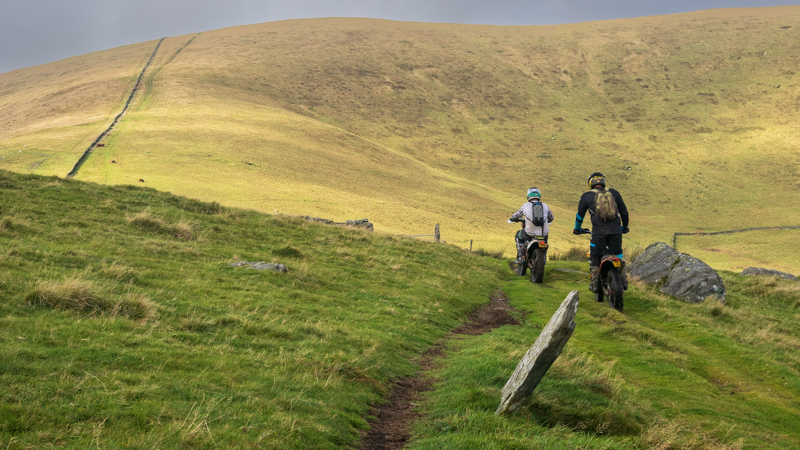
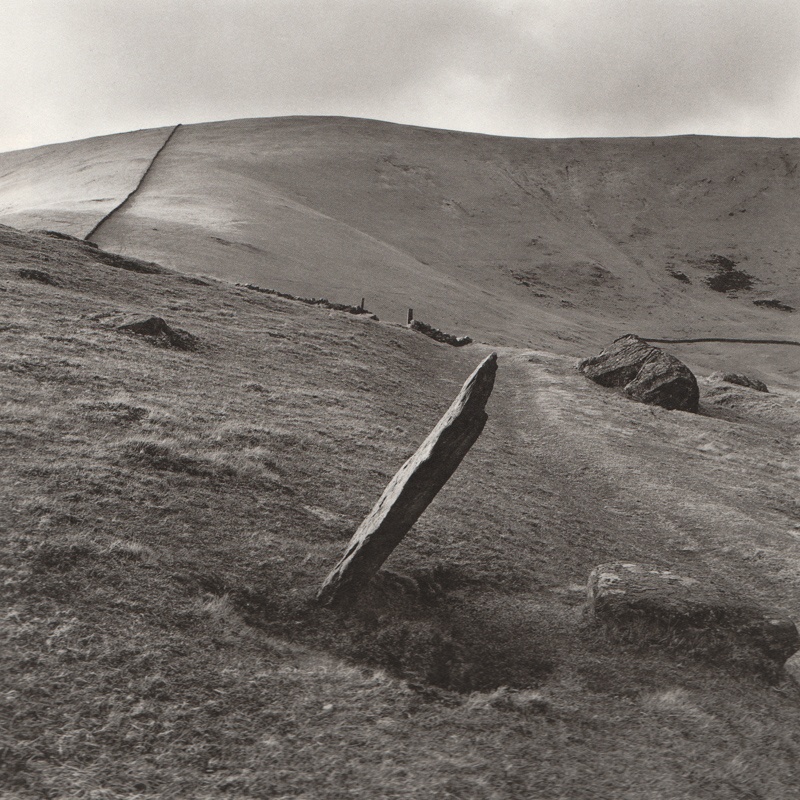
Until now. I was intrigued by one of her most iconic images, “Marker stone, Harlech to London road”, which first appeared in the book The Drovers’ Roads of Wales (1977) by Godwin and the author Shirley Toulson. It is brilliantly seen and geometrically composed, perhaps more exactly than most of her images. The wall on the hillside in the background is exactly parallel to the angle of the stone and the two are linked by another wall almost at ninety degrees to both. But the exact location was not mentioned and I wondered if Godwin had taken the photograph but couldn’t remember exactly where it had been. I decided I would track the location down and replicate the image.

Godwin (1976)
Moore (2024)

The route of the old Harlech to London drovers’ road is mapped in Toulson/Godwin and I wrongly assumed that the stone would be marked on the current 1:25000 Ordnance Survey map. At the Royal Commission for Ancient and Historic Monuments in Aberystwyth I was told that marker stones were commonplace, not necessarily ancient, and as a rule not catalogued. I studied the ancient road’s route on an old OS map online in their library. Marker stones were plotted at regular intervals and by carefully relating one of them to a gate in a wall (visible in the Godwin image) and the wall up the hillside in the background I came up with the prime suspect.

It was an exciting walk up from the roadhead towards the uplands. The closer I got the more confident I became that my guess was correct. The drovers’ road is what would now be described as a “green lane” and was suffering the same fate as many others – offroad bikers churning up the grassy surface into a rutted mess. Then I began to lose faith; none of the other marker stones were visible, and the far “vertical” wall seemed to be pivoting around to the wrong angle. But I needn’t have worried.

I was just getting acclimatised to the place when I heard the (unfortunately) familiar sound of scramble bikes heading towards me. My heart sank but I quickly realised it would be an opportunity to add value to the image I was visualising. I took a series as they headed past the stone towards the gap in the wall. I then got down to the task in hand – finding the exact location where Godwin had stood, sat or kneeled to make her image.

It proved to be impossible. The stone was smaller than it appeared from her photograph and it looked as if it might have sunk or toppled slightly over the last 48 years. The left/right wall was invisible unless I stood up, in which case the tip of the stone was well below its position in the original. I also came to the conclusion that since 1976 grazing pressure on the grassland had become less intense, allowing the turf to spring up and hide the wall and most of the gateway.

An obvious new route has been created to the left of the stone by offroad bikers. On the far hillside, parallel to the wall, a network of illegal scramble bike tracks can be seen; in fact the two offroaders that passed me carried on and added to them – up to the ridge……turn around……slither down again….. The final difference between the two images being a substantial flat rock lying to the right of the marker stone which is missing in the 2024 images.

So would Fay Godwin have approved of my pilgrimage? Quite possibly not. Would she have approved of the new image complete with bikers? I’d like to think so, particularly later in her life.

*Chief editor at Penguin Books and later Managing Director of Weidenfield and Nicholson. It all helps……

To read more Tales from Wild Wales as they are published, please click the Follow button.

My website –http://www.wild-wales.com

Another visit to the Teifi Marshes.

Otters on the mallard pool

It almost always worth visiting the Teifi Marshes, a Wildlife Trust reserve near Cardigan (See this post as well). The big attraction for me is the reedbed which has three hides situated within it. Two are on the edge of small pools and the third overlooks a narrow creek draining into the River Teifi. Because the pools are small any wildlife using them tends to be pretty close, and all three hides are popular with wildlife photographers. It is an exceptionally good location to see and photograph kingfishers and even water rails – although my record with the latter is pretty sketchy. They are nimble and fast moving and tend to appear only close to dusk or dawn.

Last Saturday I arrived just after dawn and made my way along the old railway line (now a multi-use path) to the hides. Two otters visited the Kingfisher pool but all that could be seen of them was the top of one head and two trails of bubbles. Entering the Mallard hide I sneezed and a water rail immediately responded with its squealing call. It was on the water’s edge just below the hide but had disappeared by the time I got my gear set up. The same pool was full of activity later on with six squabbling moorhens present. There were also eight little grebes and at one point they all gathered in a semi-circle around the moorhens to watch the battle. Real school playground stuff!

Suddenly two otters appeared from the reeds. I tried to keep calm. My camera was set up correctly to photograph them as they swam slowly across the pool. I had the hide to myself and scrambled from one side to the other in an attempt to avoid having an out-of-focus kingfisher perch in the foreground. (In the end I was able to crop it out) After just one minute the otters disappeared back into the reeds as quickly and as mysteriously as they had arrived.

Unfortunately I didn’t have time to alter the aperture setting so while the otters are sharp the heron is just out of focus. Being a perfectionist this matters to me and I need some sharpening software to improve the image. Lightroom does almost everything I need my software to do but it does have its limitations. Topaz Sharpen AI does a very good job but I only have a trial version and the output has a watermark across it. I can’t get the same results from Photo AI, its successor. Shame!

If you visit the Teifi Marshes, here’s a few pointers. Coming from the south by car head for Cilgerran and take the main drive to the car park and visitor centre (parking fee payable). From the north, it is easier to park in the industrial estate south of the river, between the two bridges, and walk to the hides along the old railway track. For seeing and photographing wildlife dawn is best; by mid-morning the reserve will be the domain of dog walkers, child minders and families with limited interest in natural history. You have been warned!

To read more Tales from Wild Wales as they are published, please click the Follow button

My website : http://www.wild-wales.com

Edit: I have since found that Topaz PhotoAI DOES give a good sharp result when used on this image and I am considering purchasing it.

The Llanberis lone tree

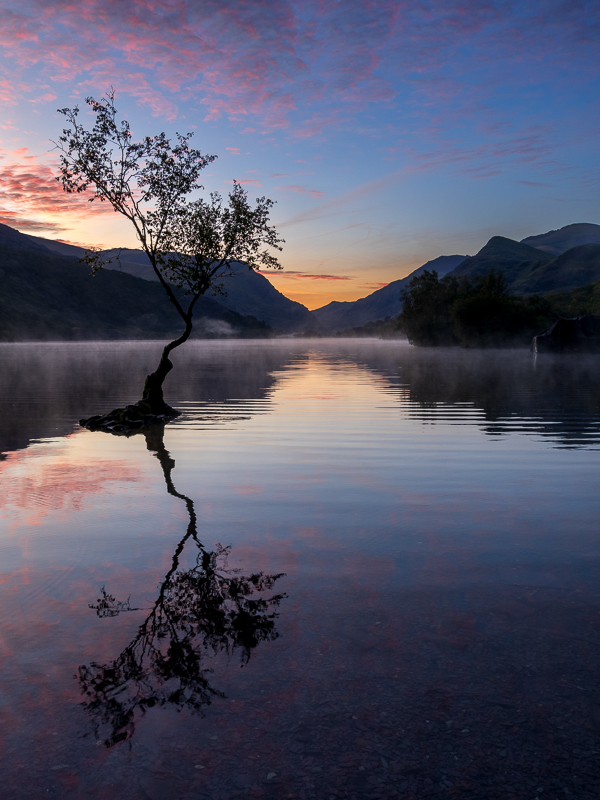
I was vaguely aware that it existed, and I think I may have visited the area many moons ago. But I’d never taken any photographs of it. I had no idea that there were countless zillions of photos on the internet of the Llanberis lonely tree. It even has its own Facebook page (well sort of…..). So last week I decided it was time I put this situation to rights.

Sunday it had rained all day but the forecast was for a clearance overnight with sunshine throughout the following day. It sounded perfect! I had a pretty good idea where the tree was so the plan was to arrive about 10pm, shortly afterwards falling into a deep and restful sleep in my van, and waking gently just before dawn. What I hadn’t allowed for was the fact that a Netflix movie was being filmed there, and barriers were up everywhere. The nearby car parking had also been “improved” with a long list of restrictions, including “no overnight parking”. This is now typical at honeypot locations throughout Wales and probably elsewhere, but I wondered how many parking attendants would be active between 10 pm and 6am. I had a good chat with a very helpful security guard from the location company who reassured me that my presence nearby would be tolerated.

The next morning I did wake fully rested and brewed myself a quick paned*. I found the tree quickly enough although to get there I had to sidestep one security barrier. Everything was set up perfectly. It was flat calm, the sun was just about to rise and there was enough cloud in the sky to make it interesting. About 6.45 the clouds reddened up. Oh joy! I started with a portrait format image and then began a series of landscapes. The reflections were perfect. And then the first security guard noticed me. She came over and asked me how I had got there. Perhaps I had arrived by helicopter? “Well,” I told her, “I walked.” It had been dark and I couldn’t really remember in any detail. I eventually explained that I had walked round a security barrier. It all ended amicably enough, with me reassuring her that I would soon be finished and would then leave. Two more security guards arrived in the next few minutes. All three seemed to surprised to see me there. One was rather officious, telling me he would have to contact his superiors. We both knew it was all bluff. But shortly after 7 am, it was “mission accomplished”. It had given me extra satisfaction to know that I had outwitted “security”, but if they really wanted to exclude visitors they would really have to try harder! I packed up and left.

When I arrived home a few days later I was very pleased with the results, especially the earliest images with the pink clouds. Very soon this gorgeous colouration had disappeared and the later images look better in monochrome. Photography can often be about moments and this moment had lasted about fifteen minutes.

This was the first stop on a whistle stop tour of north Wales and I may write more later.

* Welsh for “Cuppa”……..

My website www.wild-wales.com

To read more Tales from Wild Wales as they are published, please click the Follow button.

Once you’ve seen it…….

……… it’s difficult not see it.

I don’t know how many times I had walked to St Davids Head along the undulating coastal path without seeing Coetan Arthur, the neolithic burial chamber. I had walked around it, possibly crawled under it and definitely photographed it in close up but never noticed how clearly it was visible from some distance away. Then one day I must have seen it and now I cannot walk along that section of the path without seeing it. It draws the eye. I don’t believe this a coincidence either; the coastal path presumably follows an ancient route to the promontory fort on the headland itself. The burial chamber must have been sited so prominently for good reason.

I realised on one visit that the burial chamber would be an excellent foreground against which to photograph the sunset – even if it was but a small feature in a big landscape. So, weather permitting, I have now walked there late in the evening several times to see what the sunset would bring. A few days ago I was in St Davids, exhausted after a day on the road visiting my postcard customers. The weather hadn’t been great but I could see a hint of something interesting in the sky as the evening drew on. I grabbed my camera bag and set off.

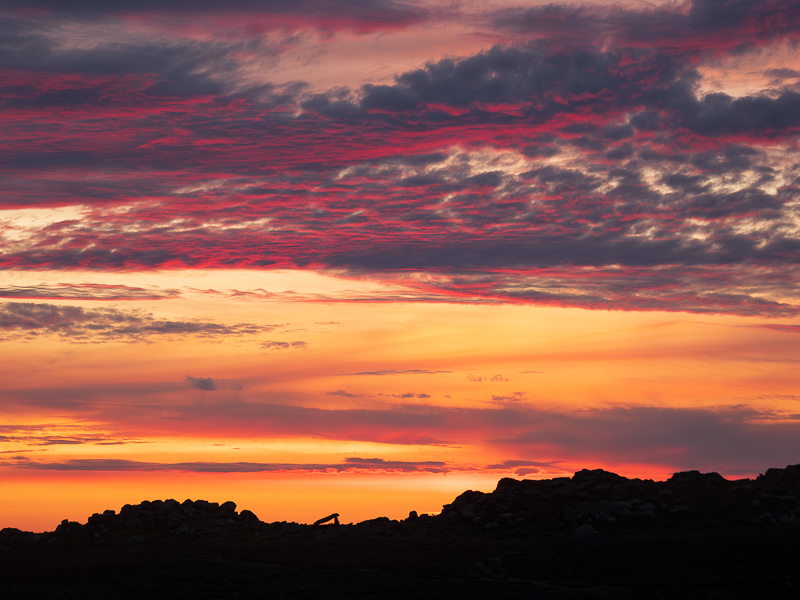
It turned out be a rather wonderful sunset. After the sun disappeared behind the headland all sorts of oranges and reds appeared in the clouds above it. The burial chamber was silhouetted nicely against this stunning backdrop. So, for a photographer who doesn’t really “do” sunsets, I seemed to have struck lucky again.

To read more Tales from Wild Wales as they are published, please click on the Follow button.