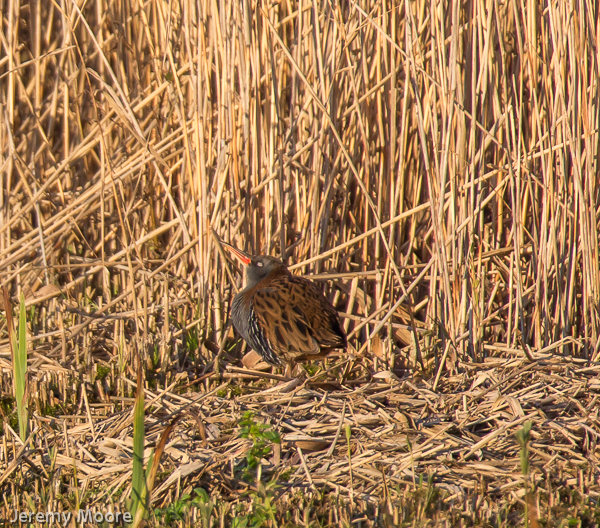
I think I’ve cracked it……

I ended my post of January 20th this year by saying “One of these days I’ll get a decent picture of a water rail.“. On October 10th I mentioned water rails again and said “My record with them is pretty sketchy. They are nimble and fast moving and tend to appear only close to dusk or dawn.

On another visit to the Teifi Marshes at Cardigan early one morning last week all that changed. No sooner had I entered the mallard hide and sat down, than one of the little blighters started squealing from the tiny island just in front of the hide. Soon the bird appeared, quickly followed by another. It seemed as if there was some kind of dispute going on between them. This wasn’t the shy and retiring species of the text books. About nine thirty one emerged from the island’s reeds , walked towards the hide, immersed itself for a short swim, and disappeared again. A few minutes later it re-emerged and swam most of the way towards the reeds to the left-hand side, only to decide that it preferred being on the island after all, and returning. This was brazen!

I took several hundred images altogether, and it has to be said that entire sequences were either out of focus or just generally mushy. I’ve never understood why this happens. But there were enough sharp and well-lit images for me to be able to say ” When it comes to water rails, I think I’ve cracked it.”

Given that the species is renowned for being more often heard than seen, let alone photographed, I can’t imagine there is anywhere better for getting to grips with them than the Teifi Marshes.

To read more Tales from Wild Wales as they are published, please click the Follow button.

My website : http://www.wild-wales.com

Another visit to the Teifi Marshes.

Otters on the mallard pool

It almost always worth visiting the Teifi Marshes, a Wildlife Trust reserve near Cardigan (See this post as well). The big attraction for me is the reedbed which has three hides situated within it. Two are on the edge of small pools and the third overlooks a narrow creek draining into the River Teifi. Because the pools are small any wildlife using them tends to be pretty close, and all three hides are popular with wildlife photographers. It is an exceptionally good location to see and photograph kingfishers and even water rails – although my record with the latter is pretty sketchy. They are nimble and fast moving and tend to appear only close to dusk or dawn.

Last Saturday I arrived just after dawn and made my way along the old railway line (now a multi-use path) to the hides. Two otters visited the Kingfisher pool but all that could be seen of them was the top of one head and two trails of bubbles. Entering the Mallard hide I sneezed and a water rail immediately responded with its squealing call. It was on the water’s edge just below the hide but had disappeared by the time I got my gear set up. The same pool was full of activity later on with six squabbling moorhens present. There were also eight little grebes and at one point they all gathered in a semi-circle around the moorhens to watch the battle. Real school playground stuff!

Suddenly two otters appeared from the reeds. I tried to keep calm. My camera was set up correctly to photograph them as they swam slowly across the pool. I had the hide to myself and scrambled from one side to the other in an attempt to avoid having an out-of-focus kingfisher perch in the foreground. (In the end I was able to crop it out) After just one minute the otters disappeared back into the reeds as quickly and as mysteriously as they had arrived.

Unfortunately I didn’t have time to alter the aperture setting so while the otters are sharp the heron is just out of focus. Being a perfectionist this matters to me and I need some sharpening software to improve the image. Lightroom does almost everything I need my software to do but it does have its limitations. Topaz Sharpen AI does a very good job but I only have a trial version and the output has a watermark across it. I can’t get the same results from Photo AI, its successor. Shame!

If you visit the Teifi Marshes, here’s a few pointers. Coming from the south by car head for Cilgerran and take the main drive to the car park and visitor centre (parking fee payable). From the north, it is easier to park in the industrial estate south of the river, between the two bridges, and walk to the hides along the old railway track. For seeing and photographing wildlife dawn is best; by mid-morning the reserve will be the domain of dog walkers, child minders and families with limited interest in natural history. You have been warned!

To read more Tales from Wild Wales as they are published, please click the Follow button

My website : http://www.wild-wales.com

Edit: I have since found that Topaz PhotoAI DOES give a good sharp result when used on this image and I am considering purchasing it.

The robin says……

Christmas greetings to all my readers!

A couple of weeks ago I spent a few days in the Morecambe Bay / Leighton Moss area of Lancashire. Waking early on the first morning I had arrived at Leighton Moss’s Lower Hide by daybreak – well, it’s not that early this time of year! The windows were smothered in frost so I opened one and peered out. Little egrets were leaving their roost in some scrubby woodland opposite and I counted fifty-seven altogether. How quickly times change in nature…….. Then, all of a sudden, a robin appeared on the window frame about nine inches from my face! It turned out to be the tamest robin I have ever come across. It was obviously a regular visitor because there was a scattering of bird seed on the window  ledge, but I got the impression that it genuinely wanted some human company. Apart from the couple of hours when I went for brunch I was in the hide all day. The robin was never more than a few yards away and usually actually inside it, despite an often full compliment of human visitors being present as well.

Sunbathing water rail

The robin seemed to be paying particular attention to something lying on an empty bench at the back of the hide, so I went over to investigate. It was a laminated photograph of a robin, which had originally been attached to the hide wall.   Every time I held it up the real robin pecked the eye of the robin in the photograph.  Over and over again, absolutely consistently. I held the photograph up and slowly turned it round. The real robin would go round the back to investigate. It was absolutely fascinating. And yet I didn’t feel that the real robin was genuinely angry. It seemed to be playing a game in the same way that a dog will repeatedly bring back a thrown stick.

Well, small things please small minds, you might be thinking. What else took my attention? Leighton Moss seemed to be bursting with two elusive reedbed species, water rails and bitterns, and I had excellent views of both. The former were pecking around the edges of the reeds in several places, but they are extremely nimble and you need lightning fast reflexes to be able to photograph one. One spent quite some time sun-bathing not far from the hide. It must have been asleep because the white nictating membrane in the eye was visible. Another spent a long while in and out of vegetation directly below the hide window, but by that time it was almost dark; I’m still searching for the perfect water rail image, or even something useable. I do get the impression that water rails are common than they were ten or twenty years ago, though.

Bittern at Leighton Moss

It is nearly always exciting to see a bittern although at a big reedbed like Leighton Moss one does get a little blasé about distant half-views of them creeping in and out of the reeds. Reserve staff reckoned there were between nine and eleven birds present last winter, and on my visit several flew towards a particular area of the reedbed from late afternoon onwards. I guessed they were roosting communally.The above was captured on one of these late afternoon flights, but I’m still searching for the classic bittern shot too!

To follow Tales from Wild Wales, scroll right to the bottom and click Follow