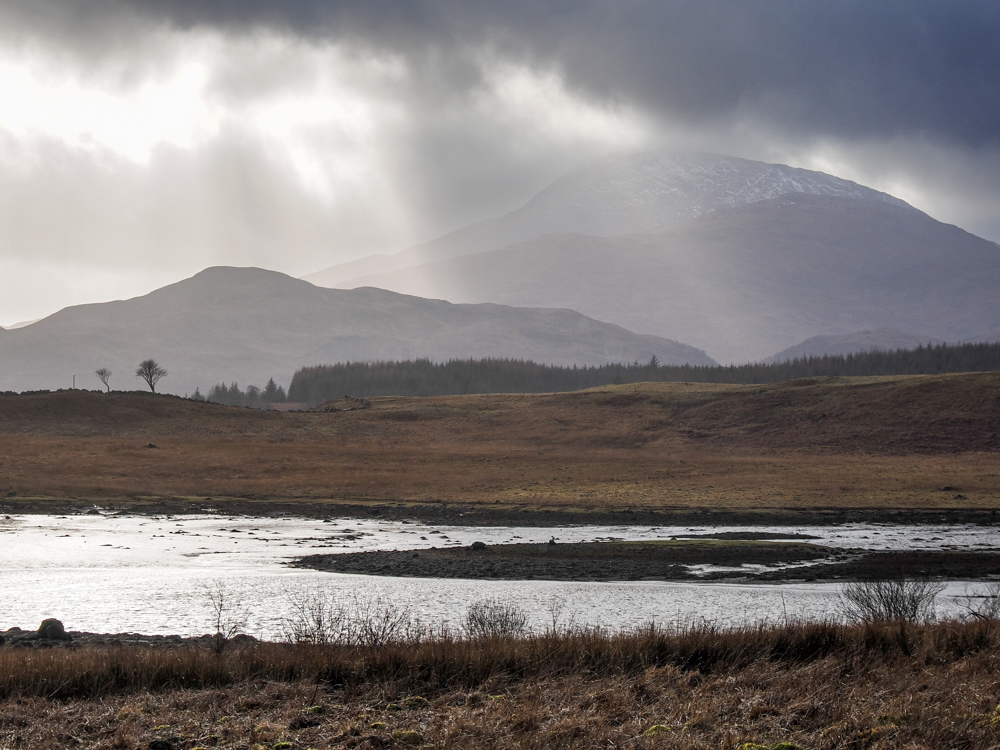
Mulling it over……..

Near Lochdon, Isle of Mull

It was always going to be a bit of a punt, visiting the Isle of Mull at the end of February. I’m not going to tell a lie, the weather was pretty poor. While we were able to get outside every day, even if just for an hour in the evening, I can’t remember a single moment when the sun shone from a clear blue sky. Maybe a peek through thin cloud now and again on a good day…….

At that time of year we hoped to see eagles (golden and white-tailed) and…yes… we did. I surveyed eagles on Mull for the RSPB in 1981, before sea eagles became established. It became apparent that the island was just bursting with golden eagles. Where a territory had no suitable tree- or cliff nesting sites, they would nest more or less on the ground. I’m sure I didn’t find them all but it was thought that there were probably 25 pairs on the island.

There has been a school of thought that during the following decades, as white-tailed eagles successfully colonised the island, golden eagles might be driven out of their territories, especially along the coast. But on the evidence of our visit that did not seem to be the case. Most of our eagle sightings were of birds high in the sky a quarter of a mile away or more and nearly all of them were goldens. While we did see some white-tails they tended to be closer to ‘civilisation’ and thus easier to see. I know this is very poor evidence to support any kind of theory but it was interesting. I’d love to know the truth.
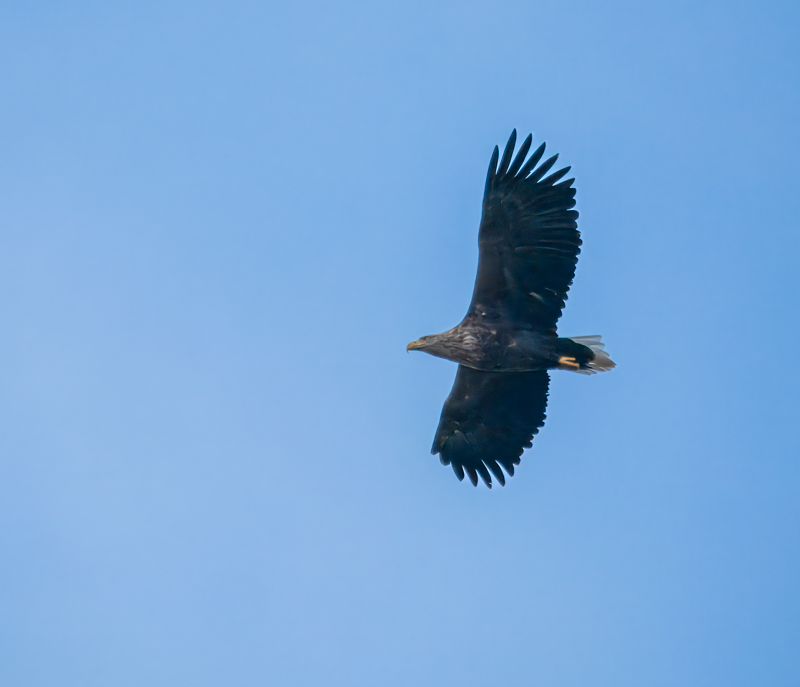
This white-tailed eagle drifted across to take a look at us on our first evening.

But the eagles were by no means the only highlight of the week. Our last morning was wonderful, with little wind and blue skies. From the Oban ferry I picked out what I first thought was a group of small cetaceans. Further observation suggested they were probably blue-fin tuna; I’ve searched online for ID pointers but most websites are far more concerned with catching them than identifying them! Wintering great northern divers were common and the chocolate shop at Craignure was wonderful! Perhaps my most enduring memory was of an otter at the narrow mouth of a sea-loch, Loch Spelve. Sitting onshore and looking across the water I noticed a disturbance mid-channel and it turned out to be an otter, heading inland from the ocean. Every so often it would appear for a few seconds, then dive, its conical tail being the last part of its body to be visible. It came onshore briefly and I managed to get some photographs of it before it headed off again.
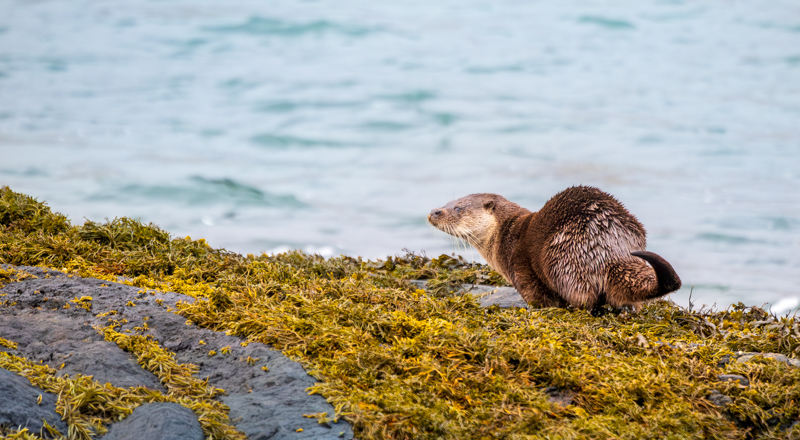
Otter , probably sprainting, Loch Spelve.

I’m trying to get in touch with Dave Sexton, the RSPB’s “man on the ground” on Mull (now retired) for some thoughts on the relationships between golden and white-tailed eagles on the island. If I get a reply, I’ll update this.

For more “Tales from Wild Wales” as they are published, please click the follow button.

Wild goose chase numbers 1 and 2…….

The coming of some sunnier weather last week had me chomping at the bit to do some photography. I have never seen an eagle in Wales but a shower of records and photographs on Facebook suggested that the first-winter white-tailed eagle was still in the Llanuwchlyn area (near Bala) on the Sunday. I contacted my friend Jonathan and we decided to meet up there on Monday morning. A car-load of birders confirmed that I was indeed in the correct area – a tributary of the Lliw valley about three miles north-west of the village. It was a cold but sunny day with a smattering of snow on the ground. I had a an “interesting” time turning the van round on a steep, narrow and icy single track lane with few passing places but having done that it was time to go for a walk. By early afternoon it became apparent that the eagle hunt was a lost cause. There was no sign of it and I returned home disappointed. A post on Facebook during the evening showed that it had been seen at 9 a.m. that day about four miles to the east.

Chores kept me at home for a couple of days but on Thursday what did I do? Set off on another wild goose chase, of course! Four waxwings had been reported on the Teifi Marshes near Cardigan. I was determined to travel down by public transport this time but by 8.30 there had been no sign of the 8.15 bus so it was back to the van. It didn’t take me long to find the waxwings and I watched them on and off until mid-afternoon. They remained within a short section of overgrown hedgerow bordering the old railway track, which is now a foot- and cycle-path. A knowledgeable local birder said it was now their eleventh day on the reserve.

My only previous sighting of waxwings had been at Machynlleth in 2012. A large flock was frantically feeding on ornamental rowan berries outside the library on the main street. Perhaps on that occasion they had recently arrived in the UK after an energy-sapping journey across the North Sea. In contrast the Teifi Marshes birds were very relaxed. Now and again one would half-heartedly pull a desiccated hawthorn berry off a twig but it didn’t seem too concerned if it fell to the ground. In an unusually informative description the Collins Bird Guide states :

“In winter can eat frostbitten and semi-fermented berries, which may intoxicate the bird and render it temporarily incapable of flight”

While they were capable of preening and spent some time doing so, perhaps they were otherwise too sloshed to move! They did, however, fly off as a group just before I left for home. It also was evident that they had no fear of humans or dogs, either, so perhaps they had no previous contact with people in their home in the Scandinavian (or Russian) taiga.

I was pleasantly surprised at the quality of the pictures I managed to come back with. The light was variable, from dark and gloomy to bright sunshine. Fortunately there were some periods of bright sunlight obscured by thin cloud. These conditions produced the best results as no harsh shadows were created and reasonably short shutter speeds could be used..

I also dipped in and out of several hides and had particularly good views of a snipe, while one or more water rails caused momentary excitement. But boy…. do they move fast! One of these days I’ll get a good picture of a water rail.

To read more Tales from Wild Wales as they are published, please click on the Follow button.