Campare and contrast.

Visitor display at the Urdaibai Visitor Centre

There’s no doubt that a highlight of my visit to the Basque country was San Juan Gaztelugatxe on the coast near Bermeo (see previous post) . But there were others too. We planned to do a “compare and contrast” exercise between the Dyfi Biosphere and the Urdaibai Biosphere as the areas are superficially similar. Both sit within regions using a minority language. Each is based on a single river catchment and each has a core area where wildlife is strictly protected. For Machynlleth – a town of about 2200 people in a very rural area of mid-Wales – think Gernika, with its population of 16,000, in the still rural but more highly developed Basque country. For the downmarket holiday resort of Borth in Ceredigion, think Bermeo, once the centre of a thriving whaling industry, now thankfully part of the town’s history. For the Dyfi estuary think the estuary of the Oka. The obviously very well funded Urdaibai is in startling contrast to the Dyfi, with two part-time members of staff, surviving on a shoestring and with its future very much in doubt. So there are similarities but the small scale and perceived lack of importance of one contrasts strongly with the other.

Each has a visitor centre in its core area and the fate of the two couldn’t be more different. In Wales, Ynyslas Visitor Centre near the mouth of the Dyfi was closed last year by its operator, Natural Resources Wales, in very controversial circumstances. It had been open in several different guises for at least 46 years and been steadily developed over that time; I worked there in 1978 when I first moved to Wales. Meanwhile the “Bird Centre” in the Urdaibai was opened in 2012, and is a startlingly modern (high-tech even) facility with large picture windows overlooking lagoons created in the wetlands. It is equipped with telescopes so that staff and visitors can study the estuary’s wildlife.

Breakfast at Urdaibai

And what is more, you can stay there! The bedrooms are modern and comfortable and at breakfast time you emerge into the “guest lounge” reserved for overnight visitors. It is on the top floor and has a wonderful view of the estuary. Telescopes are available and every table has a pair of binoculars for each guest. What a lovely touch! A delicious buffet meal is laid out and you just help yourself. You can eat your fill over a leisurely breakfast and watch birds at the same time. The highlight for me was a black-winged kite, (a distant view only, admittedly), seen as I tucked in to toast, croissants, fruit and coffee. Talk about a breakfast with a view!

Edit: The top photograph lists Biospheres throughout the world but for some reason omits the Dyfi!

For more information about the Urdaibai Biosphere and the Bird Centre see the following –

https://en.wikipedia.org/wiki/Urdaibai_estuary

https://www.birdcenter.org/en

To read more Tales from Wild Wales as they are published, please click on the Follow button

My fifteen minutes of fame.

I wonder if most landscape/outdoor photographers are as solitary as this one? I suspect not. But if I’m not out in the landscape with my camera or binoculars I can usually be found sitting at my desk watching cat videos on Youtube or scrolling though Facebook er….. sorry……. er ……..processing images and running my business. Rarely does the phone ring or an exciting proposal arrive by email. I’m not naturally gregarious and promoting my work comes pretty low down on my list of priorities these days. But an unexpected opportunity came my way last weekend.

I was attending “The Eye” photography festival at Aberystwyth Arts Centre.. It is devoted to documentary photography and photo-journalism and its organiser – Glenn Edwards – has been able to bring some of the biggest names in the genre to little old Aberystwyth over the years. While these are not my specialities I do appreciate good photography of all types and I have always found it a stimulating event.

During the first lecture I noticed that my friend Will Troughton was in the audience. He is the photography curator at the National Library of Wales in Aberystwyth and has always been a supporter of my work. So I went over to have a chat, during which he told me that one of the afternoon events was a visit to the Library. He had selected some prints from its huge Photography Collection (almost a million prints altogether) for attendees to browse through. As well as work from some of the greats of 19th Century photography, he had also chosen some more contemporary work including some of mine. So alongside Carleton Watkins prints of the nineteenth-century American West, and a set of prints of Native Americans from the same era by Edward Sherriff Curtis, was a selection from my exhibition Bird/land (click here to visit my website).

As it happened I had a one-off copy of the Bird/land book with me, so I offered to come down to the Library with him. While I hadn’t prepared a presentation I was introduced as the photographer and it gave me the opportunity to talk about Bird/land with some knowledgeable and interested photographers. I also had a copy of another one-off book with me – the result of a very long term project variously known as ‘my black-and-white project’, the ‘Fay Godwin project ‘, or, most definitively, ‘A Sideways Glance(click here to visit my website.) The two books are so different in style and subject matter that it must seem difficult to believe that the same photographer could have produced both. But I am living evidence that he did! Both books provoked a great deal of interest and some good feedback.

This was a real boost to my confidence. Back at the Arts Centre I collared Glenn Edwards and showed them to him as well. The documentary style of A Sideways Glance was more to his liking, I suspect, and he looked through it very carefully, finally giving me very positive feedback. A few years ago I had hoped that he might give me a slot at “The Eye” but I think his intention has always been to bring photographic excellence to Aberystwyth, rather than showcase local photographers.

The following morning one of the other photographers asked me if it was possible to buy a copy of Bird/land, and I had to explain it was a one-off, and therefore quite expensive. But we agreed on a price and I’m just about to send it off to him down in Pembrokeshire.

As for me, until the weather improves, it’s back to the cat videos!

If you are interested in buying a copy of Bird/land, please let me know. It is in hardback, 28 x 28 cm in size with 20 double-page spreads, on very thick paper in “lay-flat” style. It contains a total of 117 images mostly in the form tryptichs. The price would be £95 including postage.

NB. Sadly it looks like this will have been the final “Eye” in Aberystwyth due to declining attendances. It was good while it lasted!

To receive more Tales from Wild Wales as they are published, please click the Follow button.

Watching me, watching you.

Following a successful and worthwhile visit to the Teifi Marshes, culminating in a stunning photograph of an osprey carrying a fish (click to view) , I continued towards St Davids. One of my very best postcard customers has a shop there and I had been asked to do some more designs of the area. I have to consciously think “postcard” when this is the objective. I suppose I expect other people to have the same visual sense as I do. It was a sunny day with little cloud and a rather dusty atmosphere – not surprising considering all the dry weather we have had this summer. Long distance visibility was not great.

And I couldn’t find my polarising filter. I had “mislaid” (not quite officially “lost”) my first choice polariser and could mentally picture my spare sitting on the desk at home. I don’t use one for bird photography but find it indispensible for landscapes. Without it, what would I actually do on this trip? I decided to concentrate on the area around the Cathedral and Bishops Palace, both situated in the shallow valley of the River Alun, west of the main built up area. I was on the edge of the woodland overlooking the Bishops Palace when I happened to glance upwards – and there was a fox calmly looking down on me as I went about my business.

First sight of the fox (ISO 1600, 1/13 sec at f4)

The only lens I had with me (a 12-100 mm zoom) was long enough. I had time to adjust various settings for optimal quality, but I was grateful for the image stabilisation built in to the lens. By this time light levels were rather low.

Eventually the fox carried on its way. I quietly followed it on a parallel path and then, reaching a track, went upwards. The fox re-appeared from the vegetation and looked at me silently again. I took another burst of images, including the main photo above. I’m going to have to admit here that there was some extraneous and out-of-focus vegetation around the animal but I found it was easy enough to remove it using Lightroom’s AI Removal tool. (Almost too easy, really: where will it end?) None of these images would win the Wildlife Photographer of the Year for that reason , but I’m contented enough. What do you think?

Would this make a good postcard, I wonder?
Or perhaps this?

I had a fitful night’s sleep, waking about 4 a.m. and frantically ransacking the van again for my polariser, but to no avail. Come the morning I looked through my bag again and there was the polariser. It was just sitting there in one of the pockets. How could I have missed it?? So it was over to the Cathedral with a spring in my step. As well as being a crucial photographic tool for me I think it must also be a comfort blanket. The Cathedral has surely been photographed a million times and it was difficult to envisage anything different, especially with a postcard in mind. I spent a while around the Cathedral grounds trying to find something new but I’m not sure I succeeded.

To read more Tales from Wild Wales as they are published, please click the Follow button.

Oh the irony of it.

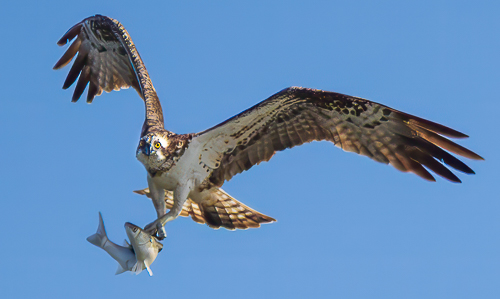
Osprey (unringed….) with prey

I’m a fairly regular visitor to the Teifi Marshes, at Cardigan, which has a selection of easily accessible hides allowing excellent views of interesting birds at close quarters. It must be one of the best places in the UK to photograph water rails, for example (see this post), and kingfisher. It is about fifty miles away from home, and I tend to visit the reserve if I am on my way down to Pembrokeshire for some reason. What I usually do is leave home the previous evening and sleep in the van, meaning that an early morning visit is easy. For a number of years I had a favourite park-up, about a mile away, in a very wide and deep farm gateway, where I had never seen any farming activity.

One such visit was late last winter. It was a cold and frosty night and I woke early to find the van enveloped in thick valley fog. I opened the rear doors to see a group of white ponies standing the other side of the gate in a white-out. It really was magical. I put the kettle on and began making my breakfast. Then I heard a vehicle arrive next to mine and its door opening. “Oi…. you can’t park there ….it’s private property!” came a voice (or words to that effect) . It was the farmer, coming to feed his animals. I hurriedly threw on some clothes and apologised profusely, switching off the kettle and moving into the driver’s seat. Turning the ignition key there was a click, and then silence. The battery had died overnight. I was so embarrassed! To his credit the farmer could see that I was harmless and was in an impossible situation. He easily carried his bales of hay the few extra yards from his trailer to the gate, and was away. I called the breakdown service and settled down to a long wait and a leisurely breakfast. I wouldn’t be visiting the Marshes that morning…….

Since then I’ve found another park-up not far away and have spent a few nights there. One such was last week, and I arrived at the reserve about 7 o’clock on Thursday morning; the tide was high, the river full and the hide overlooking the (tidal) creek seemed to be a good place to start. I spent some time there and saw a very good selection of species – kingfisher, water rail, greenshank, and curlew among others. The problem for the photographer is that both the Creek and Kingfisher hides face east; the light can be very difficult at both until at least mid-morning. Nevertheless I did manage some close-up images of a kingfisher from the latter; I also watched a water rail there fly to the island, and then swim back to the main reedbed a few minutes later! Returning to the Creek hide I photographed a small wader creeping around at the water’s edge. Although the photograph is nothing to write home about it was good enough to identify the bird as a green sandpiper.

It had been reported earlier in the week that three different ospreys had been seen fishing on the Teifi river alongside the marshes. They had been identified by the colour rings fitted to their legs as nestlings. One was unringed, another had been ringed in Germany and the third in Scotland. I returned to the Curlew hide on the river-bank in the hope that one would turn up. And turn up it did! Another photographer was droning away about all the birds he’d seen and where, when I noticed the gulls on the river had all flown and scattered. There was obviously “something about”. And sure enough, an osprey appeared over the river and, at its first attempt, proceeded to catch a fish right in front of the hide! During the minute it took the bird to gain enough height to fly away I was able to get a sequence of images of it with its prey. They weren’t all sharp but by judicious use of the denoise, selection and sharpening tools in Lightroom (and even a tweak in Topaz Photo AI) I was able to get several I am very pleased with.

I’m not sure if ironic is the correct word to use here but I chose the main photograph from the sequence because of the fish’s position. I doubt if the poor creature appreciated how this single split second (one four-thousandth to be exact) during its final moments of life in the osprey’s talons gave this meticulous photographer the most creative satisfaction.

NB. I’ve just cropped the main photo to enlarge the bird.

To read more Tales from Wild Wales as they are published please click the Follow button.

Immaculate birds, constant activity and plenty of noise!

I might be a raptor nut but I love terns too. Wales is a bit of a “tern desert” and with one exception (little terns near Prestatyn) one must visit Anglesey to connect with them. Cemlyn Bay on the north coast is the Welsh tern H.Q. with its large sandwich tern colony, alongside smaller numbers of arctics and commons. On a good day one might see a roseate as well. I can confidently say that a visit to Cemlyn is one of the finest wildlife experiences in Wales. But your timing needs to be carefully judged.

The ideal time is just after the tern chicks have fledged because their parents then guide them to the shingle spit which divides the lagoon from the sea, away from the chaos of the nesting islands. But leave it too late and the whole damn lot of them will have left altogether! Last year I arrived on July 23rd to find that most had already gone, whereas in 2020, August 1st was just perfect.

This year I discovered that the North Wales Wildlife Trust helpfully posts updates on the progress of the colony on its website. It suggested that a visit sooner rather than later would be advisable. So I headed north late on July 12th. The following morning I was there bright and early for the full tern colony experience. Immaculate birds, constant activity, and plenty of noise! Despite nearly 50 years of birding experience I have never totally got to grips with the differences between arctic and common terns. Many birders refer to them as “comics” because they are so difficult to separate. However after this visit I think I’m getting there! Sandwich terns are comparatively easy, and I have so rarely come across roseates that identifying one would be a real adventure (but see this post…..).

Roseate tern (r.) with three sandwich terns. Note its long black bill and long-ish red legs..

As it happened I picked up my first roseate quite quickly. It was visible on and off on the near edge of the main nesting island during the morning, and around lunchtime there were two together. I was able to get a few (rather poor) photographs of them. One of the tern wardens arrived soon afterwards and I was able to point them out to him. How about that for confidence! But as he had been seeing them throughout the breeding season he wasn’t too excited. He told me that one pair had attempted to breed early on but had failed, while he was still hoping that another pair would soon appear from the denser vegetation on the island with a youngster.*

For some time prior to that I was in “spray and pray” (or point and hope) mode. In other words: point your camera at a bird in flight, press the shutter button and try to follow it. This seems to me to be rather a technical task more dependent on luck than anything else, and I find it rather unsatisfying.

Arctic tern …………probably………

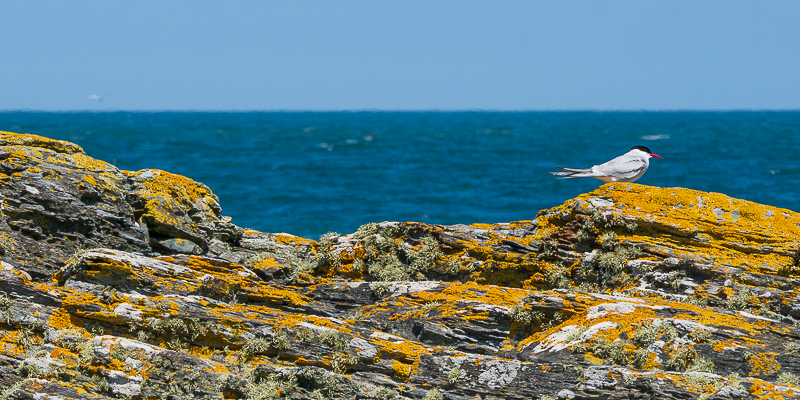
What I found more challenging was to place the terns within the landscape to give them some kind of context. At low tide, during the middle of the day, many roosted on the beach or on rocky outcrops along the foreshore. One could thus place them within an unspoiled landscape, suggesting that all is well with the world, which is perfectly valid. Alternatively, shooting from a different angle, one could set them against the massive hulk of Wylfa nuclear power station , now disused, only a couple of miles away. The viewer can then make up their own mind about the state of the world.

With ……… or without ……..?

As I mentioned this was during the middle of the day when the sun was at its highest. This is never a good time to take photographs of anything in summer so one does one’s best to compensate for it at the processing stage. Some of the newer features in Lightroom are excellent for this – in particular the ease with which “objects” can be selected and processed individually without affecting the rest of the image. And “denoise” is excellent, although rather slow on my PC.

Another thing I noticed very clearly was how the apparent colour of the power station changed during the course of the day. Its colour scheme at breakfast time matches the colour of the lichen covered rocks on the foreshore very well, and it would be uncanny if this had not been part of its design. I included a photograph illustrating this in my book “Wales at Waters Edge”; I wonder if anyone noticed….? But by early afternoon the plant was naturally bathed in blue light and looked quite different. To put it more technically, the colour of sunlight is towards the blue end of the colour spectrum (“cooler”) during the middle of the day, while it is “warmer” earlier and later. This is well known among photographers but I have never known it being demonstrated so clearly as it was that day.

Arriving as early as July 13th was, in the event, quite a close shave. A note on Facebook from the tern wardens on the 18th said that most of the terns (95% of them) had already left the area. I wish them good luck on their travels and hope they make it back to Cemlyn next year.

*N.B. : The second pair also failed …..

To read more Tales from Wild Wales as they are published, please click the Follow button.

My website : www.wild-wales.com

Pipsqueaks.

Bardsey Island (Ynys Enlli in Welsh) is situated off the tip of the Lleyn Peninsula (Penllyn), separated from the Welsh mainland (Y Tir Fawr) by only a short sea crossing, but it could be many miles away. With its remote location, the island tends to attract rare migrants; it also has a manx shearwater colony and a bird observatory. Together with Jane (my partner) and three good friends, I spent last week there. It was actually my seventh stay on the island; each week has been quite different and I well my remember my first. I picked up an infection, probably from the spring water supplied to the houses, which laid me low for a few days. Alone in my accommodation, I felt very ill indeed and believed I could have died there without anyone knowing! Fortunately in recent years a water purification system has been installed.

After another visit I was chatting to a Welsh-speaking neighbour and told her I had just spent a week on Enlli. She looked at me very strangely, and then explained that Enlli is the name of the psychiatric ward at the local hospital. I’ve always used the name Bardsey since then…….

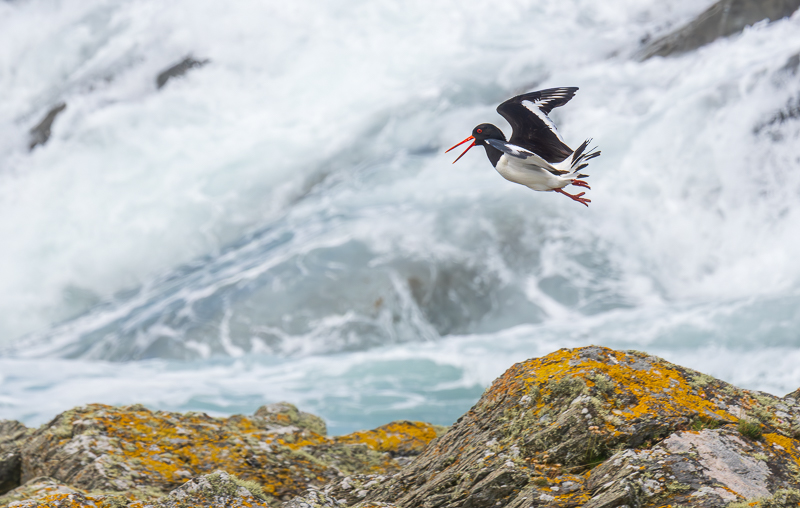
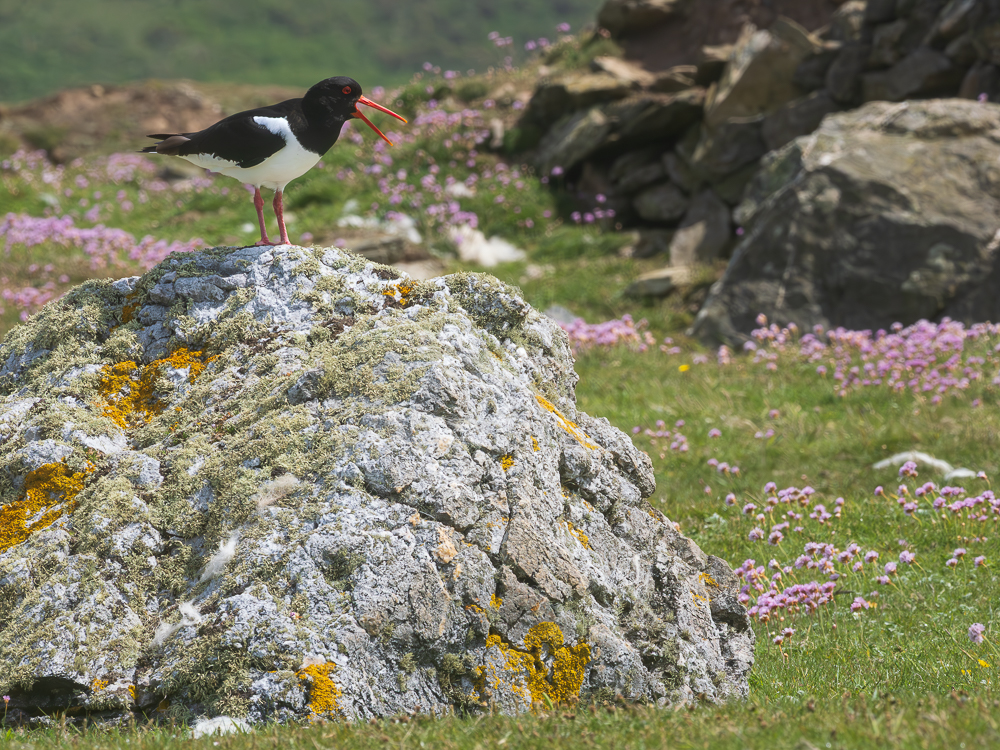
I don’t usually resort to cliches such as “bird of the week” but just this once I’m going to. It could have been the (scarlet) rosefinch which my friend Jonathan first identified, and whose song could be clearly heard from our kitchen table for a couple of days. The island has a large population of my favourite bird, the chough, and their calls could frequently be heard wherever you were. But the chough is a Schedule One (specially protected) species during the breeding season so I tended to avoid them. So I’m going to plump for something much more familiar – the oystercatcher. As you walked around the island you would pass from one oystercatcher territory to the next, and you would be subject to a new tirade of raucous high-pitched screeching. One bird was particularly aggressive, repeatedly flying noisily towards me at eye-level and only veering away at the last second. I believe on one occasion its wing tip brushed my arm as it flew past.

Their behaviour and alarm-calling is designed to alert their youngsters of the presence of a potential predator (in this case me) and it is obviously very successful. No matter how hard I tried I never managed to locate a single chick. They leave the nest as soon as they hatch and must hide amongst the pebbles and boulders amongst which they are feeding. But I wondered how intelligent the adults actually are. I found that while I was standing upright I was fair game for all the aggression that they could muster. But if I made a half-hearted attempt to “hide” or lower my profile their behaviour became calmer and their calling quieter. It was during these moments that I was able to photograph them in a more relaxed fashion. I ended up with hundreds of oystercatcher images, and have spent many hours deleting and processing them since I returned home.

It was during these lulls in activity that also I coined a new name for the species – “pipsqueaks”. After all, they don’t actually eat oysters ………….

Enjoy…….

Please click the Follow button if you would like to receive more Tales from Wild Wales as they are published.

My website : www.wild-wales.com

A tricky one…..

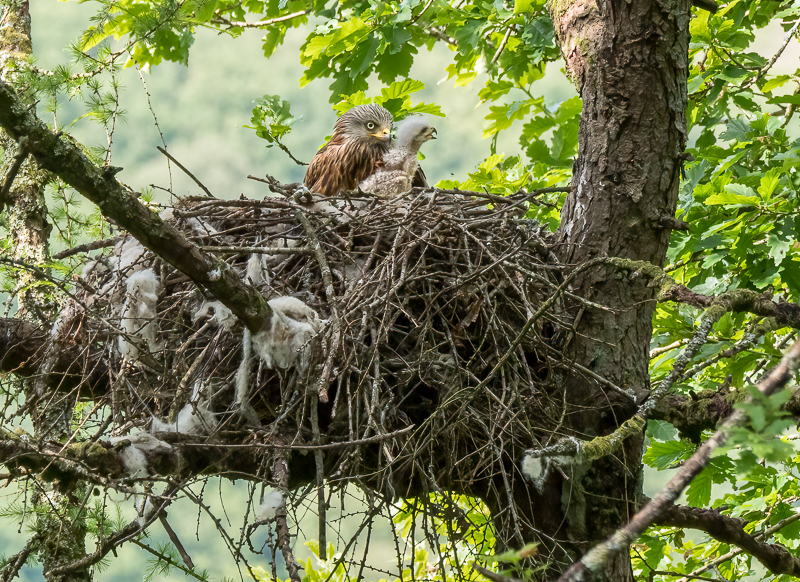
In spring 2020 we were all locked down in our homes. On my daily walk (well, one of them….), I discovered a red kite nest just five minutes away. It was easily visible from the track running through the wood and the female didn’t bat an eyelid as you walked past. When she was ‘off duty’ her mate took over and it was panic stations as soon as he saw anyone. The owners of the woodland, both red kite lovers, were managing it for firewood and wildlife and noticed exactly the same thing. They were happy to let me take my kit just inside the wood where I could be slightly closer . And the female carried on incubating as if nothing untoward was happening. It seemed like too good an opportunity to miss. Red kite is a Schedule One species in the UK, meaning that it is illegal to disturb nesting birds at any time during the breeding cycle – from nest-building to post fledging. But was I disturbing her? It didn’t look like it but it was rather a grey area legally.

Beauty is in the eye of the beholder……….

I waited until the chick had hatched and then visited the wood several times during late May. By the 21st the chick was strong enough to raise its head over the rim of the nest and I was able to photograph it with its mum looking on adoringly ( I may be anthropomorphising here ….). By the 25th it was stronger and its white down had become largely brown, with just a few tufts of white on its head. On the 30th the female was leaving the nest for short periods of time and on one occasion, while she was away, a magpie crept unseen close to the nest. As soon as she saw it she was back like a shot. I did not believe a kite could look so threatening! I was set up with the camera and long lens on the tripod, focussed on the nest, so was able to quickly take a few frames of the action. I was thrilled…… and the magpie made a hasty retreat.

You may recall that spring and early summer of 2020 were warm and sunny for long periods, often with no cloud at all, which made lockdown quite bearable. It also meant that for long periods of time photography was difficult with harsh sunlight throughout the middle of the day. Photographing in woodland in these conditions involves dark leaf and branch shadows and bright highlights, with massive contrast differences. The red kite nest was no exception. I decided to give it a break until some more photographer-friendly conditions came along. When I returned about a week later I discovered something tragic had happened to the kite chick. My friends had just discovered that it had disappeared and the parents were flying around in an anxious and agitated fashion. That was the end of the kites’ nesting attempt and they drifted off fairly soon afterwards. What had happened was a mystery, and the nest disintegrated and disappeared over the next couple of years.

Is this the same female?

So why am I recounting this story in April 2025? Well…. the kites are back! A pair has built a new nest in a different tree only about ten yards from the 2020 nest, in a very similar position, right out in the open, below eye level as seen from the track, and the female doesn’t bat an eyelid as you walk past. My guess is that she is the same bird that I photographed in 2020.

I am currently monitoring red kites in the area surrounding my home and have a licence to disturb the birds at the nest for this purpose. However it doesn’t include photography, unless incidental to the monitoring. I did inquire about a photography licence but the paperwork looked like it would take forever to complete. So I’m wondering if I can photograph the chick’s development at this nest in particular, with the very confiding female, without breaking the law. It’s a tricky one.

To read more Tales from Wild Wales as they are published, please click the Follow button.

My website : http://www.wild-wales.com

Do you know your willow tit from your marsh tit?

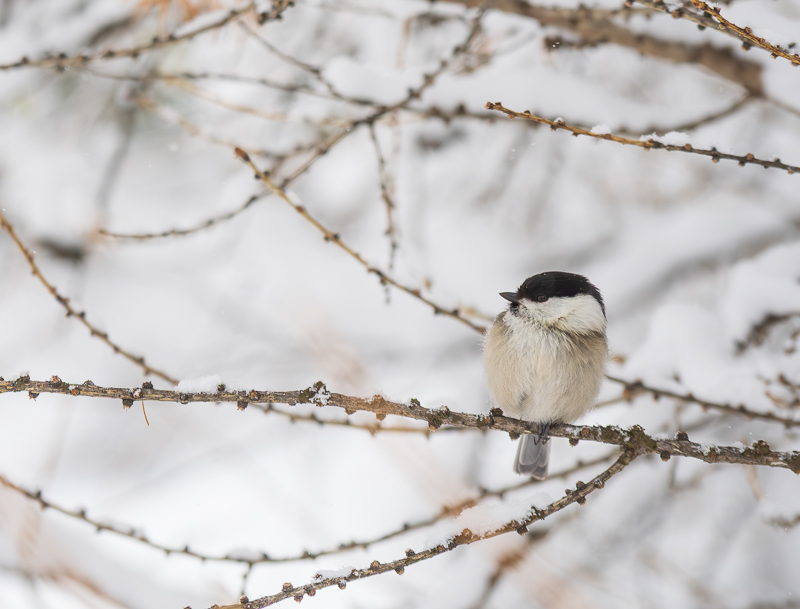
Willow tit……..

There can be no more difficult bird i-d challenge in the UK than distinguishing willow tit from marsh tit. According to ‘Birds in Wales’ willow tit was not even proven to occur in the UK until 1897, and for several decades following that “…its distinct identification from marsh tit was not universally accepted”. The Collins Bird Guide suggests various subtle differences; for example marsh tit has a glossy black cap while the willow’s is matt. The white cheek is more extensive on the willow than the marsh, and one (the willow tit) has a pale panel on its wing while the marsh doesn’t. The black bib is “usually” larger in the willow than the marsh. However a video from the British Trust for Ornithology now suggests that it is not safe to distinguish one from the other on any of these characteristics. The only reliable difference is a pale grey spot at the base of the upper mandible (the beak) which the marsh has but the willow doesn’t. This conclusion would have been reached following the close examination in the hand of large numbers of individuals by bird ringers, so is likely to be correct. But no wonder there was such a long period of doubt over whether both species existed in the UK.

Along with the willow tits came crested tits………

It is widely agreed that the safest way of telling one from the other is by voice. I’m not confident that I’ve ever definitively seen or heard either species, but during the winter I heard a new (to me) bird song on a regular walk in some woodland below the house. I believed it was either a willow tit or a marsh tit. It sounded very like a wood warbler, which, being a summer visitor, could not have been present. My Collins Bird Guide specifically mentions a “series of pensive, melancholy, wood warbler-like notes”, under willow tit. I hadn’t actually seen the bird but this was about as good an i-d feature as I was likely to get. I announced my record on the Ceredigion Bird Blog, with the caveat that Ian Morris – the county’s resident willow tit expert – might have an opinion on it. A few days later I had an interesting email from another Ceredigion birder who had had a similar experience to mine. Over a period of some weeks he had re-visited his location and played back a recording of the willow tit song. On every occasion he had attracted a pair of nuthatches! It’s enough to make you tear your hair out!

A few weeks later Ian Morris visited and we walked down to the location where I had heard my mystery bird. He played back the song but there was no response. It was a long shot really but he didn’t believe the habitat was right for willow tit anyway…..much more suitable for marsh …………

…………and a few nuthatches………..

One reason I recount this cautionary tale is that during March I spent a couple of days quite high in the Swiss Alps. It still being deep mid-winter some lovely conifer woodland there was blanketed with fresh snow and almost completely devoid of of birdlife. The main exceptions were flocks of tits roaming around waiting for hand-outs from folks like me. Among them were “poecile montanus” (according to the interpretation boards) which were so bold as to perch on people’s hands to grab a seed or two. This, of course, is the willow tit, which, according to the bird books, rarely even visits bird tables in winter ……..

To read more Tales from Wild Wales as they are published please click the Follow button.

A walk along the beach.

Just after the New Year we went for a low tide walk along the beach at Ynyslas. It was stunning …… blue skies, no wind….everything you could want from a winter’s day. We walked from the golf club car park, round the end of the dunes to the visitor centre (soon to be closed); then after a cup of coffee back along the board walk to return to the car park along the beach. By this time lengths of the peat underlying the sand had been exposed. As I walked along, Jane drew my attention to a small flock (21 birds) of sanderling which had alighted on the peat just behind me. I hesitated for a while before extracting my camera from my backpack. I expected them to fly off immediately, but they stayed put, probing in the peat for food, and running backwards and forwards as the waves washed in and out. I had two minutes with them before they flew off as quickly and mysteriously as they had arrived.

Enjoy the photographs!

To read more Tales from Wild Wales as they are published, please click on the Follow button

A close encounter.

Play-fighting stoats, July 2020.

In an earlier post I explained how I had been unable to sharpen a particularly good (……. I thought) image in Lightroom. Under normal circumstances Lightroom does everything I need, including sharpening, but it is not designed for more extreme situations. In my post I explained that I had successfully sharpened the image in Topaz Sharpen AI, but that my trial version added a watermark. Unfortunately it was no longer available and its successor, Photo AI, costs close on $200. How much was a I willing to pay for such specialised software?

Luminar Neo also has built-in AI sharpening and is available for a more reasonable price. The marketing spiel for this software suggests that it is aimed mainly at those who wished to replace skies in their images, which is anathema to me. But I swallowed my pride and signed up for a trial. It seemed to sharpen my problem file but I could not get it to work as a plug-in to Lightroom, which was a pain. It seemed there must have been a bug in the software and their technical people were using me as a guinea pig to trouble-shoot it. I gave up. Then Photo AI appeared at a “sale” price and I took the plunge.

I have recently been going through my files from the last decade for a potential sale to a rewilding charity. In some ways this is a tedious chore involving making countless decisions between images differing only by minutiae. However at the same time I was able to re-discover some that I had completely forgotten about. The one above is a case in point.

It was taken during lockdown in July 2020. I visited a local pond a number of times during that spring and summer, as it was within walking or easy cycling distance of my home. On one visit a family of stoats appeared out of the vegetation and began playing on the road. There was probably a mother and three kits. I was treated to a close encounter with this lovely group of animals which lasted about ten minutes. The youngsters were aware of me but didn’t seem to recognise me as a threat. It was the sort of encounter that wildlife watchers dream about. There was plenty of action which was quite a challenge for me with my slow reflexes. Much of the activity seemed to be play-fighting; the sequence from which the main image was taken ending up with the right-hand animal appearing to be “playing dead” on the ground.

I came away with quite a selection of images but many were below par in some way, mainly due to the narrow depth of field that long lenses produce. In the main image the left-hand animal was perfectly sharp but the one on the right just wasn’t. Fortunately Photo AI has worked wonders on the out of focus animal and I have a photograph I can feel very proud of. One for the Countryfile calendar, perhaps………*

*Or possibly not…..I’m still a professional. But you see what I mean?

To read more Tales of Wild Wales as they are published, please click the Follow button.