In an earlier post I explained how I had been unable to sharpen a particularly good (……. I thought) image in Lightroom. Under normal circumstances Lightroom does everything I need, including sharpening, but it is not designed for more extreme situations. In my post I explained that I had successfully sharpened the image in Topaz Sharpen AI, but that my trial version added a watermark. Unfortunately it was no longer available and its successor, Photo AI, costs close on $200. How much was a I willing to pay for such specialised software?
Luminar Neo also has built-in AI sharpening and is available for a more reasonable price. The marketing spiel for this software suggests that it is aimed mainly at those who wished to replace skies in their images, which is anathema to me. But I swallowed my pride and signed up for a trial. It seemed to sharpen my problem file but I could not get it to work as a plug-in to Lightroom, which was a pain. It seemed there must have been a bug in the software and their technical people were using me as a guinea pig to trouble-shoot it. I gave up. Then Photo AI appeared at a “sale” price and I took the plunge.
I have recently been going through my files from the last decade for a potential sale to a rewilding charity. In some ways this is a tedious chore involving making countless decisions between images differing only by minutiae. However at the same time I was able to re-discover some that I had completely forgotten about. The one above is a case in point.
It was taken during lockdown in July 2020. I visited a local pond a number of times during that spring and summer, as it was within walking or easy cycling distance of my home. On one visit a family of stoats appeared out of the vegetation and began playing on the road. There was probably a mother and three kits. I was treated to a close encounter with this lovely group of animals which lasted about ten minutes. The youngsters were aware of me but didn’t seem to recognise me as a threat. It was the sort of encounter that wildlife watchers dream about. There was plenty of action which was quite a challenge for me with my slow reflexes. Much of the activity seemed to be play-fighting; the sequence from which the main image was taken ending up with the right-hand animal appearing to be “playing dead” on the ground.
I came away with quite a selection of images but many were below par in some way, mainly due to the narrow depth of field that long lenses produce. In the main image the left-hand animal was perfectly sharp but the one on the right just wasn’t. Fortunately Photo AI has worked wonders on the out of focus animal and I have a photograph I can feel very proud of. One for the Countryfile calendar, perhaps………*
*Or possibly not…..I’m still a professional. But you see what I mean?
To read more Tales of Wild Wales as they are published, please click the Follow button.
It is always nice to receive a compliment and this is one of the nicest I’ve ever had:
I am very grateful for the photograph, which arrived safely today. I think it’s really fantastic ……,. showing clearly the bungalow, Uwch y cwm, (of) which we as a family have fond memories. I am going to get it framed. Diolch yn fawr iawn, Tec .
The image concerned (above) dates back to the 2000’s and was used on the front cover of my book Blaenau Ffestiniog. The original was on a transparency, and although I do have a good quality scanner, it had developed a fault. The sale of a single print didn’t actually cover the cost of the repair but the knowledge that the buyer was happy more than makes up for it! And of course I’ve now got a scanner that works.
Satisfying in a different way was the recent sale of ten ‘works’ from my Bird/land exhibition(click to view) to the National Library of Wales in Aberystwyth. The Library has been buying my work intermittently for nearly thirty years and now has well over 300 of my prints in its collection. It was interesting to look my name up in their catalogue and discover how many bits and bobs relating to my life as a photographer are stored away in their vaults. It is an honour and a compliment that the library chose to collect my work and continues to do so. It is also satisfying to know that some of it will outlive me.
To read more Tales from Wild Wales as they are published, please click the Follow button.
It almost always worth visiting the Teifi Marshes, a Wildlife Trust reserve near Cardigan (See this post as well). The big attraction for me is the reedbed which has three hides situated within it. Two are on the edge of small pools and the third overlooks a narrow creek draining into the River Teifi. Because the pools are small any wildlife using them tends to be pretty close, and all three hides are popular with wildlife photographers. It is an exceptionally good location to see and photograph kingfishers and even water rails – although my record with the latter is pretty sketchy. They are nimble and fast moving and tend to appear only close to dusk or dawn.
Last Saturday I arrived just after dawn and made my way along the old railway line (now a multi-use path) to the hides. Two otters visited the Kingfisher pool but all that could be seen of them was the top of one head and two trails of bubbles. Entering the Mallard hide I sneezed and a water rail immediately responded with its squealing call. It was on the water’s edge just below the hide but had disappeared by the time I got my gear set up. The same pool was full of activity later on with six squabbling moorhens present. There were also eight little grebes and at one point they all gathered in a semi-circle around the moorhens to watch the battle. Real school playground stuff!
Suddenly two otters appeared from the reeds. I tried to keep calm. My camera was set up correctly to photograph them as they swam slowly across the pool. I had the hide to myself and scrambled from one side to the other in an attempt to avoid having an out-of-focus kingfisher perch in the foreground. (In the end I was able to crop it out) After just one minute the otters disappeared back into the reeds as quickly and as mysteriously as they had arrived.
Unfortunately I didn’t have time to alter the aperture setting so while the otters are sharp the heron is just out of focus. Being a perfectionist this matters to me and I need some sharpening software to improve the image. Lightroom does almost everything I need my software to do but it does have its limitations. Topaz Sharpen AI does a very good job but I only have a trial version and the output has a watermark across it. I can’t get the same results from Photo AI, its successor. Shame!
If you visit the Teifi Marshes, here’s a few pointers. Coming from the south by car head for Cilgerran and take the main drive to the car park and visitor centre (parking fee payable). From the north, it is easier to park in the industrial estate south of the river, between the two bridges, and walk to the hides along the old railway track. For seeing and photographing wildlife dawn is best; by mid-morning the reserve will be the domain of dog walkers, child minders and families with limited interest in natural history. You have been warned!
To read more Tales from Wild Wales as they are published, please click the Follow button
About thirty years ago I was part of a team of volunteers who spent a week on Ynys Enlli (Bardsey Island) looking out for Risso’s dolphins. We stayed at the lighthouse (reserved for researchers) and kept a dawn-to dusk watch for these lively cetaceans using a telescope. There were a number of sightings but all were pretty distant. One day I was on observation duty when I spotted what appeared to be a cetacean “blow” (exhalation) in the far distance. It was angled at 45 degrees to the vertical and may have been a sperm whale. I called the others out but it was just a one-off sighting.
Since then I have drifted away from marine conservation but was aware that risso’s dolphins could be seen from certain locations along the Welsh coast. As well as Enlli there were sightings from Strumble Head in Pembrokeshire, and Point Lynas on the north coast of Anglesey. In fact the latter has become a regular and almost guaranteed location at the right time of year. Many excellent photographs of risso’s have appeared on the internet in the last few years. My first visit was on September 28th 2022, when animals were certainly present and very active, but were too distant to allow successful photography. I decided to try again one day last week.
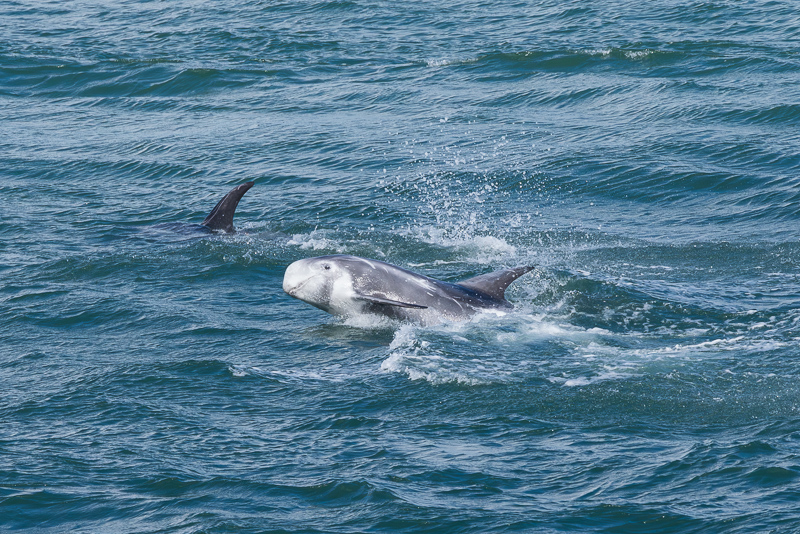
I stayed overnight with my friend Jonathan in Nantlle, about an hour’s drive on a good day from Point Lynas. We aimed to be there by high tide at 12.20 pm, but for various reasons set off far too late. Further delayed by road works and the remnants of summer holiday traffic it was actually 12.45 before we arrived at the lighthouse. A small group of Sea Watch Foundation volunteers with binoculars and clipboards were just leaving. This was not a good sign! I tentatively enquired if they had seen any dolphins and one girl told me they were “just around the corner”. A woman sitting on the rocks below the lighthouse said she had been watching them for an hour and a half. I took a quick snap as one individual disappeared beneath the waves but another small group weren’t far away. There was a sudden burst of activity from one individual in this group with vigorous tail slaps and much sea-spray, and they disappeared. It all went very quiet. I said to Jonathan “I hope it wasn’t saying to the others “Come on lads, it’s time we were off……”” But it was.
There was a fair bit of porpoise activity in the rough water off the point, and at least one more distant risso’s and a probable bottlenose dolphin or two on the walk back to the car, but that was it. What a lost opportunity!
All was not completely lost, however. I managed one sharp and pleasing image from a couple of bursts before the group disappeared (see above). It made me determined to go back to Point Lynas before the month of September was over.
In recent posts I’ve written about some of the exciting and fascinating wildlife encounters I had during my May travels. These included great bustard, lady’s slipper orchid, snakeshead fritillary, even the humble Duke of Burgundy butterfly; all four were either re-introductions and/or found specifically on National Nature Reserves. Without interventions from conservationists none of these four species would be found in the UK, or would be struggling to survive. The last post of this series involves a bird species which has, on the quiet, become very much more common over the last fifty years. At the time of the first Breeding Bird Atlas (published in 1976) there was an estimated 100 pairs of hobbies in the UK. By the time of the 2013 edition, it was far more widespread, with a population of about 2,200 pairs.
The hobby is a small falcon related to the peregrine. It is fully migratory, arriving in the UK in April and leaving for Africa in September. It feeds on small birds and large insects caught on the wing. As a very fast, fluid and agile hunter it can catch even swallows and swifts in flight. On their arrival in the UK hobbies congregate at certain wetlands (where there is normally an abundance of dragonflies to feed on), before dispersing to their breeding areas. I had read of flocks or even “swarms” of hobbies at certain locations in early May and longed to see such a spectacle.
I have visited one of these locations – the Avalon Marshes, near Glastonbury – several times in recent years (see here), and it is one of my favourite UK birding destinations. Up to eight species of heron have bred there, which is extraordinary – given that just a few decades ago only the grey heron and the rare and elusive bittern were found in Britain. It was here that I headed after leaving Stonehenge.
My first evening and the following morning there were unspectacular. I was disappointed that the hides at the RSPB’s Ham Wall reserve were still closed following the Coronavirus lockdown, and birds seemed a little thin on the ground. After lunch I headed in the opposite direction along the disused railway line into Shapwick Heath NNR. Just a few minutes later I had seen my first hobbies, a dozen or more, hunting independently in a loose flock. Prey must have been small insects because there was also a very large dispersed flock of hirundines (swallows and martins) doing the same thing. Occasionally I caught sight of a bird transferring prey from its feet to beak in flight, a sure sign that these were hobbies. A few minutes later I heard loud bugling calls coming invisibly from Meare Heath to the north – surely they must have been cranes? *
Checking me out………
I hurried on towards a northward facing hide. From there it looked like the hobbies had disappeared. I then began to pick them out in the heat haze, perched singly or in small groups on stunted dead trees amongst the reeds. Gradually they resumed their hunting and I managed a reasonable count of thirty-three birds altogether. It occurred to me that these were truly African birds spending just a few months of every year in the UK. Although they were very active, the hobbies were really too far away to photograph, so I returned to the railway line. And guess what? Hobbies, lower and much closer. Part of the same flock, no doubt, but this was more like it! I returned to the van to eat and recharge my mental batteries.
Late that evening I returned to the same area. Still hobbies! They were hunting insects low over one of the lagoons until well after sunset. Close to darkness in the far distance I could see about twenty of them perched on the stark boughs of a dead tree, one-by-one disappearing to roost somewhere nearby. They had gone by the next morning; but great white egrets – ethereal and otherworldly – floated by just outside the hide window. There must have been a nest nearby.
These spectacular birds are a very welcome addition to the British avifauna; as are the little egrets that are now a familiar sight in many parts of the UK. The flocks of hobbies that are now seen in the UK every spring are another example of the continually changing nature of our bird populations. It is a mistake to believe that wildlife distributions and numbers are normally static. For the wildlife lover there is a relentless diet of bad news in the media, and there’s no doubt that we are still losing some species rapidly. The difficulty is in distinguishing between natural fluctuations of bird populations and those changes, like the loss of farmland birds (and other wildlife), that are entirely down to human destruction of wildlife habitats.
* Sightings at nearby RSPB Ham Wall that day included a flock of eight cranes flying over, and two returning.
To read more Tales from Wild Wales as they are published, please click Follow
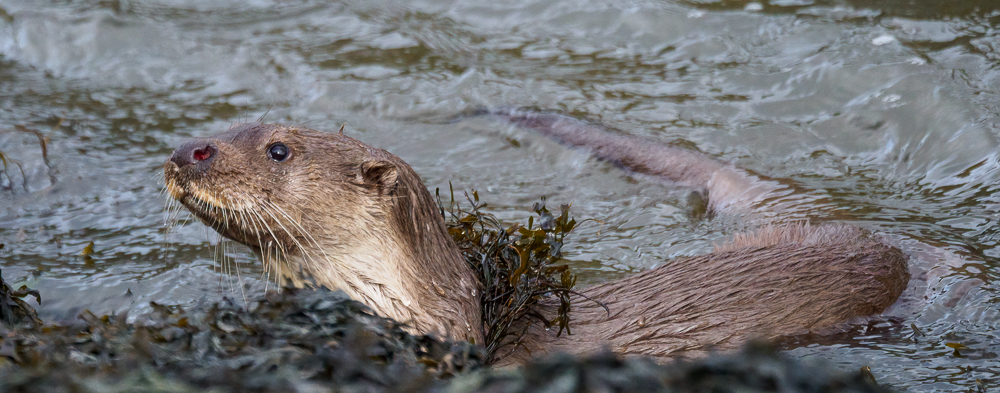
I recently heard about a very approachable otter not far from here. I assumed it was a one-off but later discovered it had already been attracting wildlife watchers and photographers for several weeks. Better late than never, of course, but my first visit offered two brief, unsatisfactory views and a few unusable photographs. I was more lucky on my second visit. I first noticed the otter mid-river; it then proceeded to hunt downstream towards me in the seaweed along the edge of the channel. It very quickly came up with an eel, brought it onshore and proceeded to crunch it down. It then resumed its hunt, moving back upstream in a similar manner. I quickly realised that if I could position myself beyond it, and my luck held, it would gradually get closer. And so it did! I was particularly fortunate in that there was no-one else around, so no there was jockeying for position or complaints that I might be too close.
I lay flat on my belly on the riverbank, the otter oblivious to my presence. I repeatedly reduced the focal length of my zoom lens as it got closer. At a certain point it stared directly at me at close range without really registering what I might be. After twenty minutes with this lovely animal I realised it was finally heading downstream. Meanwhile quite a crowd had built up on the bridge: the otter and I had had quite an audience! Back on dry land I felt like I was floating on air: one photographer friend said she thought I was in shock!
I hasten to add that I had already put plenty of hours in but when an opportunity like this presents itself you just have to grasp it with both hands and take it………..
To read more Tales from Wild Wales as they are published, please click on the blue Follow button.
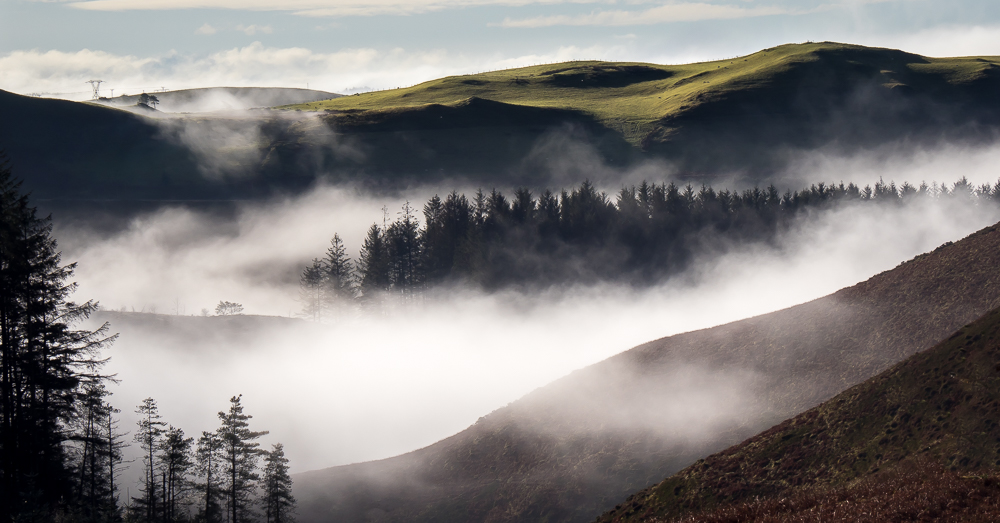
Above Penrhyncoch, Ceredigion. (1/60th @f11; ISO 200)
In November I wrote that I had taken the plunge and bought into the Olympus micro four-thirds system (see this post). I knew I was at the very beginning of a steep learning curve and I’m probably only a couple of steps further forward four months later! For one thing, while some photographers probably never get past the “testing” phase with their new kit, I seem to be allergic to doing so. I just want to get out and actually use my equipment for real. And secondly, the weather this winter has been almost unrelentingly dull, wet and windy; I just haven’t felt like getting out into the field in those conditions. My em1mk2 / 12 – 100 f4 zoom have been sitting in their bag, together with the Panasonic 100-400 mm zoom lens which I bought during the Black Friday sales for wildlife photography.
However I’ve taken advantage of a couple of short spells of better weather and come back with some decent results. So I feel like I’m making some progress. The top picture was a bit of a grab shot taken from the side of the mountain road a few miles above my house on a morning which just seemed tailor made for landscape photography: bright blue skies and patchy cloud above and below that valley fog drifting inland from the sea. In fact, although I spent most of the day out with the camera this was the best shot of all, although I had to crop and clone out the tops of some spindly conifers in the foreground. Later that day I went down to Aberystwyth and managed a few shots of kayakers at sunset. This was a real test for the ISO capabilities of the camera; don’t look too closely, though, because it wasn’t entirely successful…!
Aberystwyth sunset (1/60th @ f11; ISO 1600)
In November I had spent a couple of days with friend in north Wales. I spent a few hours among the derelict slate quarries near Nantlle. The following day – a rare sunny one – we headed over to Anglesey and spent a couple of hours around sunset on the west coast near Aberffraw where I was able to take advantage of the em1ii’s amazing image stabilisation capabilities. The picture below was hand-held at 0.6 seconds – and perfectly sharp. Another was equally sharp at 1.6 seconds!
Eglwys-yn-y-mor Sant Cwyfan – 0.6 secs @ f8. (ISO 100)(handheld)
Last week I had my first real opportunity to use the long zoom in earnest. I met up with some birding friends in Pembrokeshire and we headed off to Carew, in the south of the county, where two or three firecrests had been regularly seen over a period of a couple of months. Sure enough one was visible on and off for an hour or so, and what a little beauty it was! Firecrests have been described as ‘little jewels’ and I would certainly go along with that description. I watched it with binoculars at first and saw it raise and spread its stunning little orange crest at close range. Eventually I got the camera out of my bag, attached the Panasonic and managed to catch it as it rested briefly between spells of frantic activity.
Firecrest, Carew Cheriton. (1/1250@ f8 ISO 1250.)
What a stunning little creature! And I was very happy with the technical quality of the picture. While the em1ii / Panasonic 100-400 zoom combo is still pretty chunky it is about half the weight and size of my previous Canon 5d4 / Tamron 150- 600 set-up. And despite the massive difference in sensor size, on the evidence of this picture, image quality is very similar. Bearing in mind the crop factor of the micro four-thirds format I can cover the entire range of focal lengths from 24 to 800mm with just the two lenses. The handful of outings I’ve had with my new kit this winter have persuaded me that it is worth persevering with the em1ii’s rather frightening manual and the online guide (442 pages long) by Tony Phillips which a fellow user directed me towards.
So watch this space for more pictures and roll on springtime!
To read more Tales from Wild Wales as they are published please click Follow
For many years I used a Magicball tripod head which I thought was a brilliant and very versatile piece of kit. I had two, in fact, with a Mini-Magicball on my lightweight “walking” tripod. The secret of the design was that it was “upside down” and screwed directly into the base of the camera or lens plate. It wasn’t until I started using long, heavy lenses to photograph wildlife that I began to see the weakness in the Magicball design. It was VERY stable when the lens (even a heavy one) was aligned along the main axis of the head. When it was at 90 degrees for a portrait format image it tended to slip out position very easily. So it was time for a rethink…..
Then I discovered the Uniqball, as its name suggested another unique design this time with one ball inside another. The outer ball was first locked to fix the horizontal axis; the inner ball then behaving like a pan-and-tilt head for an exact composition. About a year ago I got hold of one of the very first UBH35P models in the UK, and I really, really wanted to like it. Over a period of a few weeks I got to know it reasonably well and concluded that it was a qualified success as a piece of equipment. It had two weaknesses, but I thought I would get to grips with them over a period of time (to read the full review click here). The problem was, I just couldn’t. While using the head in “landscape” mode I found it incredibly frustrating to have to re-set the outer ball every time I moved the tripod. This was particularly annoying on uneven and/or sloping ground, and I found myself cursing over and over again in such situations. The photographer should never have this kind of relationship with their equipment so I retired it and dug out a rather cruddy old ball-and-socket head while I decided what to do next.
Poseur? Moi?
After many hours of browsing the internet I came across an American brand called Acratech. Their ball-and-socket heads are distinctive in several ways, including their very light weight, and their astronomical price in the UK, but what really grabbed my attention was the claim that they could also be used as a gimbal head. I’ve never used one myself but actual gimbals are very specialised and bulky heads used by bird photographers. With a well-balanced camera/lens combination, all the locks can be slackened off to allow movement in all directions using only fingertip pressure. I was sceptical that a lightweight ball-and-socket head could also include this functionality. I worried particularly that with a heavy camera/lens combo tipped over to one side, the tripod would become unbalanced and tip over. Manufacturers continually claim that their new gadget will solve all your photographic problems, and it may solve some. But at the same time it may have disadvantages which only become apparent when you get one in the field……. however, I digress: my b&s head was getting stickier and stickier and I was cursing it more and more. Things were looking desperate. I saw one final positive Acratech review and my mind was made up. It was time to click “buy”.
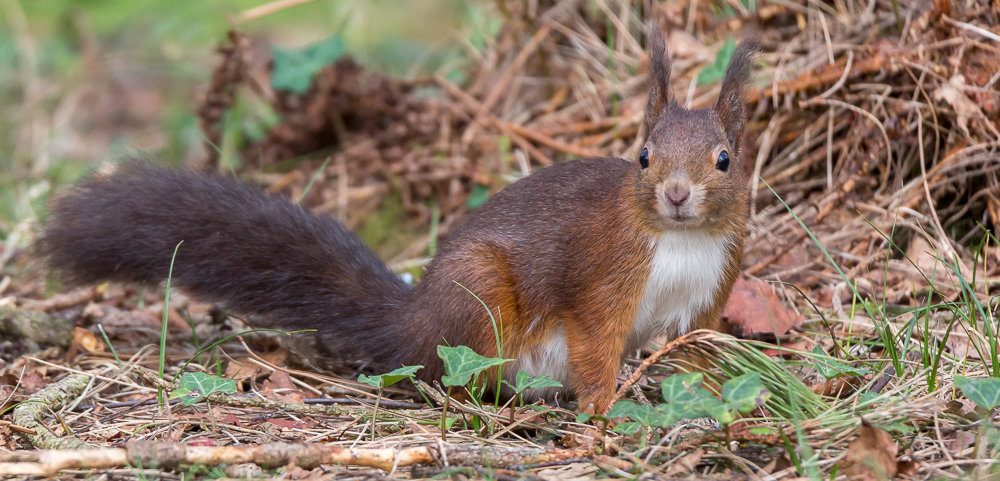
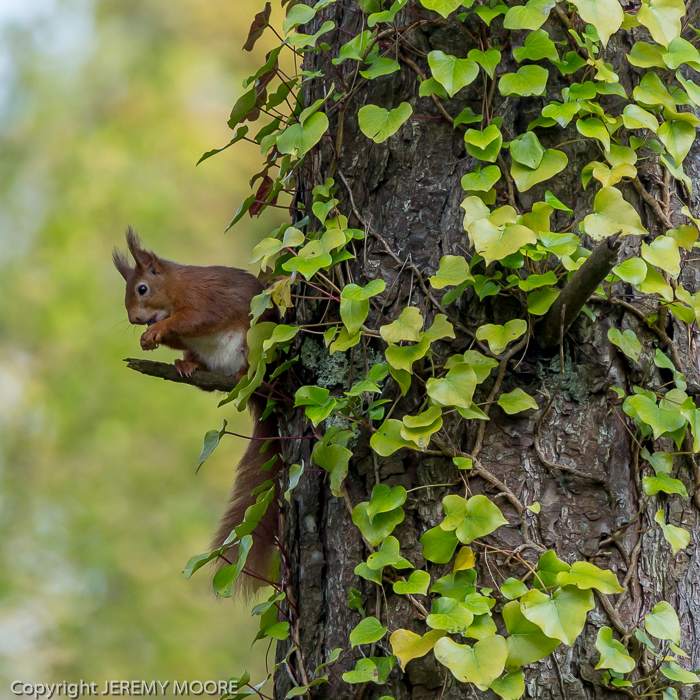
Last weekend saw the first outing of the new head (model code GPss) when I headed off up to Anglesey to have a go at photographing red squirrels. This lovely mammal was close to extinction on Anglesey in the late 1990’s when the Red Squirrel Trust Wales was set up. Its aim was through education and conservation measures – including the release of captive bred animals – to re-create a thriving population of red squirrels on the island. Grey squirrels had already arrived by using the bridges across the Menai Strait (or by swimming) but it was thought to be relatively easy to keep Anglesey free of them. The project has been a real success and it is thought there is now a population of about 700 on the island. They are beginning to re-colonise the area around Bangor on the mainland from this stronghold, and extermination of greys there will help to encourage this process. I had been told that the Newborough Forest – where there are some feeders – was the place to see them, although I failed to do so on my first visit last November. This time, however, I was more successful and I spent several happy hours in their company over a couple of days.
Another red squirrel……
What lovely creatures they are! On a cuteness scale of one to ten, they must be at least eleven! They proved pretty elusive during the day but around breakfast time and before dusk up to five visited the area around the feeders. They are also kept well-fed with treats there by nature lovers and wildlife photographers. They are partial to all sorts of nuts and seeds and at quieter times of the day will sit calmly feeding (and looking really, really, cute) just a few yards away from people sitting at nearby picnic tables. When more nervous they might scamper up a nearby tree-trunk and then stop, posing for all their worth for the photographer. Problems included trying to keep up with their erratic movements within the trees and occasionally high levels of contrast when stray sunbeams found their way through the tree trunks into the feeding area. It was sometimes difficult to expose correctly when an individual moved from a dark background to a light one, or vice versa.
And how did the new tripod head cope? I have to say very well. I was pleasantly surprised at how easy it was to use the head as a gimbal; there was no real threat that the tripod was about to overbalance although one would always need to keep an eye on this. And even with shutter speeds down to 1/125th second due to the low light levels within the woodland I managed a high percentage of sharp images. This suggests the tripod and head combo was keeping the lens pretty stable, even at 600mm.
There was a steady stream of other photographers and wildlife lovers visiting the site over the couple of days I was there, and I enjoyed some interesting conversations. On Sunday morning I shared a long session of red squirrel fun with Martin and Jayne from Rhos-on-Sea. We were entranced by the animals’ antics and, as our shutters clicked away busily, it felt quite special to share the experience with other like-minded people. But the thought remains that if it wasn’t for those dedicated people, often volunteers, who worked on this conservation project we would have had no red squirrels to photograph and enjoy. So my thanks go to all of them.
UPDATE: A fter using the Acratech GPss for a couple of months, I exchanged it for the larger model – the GP – which holds the ball more firmly, although not always firmly enough……. However, I am otherwise very pleased with it. Many thanks to the importer, Bob Rigby, for the exchange.
To follow Tales from Wild Wales, please scroll right to the bottom and click Follow.
A few days before Christmas I headed down to the Teifi Marshes near Cardigan with high hopes of seeing a bittern. It is a regular winter haunt for this extraordinary but elusive species and I had photographed one there in January 2015 (see this post). Furthermore there had recently been reports in the local bird blog of one by the Kingfisher Pool. It all seemed very promising. But after six hours in a very cold hide without a single sighting I felt somewhat deflated……and I’m sure the bad cold I suffered over Christmas was not a coincidence.
But they do say that every cloud has a silver lining, though, and in this case it was the kingfisher which made a circular tour of its perches around the pool at lunch time. Various sticks and branches have been provided here for kingfishers by the Wildlife Trust, but they result in rather conventional “bird on a stick” type images. I think the perch shown above shows the bird in a more natural setting and the falling rain gives the photograph a rather painterly feel.
Bittern at Teifi Marshes, Cardigan
The bittern was reported (and photographed) again on Tuesday so it seemed like another attempt might produce results. Another photographer was already in the hide when I arrived about 9.30 a.m. yesterday and we were soon joined by several others. One told us that the bird had spent two full days wedged between branches in a nearby willow. Local birders and conservationists became concerned for its welfare so reserve staff had climbed up towards it and poked it with a stick, whereupon it flew back down to the reeds!
The bittern was first seen not long afterwards. It was crouched low to the ground, fluffed up like a big round feather duster, and appeared quite immobile. It did not look like a healthy or a happy creature. But after a while it began to walk slowly towards the hide, its weight breaking the ice at one point. It came closer and closer and motor drives began to rattle away in earnest. Over the next hour it was hardly hidden at all. It walked slowly, and then more quickly, around, pausing to take the sun from time to time. The light was lovely, either bright sunshine or light cloud. Either was excellent for this large, cryptically patterned bird. It can’t eventually have been further than 20 yards from the hide. Then there was a crouch, a pause, another crouch, and it launched itself into the air, flying away quite powerfully low above the reeds and blackthorn crub.
Bittern in flight
It had been a truly exhilarating hour for everyone in the hide. One always opens oneself to disappointment by a making a tightly focussed photography expedition like this. Without the bittern it would have been a rather dismal morning – dismal and cold. So we were all happy, although we all knew we would have many hours of file processing to look forward to. Let’s just hope that the bird itself stays well and finds enough food to get through the winter.
To follow Tales from Wild Wales, please scroll down to the bottom and click Follow
Beech woodland is normally associated with the south-east of England; Burnham Beeches and Epping Forest are fine and well-known examples. But here in Wales native beech woodland extends into the south-east corner of the country, around Abergavenny, for example. It can be found as far west as Castell Coch, just to the north of Cardiff. It is what the writer and naturalist William Condry called “the district’s most distinguished calcicole” referring to its association with a narrow band of limestone rock which runs along the northern rim of the south Wales coalfield.
It is for oak woodland that most of Wales is renowned but in a forthcoming book I want to open people’s eyes to the presence and stunning beauty of beech woodland. This spring I visited Cwm Clydach, where the Heads of the Valleys main road squeezes through a narrow defile alongside the river between steep valley sides. I had first photographed here in the mid-1990’s and an image of the polluted watercourse complete with dumped debris was used in my first book “Wales – The Lie of The Land” (published in 1996). The gorge’s steep and rugged southern flank is clothed with native beech, but it is a far cry from the expansive woodland of southeast England. Here it is largely inaccessible but a public right of way descends to the valley bottom from the A465 and then climbs steeply through the trees to reach scattered houses, narrow lanes and an abandoned railway track.
Walking back to my van on this year’s first visit I heard the familiar laughing call of a green woodpecker, which I tracked down to the branches of an venerable but dead beech tree right by the side of the road. What’s more the tree’s branches were riddled with woodpecker holes large and small. One bird visited one particular hole which I took to be a potential nest-site. This looked like a photo-opportunity!
Anyone at home?
I spent many hours on three visits sitting in my van watching the woodpeckers going to and from the hole. The off-duty bird would call from a distance and its mate would appear in the entrance to the hole. They would then swap over. I was surprised at how late their breeding season was – there was no sign of food being brought to the nest even as late as June 11th. On one occasion a great spotted woodpecker peered in, and I believe I may have seen a lesser spotted on the same tree as well. This really was Woodpecker HQ! Green woodpeckers seem to be quite wary birds at the nest and they are apparently very difficult to photograph there. So I was really thrilled when I managed to get what seems to me the perfect image of a pair at the nest.
To follow Tales from Wild Wales, please scroll right to the bottom and click Follow.











 Tales from Wild Wales