Bardsey Island (Ynys Enlli in Welsh) is situated off the tip of the Lleyn Peninsula (Penllyn), separated from the Welsh mainland (Y Tir Fawr) by only a short sea crossing, but it could be many miles away. With its remote location, the island tends to attract rare migrants; it also has a manx shearwater colony and a bird observatory. Together with Jane (my partner) and three good friends, I spent last week there. It was actually my seventh stay on the island; each week has been quite different and I well my remember my first. I picked up an infection, probably from the spring water supplied to the houses, which laid me low for a few days. Alone in my accommodation, I felt very ill indeed and believed I could have died there without anyone knowing! Fortunately in recent years a water purification system has been installed.
After another visit I was chatting to a Welsh-speaking neighbour and told her I had just spent a week on Enlli. She looked at me very strangely, and then explained that Enlli is the name of the psychiatric ward at the local hospital. I’ve always used the name Bardsey since then…….
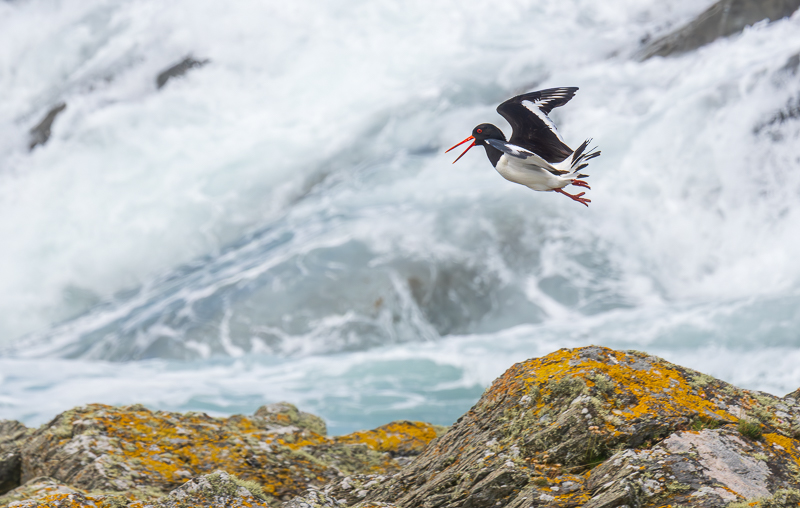
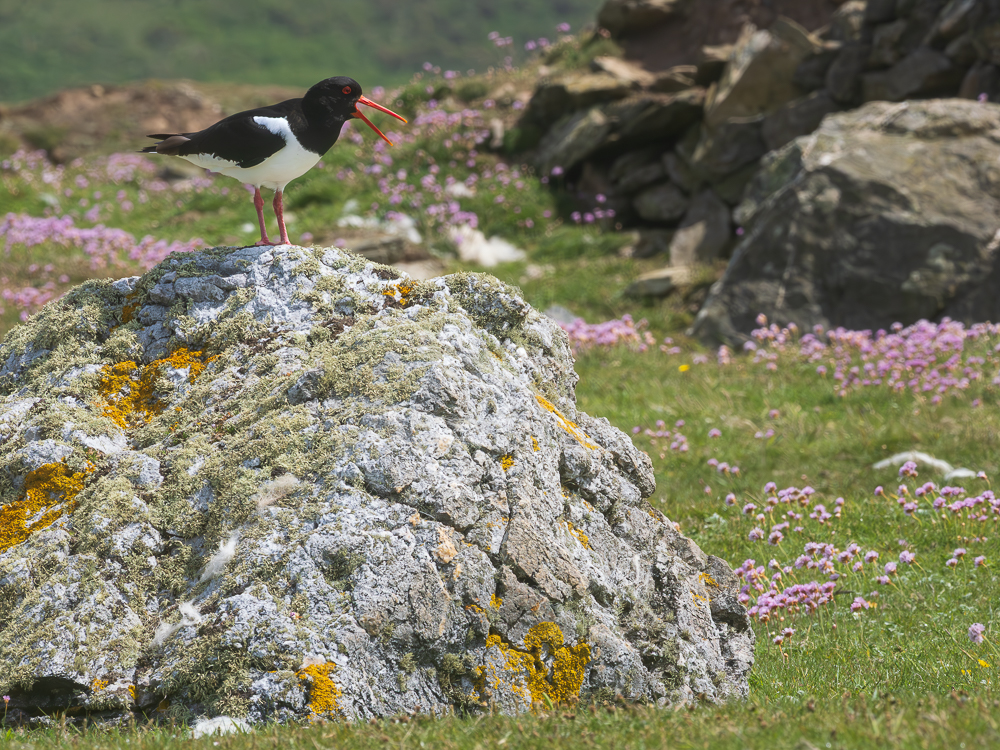
I don’t usually resort to cliches such as “bird of the week” but just this once I’m going to. It could have been the (scarlet) rosefinch which my friend Jonathan first identified, and whose song could be clearly heard from our kitchen table for a couple of days. The island has a large population of my favourite bird, the chough, and their calls could frequently be heard wherever you were. But the chough is a Schedule One (specially protected) species during the breeding season so I tended to avoid them. So I’m going to plump for something much more familiar – the oystercatcher. As you walked around the island you would pass from one oystercatcher territory to the next, and you would be subject to a new tirade of raucous high-pitched screeching. One bird was particularly aggressive, repeatedly flying noisily towards me at eye-level and only veering away at the last second. I believe on one occasion its wing tip brushed my arm as it flew past.
Their behaviour and alarm-calling is designed to alert their youngsters of the presence of a potential predator (in this case me) and it is obviously very successful. No matter how hard I tried I never managed to locate a single chick. They leave the nest as soon as they hatch and must hide amongst the pebbles and boulders amongst which they are feeding. But I wondered how intelligent the adults actually are. I found that while I was standing upright I was fair game for all the aggression that they could muster. But if I made a half-hearted attempt to “hide” or lower my profile their behaviour became calmer and their calling quieter. It was during these moments that I was able to photograph them in a more relaxed fashion. I ended up with hundreds of oystercatcher images, and have spent many hours deleting and processing them since I returned home.
It was during these lulls in activity that also I coined a new name for the species – “pipsqueaks”. After all, they don’t actually eat oysters ………….
Enjoy…….
Please click the Follow button if you would like to receive more Tales from Wild Wales as they are published.
For many years I used a Magicball tripod head which I thought was a brilliant and very versatile piece of kit. I had two, in fact, with a Mini-Magicball on my lightweight “walking” tripod. The secret of the design was that it was “upside down” and screwed directly into the base of the camera or lens plate. It wasn’t until I started using long, heavy lenses to photograph wildlife that I began to see the weakness in the Magicball design. It was VERY stable when the lens (even a heavy one) was aligned along the main axis of the head. When it was at 90 degrees for a portrait format image it tended to slip out position very easily. So it was time for a rethink…..
Then I discovered the Uniqball, as its name suggested another unique design this time with one ball inside another. The outer ball was first locked to fix the horizontal axis; the inner ball then behaving like a pan-and-tilt head for an exact composition. About a year ago I got hold of one of the very first UBH35P models in the UK, and I really, really wanted to like it. Over a period of a few weeks I got to know it reasonably well and concluded that it was a qualified success as a piece of equipment. It had two weaknesses, but I thought I would get to grips with them over a period of time (to read the full review click here). The problem was, I just couldn’t. While using the head in “landscape” mode I found it incredibly frustrating to have to re-set the outer ball every time I moved the tripod. This was particularly annoying on uneven and/or sloping ground, and I found myself cursing over and over again in such situations. The photographer should never have this kind of relationship with their equipment so I retired it and dug out a rather cruddy old ball-and-socket head while I decided what to do next.
Poseur? Moi?
After many hours of browsing the internet I came across an American brand called Acratech. Their ball-and-socket heads are distinctive in several ways, including their very light weight, and their astronomical price in the UK, but what really grabbed my attention was the claim that they could also be used as a gimbal head. I’ve never used one myself but actual gimbals are very specialised and bulky heads used by bird photographers. With a well-balanced camera/lens combination, all the locks can be slackened off to allow movement in all directions using only fingertip pressure. I was sceptical that a lightweight ball-and-socket head could also include this functionality. I worried particularly that with a heavy camera/lens combo tipped over to one side, the tripod would become unbalanced and tip over. Manufacturers continually claim that their new gadget will solve all your photographic problems, and it may solve some. But at the same time it may have disadvantages which only become apparent when you get one in the field……. however, I digress: my b&s head was getting stickier and stickier and I was cursing it more and more. Things were looking desperate. I saw one final positive Acratech review and my mind was made up. It was time to click “buy”.
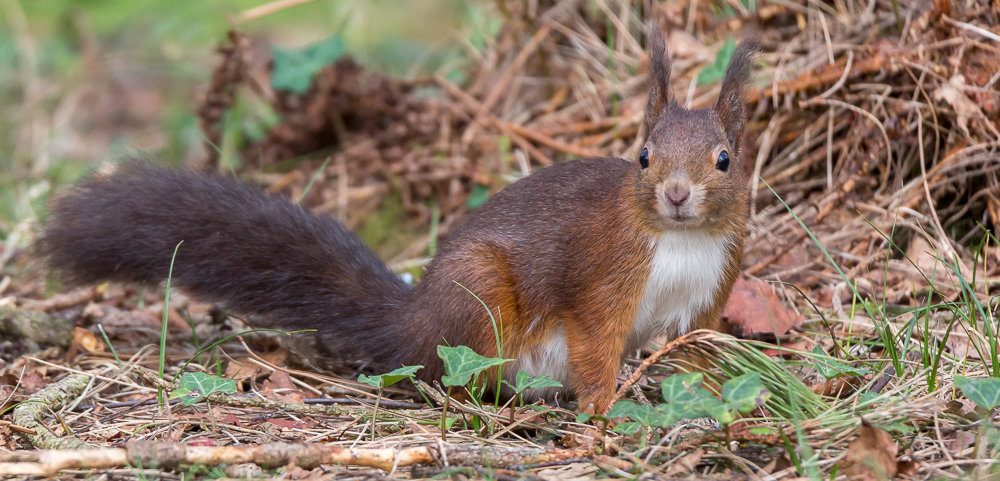
Last weekend saw the first outing of the new head (model code GPss) when I headed off up to Anglesey to have a go at photographing red squirrels. This lovely mammal was close to extinction on Anglesey in the late 1990’s when the Red Squirrel Trust Wales was set up. Its aim was through education and conservation measures – including the release of captive bred animals – to re-create a thriving population of red squirrels on the island. Grey squirrels had already arrived by using the bridges across the Menai Strait (or by swimming) but it was thought to be relatively easy to keep Anglesey free of them. The project has been a real success and it is thought there is now a population of about 700 on the island. They are beginning to re-colonise the area around Bangor on the mainland from this stronghold, and extermination of greys there will help to encourage this process. I had been told that the Newborough Forest – where there are some feeders – was the place to see them, although I failed to do so on my first visit last November. This time, however, I was more successful and I spent several happy hours in their company over a couple of days.
Another red squirrel……
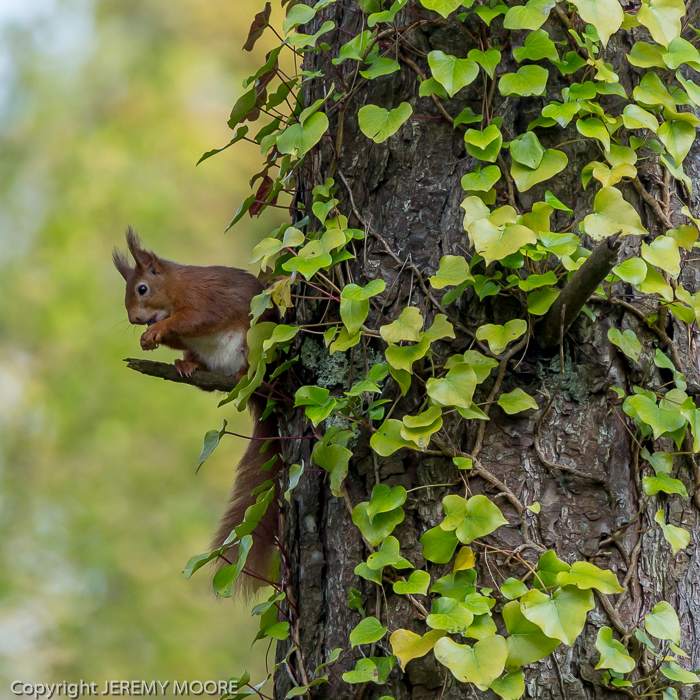
What lovely creatures they are! On a cuteness scale of one to ten, they must be at least eleven! They proved pretty elusive during the day but around breakfast time and before dusk up to five visited the area around the feeders. They are also kept well-fed with treats there by nature lovers and wildlife photographers. They are partial to all sorts of nuts and seeds and at quieter times of the day will sit calmly feeding (and looking really, really, cute) just a few yards away from people sitting at nearby picnic tables. When more nervous they might scamper up a nearby tree-trunk and then stop, posing for all their worth for the photographer. Problems included trying to keep up with their erratic movements within the trees and occasionally high levels of contrast when stray sunbeams found their way through the tree trunks into the feeding area. It was sometimes difficult to expose correctly when an individual moved from a dark background to a light one, or vice versa.
And how did the new tripod head cope? I have to say very well. I was pleasantly surprised at how easy it was to use the head as a gimbal; there was no real threat that the tripod was about to overbalance although one would always need to keep an eye on this. And even with shutter speeds down to 1/125th second due to the low light levels within the woodland I managed a high percentage of sharp images. This suggests the tripod and head combo was keeping the lens pretty stable, even at 600mm.
There was a steady stream of other photographers and wildlife lovers visiting the site over the couple of days I was there, and I enjoyed some interesting conversations. On Sunday morning I shared a long session of red squirrel fun with Martin and Jayne from Rhos-on-Sea. We were entranced by the animals’ antics and, as our shutters clicked away busily, it felt quite special to share the experience with other like-minded people. But the thought remains that if it wasn’t for those dedicated people, often volunteers, who worked on this conservation project we would have had no red squirrels to photograph and enjoy. So my thanks go to all of them.
UPDATE: A fter using the Acratech GPss for a couple of months, I exchanged it for the larger model – the GP – which holds the ball more firmly, although not always firmly enough……. However, I am otherwise very pleased with it. Many thanks to the importer, Bob Rigby, for the exchange.
To follow Tales from Wild Wales, please scroll right to the bottom and click Follow.




 Tales from Wild Wales