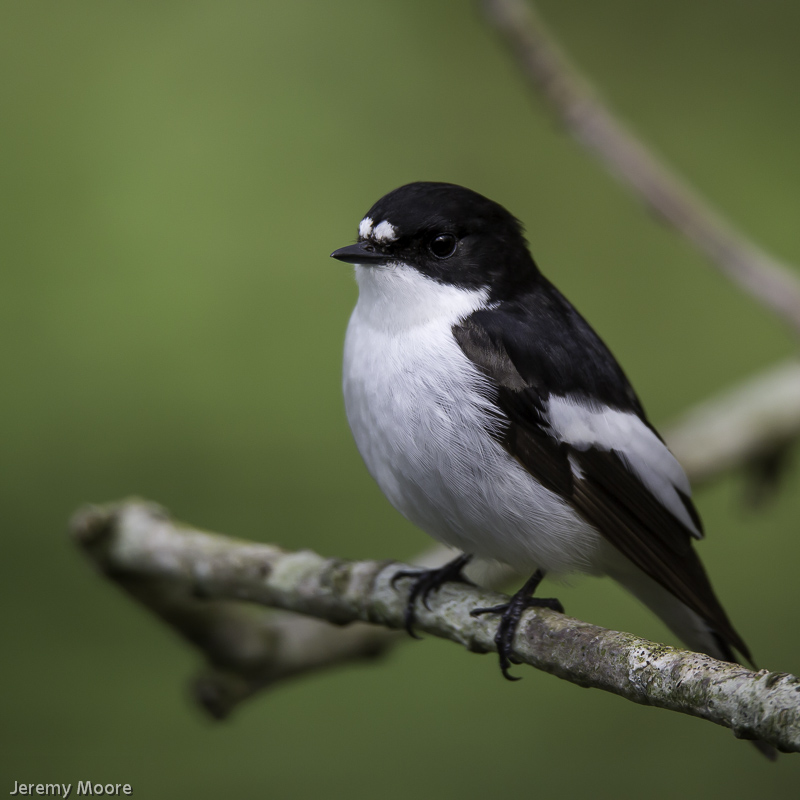
Who’s a pretty boy, then?

Pied flycatcher - Ynyshir
Pied flycatcher – Ynyshir

Sitting staring out of my window at sullen grey cloud and the branches of the ash tree in the garden whipping backwards and forwards, it is difficult to recall the delightful conditions we experienced during April.

In this part of the world the last week in April is a critical one for photographing small woodland birds. Most of the migrants will have arrived but the leaves are not fully open, meaning that those birds are still visible. During several visits to Ynyshir RSPB reserve during late April there’s no doubt that the most prominent of those attractive summer visitors was the pied flycatcher. I spent many hours with two males which were both energetically defending small territories around their chosen nest-boxes. For hour after hour they flew from bare twig to bare twig and uttered their simple sweet song. When you see the determination with which they do this it is worth remembering that each bird had probably completed its journey from Africa only a day or two – or possibly just hours – previously. And not only that, but it is quite likely to have been the same nest box they had used last year. By the time of my last visit one bird had attracted a female – again possibly his mate from last year – and they were visiting the box together. Who knows what they got up to in there! (discussing the colour scheme, I should think…..). By that time he was also noticeably less inclined to sing.

Who's a pretty boy, then.......
Who’s a pretty boy, then…….

One bird was easily visible from the Ynyshir hide, which in theory should have made photography easier. But a constant stream of other human visitors to the hide was a distraction for both bird and photographer. How dare they! The other bird was quite approachable out in the open. Over a period of a couple of days altogether I came back with hundreds of pied flycatcher images, many almost identical, and it has been quite an ordeal processing and sifting through them. It was easy to pick out one classic bird portrait, but as far as “pied flycatcher in the landscape” goes I still haven’t come up with an absolute favourite. The birds’ surroundings were usually a jumble of oak twigs and branches, some in focus and some out, with a few leaves, but little regular structure. In any event I plan eventually to show three images together so (in theory) that should make life a little easier when the time comes to make final decisions.

As far as the technicalities were concerned modern equipment makes bird photography SO much easier. At 1000 ASA (equivalent) I was getting lovely clean results with my Canon 5d3, and any noise is easily removed in Lightroom.  Such high sensitivities  allow fast shutter speeds to be used, with lower risk of subject movement or camera shake. Thanks once more to the 5d3 it has been possible to crop down quite deeply into an image to obtain a pleasing composition.  My lens is the new Tamron 150-600 zoom. The Canon version was released several months ago and I was lucky to get hold of one of the first batch. It has received generally favourable reviews – with the proviso that there may be “issues” when focusing on moving subjects, and particularly with older bodies. I can’t comment on that but in general I’m very pleased with the results. The results are certainly sharper and more consistent than the Canon 100-400/1.4x TC combination that I was previously using. As always a black and white bird presents contrast problems in strong sunshine so slightly subdued lighting was helpful

The other birds I had hoped to photograph were redstart and wood warbler. The former was present but difficult to get to grips with; I’ve never found Ynyshir to be the best of places to connect with this species. The latter just hadn’t arrived by the end of the month. Oddly, if one left the reserve and went a short distance inland several wood warblers were holding forth in tall beech trees on the side of the Einion valley. They were impossible to photograph, however, so I wonder if the Ynyshir birds are back yet. And I wonder if this awful weather will relent for a while before I leave for the Camargue on Tuesday?

The Welsh government and its copyright grab

During the late 1990’s and early years of this century I did a fair bit of freelance work for the Wales Tourist Board. The agreement involved handing over copyright with the images but there was a “nudge, nudge….” understanding with staff at the WTB that any out-takes from the shoot could be retained by the photographer. I wasn’t happy about the loss of copyright but felt that being able to retain identical images (in some cases) was adequate recompense.

Wales Tourist Board commissioned photographers to shoot landscapes and events in Wales. as well as using them itself it would also loan them to tourism-related businesses (free of charge) in order to promote Wales as a holiday destination. It became apparent that almost any business could be on the receiving end of the WTB’s generosity, however.

In the late 1990’s most of the WTB photographers got together to present a case to the WTB for a fairer contract. This initiative was led by a former photographer, Steve Benbow, who had by then started a commercial picture library specialising in Welsh subject matter. This was a direct competitor to the WTB in many instances so he found himself on an very uneven playing field indeed.

Letters and meetings with WTB staff followed. It was suggested that the WTB followed the Scottish Tourist Board’s example by themselves setting up a commercial picture library which would pay the photographers a percentage of the income from the images. But the WTB refused to listen. They were determined to retain copyright, come what may. When asked to explain why, they claimed, for example, that the photographer might use an image to show Wales in a poor light while the WTB used the same image to show it in a good light! Hardly likely at all.

This went on for a couple of years with no solution being found. I began a commission for the WTB one summer assuming the contract would be unchanged. When it arrived I discovered that the WTB had further tightened it up to their advantage. The photographer had to agree to hand over EVERY piece of film from the shoot, rejects and all. The loophole was closed. I was particularly irate about this because it showed that the WTB had no intention of working alongside its photographers; instead, it had every intention of dominating them. Despite being half way through a lengthy commission, and knowing that I wouldn’t get paid, I told them I would not sign the new contract.

The letter writing campaign continued when the WTB was absorbed into the Welsh Assembly Government, but to no avail. In fact the WAG adopted the WTB methods of dealing with photographers for all its departments. For me it was a matter of principle – I would not work under these terms. It was particularly galling that one part of the UK government was bypassing the 1989 Copyright, Designs and Patents Act, set in stone by the UK government to protect the rights of the freelance. And the Welsh Government (as it now calls itself) continually encourages other businesses to protect their intellectual property and profit from it whenever possible. Talk about hypocrisy!

Over the years the economic climate has changed and I feel myself reluctantly considering whether to work for the Welsh Government again. The copyright grab continues, and the photographer must still hand over every single image. In the digital age it would be easy for them to identify exactly when an image was taken or if one was missing from a sequence. They do seem to have it all sown up.

But in one respect they have softened. There is now a “fair use” clause in the contract. It states –

“Contractors have limited permission to use copies of imagery produced in the execution of assignments for the Client in order to promote them, using a portfolio or similar promotional tool.

Such use will in no way contravene the Client’s copyright. However fair use rights do not extend to the commercial sale or licensing of such imagery, either directly, or via a third party (e.g. a stock library or photo agency).

In all instances, written permission to use Client imagery for promotion should be obtained from the Contract Manager prior to the use of that imagery.”

This might seem to be an improvement but looked at in another way the WG has still turned copyright on its head. Rather than the photographer giving the client a licence to use the images in return for a fee, it is now the client that offers permission to the photographer – if they feel like it!

I thought I would float this situation for comments in the “Talk Business” section of an online photographers forum. I thought there might be a range of opinions, including some backing me up. But not a bit of it. The overwhelming view was that the client (Welsh Government) is making the terms and conditions of the contract quite clear so it is then up to the photographer to decide whether to go for it or not.

It is probably too late to do anything about it now but with the benefit of experience one does have a different perspective. If, over the past twenty years, photographers had taken a principled position and refused to work on these terms, clients would soon learn not to offer them! Because most did not it is increasingly becoming accepted that unless copyright is handed over, a photographer will not get the work. We called that a copyright grab in the 1990’s and in my opinion, it still is.

Does everyone do this now but me?

Avocet, titchwell
Avocet, Titchwell

On a recent trip to Norfolk I spent a day at Titchwell RSPB reserve. It was one of those misty/hazy days where atmospheric pollution led to disappointing long-distance visibility. But with variable layers of cloud – often thin – and with no great contrast between light and shade – and little wind, it was ideal for bird photography, I spent many hours in the Parrinder hide, focusing my attention on the waders, ducks and gulls on the freshwater lagoon. When the cloud was at its thinnest birds and background were illuminated by bright, silvery light which was exquisite and close to perfection. The image above is one of my favourites from the day.

At lunchtime I left the hide and walked back towards the visitor centre. A cluster of photographers were stationed on the embankment with long lenses pointing into the reedbed. Alert to what other people may already have seen, I heard a distinctive “pinging” call emerging from the reeds – a bearded tit. This is one of the most stunning and sought-after of British birds, and one of the rarest. Further calls followed and it became apparent that a pair of “beardies” was moving through the reeds parallel to the path. Then I heard another “ping” to my left and quickly turned to find its source. Another birder was fiddling with his phone and saying …”Oh, that was me”. The penny dropped – he was broadcasting bearded tit calls in order to entice the birds out of the reeds and into visibility. Over the next few minutes a male perched high in the reeds several times to investigate whether a rival was in his territory. It was an ideal photographic opportunity and despite forgetting to re-adjust my camera settings for this new situation I obtained a few decent images of the bird.

But I couldn’t help expressing my surprise over his methods to the birder. Many people believe that using tape lures such as this is unethical, and the British Birds Code of Practice for bird photographers states the following –

The use of playback vocalisations should be employed sparingly, if at all; if a reaction is not forthcoming immediately, then playback is unlikely to work and should not be repeated in a given territory. It should be noted that the use of playback for species protected under Schedule 1 [like the bearded tit] of the Wildlife & Countryside Act may be considered illegal.

He was unconcerned. He got the recording from the RSPB website, he said, and also did it at home in Birmingham to attract woodpeckers. It reminded me of a friend who, many years ago, and despite being a committed insect conservationist, threw branches into trees to dislodge tree-dwelling butterflies. A scouser with a drier than dry sense of humour, he called it “science”, because it “got results”.

In the greater scheme of things the occasional use of tape lures may cause little more than irritation to a bird, rather than actual disturbance. But it appears to be a growing trend. A columnist in the current edition of “Outdoor Photographer” magazine, Steve Young, recalls an incident at a lesser spotted woodpecker nest site where he berated a bird-watcher for doing the same thing. I consoled myself with the fact that in this instance the birds genuinely WERE there before the use of the recording, and, rather selfishly, that any bearded tit images I managed would have been obtained without any unethical behaviour on my own part. Under other circumstances I would have been thrilled with this image, but in fact it just feels a little bit flat.

Bearded tit, Titchwell

The birder moved on and another took his place. I couldn’t help recounting to him what had happened just a few minutes earlier. “Oh,” he said brightly, “I’ve got a bearded tit on mine.” He retrieved the phone from a pocket, turned it on, and hey presto – “…..ping…. ping…..”. Does everyone have a damned bearded tit on their phone but me?


To follow “Tales from Wild Wales” scroll down to the bottom of the page and click “Follow”

More from the submerged forest.

Submerged forest, Borth - receding tide.
Submerged forest, Borth – receding wave.
Submerged forest, Borth - incoming wave.
Submerged forest, Borth – incoming wave.

A few weeks ago I wrote about the submerged forest which had been exposed by January storms between Borth and Ynyslas – see this post. Since then I’ve been back several times in different conditions, with mixed results. I’ve been plagued by camera shake problems using a ten-stop ND filter. On one visit, during the middle of the day, I came away with virtually no useable images at all, even with exposures of just a few seconds. I decided to forget about the filter and rely on natural light (or the lack of it) to create the conditions I was looking for.

My intention had anyway been to capture waves moving through the tree stumps at sunset. Until the sun dropped below the horizon light levels were still too high, but after sunset conditions became almost perfect. On a recent visit I eventually found a photogenic-looking arrangement of stumps, set the camera on the tripod and waited. For a period of just a few minutes the incoming tide washed in and out through the stumps before covering them completely. Sunset colours in the western sky formed the backdrop. Having found “the moment” it was actually quite easy to make the images. I chatted to a fellow photographer, breaking off to press the shutter button every now and again as waves came in and receded! I returned home with dozens of almost identical images to wade through, however, and so far I’ve only processed a few of them. It hadn’t been a particularly intense sunset so I’ve processed them quite hard to give them a little more impact. I’m quite pleased with the results.

The beach seems to be returning to normal slowly but steadily. The upper part of the very distinctive tree stump pictured in my first post is still visible but sand is building up around it. There’s no sign of the rather remarkable peat cutting shown in the second picture, which must have been filled in with sand. Perhaps within a few months there will be no sign at all of what the winter storms of 2014 left behind.

To read more Tales from Wild Wales as they are published, please click the Follow button.

Because I’m worth it……

Grey Heron fishing for eels, Betws-y-coed

About three years ago I made a difficult decision. It is not like me to blow my own trumpet and I have usually preferred my photographs to do the talking. But I began to describe myself as “a leading Welsh photographer”. I was working on the photographs for my sixth book – Wales at Waters’ Edge – which had been sponsored by the Countryside Council for Wales. It was therefore the best paid project I had ever worked on. There was a good prospect that I would be able to exhibit the photographs, too. It is difficult to be objective about one’s own work but after about twenty years as a professional, and knowing what other Welsh photographers had achieved, it seemed like a reasonable claim to make.

At the same time I could see that difficult times lay ahead. The funding for the book would only last two years. Sales of my self-published postcards and calendar were still reasonable, but in economic terms Wales lags a couple of years behind the south-east of England, and the recession was just beginning to bite. The number of independent book- and gift-shops was declining and has continued to do so. Most local authorities across Wales have been forced to close tourist information centres. So I began to lose more and more outlets for my products. And my ‘business model’ (if it can be called that) was that my commercial activities subsidised my more personal work – the books and exhibitions that I worked on on a fairly regular basis.

I began publishing postcards in 1987 and it would be many years before the mobile phone was widely available, let alone Facebook and Twitter. I never believed that people would stop sending postcards, and thought they would provide an income for the rest of my working life. How wrong I was. One has to accept that times have changed and that a little rectangle of quality imagery dropping through the letterbox of a friend or relative is no longer the event that it used to be. The punitive increase in the price of postage in 2012 seemed like a particularly long nail in the postcard’s coffin.

There is no doubt that for me 2012 marked a career highpoint. Wales at Waters Edge was published in May and I was asked to speak at the Hay Festival during the summer alongside the book’s author, Jon Gower. Photographs from the book were exhibited for the first time, and were very well received. I ran a successful photography workshop in the autumn. But there was this nagging doubt about what I was going to do next. There was, in fact, a bit of a void.

The exhibition continued to tour in Wales during 2013, and gained more excellent feedback from gallery directors. But a book project fell through, and my recession-hit publisher seemed unwilling to take on any further proposals (from me anyway!). Despite undertaking a lengthy landscape commission during the summer, I felt that public spending cuts would hit further work of this kind quite hard. Sales of the 2014 calendar have been so poor that I can no longer justify publishing it. The future started to look quite bleak. I would be happy to retire on my own terms but not to be forced out of work by circumstances. In any case retirement really isn’t an option for a few years yet! Could I still be ‘a leading Welsh photographer’? It is a question which has haunted me over the last few months.

For many years I considered myself ‘a landscape photographer’ but during work on Wales at Waters Edge I began move away in other directions. Hell, I even photographed people! But I seriously started to shift my focus towards wildlife. It made sense because I had been interested in wildlife for as long as I had owned a camera. I just hadn’t put the two together. There are some brilliant wildlife photographers around and I know I don’t have their mastery of technique or their dedication. But what I do have after half a lifetime of photographing the landscape is a sense of how a bird relates to its surroundings – in a visual sense, that is. And in an ecological sense – well, I don’t have the qualifications but I’ve certainly picked up a great deal of experience over the years. And that should help me as a photographer.

So last summer I approached MOMA Wales (Museum of Modern Art) in Machynlleth with an exhibition proposal. Machynlleth is only a small town in mid-Wales, but it is a lovely venue and they have always been very supportive of my work. An exhibition there would now have to be be dependent on me obtaining external funding, however. So I put in an application to the Arts Council of Wales, and I am absolutely delighted to say that it was successful. It will fund the cost of printing and framing the work and a proportion of my time and expenses in preparing it.

The exhibition is provisionally entitled ‘Birdland’ and will show over July – September 2015. It is an ambitious project and I certainly hope it will be seen more widely than the one venue already agreed. So watch this space. And as for ‘leading Welsh photographer’, I think I can justify that for a little longer.

To follow Tales from Wild Wales please scroll right to the bottom and click the follow button

A winter visit to the Camargue.

Flamingos, the Camargue

Mid-winter might not seem to be the obvious time of year for the bird photographer to visit the Camargue – well known for its nesting herons, other brightly coloured summer visitors and phenomenal spring and autumn passage migration. But I wanted to have a crack at some of the reedbed specialities which are so difficult to find here in the UK. And small numbers of several species of eagle are known to winter there, although I knew I would be lucky to even see them. As it turned out the bitterns and the bearded tits were just as elusive there as they are in the UK. I may also have seen a distant glimpse of a booted eagle as it flew away in the rain.

As far as the practicalities are concerned I will summarise them first. Travel down to Nimes was by train to minimise my carbon footprint. Some nature photographers must believe their carbon emissions do not count, but that seems an irresponsible attitude in my opinion. It is quite feasible to do the journey in a day by train, even from Aberystwyth, although it seemed sensible to book a  room in Nimes in advance to avoid the risk of spending my first night on a park bench. Train fares are quite reasonable especially if they are booked in advance; London to Nimes was £110 return. I picked up a hire car at Nimes train station on my first morning and spent five of the next six nights at Salin de Badon, a “gite” right in the heart of the Camargue, owned and operated by the Societe National pour la Protection de la Nature.

Previously a hunting lodge, this old stone house is correctly described as “rustique” by its owners, although characterful would be another way of putting it! Accommodation is self-catering, there is no drinking water, and rooms are shared. But on the positive side, it has hot and cold running water and central heating, and access to three nearby hides is included. For me another big positive was getting to meet other French visitors with interests in common, and to practice my French on them! In particular I met two bird photographers there. Having asked if they could help me with French bird names, I was so knocked out by the quality of the images one showed me on his phone that the bird names largely passed me by. I can’t imagine any meeting of minds at the quite characterless hotel by the motorway outside Arles, where I spent my sixth night. You can find Salin de Badon on the internet or contact me for further information.

Great white egrets, the Camargue

As far as birds were concerned, on my first morning I discovered some large congregations of great white egrets, grey herons and cormorants on agricultural land outside the protected area. The egrets, in particular, were staring intently into a ditch, although what there was to see I have no idea. Another egret gathering nearby contained 73 of these spectacular birds (with about 50 others in nearby fields), I was able to photograph some of these using the car as a hide. I was surprised at the number of this species wintering in the Camargue – as well as this group, individuals birds could be widely seen.

Another species which has increased rapidly in recent years is the common crane. About ten years ago I felt lucky to see a flock of ten wintering birds, but now they have reached an incredible four thousand. Apparently they have discovered a new food source in spilt grain on the agricultural land surrounding the Camargue wetlands – ironic really as so much natural habitat was lost in land reclamation for rice growing. Who says nature is not adaptable? The birds roost in the reserve and commute between it and their feeding areas at sunrise and sunset. During the day, with some good fortune, they can be photographed from local roads from your car.

The flamingo is another conspicuous bird with which I spent some time. It seems an impossibly exotic species to be seen anywhere in Europe, but they are fairly widespread around the western Mediterranean in winter; their only French breeding site is in the Camargue. I managed some images of them on lagoons close to the sea, against a backdrop of the heavy industry at Fos-sur-mer, across the river Rhone. On  a more tranquil afternoon I photographed them and their reflections in still water at the same location. Despite a rather limited range of species, then, and some distinctly changeable weather, it proved a fairly profitable visit, and I’m thinking of going back in May.

To follow Tales from Wild Wales, please scroll right down to the bottom and click Follow

Walking through history

Submerged forest with tree stump - Borth/Ynyslas
Submerged forest with tree stump – Borth/Ynyslas

The recent storms along the west coast of Wales have exposed a large expanse of peat between Borth and Ynyslas, dotted with numerous tree stumps. Depending on the distribution of the sand, this submerged forest is visible there to some extent in most winters, but this year it is something else. Judging by tide lines on groynes, sand to a depth of two feet has been shifted completely from a two-mile long section of beach. It is difficult to conceive of the sheer volume of material involved. Or where it has gone!

The trees have been dated to between 3500 to 5500 years before present and consist of pine, alder, oak and birch. Their root systems tend to extend horizontally – as can easily be seen in situ – and this is typical of fen woodlands with a high water table. It is known that in prehistoric times sea levels rose to inundate this coastal woodland. The submerged forest has been reasonably well documented, so I’ll leave interested parties to investigate further for themselves (for example here ). What seems to be lacking is any mention of human activities associated with it. While most stumps look broken and worn as if naturally created, it can clearly be seen in the top photograph that a tree has been felled at stump level using a saw. Probably not that long ago then…… Elsewhere there are quite clear signs of peat cutting, presumably for fuel (see lower picture). How long ago this was done I would love to know.

Peat cuttings in submerged forest - Borth / Ynyslas
Peat cuttings in submerged forest – Borth / Ynyslas

Photographically speaking I found the submerged forest rather a challenge. I’m getting used to a new L-bracket/tripod head combination at the moment, so what was until recently second nature no longer is. I knew what I wanted – water flowing amongst tree stumps at sunset – but my technique tends to get a bit rusty over the winter (see this post). I would need exposures of five or ten seconds and only the use of a heavy neutral density filter would achieve this. With just one exception all the exposures on my first visit suffered badly from camera shake. Time for a rethink! I’ve never bothered with a filter holder but using multiple filters really does call for one. I was, on occasion, stacking a polariser and a screw-in 10-stop ND, topped off with a 2-stop ND grad held against the rim of a telephoto zoom lens! Not ideal at all. But given that I don’t actually possess a filter holder, on my second and third visits I tried to eliminate all other sources of wobble. Short zoom only, two-second timer, then ten second timer. More wobble. Then I noticed that the lens IS was switched on. Could that be the source of the problem? Hopefully my next visit will be more fruitful.

Camera shake was not a problem on shorter exposures – up to two seconds, for example. My third visit – yesterday – was on a cracking sunny afternoon with little wind to ruffle the pools of water gathered in depressions in the peat, and a pleasant sunset. It took me some time to get to grips with some rather chaotic subject matter, and I don’t think I’m there yet. In some ways I found little arrangements of rounded rocks more photogenic than the tree stumps. One thing I could do nothing about was the fact that at low tide the waves were breaking beyond the forest, lower down the beach. I would need to be there on a falling or rising tide to get the pictures I have in my mind’s eye. Oh, and the sun would be setting. It should be easy!

So it is work in progress at the moment, but there seems to be little likelihood of the submerged forest disappearing in the near future. I’ll be down at the beach again tomorrow afternoon if the sun is shining, and while I’m there I’ll know that I’m walking through history.

Edit: The top photo here was Highly Commended in the British Wildlife Photography Awards in 2015.

To follow Tales from Wild Wales, please scroll right down to the bottom and click Follow

A snapshot from the weather war zone.

It has been an interesting few days down on the sea-front at Aberystwyth recently, as unusually high spring tides and gale force winds coincided to create some extreme conditions. Last Friday morning a huge swell rolling in from the Atlantic, coupled with a gale from the south-west, produced the first spectacular but damaging high tide.

Mountainous seas at Aberystwyth

Saturday morning was quite surreal – still a massive swell but the wind had dropped out to virtually nothing. During the afternoon people strolled along the prom amongst the debris as if it were a summer’s day. But by Monday, despite a slightly lower tide, the wind was back to gale or severe gale, and boy – did it rain. Aberystwyth has never looked so grim. The local police were out in force by then and access to the promenade was severely restricted. I was told I would be arrested if I walked one stretch of South Parade – on a falling tide – despite the fact that I had already walked it in the opposite direction, quite safely, about half an hour earlier! I eventually realised that the best overall view of the prom would be from an elevated position on Constitution Hill at the northern end, and I was lucky that a brief sunny interval coincided with a rain stoppage while I was there. It’s amazing what a little back-lighting can do!

Aberystwyth Promenade

Of course what is spectacular in a visual sense can mean misery for those directly affected. As far as I’m aware no-one suffered serious damage at Aberystwyth but the prom itself looked like a war zone. Railings, benches, paving slabs and the like uprooted and flung around, and the “beach” moved about ten yards inland as far as the front of the hotels…..! The most obvious casualty was a seaside shelter which slowly subsided after the brick and concrete structure supporting it was washed away over a period of four days and nights.

A Saturday afternoon stroll at Aberystwyth

On a broader scale the gravel pits and RSPB visitor facilities at Snettisham (Norfolk) which I enthused about in earlier posts were very seriously “re-arranged” in the North Sea storm surge earlier in December, and other coastal reserves have, unfortunately, also been badly damaged. Inevitably there’s now much talk about “rebuilding coastal defences” and/or “managed retreat” in this era of global warming. We know that sea levels have fluctuated naturally and widely over the past few thousand years but even this hard-won knowledge is just a snapshot in geological terms. Looked at with this perspective our civilisation really is built on shifting sands.

To follow Tales from Wild Wales, please scroll right down to the bottom and click Follow

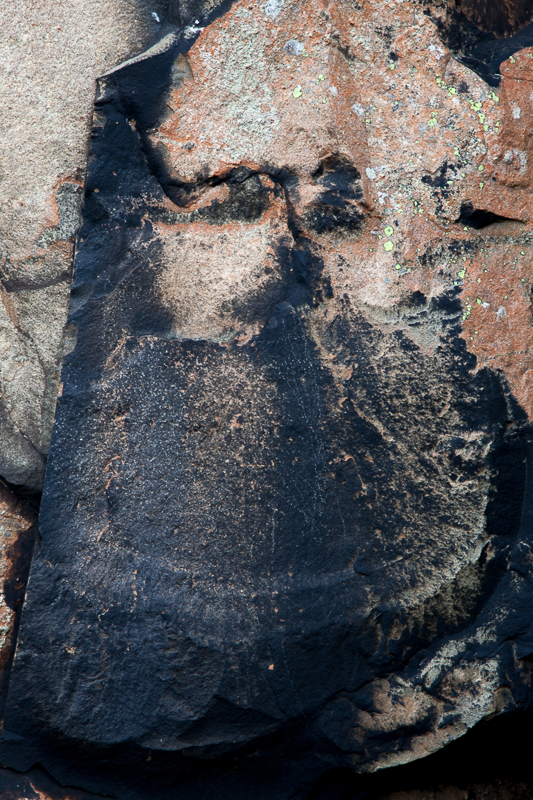
Portrait of Santa Claus as a young man …….. and some reflections on “being a photographer”

Abandoned quarry, near Penmaenmawr

During my coastal explorations of 2011 I visited some phenomenal abandoned quarries above Penmaenmawr in north Wales. The workings were so extensive and the buildings so well preserved that the description “Blaenau Ffestiniog – by – the – Sea” seemed quite appropriate. I came across this human likeness on a quarry face and during the sorting and processing stages the extensive beard and bushy eyebrows reminded me of our friendly seasonal visitor.

I’m very aware that this is my first post for almost exactly two months. The truth is I’ve done very little photography since my trip to Norfolk in early October. I’ve pottered down to Aberystwyth to watch the starling roost on several occasions when conditions looked promising, but barely pressed the shutter in anger. A trip down to the Somerset Levels in November to photograph the same birds also proved disappointing. While they were present in huge numbers there was nothing that could possibly described as a display to photograph. On the several lovely days during a much-extended autumn I was otherwise engaged in painting the outside of the house before the scaffolding was taken away. So it has been a bit of a fallow period, photographically speaking.

Not that that is necessarily a bad thing. It can feel frustrating to have to channel one’s creative energies in other directions, or to subsume them altogether. But it feels good to have a social life again even if I’m not really a party person. And when the muse strikes again, one feels that one’s outlook may have shifted a little in the meantime and thus one’s creative life will have evolved.

In the early months of 1994, I think it was, it would be fair to say that my life was in a bit of a crisis. My house was undergoing major renovation work – well, more or less demolished and then rebuilt – and I was lodging with a friend. Shortly before that a relationship had ended and I put it partly down to the fact that I identified myself firstly as a photographer and secondly as a more rounded human being. Photographers (and others) often describe themselves as “passionate” about their activities and this is usually accepted as being ‘a good thing’. But replace that adjective with “obsessive” and see how perceptions change. I made the conscious decision to stop being a photographer for a few months and see what it felt like. I did nothing photography related that winter other than what was absolutely necessary to keep my business afloat. There was no doubt then that much of my identity revolved around being successful as a photographer. I suppose I was at an early stage in a career, and it probably really mattered. Over the years I have mellowed a little, but I still feel the same way in many respects. The buzz I get from a good session out in the landscape is still unbeatable. At the same time it can be difficult to accept that the kind of recognition that I feel I deserve has eluded me; and that having recently picked up my bus pass, nothing is likely to change in that respect.

But back to the present. Winter in Wales tends to be wet, windy and often rather dismal. Most of my location work is done with the aid of a camper van; I’m on my third now and it’s absolutely essential to my way of working. As autumn progresses it becomes more and more of an ordeal to spend the night in it. I can bear the odd night with sub-zero temperatures (well, just sub-zero anyway) especially if I can start out in a warm van. But returning to a cold van after a day in the field with the knowledge that there may then be up to sixteen hours before sunrise does not fill me with joy. Nor does driving to the nearest town and paying through the nose for a hotel room which in all likelihood will come with an inflexible breakfast time.

And my final excuse? I do not believe we have progressed too far as a species from the stage where hibernation came naturally to us. We may not now be huddled round a camp fire at the back of a cave, venturing out only when it was light and sleeping the rest of the time. But I feel that winter still comes with the opportunity, like it or not, to settle down in front of the wood-burner and ponder the deeper and possibly darker aspects of one’s life, the universe and our relationship with it. Maybe, at the turning of the year, long before the Christian era, our ancestors left their caves for a big party. They knew that, in one sense at least, things could only get better. There is little doubt that our own Christmas and New Year festivities relate back to earlier times when the winter solstice was a time for major clebration. Which brings me right back to Santa Claus….

With Seasons Greetings to all (both) my readers.

To follow Tales from Wild Wales, please scroll right down to the bottom and click Follow

Knots landing (Part 2) -or why we need a 7D mark 2 as soon as possible!

Oystercatchers, Snettisham (Canon 7D, 100-400L zoom
In the first part of this post I described in a general sense my recent visit to Snettisham to photograph its big wader flocks. This time, without getting into too much detail, I’m going to discuss some of the technique and equipment issues I experienced.

The big difference was that I had changed camera bodies between visits. About eighteen months ago I had purchased a Canon 7D to use as my bird photography body, and I thought it would be the answer to all my prayers. How wrong I was. At first I was surprised at how difficult the 7D’s autofocus system found it to distinguish between subject and background – a bird on a branch, for example. It often seemed specifically to focus on something outside the AF point that was placed so carefully on the bird. I’m still not sure if it was a malfunction, user error, or if I was just expecting too much of it.

Probably more seriously, I was taken aback at how poor the ISO performance was. Even at ISO 400, the results I was getting were markedly inferior to those I was accustomed to from my 5D2. That is perhaps to be expected from a camera with a crop sensor, and I have managed some absolute belters. But more often than not the resulting images have been what a fellow photographer described as “mush”. Underwhelming to say the least! Again it could be down to user error: at 400mm on a 1.6x crop camera any minor inadequacy will be magnified by almost thirteen times. Most wildlife photographers will be pushing a 7D to the limits of its abilities – long, heavy lenses, high ISO’s, narrow depth of field. What could possibly go wrong?

Just about everything. Image not quite sharp for some reason? Easy – turn to your software. Underexposed? Ditto. But in both cases the noise levels quickly become almost intolerable. It may be – and probably is – a good camera in the fairly undemanding situations where a DSLR is typically used. Many people swear by them. But as far as I can see, for its intended purpose – fast-moving action at long distances – the 7D just can’t quite cut the mustard. In my opinion it boils down to this: for good results the 7D demands absolutely immaculate technique.

So following the advice of other bird photographers, it looked like it might be possible to replace both my camera bodies (a 7D and a rather elderly 5D mark2) with a 5D mark3. This became viable once the camera’s firmware was upgraded to allow the use of autofocus on an f5.6 lens with a 1.4x extender. The 5d3 could do the job of both.

My second trip to Snettisham was its first outing as a bird photography lens. There are disadvantages. To reach the same level of magnification (roughly) as the 7D (with its crop sensor) I would also need the 1.4x extender, and this adds bulk and weight to my outfit. I cannot leave the 5D3 attached to my long zoom as I did with the 7D – I also need it for other things. The burst rate is slightly slower on the 5D3 – 6fps compared to 8fps – and this may be to be a slight disadvantage. But the proof of the pudding is in the eating, as they say, and I’ve been very pleased with the quality of the images so far. It is early days yet, and I’ve only just begun to dip in to the 402 page manual. But the latest images sharpen well, noise is negligible, really, compared to the 7D, and cropping down into the images gives very acceptable results.

On the first visit, dawn was bright and clear but thick fog very soon arrived. Very few of the waders on the pools were actually visible. It really was that thick! But over time the fog lifted to low cloud, leaving lighting conditions that were subdued but very even. Ideal, in fact, for photographing birds with high levels of contrast in their plumage, like oystercatchers (see above). It is difficult to expose correctly for any black and white bird in bright sunlight, so that was an unexpected bonus. Second time around, a gorgeous pink dawn was quickly replaced by powerful low sunlight, which cause some contrast problems for a while.

Photographing birds is a very different discpline to landscape. In some ways it takes me back to my early days when I tended to point, click and hope! But one refines one’s techniques over the years and I expect my hit rate will improve. As it is I’m spending a lot of time deleting images. But I’m sure even the most experienced pro’s will be looking for that one image from a motor-driven burst that catches the action perfectly. A far cry from parsimonious picture-taking of the landscape specialist.

To follow Tales from Wild Wales, please scroll right down to the bottom and click the follow button

__________________