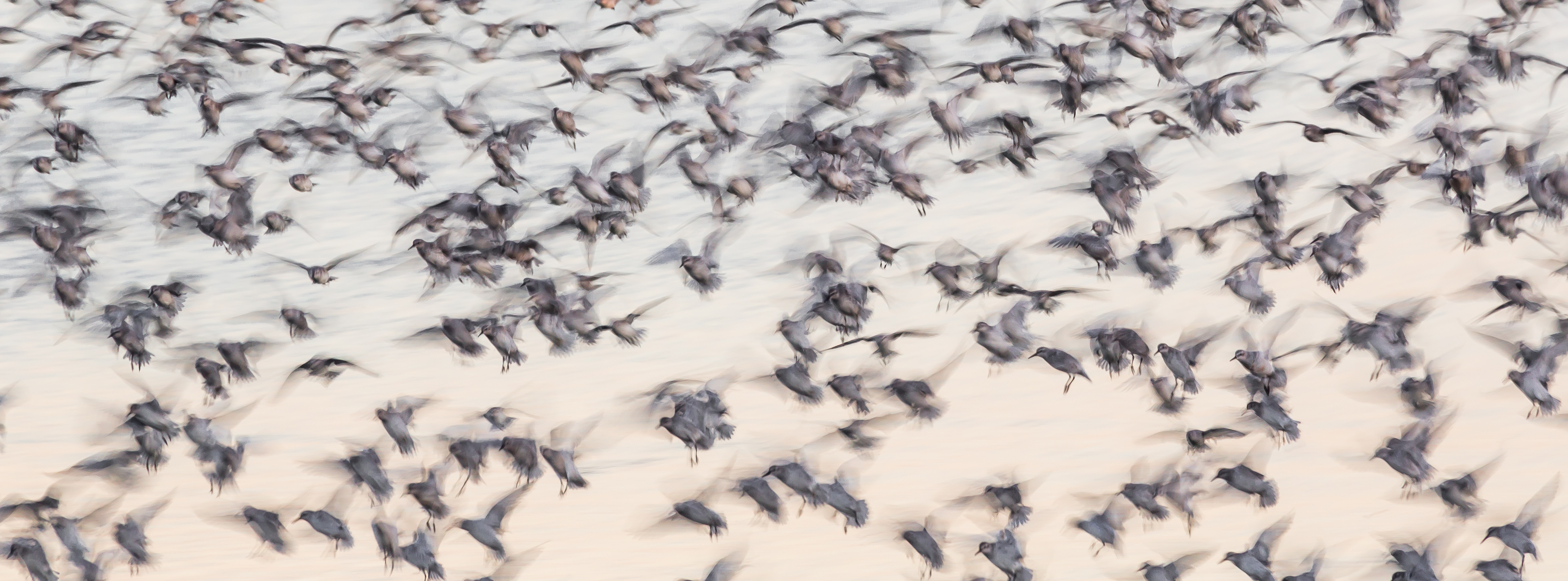
Knots landing (Part One).

Knot, Snettisham, Norfolk

For many years I hardly took a single photograph outside the borders of Wales. It is an infinitely varied country with enough landscape interest to last a lifetime, and it was how I defined myself as a photographer. ‘Wild Wales’ was my brand and in one way or another I earned an income from Welsh landscapes. Despite a passion for wildlife that pre-dated one for photography, my two interests ran largely in parallel for almost thirty years. But gradually my priorities began to shift and the purchase of the requisite equipment (a secondhand Canon 100-400 L zoom) in summer 2011 allowed me to extend my range of subject matter significantly. While I’m still earning a living from landscape – just – it is bird photography that gives me more of a buzz these days. In a rather unstructured way I’m working on a wildlife project which I hope will see the light of day at some stage.

With this new interest in mind I’ve given myself permission to travel outside Wales to seek out new subject matter – hence two visits to north Norfolk this autumn. Lying between Norfolk and Lincolnshire, the Wash is an extensive area of mudflats at low tide but totally inundated by the sea during the highest spring tides. It is a rich source of food for tens of thousands of wading birds – notably knot – during the autumn and winter. At peak spring tides all these birds are forced onshore by the sea and a large percentage of them congregate on some old gravel pits at Snettisham, near Kings Lynn, now an RSPB reserve.

Tidal rhythms dictate that the highest springs at Snettisham are at roughly of seven o’clock, morning and evening. During the short days of winter the roost thus usually takes place in the dark, and even in autumn it may be necessary to begin one’s walk to the gravel pits in total darkness. So one morning about a fortnight ago I began the journey from my camper van towards the wader roost about 6 a.m. The first few other vehicles had also already arrived: shadowy figures emerged from them, torches in hand, rummaging for equipment in car boots, and quiet voices could be heard. There was a sense of anticipation apparent in the air. Conditions overhead were clear; it all augured well for an exciting morning’s photography.

It was still more or less dark when, half an hour later, I reached the vicinity of the gravel pits. A quiet stream of other visitors were also arriving, many of them laden with photographic gear. Dark figures engaged in quiet conversation as they waited. Small groups of oystercatcher and knot were already moving (and other species) but many more could be heard offshore. Gradually dawn blossomed and a wonderful pink light flooded the area. I couldn’t help noticing as light levels increased that the woman I was chatting with was a lot older than I had imagined! I then had a difficult decision to make: enjoy the tranquillity of the dawn or move quickly to the hide where there would still be room in the ringside seats? As more and more flocks moved into the roost I decided to make a break for it.

I first discovered Snettisham on a bird photography workshop with Chris Gomersall and I am a great admirer of his work – not flashy at all and often paying more attention to the birds’ surroundings than that of other photographers. I’d like to think his work is an inspiration for me rather than something I am consciously trying to copy. I had made some reasonable images of roosting birds two weeks earlier and this time I also wanted to try something more experimental – slow exposures of birds in flight, for example, to try and capture attractive movement blur. From the hide I was hoping for close-ups of wader flocks landing and taking off. In practice the results one can expect using these techniques seem to be unpredictable and it would be difficult to emulate exactly what another photographer has already achieved, so my conscience is clear.

Over a period of an hour and a half I sat in the packed hide and watched the wader flocks arrive and then depart. The rapid-fire clicking of motor-driven shutters was interrupted by short periods of calm. A rather lovely old man squeezed in next to me – a newcomer to the world of birding, I guessed. His comments and questions showed how he was over-awed by the sheer number of birds and their closeness to him. It was far more a reflection on my own attitudes that I found this rather childlike innocence at the spectacle slightly irritating. It was a very intense, goal-oriented experience for me. The sense of wonder that one might hope to feel at such a marvellous natural phenomenon was over-ridden for this photographer by the desire for results.

But such is our lot. It is the same, I feel, for the landscape photographer. A stunning landscape may be unfolding in front of your eyes; a moment when light and land come together completely. It is almost essential to subdue any feelings or emotions that might naturally be felt in that situation – only the calm, collected and efficient operation of one’s equipment will allow the image to be successfully made.

At the very moment the biggest knot flock in front of the hide exploded into flight Sod’s Law dictated that I would be fiddling with my camera bag on the floor! Nevertheless I did get some interesting results like the one above, which, incidentally, looks far better viewed large. I’m still on a fairly steep learning curve, but one thing is for sure: there is so much potential at Snettisham for creative bird photography that I just can’t wait to go back.

To follow Tales from Wild Wales, please scroll right down to the bottom and click the follow button

Circumstance and good fortune: some experiences in the world of publishing.

Given the depressed state of the publishing industry at present (appropriately summarised by the headline in last week’s Observer‘Publishing in crisis as book sales plunge’) we do not, I regret to say, share your optimism regarding the sales potential of such a venture 

Rejection letters like this – from the Welsh publisher Gomer Press –  will probably be familiar to many ambitious photographers today, but this was dated 2nd July 1992! I had proposed a  book of Welsh landscapes in the style of those already being produced elsewhere in the British Isles, notably in Scotland by Colin Baxter. Coffee-table? Yes, I suppose so. 

Yet a very short time later I was beginning discussions with Cornerhouse Publications about a  similar book project. In those days, Cornerhouse published work by some of the most respected  photographers in the world.  A catalogue from that era features names like Richard Misrach,  Paul Graham, John Davies and Robert Frank. They described themselves as “Britain’s leading photography publisher with an international reputation for the quality of (our) books.” In 1993, Cornerhouse produced  a dummy and a publication date for my book of summer 1994 was mooted. And then things went quiet. I have letters from Dewi Lewis at Cornerhouse and carbon copies (remember them?) of my letters to him but the sequence comes to an end in November 1993. I have no memory at all of why the project came to a halt. It must have been a shattering blow –  for me anyway….. 

The next letter in my collection, dated November 1994,  once more comes from Gomer Press. There had been a change of staff and a change in attitude. Mairwen Prys Jones had become the English-language editor and was enthusiastic about working with me on a book. ‘Wales – the Lie of the Land’, published in May 1996, was the result; roughly what I had envisaged the Cornerhouse book would be. It was the first in a series of books I have done for Gomer Press, each time working with a different author. ‘Wales at Waters Edge’, which appeared in May 2012, was the most recent, and, I think it is fair to say, probably the most successful. I have never shied away from including some more challenging images amongst the sumptuous landscapes in these books so I have been enormously grateful to Gomer Press, and Mairwen in particular, for their faith in my work. 

Collaborating with an author can be rather hit-and-miss affair. Each of the half-dozen I have worked with has been a different experience, but nothing can compare with the most recent. Late in 2012 I was approached by an author to see if I would be interested in working with him on a new book for a different publisher.  He came from a journalistic background, and his name is not particularly well-known. Nevertheless he showed me an excellent, well thought-out proposal and it was subject matter that I was very keen on moving into myself. At a very productive meeting we agreed how fruitful and enjoyable a true collaboration between the two of us could be. A small amount of funding was obtained for me from the Welsh Books Council by the publisher.  It would realistically only cover my travelling expenses but I was still keen to go ahead. I began work on the photographs. 

Then, completely out of the blue, it all came shuddering to a halt. It really was a car-crash. In the spirit of collaboration I had made a list of constructive suggestions and ideas on how to progress the book from the photographers point of view. We discussed it over the phone. The conversation ended like this: 

Him: “Well if we’re going to have an argument, we might as well do it now”. The criticism begins…..

Me: “I’m finding this conversation very difficult.”

Him: ……..criticism continues…..

Me: “I’m finding this conversation very difficult.”

Him: ……..it’s a rant, really……..

Me: “I’m going to have to ring off now.”

Him: …….the rant continues.…..

Me: “Please……”

Him: …….there’s no end to the rant……

Me: “Please…….”

Him: …….he carries on…… 

At this point I put down the phone. 

This was, in effect, the end of the project for me. I was in a state of shock for a while, but it would have been impossible to work with such a domineering individual who had so little understanding of how photographers produce great pictures. I have not heard from him again, and the publisher pulled the plug on my involvement. Despite massive disappointment on my behalf, it was probably a good thing that I had not yet signed the contract for the book. 

So what might I conclude from all this? Having one’s work published in book form would probably be the fulfilment of a dream for most photographers. Progress towards that goal is, however, often dependent on circumstance and good fortune. The change of heart by Gomer Press between July 1992 and November 1994 was partly the result of a new member of staff being appointed and partly to a recommendation by a writer friend. It worked in my favour that time but these things can equally well work to one’s disadvantage. I have been lucky enough to see my work in print a number of times – some would say very lucky. But even so the state of the economy, the development of new technology and other unpredictable factors mean that good fortune can never be guaranteed, no matter how good one’s work is. It is a bit of a lottery.


To follow Tales from Wild Wales, please scroll right down to the bottom and click the follow button

A eureka moment.

Dyfi Valley, near Machynlleth

This summer has offered few moments for the landscape photographer to rejoice at the quality of the light. Too much cloud….not enough cloud……. It’s not as if I’m choosy or anything.

Last Wednesday was a case in point. The promised morning clearance came a little too late, and left a residue of extensive sheets of high-level white cirrus, rather than the blue sky that one expects. But late in the afternoon things really did take a turn for the better: the cirrus became more wispy and a big patch of blue sky was revealed. And I was in the perfect position to take advantage of it.

This viewpoint over the Dyfi valley has become rather a favourite of mine recently. It has great views to the Snowdonia National Park to the north. With such a commanding position it is also a great spot to spend the night or sit and wait for an improvement in conditions. And when that happens one is right on the spot.

It took me a while to find some foreground interest for this “big”, almost panoramic, landscape. A small rocky outcrop did the trick though, and the colourful autumnal tones of the bracken fronds and mountain ash tree were also helpful. To fit it all in, though, I needed to use the wide end of my wide-angle zoom, which added its own problems.

Using a polarising filter on a lens as wide as 17mm nearly always leads to visible uneven polarisation. This results in a dark blue, over-saturated patch of sky at the top of the image – in the centre if you are at right angles to the sun. If – as I do – you add a graduated neutral density filter the patch will tend to be greyish-blue, which is most unattractive. And yet a polariser is so critical for this type of image. Until this morning I really didn’t know how to solve this problem.

Back at base I had tried cloning the dark patch out and replacing it with another area of sky, but this was hopelessly crude with a complex sky like this. Then I came across the radial filter – a new feature of Lightroom v5, but not one for which I had expected to find a use. I decided to have a quick play, and suddenly it all came together. I selected the dark patch with the radial filter, altered its dimensions so it fitted reasonably well, and feathered it to 100%. Finally I inverted the mask so that I could work only on the area within the selection. It was then a matter of using trial and error with the exposure, highlights, shadows and saturation sliders to get the natural result I was looking for.

Very definitely a eureka moment!

Postscript: after further experimentation I’ve come to the conclusion that adjusting the contrast is probably the most useful in this situation. Lowering the saturation results in the blue becoming greyer.

To follow Tales from Wild Wales, please scroll right down to the bottom and click the follow button

The gift.

Abandoned chapel, near Corris

Quite a number of years ago I was at a get-together of outdoor photographers and the question was floated -” what is your favourite month for landscape photography”? I suggested August because, after the “green deserts” that are June and July, the landscape seems to come alive mid-month with the first signs of autumn. And the nights are long enough again to get a decent nights sleep…….. My choice was greeted with – well, not exactly snorts of derision – but less than an enthusiastic response. I couldn’t help suspecting that some of the others present had not actually noticed the changes that take place.

This year has been a little different. The heat and drought of July led to a very parched looking landscape, even in Wales – some might say looking more like summer! Since then there has been plenty of rain and greens have come back to the fore. Come mid-August and I’m not quite sure what to make of it.

What is difficult not to notice, for the third August in a row (at least), is the lack of bright sunshine. Here in west Wales the passing of a cold front usually leads to crisp, clear atmospheric conditions which are excellent for the photographer. For the last few weeks all that has followed seems to be a different layer of cloud. A ridge of high pressure? More cloud. Perhaps my photographic colleagues were thinking of typical August weather rather than the way the landscape actually looks; and perhaps in that sense they were actually correct. Maybe August normally is a pretty hopeless month for photographing the landscape.

All has not been lost, however. Cloudy conditions can be excellent for certain subject matter, where bright sun introduces high levels of contrast. In woodland, for example, deep shadows and bright highlights make photography very difficult. For very different reasons other subject matter demands what I call “honest light”. Industrial landscapes, for example, where you do not wish to introduce any of the glamour or warmth that sunshine might bring.

Both of these situations came together for me one day last week. As part of the “Darganfod Dyfi” (Discovering the Dyfi) commission that I am working on, I followed one of the projected circular walks above Corris as far as a deserted slate quarrying village, now being engulfed by trees. The whole place would repay further exploration, but right by the path was a tiny chapel, without door, roof or windows. 

Working for other people on their projects can be rather soul-destroying. It often involves subjects and locations that one would not normally bother with . But occasionally you come across something exciting that you would never have otherwise found, and this  was one example. It was tricky to position the camera correctly to give a perfectly symmetrical image, and I don’t think I quite succeeded, despite also using  the lens correction tools in Lightroom..  But after a period of time when photography had become rather uninspiring for me, the chapel felt like a gift. 

 
To follow Tales from Wild Wales, please scroll right down to the bottom and click the follow button
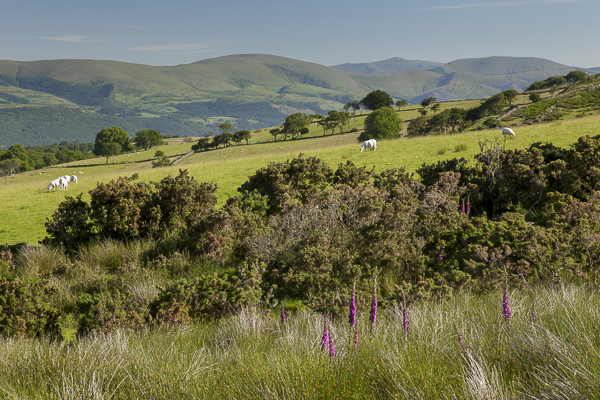
Private garden, Corris

A couple of months ago I was asked to tender for a job photographing views of and from the routes of a number of public footpaths in the Machynlleth area. As part of the Dyfi Biosphere project the paths are being cleared, waymarked, and promoted as circular routes  – with a series of leaflets being produced to assist walkers. The photographs are for the leaflets.

My first problem was that the client required “joint copyright” with me. I had an idea this was meaningless, and on investigation it turned out that joint copyright can only exist if there are joint creators. Both creators would be required to give permission for the use of an “artwork” outside any original agreement. So this was clearly not the case. After a series of phone calls and emails it became clear that the client required use of the images on a long-term basis within the organisation, and no more. So they didn’t need copyright at all! Just a licence to use the images as and when required.

Then pricing. I had a fairly good idea who the other photographers might be so I knew that I would have to price myself low to counter their bids. I imagined I could walk each path once and take photographs on the walk. Add on travel expenses, a nominal amount for subsistence and Bob’s your uncle!

I got the job.  I started work on the first day of the hot spell which lasted for three weeks in July. It immediately became apparent that  cloudless skies were quite unsuited to landscape photography, but I knew that anyway.  More to the point, there was no way that I could produce decent work on one walk around the route. The first visit would only serve as a recce for a later visit (or visits) once I knew where the views were and what time of day would give best results. It was a silly and foolish mistake to make, and I’m surely regretting it now. My best estimate is that the job will probably take twice as long as I had allowed for, and the travelling expenses will probably be double too.

Day rates had, I believed, plummeted in recent years along with all other sources of income for photographers. The price I quoted was less than that I charged about fifteen years ago when I did a lot of work for the Wales Tourist Board. It did not take into account the half a lifetime of experience I now have in landscape photography, and the quality of the images that I produce. But I believed that I would need to price myself low to get the work. The particularly frustrating thing is that no-one else had actually tendered. I was competing only against myself.

Well, such is life. There have been a few decent half-days since the end of July so I’m making some slow progress. Several of the routes are in the Corris area which, given its long history of slate mining, is a fascinating place to take photographs. Undoubtedly the most extraordinary place I have found is a private garden clinging to hillside which is crammed with scale models of Italian palaces, cathedrals and monuments. Not at all what one expects to find in a damp and claustrophobic Welsh mountain village!


To follow Tales from Wild Wales, please scroll right down to the bottom and click the follow button

Wales At Waters Edge – exhibition, talk and landscape photography workshop

Llandudno off-season - from Wales At Waters Edge
Llandudno off-season – from Wales At Waters Edge

Well, the exhibition is now showing in Gallery 2 (upstairs) at Aberystwyth Arts Centre, and very good it looks too! The Arts Centre, on the main University campus,  is probably the most comprehensive in Wales,with two dedicated gallery spaces,  theatre, cinema, concert hall, ceramics spaces, and numerous other facilities  – including a grand total of three coffee shops! I had my first exhibition there about twenty-five years ago, although I cringe now at the thought of the photographs I proudly presented. You may have heard about the Arts Centre for all the wrong reasons recently – senior staff suspended by the University on apparently spurious grounds,  followed by the “retirement” of the former Director of 28 years, Alan Hewson. It was Alan who offered me that first exhibition opportunity all those years ago so I have a lot to be grateful to him for.  How the remaining staff manage to cope with the increased workload just doesn’t bear thinking about. The exhibition programme is still taking place as planned, however, and Wales at Waters Edge is showing until September 7th.

The exhibition is based on the photographs in the book of the same name, which was published last year. It examines all aspects of the coastline, so conventionally unpromising, man-made subject matter has been sought as well as the stunning landscapes that Wales is rightly renowned for. It would be impossible to do justice to the subject without tackling both. As a consequence both the book and exhibition have also become an exploration of our relationship with nature. Recognising that the audience for an exhibition may be different to that for a book, I have selected and arranged the images using different criteria. I had to reduce the number of images by more than half, and decided to bias the selection towards the built coastal environment. That may seem strange, but there are some very interesting developments around these shores some welcome, some not. If the audience recoils at the sight of some of them,  I feel I will have succeeded. Having said that, though, there is still one group of large (30″ x 20″) wild landscapes and another section devoted to coastal birds.

So please do visit! Let me know and I will meet up with you if I can.

There are two linked events at the Arts Centre. On Thursday August 8th at 6p.m. I will be giving an illustrated talk – entry free of charge.And from Thursday 29th August until Sunday 1st September I will be leading a landscape photography workshop based at the Arts Centre. For further details, please click here

To follow Tales from Wild Wales, please scroll right down to the bottom and click the follow button

Lovely weather – but spare a thought for the landscape photographer.

What little colour I could find above the Dyfi Valley.

After what seems like an eternity most of us are enjoying some warm sunny days. Living up in the hills as I do it is several years since I’ve been able to wear shorts and a tee shirt all day long for several days in a row. And I’m finally getting some serious wear out of the flipflops I rashly bought one September several years ago…….

But for the landscape photographer these conditions are the pretty close to the bottom of the barrel. Wall-to-wall sunshine with barely a cloud in the sky do not a happy photographer make, especially in mid-summer. Sunrise is so horribly early that an enormous effort is required to get up in time and without cloud disappointment is often the result. This week the sunsets have hardly been any more interesting and the disturbed sleeping patterns don’t help either. The predominant colour – often the only colour – in the landscape is mid-green.

I’ve recently been commissioned to provide some images for a footpath promotion project in the Dyfi Valley, just north of Aberystwyth.   They aren’t the most spectacular locations but they are very pleasant mid-Wales landscapes. However one is normally judged on one’s best work, and that is often made at the right time of year and in the very best atmospheric conditions. Most photographs I produce during the next month will, I suspect, be disappointing for the client.

My first efforts last Sunday morning made me realise that this wasn’t going to be an easy job at all. The best ‘views’ from just this one walk were in several different directions. They will need to be photographed at different times of day to make the most of the polariser which I usually use. And this uninterrupted sunshine really doesn’t help at all. Partial cloud cover acts as giant diffuser allowing gentle light to penetrate into the nooks and crannies that direct sunlight cannot reach. Without it the landscape looks harsh and uninteresting.

But I love mid-August onwards, well into September. The landscape seems to come alive as wild grasses wither, bracken begins to turn golden and all sorts of other subtle changes take place. And if you visit the right parts of the country the senses can be assailed by the intense pinks and purples found in heather moorland. It almost seems like a different season, and in fact, according to the Chinese Five Element theory, there IS a fifth season, rather uninspiringly translated into English as ‘late summer’. Some of the other characteristics of the season include ‘earth’ as the relevant element, ‘afternoon’ as the time of day, and ‘spleen-pancreas and stomach’ the bodily organs. But maybe we don’t need to go there…….

Back in the present,  I’ve been able to pack a few postcard and calendar orders off to customers in the last couple of days, so some progress has been made. But it feels so desperately wrong as a photographer to be hoovering the office, spring-cleaning the van and making marmalade, while outside the sun is beating down.

To follow Tales from Wild Wales, please scroll right down to the bottom and click the follow button
Photographic cliches and the ‘big stopper’

It’s funny how a disagreement can help to clarify one’s own ideas, rather than help one to see the opposite point of view.

Whilst browsing on a photography forum recently I came across a post asking for suggestions on how to use a 10 stop ND filter (I’ll call them ‘big stoppers’). I’ve been in photography for many years now and I can spot a new trend when I see one. So a few years ago when photographers began asking about these filters on the internet I thought something was afoot. But I just couldn’t understand why anyone should want to increase shutter speeds by so much – in the case of a big stopper by approximately one thousand times. For most of the history of photography the very opposite has been the case. Photographers have striven to reduce shutter speeds to the very minimum in order to stop subject movement.

Eventually I realised that some of the big names in landscape photography were either photographing moving water in almost complete darkness to produce the silky flowing effect that is now so common –  or were beginning to use what had hitherto been a very specialist filter to produce the same result. And the technique was beginning to trickle down to the masses. The trend quickly became unstoppable, and filter manufacturers were unable to keep up with demand.  A deluge of copycat images, some of very poor quality, appeared on the internet. Beginners with very little knowledge of basic photographic techniques were posting images taken with their big stoppers. Waterfalls galore appeared even though the flowing water “effect” can be easily obtained without the filter. The classic big stopper image was of a manmade structure by a shoreline, at dusk, with milky water washing around it. They were (and still are) everywhere on the internet and in the magazines. Some are very good, I’ll admit, but many just aren’t.

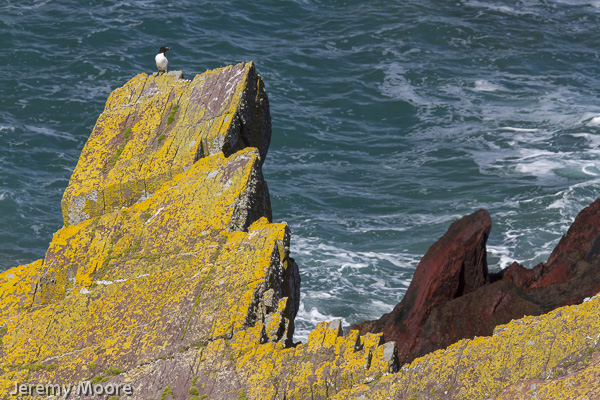
Skokholm Island, Pembrokeshire. (5 secs. @ f16)

So I suggested that the use of a big stopper in such situations had become a cliché. I likened it to the use of HDR processing, which also enjoyed a few years of popularity, before – I think – more or less dying a death. And they didn’t like it! How dare I impose my opinions on other people? But the truth is I’m not the only one and I have some well-known allies. David Ward, for example, discussing one of his images with Tim Parkin (OnLandscape Issue 59), recently said the following –

DW……. And it was timed for subsequent waves coming in so that you get a little bit of that kind of misty water effect further up the strand of the kelp but not too overboard. I am getting a bit bored with that.

TP: Milky water.

DW: Milky water indeed. Yeah, yeah, I am guilty I know. I’ve shot milky water in the past. Hands up. Yeah it was me. I suppose my problem with some of them is that there are…we were talking about means a second ago, there is definitely a meme of a bit of seaside architecture in milky water with either a completely blank sky or scudding clouds rendered as a blur. And yes, they’re perfectly attractive photographs. But to me, they don’t really say very much. What they actually talk about, to me, is more about that meme than they talk about their subject. They’re self-referential, aren’t they, in a way. And I suppose all photography is, to an extent, self-referential. But I think they are particularly about a style and that’s what you get out of them, is that reference to the style, rather than anything else. And, for me, this picture was more about colour of light and flow and those kind of things.

T: Moderation, again, isn’t it? It’s nice how it’s picked up the colour of the light, as well, the cool colour? …..(continues)…..

And in the December 2012 issue of Outdoor Photography David Noton made the following comment –

“…… certainly among the [Landscape Photographer of The Year] competition entries there were a lot of waves lapping around rocks at twilight. It’s understandable; they are fun pictures to make. I do wonder if the viewing public is as enthusiastic about these images. I have to admit to stifling a yawn when looking at another long exposure with milky seas and pink skies. That is, of course, rank hypocrisy on my part; my website has many such pictures in the galleries. I told you I’d make your blood boil! I undoubtedly will continue to be powerless to resist occasionally counting down the minutes of another long exposure at dusk, but I am under no illusions as to the novelty of the likely results.”

I did buy a big stopper. It was difficult not to, really. I would otherwise probably have been the only landscape photographer in the world without one. But I’ve not often found the opportunity to use it. It might be fun to try to remove all the traffic from the Severn Bridge with it and maybe I’ll have a go one day. For waterfalls you just don’t need them, and I couldn’t bear to copy all those milky-water-at-dusk-seascapes, especially now I’ve been so rude about them! But I have used it a couple of times in broad daylight at the coast,  for example on Skokholm Island earlier this year, and I quite like the results.

As I pondered over my internet disagreement, I realised again what I had always known; that my interest in photography is not about exploring what a particular piece of equipment can do. It’s all about exploring the world with the camera. The ‘kit’ I own is the set of tools that I use. My particular weakness may be the polarising filter but with a few other exceptions if it is obvious which particular tool I have used then I feel I may have failed.

To follow Tales from Wild Wales, please scroll right down to the bottom and click the follow button

A return visit to the waterfalls

Last week I made a return visit to the waterfalls described in a previous post  – What………..me, guv? (Part 2).  After an early breakfast in the van I set off on the steep and rugged walk down to the falls, kitted out ready for a long day by the river. It had been a still and very humid night – the midges were ravenous – and there were still signs of mist and fog in the valley. On arrival, about 7 a.m., I settled down with my back against the tree stump and began waiting to see what the day would bring.

There was no sign of the kingfishers I had seen on my previous visit but very soon it became apparent that both grey and pied wagtails had young nearby. It took me rather longer to realise that a dipper was perched on a log just upstream,  below the opposite bank. The valley bottom was still in shade, however, so I decided to walk the short distance back up to the falls themselves, and what a spectacular scene revealed itself there!  In the still humid atmosphere each separate “step” of the falls was creating large volumes of fine spray. The sun had just risen above the rim of the gorge directly behind the falls, back-lighting the spray in a very dramatic fashion.  It was rather a Stonehenge situation. Only very close to the summer solstice would this particular alignment of sunlight and landscape be possible, and  the spray was an added bonus.

Sgwd Clun Gwyn Isaf, Powys

My immediate reaction was “wow” and then “whatever do I do with this?”. The lighting was so extreme, and likely to be very short-lived,  that I began work immediately without giving technique much thought. I set up the tripod and, relying on the camera’s meter reading, began taking photographs. I don’t often use a vertical format but this scene was crying out for it; there was too much deep shadow to left and right.  Once my thought processes began to kick in again I experimented with various shutter speed/depth of field combinations which would produce different amounts of “flow” in the water. Over the next twenty minutes or so the quantity of spray gradually decreased as the sun rose and moved across the sky and I ended up with a selection of different compositions to choose from.  With very high levels of contrast in the images I was grateful for the processing power now possible with Lightroom v4, in particular the separate “whites” and “highlights” sliders which I have now got the hang of! You can see one of the best above.

After an exciting half-hour I returned to my post by the tree stump. The dipper was still there but very shortly after my arrival it began a short walk downstream towards me, feeding as it did.  It continued until it was directly opposite me, at which point it entered the river and perched on a couple of rocks mid-stream. I followed it with my camera. I felt almost certain that it was checking me out. It flew back to its log, still in deep shade despite the bright sun. And for the next four hours it spent all its time either there or in the water nearby,  preening and bathing.

…. scratch …….. tug ………. stretch left wing out ……… stretch right wing out ……. stretch both wings up …… fiddle …….. tug ……. fiddle ……. splash ……. shake ….

That’s the bird, not me. I had rather less to do.

I did get a couple of nice pictures of the grey wagtails during this time – despite their almost constant activity – and although I didn’t realise it until later, I learned an unexpected lesson about birds and their way of life.  After they have reared their young,  small birds go straight into moult. They skulk and become difficult to see while they lose their old feathers and grow new ones. And this is what the dipper was doing. My photographs showed that it was not in good condition, some of its wing primaries in particular looking to be missing.

Back at the falls, I noticed a juvenile dipper – probably reared in a nest nearby – a pair of grey wagtails feeding young, and a pair of spotted flycatchers visiting a potential nest site. A little higher up the valley  came the gorge walkers. A party of twelve inner-city teenagers. It may do them good but I still question if river wildlife can cope with such high levels of disturbance. And in a “Special Area for Conservation” as well. It appears that my conversation with the National Park authorities had not yet borne fruit.

A visit to Skokholm island ……. and the joys of running a business.

Razorbill, Skokholm Island

As mentioned earlier I spent a few days on the delightful island of Skokholm earlier this month. It is an excellent place to get close to razorbills and puffins, in particular, although the latter were conspicuous by their absence on this visit. Only during the first day – when it poured with rain – could they be seen standing conspicuously outside their burrows. And due to spring’s lateness this year, the vegetation was less colourful than I had hoped.

But my visit has become more memorable for the presence there of another photographer  – I’ll call him Greg. Soon after arriving we had a chat and he told me that, in addition to his full-time job, he was in the process of developing a sideline as a wildlife photographer.  I told him I had earned a modest living from landscape photography for about twenty years, but more recently wildlife was becoming my favourite subject matter. I told him about my “Wild Wales” calendar.

Back home a few days later I was browsing around ‘Talk Photography’ when I came across a post entitled “A trip to Skokholm Island”. I could hardly resist having a look, could I? And there were some landscape images of the island with the slogan “Wild Wales Photography” plastered across them. And yes, they were Greg’s. I immediately sent a personal message to him stating that I had been using  “Wild Wales” in my business for many years, that I was in the process of registering it as a Trade Mark, and that it would be better for both of us if he stopped using it.

During a short email conversation Greg told me that had bought “Wild Wales Photography” as a Limited Company about a year previously. It appears from the Companies House website that he actually registered it after returning from Skokholm this year, with the full knowledge that I was already using the name. He has also bought a “Wild Wales Photography” domain name.

It must be  genuinely  confusing for newcomers because, on one hand,  they can buy a domain name if it is available and immediately begin using it – no matter who else is already using one of  the myriad variations on the same theme. On the other hand if the name also happens to be someone’s business name, they are getting into much more difficult waters. In my case I have been using it for over twenty years and steadily building up an awareness of the “brand”.

This is the third time I have become involved in this kind of dispute. A year ago someone else living a few miles away from here also set themselves up as “Wild Wales Photography”, while three years ago another Jeremy Moore from Ceredigion also began trading as  “Jeremy Moore Photography”! Unlikely but true…….!  In both cases it was  the availability of domain names that began the whole process – leading to problems and unpleasantness for both of us and considerable expense for me. I’ve had to register my own name as a Trade Mark  – yes, it’s Jeremy Moore (TM)!

As for Wild Wales, once the process of registering it as a Trade Mark is complete it will trump Greg’s Limited Company name. He will never be able to use it. Through Talk Photography I have tried to explain this to him, as have several others, but he seems unwilling to listen. Oh, the joys of running a business…………

Now where was I? Ah yes  …….  Skokholm Island. It was a lovely few days, and I met some interesting people there. There was an exceptional print maker named Julia Manning; and Celia Smith, a sculptor who creates bird sculptures out of wire. It was good for me to talk to people whose interest in birds goes beyond counting and studying them – important though that is. And I found a pectoral sandpiper – a rare-ish American vagrant wader. In my opinion Skokholm is probably the best of the Welsh islands for bird photography. Skomer is great for a day visit but I’d describe  Skokholm  as “the connoisseur’s choice”.  Not only are the birds just as close – or even closer – but the island itself is much more colourful thanks to the red sandstone rock that forms its coastline. And its relative inaccessibility is an advantage too.

Postscript:  Greg has generously (cough) agreed to let me carry on using “Wild Wales” in my business.

To follow Tales from Wild Wales, please scroll right down to the bottom and click the follow button