Starlings, Aberystwyth: Saturday February 16th 2013
On bright winter afternoons I sometimes go down to Aberystyth to photograph the pre-roost starling displays above the Pier. There’s usually a couple of photographers there and quite often a gathering of other spectators, so it can be nice to have a chat too. Yesterday was a case in point but with a very different flavour.
On a sunny Sunday afternoon you’d expect quite a crowd but even the wooden jetty was packed with people. From the prom there was no sign at all that the birds were going into the tight flocks which provide the most memorable images. They were in small, untidy groupings which flew in a very disorganised fashion under the pier to roost . I squeezed past the small gaggle of photographers who mocked me for my poor timing, then threaded my way down towards the end of the jetty through the crowd. I met a young friend there and said hello. “Oh, you’re here with your fancy camera” was her light-hearted reply. But there was a tremor in her voice as she said it.
There were candles in jars on the tops of the jetty supports but they hadn’t really registered. Then she told me : “We’re here in memory of a friend who has just died.” Gulp. I eventually plucked up the courage to ask a little more. He was a local photographer who’d gone missing a few days previously but whose body had been found that morning by the railway track. “His name was Pinky Marvin….. he loved coming down here to photograph the starlings….he would have loved this”. My pre-occupation with the disorganised nature of the starling flock suddenly seemed quite improper. “He’s got an exhibition of his starling photos in the The Treehouse [a cafe in the town] at the moment.”
It later turned out that I was probably the only person there who knew nothing about the man or his death. Being a photographer can be a solitary way of life – and sometimes a dispiriting one – but he had been getting work locally and having his photographs exhibited. Lack of success could surely not have been the only reason for him to take his own life – if, indeed, that is what happened.
To follow Tales from Wild Wales, please scroll right to the bottom and click the Follow button.
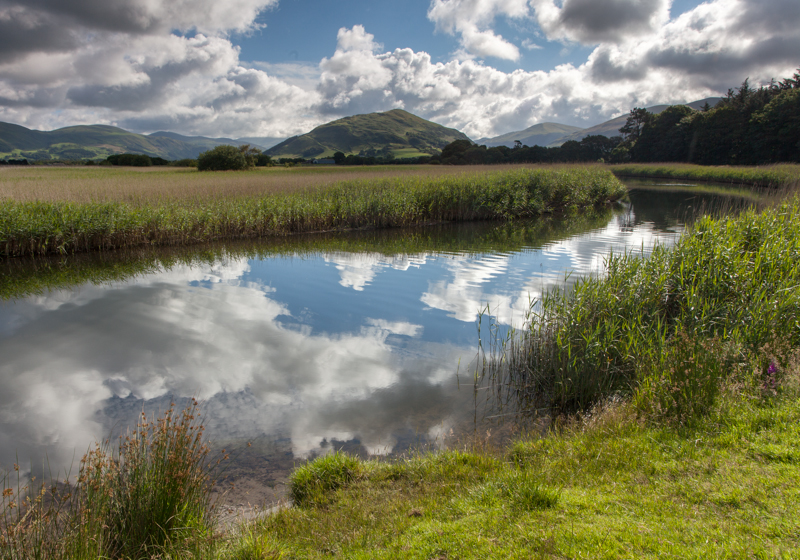
One of this year’s new postcards – M264 : Dysynni River near Tywyn.
What DO landscape photographers do during the winter? It is sometimes said “……oh, the light is so much better in winter….” but that is a pretty gross generalisation. “Good” light can occur at any time of the year and for most of the winter the sky is grey, the wind it doth blow and the rain it doth fall. There are exceptions, of course, and in crisp, frosty conditions, preferably with just enough snow on the ground, the landscape looks superb. But honestly – how often does it happen? Here in Wales, anyway, the answer is: not a lot!
Nor do I necessarily dislike cloudy conditions; in fact cloud cover can be excellent for certain subjects, as long as it is not blowing a gale as well. I call it honest light and it seems to suit man-made and industrial landscapes, whenever the intention is to make a document rather than accentuate the attractive. It is great for waterfalls and woodlands as well, where excess contrast can be a problem.
But I digress. One of things this photographer does in winter is prepare next year’s Wild Wales postcards ready to get them into the shops for Easter. There’s quite a bit of planning to do – for example ensuring that popular designs are always in stock in sufficient quantities, and choosing new designs from the previous year’s images. Then there’s the Wild Wales calendar – it seems very strange to be working on a 2014 calendar during December 2012, but that’s how it is.
I consider myself very lucky to have found a good quality printer for the postcards in a small village about six miles from my home. You’d think any printer could produce postcards but that is not the case at all. You should hear about the cock-ups I’ve had to deal with! For many years I mainly used a greetings card specialist in Cumbria, but they suddenly went out of business in May 2011. Panic Stations! I tried “my local printer” and they did a pretty good job at short notice later that month. Since then I have worked with their production manager to get the top quality results I am always looking for and I think we have 99% succeeded this winter. He has been exceptionally helpful; this year he sourced some stiffer board for me so that the postcards now really exude a sense of quality. A delivery of 40,000 postcards arrived last Friday, but shelf space is now at a premium; a pack of 150 new cards fits in the space formerly occupied by 200!
As far as the calendar is concerned the job is now at the printer. Not the same printer, but another reasonably local one who uses bigger machines which take bigger sheets of paper, and can thus print a larger product more economically. Over a period of eight years now they have done a really good job for me on the calendar. I have OK’d the proofs for the 2014 edition and am waiting to see the results; always with a hint of anxiety, it is true, but I’m reasonably confident.
There was a time when handing a job over to a printer felt like taking a leap into the dark, but I feel that era is now over. Printing technology has advanced in leaps and bounds during the digital era but that is not all. I’m pretty fastidious about the quality of my products and a good printer will also appreciate this, I think. Building a good relationship with a printer takes time and understanding on both sides but it is worth it in the long run. So I’m in the very fortunate position of working with two good mid-Wales printers and being able to support the local economy too.
Having said all that on the photography front I did manage a couple of days in snowy north Wales last week and got some interesting results. Not the iconic winter landscape that I was hoping for for next year’s calendar, unfortunately, but some very icy images indeed.
To follow Tales from Wild Wales, please scroll right to the bottom and click the Follow button.
On a recent trip to Norfolk, I spent a day at the RSPB’s Titchwell reserve. The clouds fully parted that day for the first time in weeks, and I wasn’t the only one who’d had the same idea. The reserve was heaving with birders. I had hoped to do some bird photography but I do sometimes wonder if I’m dedicated enough. Most of the afternoon I stood on the causeway in the sun with my camera trained on a flock of golden plover on the freshwater pools, waiting for them to take off. I was hoping to catch them at the very moment they took flight, but on the one occasion they did fly, my attention was inevitably elsewhere.
But the sound of perhaps one thousand golden plovers calling mellifluously together was so enchanting, it didn’t really seem to matter whether I came away with photographs of them or not.
Earlier in the day, after a very fine egg and bacon breakfast at the reserve cafe, I found my way to the Fen Hide. In my imagination a bittern would creep out of the reeds and I would come away with some stunning close-ups of a very rarely seen bird. In reality the only pictures I took were of water droplets on the hide window. I got a few strange looks from other birders there! Not that I’m complaining, because I think a couple of them are very good, but the session did lead to a lesson being learned.
I was prepared for bird photography and had only my tripod, Canon 7D and 100-400 zoom lens with me; not really ideal for close-up photography. The 7D has only moderate ISO performance (in other words – it’s quite noisy), and the lens is an unwieldy beast. Camera shake, despite bright light, and limited depth of field were both potential problems. To counter the latter I tried to position the camera’s sensor plane parallel to the sloping window – which was tricky. I was imposing a set of limitations upon myself by not using the right equipment for the job. And the stupid thing was, the rest of my kit was in the van, no more than five minutes walk away!
Despite that I did come away with some decent results as you can see from the picture. Each water droplet contains an upside-down, left/right ultra-wide image of the world outside – blue sky, golden reeds and water reflecting the sky. The black outline around many of them I think must be the hide. It has occurred to me how difficult it would be to categorise these photographs. Even though each one contains a number of “landscapes” and is taken more or less out in the landscape, could I – for example – enter one in a landscape photography competition? I’d be interested to hear your thoughts.
To follow Tales from Wild Wales, please scroll right to the bottom and click the Follow button.
I suppose I first became aware of the place during the train journey to the Channel tunnel, which passes through the brand spanking new Ebbsfleet International railway station. As well as the station there is Ebbsfleet United, a football team, placed 22nd in the Blue Square Conference Premier Division. Then there’s the Bishop of Ebbsfleet, and if a place has a bishop there must be a cathedral, right?
Wrong. The Bishop of Ebbsfleet has an office in Oxford. He is a travelling bishop whose job it is to minister to the needs of those who do not believe in the ordination of women. One has to wonder why the Church named him after a place that doesn’t exist……
It was certainly feasible for me to include a visit to Ebbsfleet in my forthcoming trip to London, but first I would have to find it. My OS map of the area dated back to the seventies, and there was no hint of Ebbsfleet on it. For a seasoned map reader, it really was a rather strange experience. I discussed the problem of Ebbsfleet with some friends and said that for some unknown reason I felt compelled to go there. We wondered if, unbeknown to me, other people were also making the same preparations. In the classic Spielberg movie “Close Encounters of The Third Kind” complete strangers were drawn to an alien landing site without knowing why. Fiction, of course – but it was fun to speculate.
The day of the visit arrived; for some reason I had not been able to persuade anyone else to come with me. The weather was a pleasant for mid-December and it was good to get some fresh air after some serious gallery bashing the previous day. I had located the site of Ebbsfleet somewhere near Swanscombe in north Kent. A walk from the village railway station in a northerly direction would take me to the Thames. It looked like a promising start. I just had with me my Panasonic GX1, a couple of lenses and a couple of filters. I was travelling light!
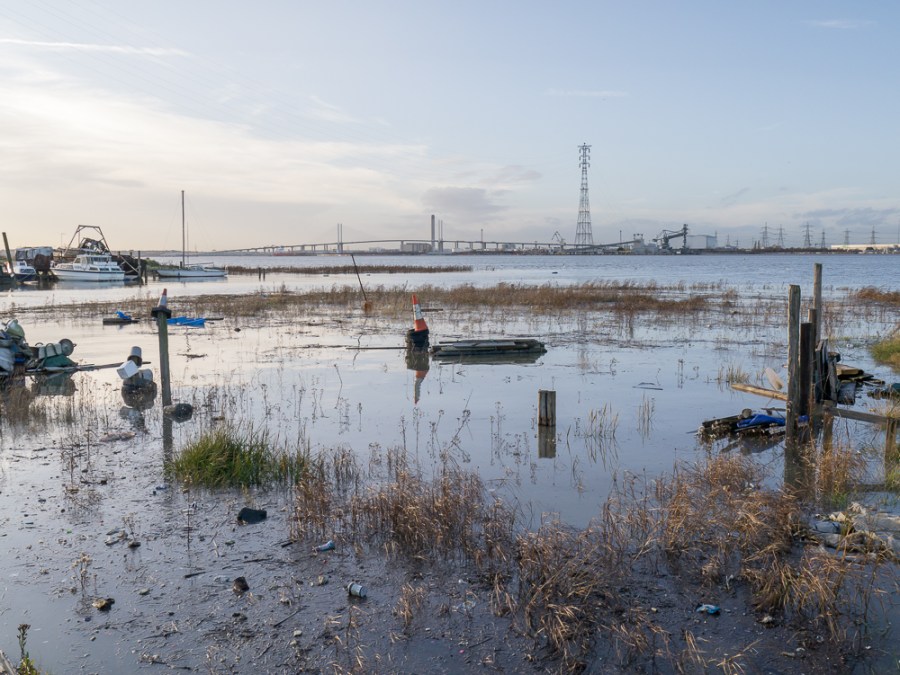
It turned out to be a really interesting afternoon. The area is semi-industrial, partly brown-field, and rich in wildlife. I heard a Cetti’s warbler and a water rail in overgrown ditches. It was once the site of a cement works but lies in the Thames floodplain, and would therefore be difficult to re-develop . A couple I met told me that ideas for a theme park had been floated for the area but they did not know what the theme might be. I found a rather ramshackle and quite fascinating community of wooden jetties, salvaged and recycled material of all descriptions, old cars, sheds, and boats of many types including a couple of houseboats. All very Fay Godwin, but unfortunately the very low, strongly directional light made it very difficult to photograph well.
On the other side of the river lay the Essex coast, Tilbury Docks and more heavy industry. Upstream I could see a convoy after convoy of heavy traffic crossing the Dartford Bridge. The tide was high and water gently lapped the shore in a light breeze. Wild duck took flight as I approached. It was the sort of country I love to explore, with all sorts of contrasts and conjunctions between human activities and nature, and on a very much larger scale than anything I had ever seen in Wales. I found a massive concentration of flotsam and jetsam in a sheltered bay which I photographed with the bridge in the background. Not beautiful in the traditional sense (or any sense, come to that) but it needs to be seen. The photographer bears witness to such things.
Dusk comes very early at this time of year and the sun quickly disappeared behind a spreading shower cloud to the south. I had no tripod with me so that put paid to the day’s activities. I would need far more than a couple of hours if I were to do justice to the enigma that is Ebbsfleet.
As a footnote , the GX1 is capable of very good results. At lower ISO’s it seems to exhibit very little noise, almost the equal to my Canon 5d Mk2, but without the delicate colour rendition of the latter. I wouldn’t like to do without the optional electronic viewfinder, though, and it took me a while to set it up so that most of the dozens of modes and other options are disabled. In normal use it is still quite easy to change settings with a careless press of a button, however – with a finger, the heel of the thumb, or the tip of the nose – which is a real nuisance. It’s certainly a decent option as a travel camera but I wouldn’t replace my DSLR with one.
To follow Tales from Wild Wales, please scroll right to the bottom and click the Follow button.
I’ve often found twitching to be frustrating in a particularly painful way. Even birding itself, while often enjoyable, can sometimes seem pretty frivolous. But to visit a location which – you have heard – was recently the temporary resting place for an avian waif is just asking for disappointment. So it was a mixture of expectations that I set out for Machynlleth last Thursday.
“Up to fourty birds” they had said, “feeding on berries outside the library”, then later “further up Maengwyn Street”. To have so many birds present, so early in the winter, so far west in Wales, it must be a “Waxwing Year”. From the van I saw a woman with binoculars outside the library, but no birds. I parked up and began the search. The woman outside the library had just seen one, and a minute later it re-appeared briefly before flying off again. Half an hour of fruitless searching nearby followed. Hmmmm……time to try “further up Maengwyn Street”. From the van I spotted another little group of ornamental rowans and “yesssss!” – there were waxwings!
Waxwing, Machynlleth
I could see that the birds (about 25 of them) were using the tops of nearby tall trees as a refuge, with small groups making occasional sorties down to feed. I parked near the rowans and had just set the van up as a hide when another local photographer parked next door and got out, long lens at the ready. The birds seemed to keep their distance. “Janet”, I called out of the window, “if you get back in they will come down to feed!” ….and then again a few minutes later, but slightly louder. The birds DID seem nervous. But eventually they got used to our presence, and I began to get some potentially decent results from inside – and then outside – the van. On reflection, over coffee and a late lunch, the morning had turned out really well.
More activity during the afternoon when the number of waxwings had increased, eventually reaching about sixty. But the sun was falling and it became more and more difficult to photograph them without deep shadows falling across their bodies. Sometimes it seemed as if they could feed on a bunch of brightly lit berries while themselves remaining in total shade. And boy, could they move quickly! Eventually I concentrated on trying to photograph the birds silhouetted against a bright evening sky.
At dusk they all congregated in the top-most twigs of a tall poplar, before flying off as a group towards the town centre, looking like a small flock of starlings. It seemed thay had gone to roost somewhere. They were soon back, though, fluttering and calling over the rowans in a tight flock, just a few feet away, before dropping down to grab the few remaining berries. After that magical moment they were gone, to the north this time, and I called it a day too.
It was apparent that local people had noticed the birds as well. They didn’t need birders with their long lenses and telescopes to point out these special visitors to the town. It seemed like it may have been the first big local event after the disappearance of April Jones two months earlier, and the consequent police and media invasion. And a much more pleasant one at that.
There was plenty of processing to be done, and plenty of deletions!. I’m a relatively newcomer to the world of bird photography, and today’s high speed motor drives are definitely a boon. The silhouettes were disappointing. But I whittled the images down to about fifty and some favourites began to stand out, like the one above. It’s cropped slightly, and it could take a lot more cropping. But I’ve left the bird within its surroundings; at heart I’m still a landscape photographer, I think. I’d love to hear your thoughts!
To follow Tales from Wild Wales, please scroll right to the bottom and click the Follow button.
Winter morning near Aberystwyth – cruelly overlooked by this years LPOTY judges.
Image manipulation has been uppermost in my mind recently. Earlier this year I entered the Landscape Photographer of the Year competition, none of my images getting past the first stage. I was disappointed but soon forgot all about it. Then ten days ago I discovered that the competition was mired in controversy. Three winning images by one photographer had been disqualified following analysis by independent observers which showed them to have been composites. In other words what appeared to be a single image was actually a combination of two or more others. Tim Parkin, the guiding light behind OnLandscape online magazine, had shown that the landscape in the winning image must have contained two suns if it had been for real – one at one angle to create strong shadows, and a second to form “god-beams” at another. Quite shockingly the judges had not originally noticed this – nor could they have seen the relevant RAW file.
The rules in three categories of LPOTY are quite clear –
“ Digital adjustments, including High Dynamic Range (HDR) imaging techniques and the joining together of multiple frames, are allowed in all categories. However for images entered in Classic view, Living the View and Urban view, the integrity of the subject must be maintained and the making of physical changes to the landscape is not permitted (removing fences, moving trees, stripping in sky from another image etc). The organisers reserve the right to disqualify any image that they feel lacks authenticity due to over-manipulation.”
Rules for the fourth category are less so –
” The judges will allow more latitude in the ‘Your View’ category, which aims to encourage originality and conceptual thinking.”
I don’t have a problem at all with the principles underlying the first three categories but the definition of Your View seems flawed. How much manipulation is too much here? And why should “originality” and “conceptual thinking” need or involve it anyway?
In my opinion there is a gulf – a yawning chasm, almost – between what has traditionally been understood as image “processing” (or “adjusting” in LPOTY parlance) and what is now achievable in Photoshop. The original competition winner was clearly working on one side of the chasm, while the rules stated that he should have been on the other side.
It must be difficult for younger photographers to understand this because they have developed their skills entirely within the Photoshop era. Photography has, until very recently, always had (with a few exceptions) an umbilical link with reality. I am surprised that some photographers cannot see that this link is broken when one image is put together from selections of two or more others. I do not deny that there are grey areas where arguments may occur. But that does not deflect me from my identification of a quantum difference between processing and manipulation. Those who claim that “It’s all manipulation” are just plain wrong.
Perhaps the current controversy will result in the LPOTY organisers making it more clear that manipulated images (such as composites) are not acceptable in the competition as it stands. They would need to define exactly where processing ends and manipulation begins, but this should not be a problem. In my imagination “Your View” suggests a personal interpretation of a landscape, or a personal relationship with the land, which would not be appropriate in the other three categories. So for those whose skills lie primarily at the keyboard end of the photographic process a separate category should be introduced. To add an analogy it would be a bit like banning smokers from inside the pub but providing them with an area outside where they could indulge.
Photoshoppery is a valid technique for many purposes, and the resulting images can be stunning. But without documentary values are they really photographs at all? A separate category for manipulated images would do all (landscape) photographers a service. They would be able to decide which side of the line their images stood, and – in an era when sometimes anything seems to go – it would help to define what exactly a photograph is.
To follow Tales from Wild Wales, please scroll right to the bottom and click the Follow button.
Wild Wales / Cymru Wyllt 2013 calendar (front cover)Wild Wales 2013 calendar (back cover)
Just a little plug for my Wild Wales / Cymru Wyllt calendar, now (2012) in its eighth year of publication. At 330mm x 245mm in size (opening to double), thick card cover and quality paper inside, and twelve seasonal image by me, it really is fantastic value at £6.50 (inc p&p in UK). An ideal Christmas gift, especially if you love Wales, or good nature photography wherever it might be found!
These three things all happened today, I promise you.
Firstly, my phone rang. It doesn’t ring that often, so that was a surprise for a start. But this call was from a large international PR company. They had seen my “highly commended” image of starlings on Aberystwyth pier (see September 10th post) and wanted to know if they could use it in a bid they were working on for Canon UK . No, “we don’t have a budget for photographs” but if their bid was successful Canon might want to employ me. As I didn’t fully understand what they wanted or what was being offered in return (if anything) I asked them to email me with the details. Needless to say there was no email.
It easy is to be sceptical about such requests, and I was. But over the course of the morning I began to wonder if it was a genuine opportunity to which I had not been receptive. I phoned the company and got an email by way of a reply. They had already made other arrangements. Or had they? A further email conversation took place in which I offered them the picture for a fee, because they really did want to use it after all. “Cool. No thanks” came the reply. And so it stands. If they do want the image, they’ll be back. Possible jam tomorrow? Not when it comes to supporting a large multi-national with my work, thanks very much!
Later this morning I had an email from a friend who operates a small environmental interpretation consultancy. Would I mind supplying an image free of charge for a bid she was working on? If it was successful……etc, etc….. . I had no hesitation in agreeing to this request because Shelagh is a good sort and has been very supportive of my work over the years. I sent a jpeg over this afternoon.
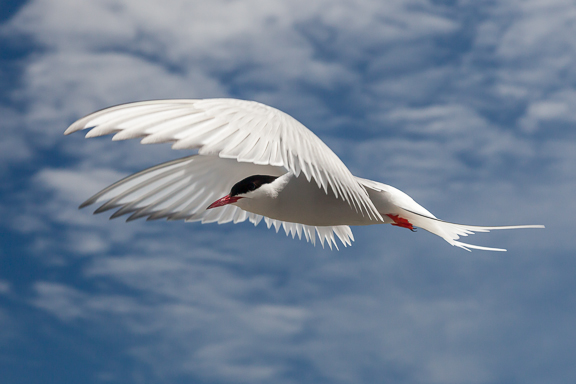
Then another email arrived, this one from the British Trust for Ornithology. I have been doing voluntary bird survey work for the BTO for many years, including, from 2007 – 2011, “The Bird Atlas” of the British Isles. The results of thousands of volunteers’ efforts on this project are being collated and will be published in book form next year. With the statistical techniques and computing power now available this will be a real powerhouse of information about British and Irish bird populations. Earlier this year they put out a request for images to illustrate the book, and to my delight one of mine – of an arctic tern – has been chosen. There is no payment but it helps me to feel even more involved in an absolutely brilliant project which will be a benchmark in ornithological knowledge for many years to come.
The image of the arctic tern is reproduced above.
To follow Tales from Wild Wales, please scroll right to the bottom and click the Follow button.
After spending a couple of hours in Purpleworld I turned my attention to the main beach, at the back of which is an easily accessible cave. Following heavy rain a stream runs down over the cliff-top and deposits its contents on the beach, cascading across the cave entrance on its way. This immediately suggested another photo-opportunity.
A waterfall is great subject matter and I have photographed them many times. In a typical location in Wales – shady and overhung with trees – I find they are often best tackled during cloudy conditions. This removes potential problems of excessive contrast if there is any risk of stray sunbeams reaching the image anywhere! A polariser is advisable to remove reflections from wet rock, a tripod a necessity, and a typical exposure will be about 0.5 second at f16; the small aperture will reduce any depth-of-field problems to a minimum. This technique allows the cascade to register on the sensor as a silky flow rather than water in stopped motion. Neither is an accurate representation of what the eye sees but only a movie camera could reproduce that.
In actual fact waterfalls are quite easy to photograph in this way, and those with a good eye for composition will often produce a striking image. But there are an awful lot of well photographed waterfall images about! So when I have the time and opportunity I try to create something different and more abstract. I might use a telephoto lens at minimum focus for extreme close-ups, for example, and I have been behind waterfalls and photographed back out through the cascade (in the Upper Neath Valley for instance). On this occasion – by now a bright and sunny morning- the curtain of falling water was brightly lit against the darkness of the cave interior. On examination through the telephoto lens each individual drop was acting as a prism and splitting the sunlight into a spectrum of colours. Wow!
I began work on a series of images, but it proved very frustrating. Using a variety of different ISO’s, shutter speeds, apertures and focal lengths, I tried to find the best combination. Some exposures produced what looked like a completely dark LCD image, but when seen on the monitor at home contained a few coloured streaks. Others seemed to be so overloaded with light streaks that they were almost white on the LCD. The cascade changed course and location unpredictably and the wind changed the angle at which the drops fell. A partial rainbow appeared in fine spray within, alongside or behind the main fall. To cap it all the tide was coming in and I was worried I might get trapped by rising water! After half a lifetime photographing in the landscape I don’t think I have ever come across a more difficult subject.
In the end it was the very first image that was my favourite, reproduced above. It is, in fact, by far the best picture of its type I have ever taken, and deserves to be seen much larger than it is here! You might wonder what post-processing I have used on it. Well, a slight crop and sharpen but you’d expect that. The main change I made was to the black point, moving the “blacks” slider in Lightroom 4 well to the left. This had the result of turning pale, out-of-focus (but just visible) background streaks into darkness. Oh, and I removed two short, out-of-focus, white foreground streaks using the Lightroom clone tool.
To follow Tales from Wild Wales, please scroll right to the bottom and click the Follow button.
For the two years ending early 2012 I worked mainly on Wales at Water’s Edge – abook about the Welsh coastline. Several photographers had covered the Welsh coastline in their books in recent years, but each had left me frustrated. One looked as if it had been put together by the Tourist Board – not surprisingly, it turned out, because of some of the photographer’s own images were replaced by the publisher with stock images from that same organisation! Another is very beautiful but portrays its subject in the glare of a decidedly rosy-tinted spotlight.
It was my intention to give a more honest impression of a very varied coastline; and in fact during the project I spent a surprising amount of time in its more built-up and industrialised stretches. But many of Wales’s iconic coastal locations, and many lesser-known ones as well, feature in the book, and I enjoyed every minute spent photographing them. As well as adding wildlife imagery (particularly birds) I also included a selection of portraits of people whose way of life connects them with the coastline in some way. It would be fair to say that the images of the “unspoilt” stretches of Welsh coastline will pull in most book buyers. But I felt that the audience for an exhibition would be slightly different.
Selecting images for the exhibition involved reducing in the number of images from 125 in the book down to just 50, a difficult task for the independent observer, I imagine, let alone their creator! To assist in the process, and to give the exhibition a different focus, I decided to bias the selection of landscape images towards the man-made. However in many cases this impact is set within natural surroundings and as a result the exhibition has become an exploration of our relationship with nature.
The book was published in May 2012 to co-incide with the opening of the All-Wales Coastal Path. As well as my images there is a very fine text by Jon Gower, who somehow managed to find time in an incredibly busy timetable to finish it! Following a showing at Rhyl Library Arts Centre in June and July this year, the exhibition is now (October 20th until November 24th) showing at Oriel Theatr Clwyd, Mold, north-east Wales (about 12 miles from Chester) in the main gallery. It is a huge space so each image really has room to breathe. Why not go along?
To follow Tales from Wild Wales, please scroll right to the bottom and click the Follow button.







 Tales from Wild Wales