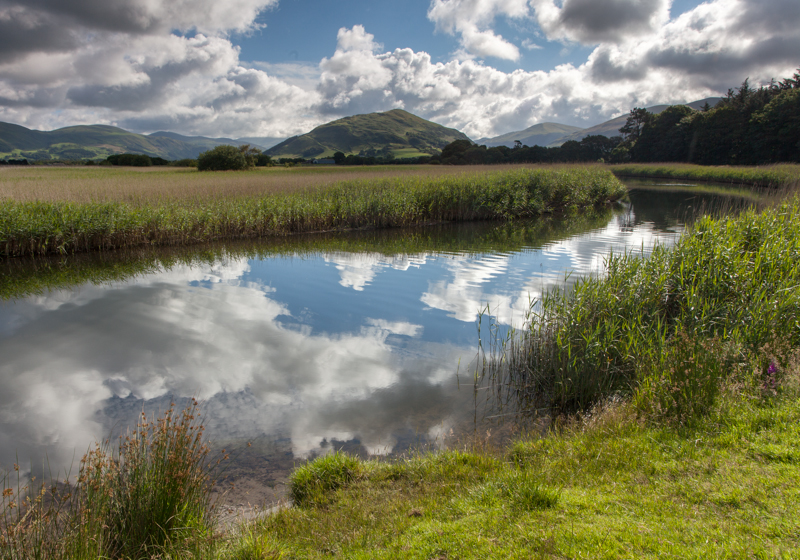
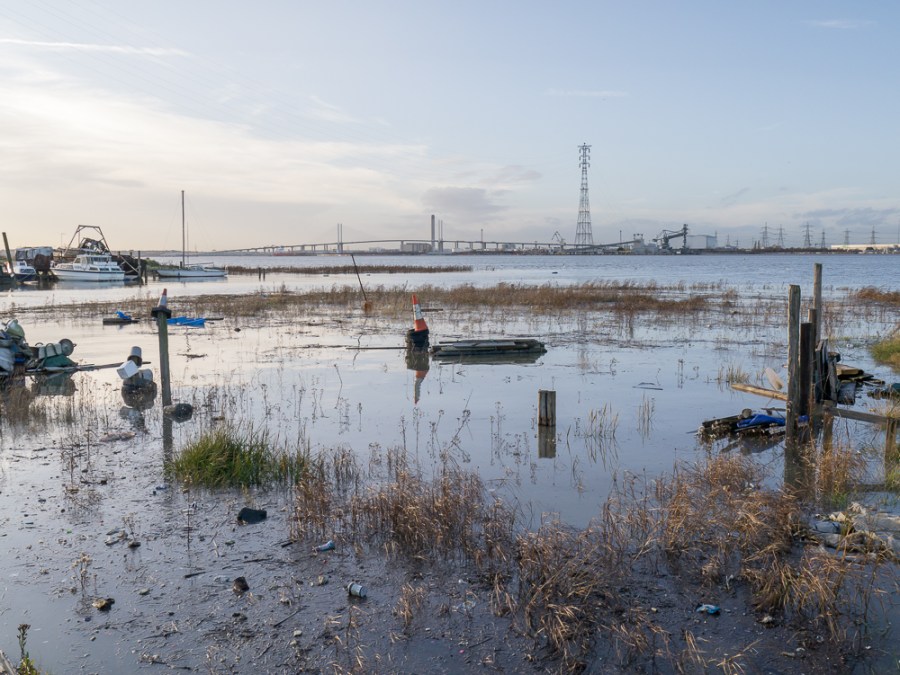
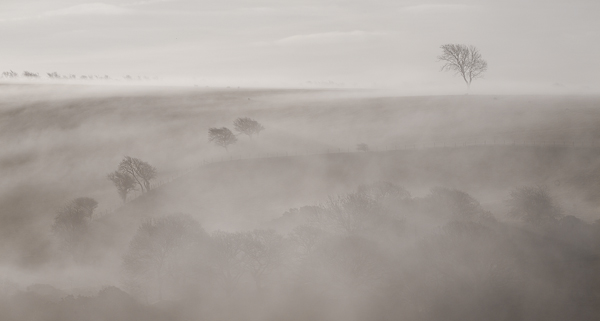
Wild Wales / Cymru Wyllt 2013 calendar (front cover)Wild Wales 2013 calendar (back cover)
Just a little plug for my Wild Wales / Cymru Wyllt calendar, now (2012) in its eighth year of publication. At 330mm x 245mm in size (opening to double), thick card cover and quality paper inside, and twelve seasonal image by me, it really is fantastic value at £6.50 (inc p&p in UK). An ideal Christmas gift, especially if you love Wales, or good nature photography wherever it might be found!
These three things all happened today, I promise you.
Firstly, my phone rang. It doesn’t ring that often, so that was a surprise for a start. But this call was from a large international PR company. They had seen my “highly commended” image of starlings on Aberystwyth pier (see September 10th post) and wanted to know if they could use it in a bid they were working on for Canon UK . No, “we don’t have a budget for photographs” but if their bid was successful Canon might want to employ me. As I didn’t fully understand what they wanted or what was being offered in return (if anything) I asked them to email me with the details. Needless to say there was no email.
It easy is to be sceptical about such requests, and I was. But over the course of the morning I began to wonder if it was a genuine opportunity to which I had not been receptive. I phoned the company and got an email by way of a reply. They had already made other arrangements. Or had they? A further email conversation took place in which I offered them the picture for a fee, because they really did want to use it after all. “Cool. No thanks” came the reply. And so it stands. If they do want the image, they’ll be back. Possible jam tomorrow? Not when it comes to supporting a large multi-national with my work, thanks very much!
Later this morning I had an email from a friend who operates a small environmental interpretation consultancy. Would I mind supplying an image free of charge for a bid she was working on? If it was successful……etc, etc….. . I had no hesitation in agreeing to this request because Shelagh is a good sort and has been very supportive of my work over the years. I sent a jpeg over this afternoon.
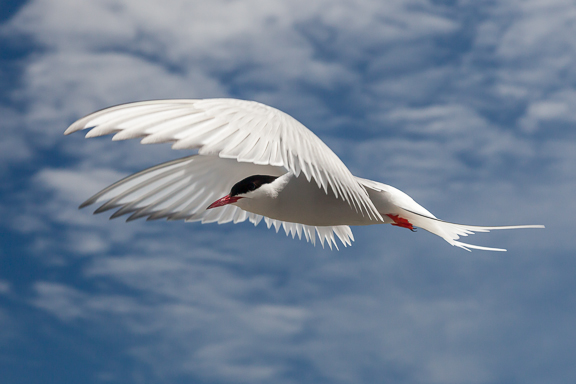
Then another email arrived, this one from the British Trust for Ornithology. I have been doing voluntary bird survey work for the BTO for many years, including, from 2007 – 2011, “The Bird Atlas” of the British Isles. The results of thousands of volunteers’ efforts on this project are being collated and will be published in book form next year. With the statistical techniques and computing power now available this will be a real powerhouse of information about British and Irish bird populations. Earlier this year they put out a request for images to illustrate the book, and to my delight one of mine – of an arctic tern – has been chosen. There is no payment but it helps me to feel even more involved in an absolutely brilliant project which will be a benchmark in ornithological knowledge for many years to come.
The image of the arctic tern is reproduced above.
To follow Tales from Wild Wales, please scroll right to the bottom and click the Follow button.
After spending a couple of hours in Purpleworld I turned my attention to the main beach, at the back of which is an easily accessible cave. Following heavy rain a stream runs down over the cliff-top and deposits its contents on the beach, cascading across the cave entrance on its way. This immediately suggested another photo-opportunity.
A waterfall is great subject matter and I have photographed them many times. In a typical location in Wales – shady and overhung with trees – I find they are often best tackled during cloudy conditions. This removes potential problems of excessive contrast if there is any risk of stray sunbeams reaching the image anywhere! A polariser is advisable to remove reflections from wet rock, a tripod a necessity, and a typical exposure will be about 0.5 second at f16; the small aperture will reduce any depth-of-field problems to a minimum. This technique allows the cascade to register on the sensor as a silky flow rather than water in stopped motion. Neither is an accurate representation of what the eye sees but only a movie camera could reproduce that.
In actual fact waterfalls are quite easy to photograph in this way, and those with a good eye for composition will often produce a striking image. But there are an awful lot of well photographed waterfall images about! So when I have the time and opportunity I try to create something different and more abstract. I might use a telephoto lens at minimum focus for extreme close-ups, for example, and I have been behind waterfalls and photographed back out through the cascade (in the Upper Neath Valley for instance). On this occasion – by now a bright and sunny morning- the curtain of falling water was brightly lit against the darkness of the cave interior. On examination through the telephoto lens each individual drop was acting as a prism and splitting the sunlight into a spectrum of colours. Wow!
I began work on a series of images, but it proved very frustrating. Using a variety of different ISO’s, shutter speeds, apertures and focal lengths, I tried to find the best combination. Some exposures produced what looked like a completely dark LCD image, but when seen on the monitor at home contained a few coloured streaks. Others seemed to be so overloaded with light streaks that they were almost white on the LCD. The cascade changed course and location unpredictably and the wind changed the angle at which the drops fell. A partial rainbow appeared in fine spray within, alongside or behind the main fall. To cap it all the tide was coming in and I was worried I might get trapped by rising water! After half a lifetime photographing in the landscape I don’t think I have ever come across a more difficult subject.
In the end it was the very first image that was my favourite, reproduced above. It is, in fact, by far the best picture of its type I have ever taken, and deserves to be seen much larger than it is here! You might wonder what post-processing I have used on it. Well, a slight crop and sharpen but you’d expect that. The main change I made was to the black point, moving the “blacks” slider in Lightroom 4 well to the left. This had the result of turning pale, out-of-focus (but just visible) background streaks into darkness. Oh, and I removed two short, out-of-focus, white foreground streaks using the Lightroom clone tool.
To follow Tales from Wild Wales, please scroll right to the bottom and click the Follow button.
For the two years ending early 2012 I worked mainly on Wales at Water’s Edge – abook about the Welsh coastline. Several photographers had covered the Welsh coastline in their books in recent years, but each had left me frustrated. One looked as if it had been put together by the Tourist Board – not surprisingly, it turned out, because of some of the photographer’s own images were replaced by the publisher with stock images from that same organisation! Another is very beautiful but portrays its subject in the glare of a decidedly rosy-tinted spotlight.
It was my intention to give a more honest impression of a very varied coastline; and in fact during the project I spent a surprising amount of time in its more built-up and industrialised stretches. But many of Wales’s iconic coastal locations, and many lesser-known ones as well, feature in the book, and I enjoyed every minute spent photographing them. As well as adding wildlife imagery (particularly birds) I also included a selection of portraits of people whose way of life connects them with the coastline in some way. It would be fair to say that the images of the “unspoilt” stretches of Welsh coastline will pull in most book buyers. But I felt that the audience for an exhibition would be slightly different.
Selecting images for the exhibition involved reducing in the number of images from 125 in the book down to just 50, a difficult task for the independent observer, I imagine, let alone their creator! To assist in the process, and to give the exhibition a different focus, I decided to bias the selection of landscape images towards the man-made. However in many cases this impact is set within natural surroundings and as a result the exhibition has become an exploration of our relationship with nature.
The book was published in May 2012 to co-incide with the opening of the All-Wales Coastal Path. As well as my images there is a very fine text by Jon Gower, who somehow managed to find time in an incredibly busy timetable to finish it! Following a showing at Rhyl Library Arts Centre in June and July this year, the exhibition is now (October 20th until November 24th) showing at Oriel Theatr Clwyd, Mold, north-east Wales (about 12 miles from Chester) in the main gallery. It is a huge space so each image really has room to breathe. Why not go along?
To follow Tales from Wild Wales, please scroll right to the bottom and click the Follow button.
It has long been a nightmare of mine that I would for some unfathomable reason be connected to a serious crime with which I had no involvement. Last Tuesday morning I came back from town to find a large dark saloon car parked outside the house, and, assuming it was the estate agent with business next door, I waited for it to move before reversing in to the drive. Two men then got out of the car and came over to speak to me. “We’re investigating the murder of the little girl from Machynlleth and your van, with a sleeping bag in the back, was reported outside a derelict house. May we ask you some questions?” They invited themselves in.
Bryn-y-Gog estate, Machynlleth.
Fortunately I was able to tell them that on the Monday night April Jones had been abducted Jane and I were still on holiday in Germany, and that we took a taxi from the railway station on the Tuesday night ( the following evening) about 9.30 pm. Needless to say the taxi driver had some very strong opinions on the subject of the girl’s disappearance! But did I remember the name of the taxi company? “Well…..no…..it was just one at the head of the queue.” After I had answered a few more questions, however, I think they realised that I could not possibly have been implicated, and were happy to leave. With the alleged murderer already behind bars I suppose they were just tying up loose ends. But apart from the interesting observation that our home appeared to be “derelict”, the episode did have a worrying side to it.
I’m often away from home for several days at a time on field trips, and sometimes no-one – not even Jane – would know where I was. It could be quite difficult to prove I was away from a crime scene if for some unknown reason I became a suspect. Would the data attached to a digital image be enough to prove one’s whereabouts? And if I had no results at all from the trip – and this does happen – how could I prove my innocence? It was a scary thought, so perhaps one should always take a few images wherever one is just to be on the safe side?
As for Machynlleth, despite the dozens of pink ribbons, it was like a morgue on the Sunday afternoon following the girl’s disappearance. I spent an hour or so walking around the town to see if anything caught my eye; the answer was no. Despite mild and pleasant weather no children were playing on the grass on the Bryn-y-Gog estate where the abduction had taken place. A police constable – his job to prevent photographers and reporters getting too close to the house – stood on duty. I had a quick chat and wished him well.
The following night I woke suddenly and saw the photograph I should have taken…… that policeman standing alone on the grass in the middle of the estate, with perhaps a pink ribbon or two somewhere in the frame. The following Wednesday – market day in Machynlleth – I made another trip there with the intention of re-creating the image I had seen in my minds eye. As it often is on a Wednesday the town was really buzzing and I had no hesitation in grabbing the camera and entering the estate through a rear gate. This time a gaggle of policemen was standing around chatting so any possibility of repeating what I had envisaged immediately became impossible. With their permission I spent a few minutes walking around the estate taking a few pictures. I just did what I could. As discussed in a previous post (Love Locks) it is often difficult to re-create an image – even an imaginary one like this! I could never work as a photographer in a formal setting. For me the joy of photography is almost always its spontaneity.
To follow Tales from Wild Wales, please scroll right to the bottom and click the Follow button.
Years ago a website designer was adding nonsense text to my then-under-construction site. Under one heading he wrote
“Jeremy Moore is out in the jungle photographing rocks”
At first glance this was just an off-the cuff remark, but on further consideration it may have been a comment on the activities of landscape photographers. The world is beset by a multitude of problems, with climate change being one of the most pressing. And what do landscape photographers do? We drive across the country and take pictures of rocks.
Not that often in the jungle perhaps, but at the coast……..we do a lot of it. And that brings me to the title of the post. One quite popular and easily accessible beach in Pembrokeshire backs on to a quite astonishing little cove with purple and bright red sandstone bedrock and a variety of boulders in red, purple and green/grey. The beach itself features on one of my postcards and the boulders are easily visible in the image. It is surprising that more photographers don’t venture down there, but even those from Pembrokeshire seem to give it a miss, let alone the big names from England. I’m not going to name the location; that would make it too easy. But look at this image – you’d expect it to be elbow room only down there at low tide!
As for “purpleworld” the sense of colour at the back of the cove is so complete that one’s eyes begin to compensate for it and it starts to look “normal”. Turning one’s back and looking out to sea again the real world seems unreal.
There are two interesting caves to explore there as well; I may post another image or two some time……
To follow Tales from Wild Wales, please scroll right to the bottom and click the Follow button.
Other than in the surname of the brilliant independent scientist James Lovelock, I’d never come across the term “love lock” until a couple of days ago. Then, by chance, I found it on the internet – where else, these days – and it perfectly described what I had seen earlier in the week on a footbridge in Koln, Germany.
My partner and I were on a European round trip culminating in a week in the Swiss Alps. Travelling by train, we had broken our return journey in Koln. We discovered a footbridge across the Rhine but at first I couldn’t understand what I was seeing there. On closer inspection it became clear…. many, many thousands of brightly coloured padlocks attached to the wire side of the footbridge. Each one was engraved with a couples’ names, or had them written on with indelible ink. The bridge ran alongside the main railway line as it left the station so it is difficult to imagine a more industrial setting
It was intriguing subject matter, but I saw I was not the only one with the same idea. How could I “add value” to an interesting but straightforward image? I had a short session with the camera at and after sunset. Down on my haunches I photographed the love locks with the railway behind them from the other side of the bridge as, almost by accident, a couple carrying a baby passed in front of me. It was a quite spontaneous pressing of the shutter; the idea or intention had not entered my conscious mind.
It had been almost dusk and I was using a slow-ish shutter speed and a wide aperture, so I couldn’t be certain the image had worked. The next morning I returned with the intention of replicating it, but this proved to be difficult. In the bright light of morning pedestrians could see me clearly and stopped to let me take my picture before walking past – they didn’t realise I needed them in it! I would wave them on but sometimes it’s just impossible to re-create a special photographic moment, even if all the elements are all present, so it was fortunate that the evening’s couple turned out to be perfect.
I read on the internet that attaching “love locks” to bridges or statues (and throwing away the key) is a trend of recent but unknown origin, which has taken root in several European cities, including Rome and Paris, in very much more romantic locations than the Koln example we came across. Sometimes they are removed by local authorities (citing Health and Safety perhaps….) and in Koln this had been proposed but residents protested and they are still there. What possible problem could they cause, I wonder? In my opinion “love locks” are wonderful idea.
To follow Tales from Wild Wales, please scroll right to the bottom and click the Follow button.
The other day I was in the Dolgellau area with some time to spend on photography during the late afternoon. It was a very showery day and I thought there might be chance of a rainbow or two. There are several easily accessible elevated locations around the Mawddach estuary, and to give my self the best chance of some good images I decided on the New Precipice Walk on the north side of the valley. A rainbow would appear roughly opposite the sun, backlit rain showers would be at 180 degrees to this, and a polariser would work at its best at 90 degrees to both, with the bulk of Cadiar Idris in the background. To cap it all, it was a very short walk from the viewpoint to the car park and I could make tea while I waited!
The first couple of hours were frustrating. I sheltered in a ruined building while one heavy shower passed over. Later a second big shower moved past to the south and a rainbow began to form. From altitude it was noticeable how much more of the rainbow’s arc was visible than is normally the case. I tried to remain calm, despite the camera beginning to malfunction. It really was touch and go here, but I took a series of images as the shower moved inland. There was a brilliantly clear outer bow as well, with the colour order reversed. Then, out of nowhere, cloud began to form below me in the valley. On it was projected a faint, but definite, Brocken spectre (or glory) , and I managed to photograph it within the rainbow just before the sun disappeared. Has this ever been seen before? Whatever….. it was a scene of primeval magnificence and I just hope I was able to do it justice. See what you think!
To follow Tales from Wild Wales, please scroll right to the bottom and click the Follow button.
Now that the embargo has been lifted, I can announce that one of my images has been Highly Commended in the 2012 BWP awards, and as such appears in the exhibition and book published by the AA.
While my interest in wildlife is as enduring as my interest in photography, it is only relatively recently that I have begun to combine the two. To have been Highly Commended is therefore very encouraging, even if the image is more “landscape with birds” than birds in themselves. In fact all my wildlife close-ups were rejected! Perhaps there’s a lesson there somewhere……
Every year from October to March starlings roost under the pier at Aberystwyth; under the right conditions the sky can be a swirling mass of them. On a sunny evening there can be quite a group of photographers there. Being a fairly solitary breed it is one of the few times we get together for a chat! Local people and visitors also gather to witness one of nature’s great spectacles. The starlings put on their most amazing displays just before they leave for their breeding quarters. The image was taken in March.
Interestingly I note that the winner of the BWPA Urban Wildlife category also features starlings on Aberystwyth pier, this time in an image by Phil Jones. What a co-incidence that the Aberystwyth starlings have won recognition twice in the same competition. Maybe it was a pity Janet Baxter didn’t enter as well – a threesome would have been a distinct possibility!
To follow Tales from Wild Wales, please scroll right to the bottom and click the Follow button.
UPDATE : A picture run over a double page in the Guardian on 6th February was very similar…… They do say imitation is the best form of flattery, but I’d rather have the recognition (and the money……).
Last Monday I climbed Snowdon. Not so remarkable, you might think, even on a grotty day like Monday when hundreds of other people were probably doing the same thing. But for me it was a bit of breakthrough. My last real “mountain” climb had been almost four years ago when I attempted Snowdon but only got as far as Y Lliwedd before escaping back down to Nantgwynant. On the ascent I was so short of breath that I genuinely worried that I might be seriously ill, and for several days afterwards my legs were so painful I just couldn’t face it again.
So what was so different about last Monday? I left my DSLR kit at base camp and took just a Panasonic GX1, two lenses, and a travel tripod. This is a brilliant combination for lightweight travel and seems to be capable of excellent results. Not that I got anything on this trip because the cloud was down at about 2500 feet and the promised clearance just didn’t happen. I’ve usually been good at choosing mountain days but got it wrong this time!
Nevertheless the exercise and sense of achievement was rewarding, and there were a couple of other things that made the day memorable. Firstly, I was amazed by the number of parents taking their children up the mountain. Never in a million years would mine have done such a thing, or even considered it for themselves. They just didn’t do the outdoors.
Secondly, I had sat in the summit cafe for a couple hours to see if the cloud would clear, but as I stood up to leave a man at the next table caught my eye, and said he recognised me. Did I live in Rhyl, or Kinmel Bay? Was I a church-goer? Had I been on Crimewatch? Errrr…… no …….wellll…… errrm…….. ! He just couldn’t place me.
For my part nothing really rang a bell. I had done a little photography in Rhyl for “Wales At Waters Edge” and I spent a morning at the Art Gallery earlier in the summer while the exhibition was showing there. But Rhyl is, to put it bluntly, a bit of a dump, and not my cup of tea at all. A vague memory came floating out of the ether. I had had a chat with a visitor to the exhibition and managed to persuade her to buy a copy of the book. Could he have been her companion? It was the only thing I could think of.
I checked my emails later that day, and there was one via my website from Dave Cutting, who had been with his wife Ellen when she had bought a copy of the book that day at Rhyl! Funny old world……..
To follow Tales from Wild Wales, please scroll right to the bottom and click the Follow button.