The long arm of the law.

It has long been a nightmare of mine that I would for some unfathomable reason be connected to a serious crime with which I had no involvement. Last Tuesday morning I came back from town to find a large dark saloon car parked outside the house, and, assuming it was the estate agent with business next door, I waited for it to move before reversing in to the drive. Two men then got out of the car and came over to speak to me. “We’re investigating the murder of the little girl from Machynlleth and your van, with a sleeping bag in the back, was reported outside a derelict house. May we ask you some questions?” They invited themselves in.
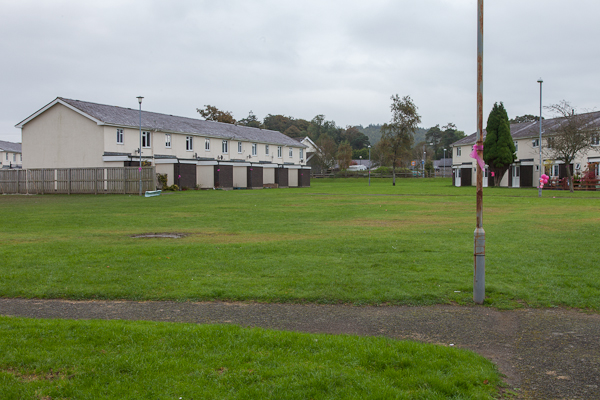
Bryn-y-Gog estate, Machynlleth.

Fortunately I was  able to tell them that on the Monday night April Jones had been abducted Jane and I were still on holiday in Germany, and that we took a taxi from the railway station on the Tuesday night ( the following evening) about 9.30 pm. Needless to say the taxi driver had some very strong opinions on the subject of the girl’s disappearance!   But did I remember the name of the taxi company? “Well…..no…..it was just one at the head of the queue.” After I had answered a few more questions, however, I think they realised that I could not possibly have been implicated, and were happy to leave.  With the alleged murderer already behind bars I suppose they were just tying up loose ends. But apart from the interesting observation that our home appeared to be “derelict”, the episode did have a worrying side to it.

I’m often away from home for several days at a time on field trips, and sometimes no-one – not even Jane – would know where I was. It could be quite difficult to prove I was away from a crime scene if for some unknown reason I became a suspect. Would the data attached to a digital image be enough to prove one’s whereabouts? And if I had no results at all from the trip – and this does happen – how could I prove my innocence? It was a scary thought, so perhaps one should always take a few images wherever one is just to be on the safe side?

As for Machynlleth, despite the dozens of pink ribbons, it was like a morgue on the Sunday afternoon  following the girl’s disappearance.   I spent an hour or so walking around the town to see if anything caught my eye; the answer was no.  Despite  mild and pleasant weather no children were playing on the grass on the Bryn-y-Gog estate where the abduction had taken place. A police constable – his job to prevent photographers and reporters getting too close to the house – stood on duty. I had a quick chat and wished him well.

The following night I woke suddenly and saw the photograph I should have taken…… that policeman standing alone on the grass in the middle of the estate, with perhaps a pink ribbon or two somewhere in the frame. The following Wednesday – market day in Machynlleth – I made another trip there with the intention of re-creating the image I had seen in my minds eye. As it often is on a Wednesday the town was really buzzing and  I had no hesitation in grabbing the camera and entering the estate through a rear gate.  This time a gaggle of policemen was standing around chatting so any possibility of  repeating what I had envisaged immediately became impossible. With their permission I spent a few minutes walking around the estate taking a few pictures.   I just did what I could. As discussed in a previous post (Love Locks) it is often difficult to re-create an image – even an imaginary one like this!  I could never work as a photographer in a formal setting. For me the joy of photography is almost always its spontaneity.

To follow Tales from Wild Wales, please scroll right to the bottom and click the Follow button.

Welcome to purpleworld……

Years ago a website designer was adding nonsense text to my then-under-construction site. Under one heading he wrote

“Jeremy Moore is out in the jungle photographing rocks”

At first glance this was just an off-the cuff remark, but on further consideration it may have been a comment on the activities of landscape photographers. The world is beset by a multitude of problems, with climate change being one of the most pressing. And what do landscape photographers do? We drive across the country and take pictures of rocks.

Not that often in the jungle perhaps, but at the coast……..we do a lot of it. And that brings me to the title of the post. One quite popular and easily accessible beach in Pembrokeshire backs on to a quite astonishing little cove with purple and bright red sandstone bedrock and a variety of boulders in red, purple and green/grey. The beach itself features on one of my postcards and the boulders are easily visible in the image. It is surprising that more photographers don’t venture down there, but even those from Pembrokeshire seem to give it a miss, let alone the big names from England. I’m not going to name the location; that would make it too easy. But look at this image – you’d expect it to be elbow room only down there at low tide! 

Image

As for “purpleworld” the sense of colour at the back of the cove is so complete that one’s eyes begin to compensate for it and it starts to look “normal”. Turning one’s back and looking out to sea again the real world seems unreal.  

There are two interesting caves to explore there as well; I may post another image or two some time……

To follow Tales from Wild Wales, please scroll right to the bottom and click the Follow button.

Love locks…..

Love Locks on the Hohenzollern Bridge, Koln.

Other than in the surname of the brilliant independent scientist James Lovelock, I’d never come across the term “love  lock” until a couple of days ago. Then, by chance, I found it on the internet – where else, these days – and it perfectly described what I had seen earlier in the week on a footbridge in Koln, Germany.

My partner and I were on a European round trip culminating in a week in the Swiss Alps. Travelling by train, we had broken our return journey in Koln. We discovered a footbridge across the Rhine but at first I couldn’t understand what I was seeing there. On closer inspection it became clear…. many, many thousands of brightly coloured padlocks attached to the wire side of the footbridge. Each one was engraved with a couples’ names, or had them written on with indelible ink. The bridge ran alongside the main railway line as it left the station so it is difficult to imagine a more industrial setting

It was intriguing subject matter, but I saw I was not the only one with the same idea. How could I “add value” to an interesting but straightforward image? I had a short session with the camera at and after  sunset. Down on my haunches I photographed the love locks with the railway behind them from the other side of the bridge as, almost by accident, a couple carrying a baby passed in front of me. It was a quite spontaneous pressing of the shutter; the  idea or intention had not entered my conscious mind.

It had been almost dusk and I was using a slow-ish shutter speed and a wide aperture, so I couldn’t be certain the image had worked. The next morning I returned with the intention of replicating it, but this proved to be difficult. In the bright light of morning  pedestrians could see me clearly and stopped to let me take my picture before walking past  – they didn’t realise I needed them in it! I would wave them on but sometimes it’s just impossible to re-create a special photographic moment, even if all the elements are all present, so it was fortunate that the evening’s couple turned out to be perfect.

I read on the internet that attaching “love locks” to bridges or statues (and throwing away the key) is a trend of recent but unknown origin, which has taken root in several European cities, including Rome and Paris, in very much more romantic locations than the Koln example we came across. Sometimes they are removed by local authorities (citing Health and Safety perhaps….) and in Koln this had been proposed but residents protested and they are still there. What possible problem could they cause, I wonder? In my opinion “love locks” are wonderful idea.

To follow Tales from Wild Wales, please scroll right to the bottom and click the Follow button.

Nature, take a bow………

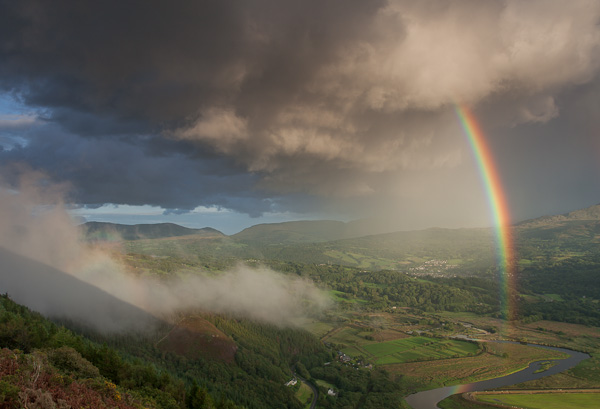
The other day I was in the Dolgellau area with some time to spend on photography during the late afternoon. It was a very showery day and I thought there might be chance of a rainbow or two. There are several easily accessible  elevated locations around the Mawddach estuary, and to give my self the best chance of some good images I decided on the New Precipice Walk on the north side of the valley. A rainbow would appear roughly opposite the sun, backlit rain showers would be at 180 degrees to this, and a polariser would work at its best at 90 degrees to both, with the bulk of Cadiar Idris in the background. To cap it all, it was a very short walk from the viewpoint to the car park and I could make tea while I waited!

The first couple of hours were frustrating. I sheltered in a ruined building while one heavy shower passed over. Later a second big shower moved past to the south and a rainbow began to form. From altitude it was noticeable how much more of the rainbow’s arc was visible than is normally the case. I tried to remain calm, despite the camera beginning to malfunction. It really was touch and go here, but I took a series of images as the shower moved inland. There was a brilliantly clear outer bow as well, with the colour order reversed. Then, out of nowhere, cloud began to form below me in the valley. On it was projected a faint, but definite, Brocken spectre (or glory) , and I managed to photograph it within the rainbow just before the sun disappeared. Has this ever been seen before?  Whatever….. it was a scene of primeval magnificence and I just hope I  was able to do it justice. See what you think!

To follow Tales from Wild Wales, please scroll right to the bottom and click the Follow button.

Highly Commended image, 2012 British Wildlife Photography Awards

Now that the embargo has been lifted, I can announce that one of my images has been Highly Commended in the 2012 BWP awards, and as such appears in the exhibition and book published by the AA.


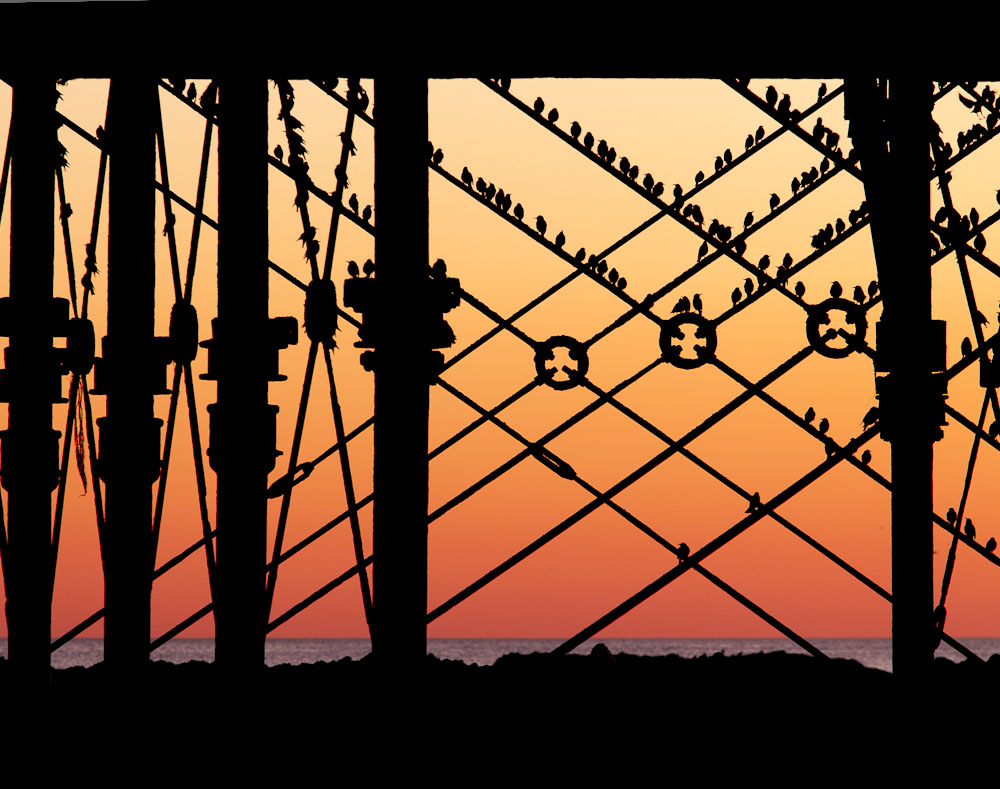
While my interest in wildlife is as enduring as my interest in photography, it is only relatively recently that I have begun to combine the two. To have been Highly Commended is therefore very encouraging, even if the image is more “landscape with birds” than birds in themselves. In fact all my wildlife close-ups were rejected! Perhaps there’s a lesson there somewhere……

Every year from October to March starlings roost under the pier at Aberystwyth; under the right conditions the sky can be a swirling mass of them. On a sunny evening there can be quite a group of photographers there. Being a fairly solitary breed it is one of the few times we get together for a chat! Local people and visitors also gather to witness one of nature’s great spectacles. The starlings put on their most amazing displays just before they leave for their breeding quarters. The image was taken in March.

Interestingly I note that the winner of the BWPA Urban Wildlife category also features starlings on Aberystwyth pier, this time in an image by Phil Jones. What a co-incidence that the Aberystwyth starlings have won recognition twice in the same competition. Maybe it was a pity Janet Baxter didn’t enter as well – a threesome would have been a distinct possibility!

To follow Tales from Wild Wales, please scroll right to the bottom and click the Follow button.

UPDATE   :   A picture run over a double page in the Guardian on 6th February was very similar…… They do say imitation is the best form of flattery, but I’d rather have the recognition (and the money……).

A walk up Snowdon.

Last Monday I climbed Snowdon. Not so remarkable, you might think, even on a grotty day like Monday when  hundreds of other people were probably doing the same thing. But for me it was a bit of breakthrough. My last real “mountain” climb had been almost four years ago when I attempted Snowdon but only got as far as Y Lliwedd before escaping back down to Nantgwynant. On the ascent I was so short of breath that I genuinely worried that I might be seriously ill, and for several days afterwards my legs were so painful I just couldn’t face it again. 

So what was so different about last Monday? I left my DSLR kit at base camp and took just a Panasonic GX1, two lenses, and a travel tripod. This is a brilliant combination for lightweight travel and seems to be capable of excellent results. Not that I got anything on this trip because the cloud was down at about 2500 feet and the promised clearance just didn’t happen. I’ve usually been good at choosing mountain days but got it wrong this time! 

Nevertheless the exercise and sense of achievement was rewarding, and there were a couple of other things that made the day memorable. Firstly, I was amazed by the number of parents taking their children up the mountain. Never in a million years would mine have done such a thing, or even considered it for themselves. They just didn’t do the outdoors. 

Secondly, I had sat in the summit cafe for a couple hours to see if the cloud would clear, but as I stood up to leave a man at the next table caught my eye, and said he recognised me. Did I live in Rhyl, or Kinmel Bay? Was I a church-goer? Had I been on Crimewatch? Errrr…… no …….wellll……   errrm…….. ! He just couldn’t place me. 

For my part nothing really rang a bell. I had done a little photography in Rhyl for “Wales At Waters Edge” and I spent a morning at the Art Gallery earlier  in the summer while the exhibition was showing there. But Rhyl is, to put it bluntly, a bit of a dump, and not my cup of tea at all. A vague memory came floating out of the ether. I had had a chat with a visitor to the exhibition and managed to persuade her to buy a copy of the book. Could he have been her companion? It was the only thing I could think of. 

I checked my emails later that day, and there was one via my website from Dave Cutting, who had been with his wife Ellen when she had bought a copy of the book that day at Rhyl! Funny old world……..

To follow Tales from Wild Wales, please scroll right to the bottom and click the Follow button.


More on Conservation Photography and 2020VISION

For the first part of this article please click here.

There is a Welsh term “Y Filltir Sgwar” (The Square Mile) which may either be taken literally or understood as the area with which one is familiar and concerned about. Some landscape/nature photographers clearly have a very modest “Filltir Sgwar” and are able to explore it with minimal environmental impact. I do admire them greatly. Others feel the need to see as many as possible of the spectacular locations the earth can offer and have to make – what shall we say – some compromises. Personally my own “Filltir Sgwar”- probably the whole of Wales –  is such that neither public transport (there’s very little) nor pedal power (it’s too large) will ever allow me to fully experience it. And such photography usually involves remote locations and anti-social working hours to the extent that neither are really practical anyway.

There are two other points I’d like to add. In the days of film it was more clear when one’s photographic activities were polluting the planet. Now many of us are on the digital upgrade treadmill instead in the search for even better image quality. Quite how the two scenarios compare environmentally would probably require a PhD thesis to understand.

The other relates specifically to 2020VISION and the claim Niall Benvie makes in the article that it allows the chosen photographers to “act locally”. Here I might be accused as suffering from sour grapes but in my defence I can say that I had completely forgotten about it until I saw the article.

There are two projects in Wales, both within about thirty miles of my home. Four photographers are involved, one of whom is nominally from Cardiff, but is better known for his globe-trotting. The other three are from distant parts of England. Nearly two years ago I met a member of staff from one project (Denmark Farm)  who asked me if I’d heard of 2020VISION. I said I had. Aren’t they going to use local photographers, she asked, to which I could only shrug my shoulders. You can sense my personal frustration but it is more than that. 2020VISION may be well-intentioned, and I’m sure the resulting book will be superb,  but it seems to fail, in my opinion, on this count and the others I have mentioned. The light coat of greenwash given to it by its organisers cannot disguise the fact that photographers are not going to save the planet.

To follow Tales from Wild Wales, please scroll right to the bottom and click the Follow button.

The problem of Conservation Photography

Wildlife photographers on Skomer island

In an article in Outdoor Photography (September 2012 issue) related to the 2020VISION project Niall Benvie makes his case for “conservation photography”. “By drawing attention to what happens in and to the natural world (rather than merely reflecting its aesthetics) conservation photography gives people the tools they need to to understand how their choices affect it.” he says. “But few, too few, to make any real difference, act on that knowledge.”

He describes some of the problems brought about by constant economic growth – among them biodiversity loss and ground water pollution. And – quite correctly – “The argument that industrial society and a vibrant natural environment are compatible just doesn’t stand close, ear-to-the-ground examination

The problem is that photography is itself a product and manifestation of the developed world which Benvie criticises in the article. A quick browse of the websites belonging to some of the 2020VISION photographers is quite informative. They illustrate just how far from sustainable nature photography often is in practice, no matter how admirable the intention. Air travel to exotic locations and the acquisition of the latest photographic gear are all prominent. Some of these guys’ carbon footprints, and let’s be honest, their financial footprints, must be off the scale. In some cases their sites contain promotions linked to equipment suppliers all designed to sell us even more “stuff”.

At the same time they make bold statements about their environmenetal credentials. One is “looking for a way to dedicate the rest of my career to the preservation of the wild. That is my mission.” I’m not criticising the sentiments, I just question whether as high profile photographers they are truly in positions to put them into practice.

The truth is that“conservation photography” is green only in the very shallowest of senses. It smacks, unfortunately, of “do as I say, not as I do”. Over many years of experience Benvie has eventually had to concede that “…….people don’t care about the earth. At least they don’t care about it if doing so impacts on their material life”. But photographers are not immune to such conflicts. Their high end photographic gear and travel-rich lifestyles are no less burdens on the planet than any other aspect of the Western society.

And it is not a new phenomenon at all. About twenty years ago I attended a symposium entitled “Green Photography”. There were very few attendees, in truth, and they split into two opposing groups. I was in the shallow green, ecological message camp. I believed it was a worthwhile way of proceeding. In the other camp were two photographers who travelled by train and bicycle to their locations. They complained that no-one had taken them seriously as photographers, even the greenest of green organisations, but in fact their actions actually spoke louder than our words.

Ansel Adams was, and still is, the best known and most effective conservation photographer of all time. He achieved a great deal of success in persuading American politicians to protect huge chunks of wilderness, and even has one named after him. But he took on all sorts of commercial clients to pay the bills, including mining, banking, and power corporations. He was aware of the paradox, but brushed it aside. He believed that such jobs were merely a means to an end, allowing him to continue his life’s work in the American wilderness.

In my own, more naïve days, I believed that if I tacked a conservation message onto my landscape images it would make a difference. Now I realise that in a rather modest, twenty year, career in photography I’m actually closer to being part of the problem than the solution. It is the unavoidable result of being a cog – even a very small one – in the capitalist machine.

In the 50 years and more since Adams was in his prime as a working photographer and conservationist, we have learned so much more about the environmental results of our activities. “Conservation photographers” seem to claim that their practice is somehow different or more worthy than other photographers. But in terms of their effect on the planet’s ecological balance, I see little basis for this belief in reality.

To follow Tales from Wild Wales, please scroll right to the bottom and click the Follow button.

Copyright Jeremy Moore (August 2012)

Canon 5d mk2 design problem

The Canon 5d mk2 is a great workhorse of a camera and is capable of stunning results. It is built like a tank as well; I have dropped mine three times and it is still coming up with the goods. But it has one design flaw – the mode dial is non-lockable. This may seem a minor problem but my experience yesterday was typical of what can happen.

I was driving along a minor road near Brecon quite early in the morning when I saw a photo-op. Quickly pulling over and grabbing the camera, I set it up with a 70-200 zoom on the tripod. During a short session of picture-taking I noticed that the mode dial had accidentally shifted to “P” (program) from its usual aperture priority. On processing the results I discovered that the P setting had given exposures of f5.0 or f5.6 at about 1/320 second – not required or desirable in the circumstances! Depth of field in the images at maximum telephoto is so poor that they are unusable. Fortunately I have a couple of post-discovery keepers like the one below that all was not lost.

I understand that Canon have put this right with the 5d mk 3 so I had better start saving!

Near Brecon
Near Brecon

To follow Tales from Wild Wales, please scroll right to the bottom and click the Follow button.
More on postcards (and copyright…….)

Nantgwynant, near Beddgelert
One of this summer’s new postcards – M260 (Nantgwynant, near Beddgelert)

I received the following unsolicited email a couple of days ago from a Mr Boyd Williams,

As a Welshman who spent over 10 years living and working for French companies in Paris, I discovered that Wales was quite unknown to most of the French so, with the aid of a ‘revolving gallery’ of your postcards …… displayed on my desk, I tried to sell Cymru Fach to the Parisians! After hearing endless ‘C’est magnifique!’ and ‘Oh – c’est beau, c’est ou ca?’ and other complimentary remarks as colleagues passed by my desk, I know for a fact that some of them have visited Wales! 
So,’Visit Wales’  – or whatever it is that the Welsh Government is calling their in-house version of the Wales Tourist Board nowadays – could really do with employing someone like you! Keep  snapping away, please!

My reply was as follows-

“Many thanks for your email. It arrived while I was on a rather gruelling trip around Pembrokeshire selling postcards so was very timely! It is very nice to know that one’s efforts are appreciated.

The truth is that I worked freelance for the Wales Tourist Board for a number of years but found that their attitude to photographers had become quite unacceptable. In particular they operated a “copyright grab” which meant that photographers had to sign over their copyright or they would not be employed. This manner of operation was adopted by the entire WAG when WTB were absorbed into it about ten years ago, despite the efforts of photographers to persuade them otherwise. I have not worked for them since on a matter of principle.

This has been a serious loss of potential income to me, but also a loss to the tourist industry in Wales, as you so kindly implied!”

As widely seen elsewhere in government thinking, WAG seems to believe that professional photography is one of the very few business sectors whose interests can be safely ignored.

To follow Tales from Wild Wales, please scroll right to the bottom and click the Follow button.