A tale of three images.

Ramsey Island (on left) and the Bishops and Clerks, from Whitesands.

It has been a while since I last posted but things have been moving apace. Most of February and March was spent getting postcards out into shops in various parts of Wales. It is always difficult to drag oneself out of the semi-hibernation of mid-winter and this year was particularly fraught because Easter was so early.

It has to be admitted that sales of postcards are steadily declining. This is partly because people are using phones and Facebook to contact their friends while they are away but also because the number of potential outlets is declining rapidly. The perils of running a bookshop in the Amazon era are well recognised, but independent retailers of all kinds have been closing and are not being replaced in similar numbers. What is particularly sad is the number of Tourist Information Centres that have closed, will soon close or are under threat of closure. It is happening all over Wales as a result of cuts to local authority funding. It may be our local councils (and National Park authorities) that are having to make the difficult decision to close them but the root cause is central Government.

A selling trip that would until recently have taken two and a half days now takes two or less. But that does mean I have a little more time available for photography on these trips and I was lucky with the weather on some of them. After one particularly busy day in Pembrokeshire I was able to nip down to Whitesands, arriving just after sunset. I started a short high-tide walk along the beach but quickly ran back for the camera. The conditions were just stunning! I only had a few minutes to run off a few exposures and I wasn’t entirely happy with the composition in any of them. But I’ll settle for the above…….

On a trip up to north Wales I spent one night at Pen-y-pass YHA. I normally avoid youth hostels these days but Pen-y-pass is so well situated for an early morning walk in the foothills of Snowdon that in winter I occasionally make an exception. Unfortunately my dorm also contained a snorer so I had a disturbed night’s sleep and was not able to get up at the crack of dawn as I had hoped. But a little later on this was the view of the Snowdon horseshoe from “The Horns”, situated between the PyG and Miners’ paths.
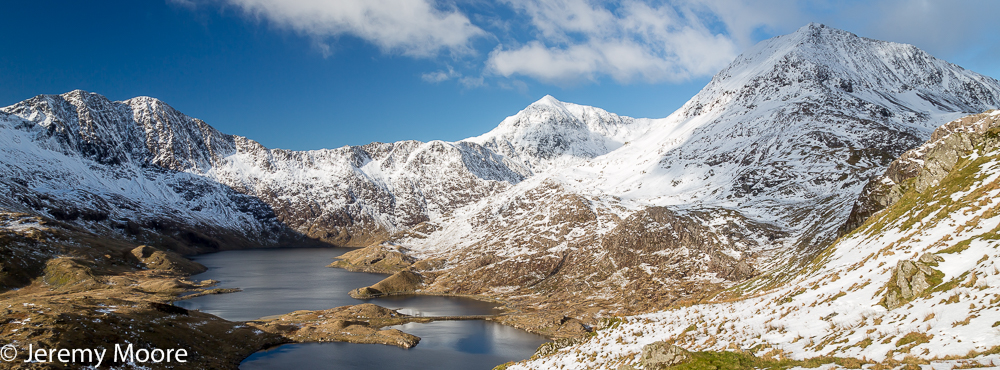
Snowdon summit and Y Lliwedd
Y Lliwedd, Yr Wyddfa and Crib Goch from “The Horns”

I was able to devote the whole of this superb day to photography so then headed off eastwards to photograph the packed masses of waders at their high-tide roost at the Point of Air, near Prestatyn. The only trouble was – there weren’t any. Just a handful of the commonest species. I then spent a couple of hours searching for, and failing to find, my current birding obsession – hawfinches. I won’t broadcast the location because villagers get pretty cheesed off with the behaviour of some birders, but there is a well-known site for this rare and elusive bird in the Conwy valley. So for the second time in one day I assumed I must be driving around in a van with a huge sign, facing upwards, on its roof saying “Bird photographer approaching destination – make a run for it”.

But I had more joy at my final location, the RSPB Conwy reserve at Llandudno Junction. There has been a starling roost there all winter and on my arrival I was pleased to discover they were still around. There was no wind and it looked like there would be a good sunset, so I found a location where I hoped the birds would be silhouetted against a stunning sky. There was even the possibility of a reflection for good measure!  Towards sunset small groups of starlings began to arrive, some time later than they do at Aberystwyth. And they just kept on coming!  Several sparrowhawks made appearances and made hunting dashes into the flock. The starlings created tightly-packed balls and ribbons of birds to try to evade them. It was fabulous to watch but set against part of the sky which was too dark to allow successfully photography.

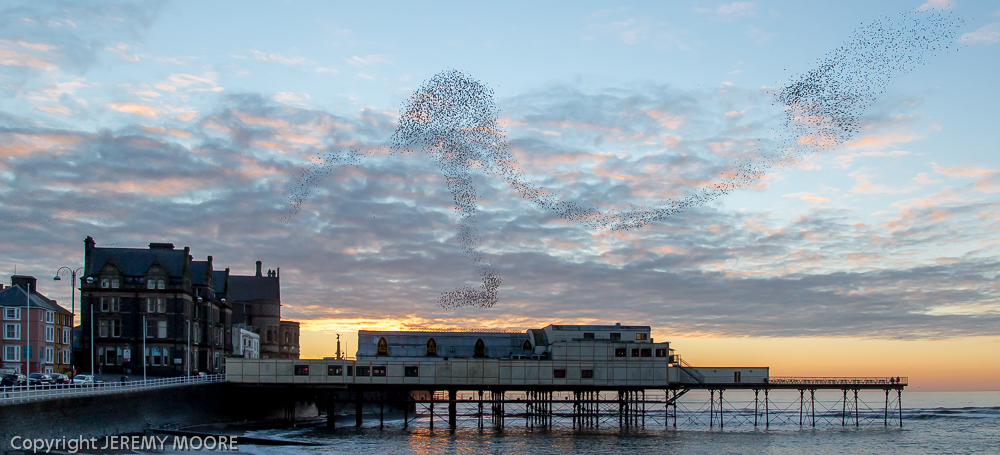
It really was a very large flock by the time they eventually disappeared together into the reedbed. It was almost dark by that time and they had been displaying for some forty minutes since the first birds arrived.  It was interesting to compare this with their behaviour at  Aberystwyth, where they were going to roost some forty-five minutes earlier. I managed this image as the flock swirled over one the reserve’s shallow lagoons.

Starlings in pre-roost display, RSPB Conwy reserve.

I don’t know if it be useable anywhere else but on the web.  It was taken at 6.31 pm on March 10th, using pretty extreme settings for this type of subject – 4000 ASA, 1/160th second and f4.

Finally, just before Easter, I installed part of my Bird/land exhibition in the Visitor Centre at RSPB Ynyshir. It will be showing there until May 30th; but for the full Bird/land experience wait until June 25th, when an updated and expanded version will be opening in the Photography Gallery at Aberystwyth Arts Centre. Watch this space for more information.


To follow Tales from Wild Wales, scroll down to the bottom and click Follow.

In search of starlings at Glastonbury and Aberystwyth

Starlings, Avalon marshes, Somerset

Last weekend Jane and I headed off to Glastonbury for a few days. It’s an unreal place. If ever you needed to visit a personal transformation coach, an angelic reiki practitioner or a shamanic hairdresser, make for Glastonbury. It would be easy to sneer at the apparent pretentiousness of it all, but that would be unfair. While there may be some charlatans involved, I’m sure many of these people are quite genuine in their thinking; and I sometimes think how comfortable it must be to live according to a ready-made belief system. It was curious to note the vigorous campaign for the retention of the last remaining bank (Barclays, if I remember correctly….) in the town, though.

An extensive area of former peat workings near Glastonbury has been reclaimed to create a cluster of wetlands and reedbeds, now known as the Avalon Marshes. These are home to several rare bird species, notably bittern and great white egret. The latter was fairly prominent at the Ham Wall RSPB reserve, and I photographed one on a beautiful, still, winter’s morning with warm light and a hint of frost on the ground. The former lived up to its reputation for skulking. But arguably the biggest  draw on the Avalon Marshes in winter is its huge starling roost, which I spent three evenings trying to capture. For roosting, the birds have a very large area to choose from, and they can move from one site to another on a daily basis. Even the local birders and photographers admit to being unable to predict what they are likely to do next. On my first visit I found a likely looking foreground at sunset and hoped a flock would fill the sky with interesting shapes. Needless to say it didn’t work out how I had hoped, but there was the above; I’m not sure yet if the image works or not.

On the second night, from a different location,  I watched as huge flocks gathered over farmland and in trees to the east against a dull background; and later, with mounting disbelief, as a continuous stream of starlings moved from one section of reedbed to another. The process lasted some 15 – 20 minutes; there must have been millions of birds altogether. But it was a frustrating encounter;  they flew too low over the ground to photograph successfully. On the third night I sought out the trees where they had gathered the previous evening but again the results were disappointing.

Starlings at Aberystwyth

Back in Aberystwyth,  decent sunsets have encouraged me to visit the starling roost three times this week. Tuesday was just the most gorgeous winter evening; cloud had largely cleared during the afternoon and there was no wind. The starlings must have felt it too. For a few brief moments a flock briefly indulged in one of their spectacular ribbon/bracelet formations before dropping in under the pier. At last! Something to write home about……

For the last couple of months my camera bag might have been a door stop for all the use it has had, so it was good to pick up the camera again….. even if I could barely remember what some of its buttons were for! But the experience did remind me how important it is to be familiar with the controls of your equipment. A few seconds delay and confusion can mean the difference between getting the shot and missing it. And which shutter speed would blur the movement of birds in flight most successfully? I just couldn’t remember. But there is one thing about trying to photograph wildlife – it teaches you patience.


To follow Tales from Wild Wales, scroll down to the bottom of the page and click Follow.


Final thoughts on Bird/land…..for now……..

Mallard (from Bird/land)

Well, Bird/land closed just over a month ago and I have to say in many respects it was a success. Feedback was excellent; visitors were particularly complimentary about how different the work was to anything that I had previously done.  Print sales were also very good  and much better than I was expecting. As a result I have just sent a cheque for £140 to the RSPB towards reconstruction of their hides at Snettisham in Norfolk. I had hoped to make multiple visits to Snettisham during the course of the project to photograph the countless thousands of waders which congregate there but a storm surge of December 2013 destroyed the hides. So my small contribution will benefit conservation generally and bird photographers in particular.

What has been disappointing is the almost complete lack of coverage I have received in the press and the photographic media in particular. I suppose the exhibition did fall between two stools – not really bird photography, and not landscape either – so it was difficult to categorise. And, of course, it was in a small town in mid-Wales and who could even pronounce its name? But not for the first time have I believed that there is a prejudice amongst the English media about all things Welsh.

All is not yet lost, however. I have agreed to display some of the work at RSPB Ynyshir, my local reserve, next spring. And on a much larger scale the whole exhibition will be shown at Aberystwyth Arts Centre for two months next summer. I am hoping to be able to expand it to fill the larger photographic gallery there but that will be subject to receiving further funding from the Arts Council of Wales. So watch this space for further information about dates, etc.

The image above is one of only two singles in the exhibition. It has sold really well and only one remains at the time of writing. How I wish I’d offered an edition of ten or more instead of just six! It is so difficult to know how to sell photographs. Over the summer I noticed an exhibition of really rather average black-and-white landscapes in a bookshop in Hay-on-Wye, in an edition of 295. Only in the photographer’s wildest dreams would anywhere near that number be sold. A short edition would, I hoped, create a feeling of exclusivity around the work, and thus increase sales. But I think I may have misjudged it. Just one of the lessons I have learned over the last few months!


To follow Tales from Wild Wales please scroll right to the bottom and click Follow

Dotterel Days

Dotterel, Pumlumon
Dotterel, Pumlumon

The rounded mountain-top of Pumlumon in mid-Wales (more of a large hill, really, but still 2468 ft above sea level) is a recognised stopping off point for dotterel in the spring. In late April a single dotterel was reported on its summit so a couple of days later I decided to go for it. Leaving the house at lunch-time, I had reached the summit two hours later. I scoured and scanned for the bird but found nothing. Then there was a sudden movement on the ground three yards in front of me. There it was! What a gorgeous creature!

I spent a happy hour photographing it in light winds and warm sunshine. It was nice to “share the moment” with Janet Baxter, who I had overtaken on the way up. And whose dog, fortunately, was more well-behaved than it sometimes is! I was back down in time to take my van to the garage by 5.30 pm, as planned. Sorted! It’s very unusual for an expedition like this to work out so successfully. I was happy, too, that I was able to reach the summit and return so quickly, Carrying just the one lens and camera body, a snack and bottle of water helped.

Bearing in mind the image was taken in mid-afternoon on a cloudless day in late April, the sun was quite elevated. Contrast was therefore high and the shadows in the bird’s belly and chest were darker than I would have liked. Selecting this area with Lightroom’s radial filter and judicious use of the highlight and shadows sliders was quite successful in bringing this problem under control.

Other dotterel days……

1. A single bird was seen and photographed on a Lake District hilltop while I was an RSPB warden in 1981. This was during my first era of bird photography. I gave one transparency to a local ornithologist with whom I was working. It later appeared under his own name in the Cumbrian Bird Report for that year. The same image later appeared in my book “Heart of the Country” (published in 2003) to accompany one of the late Bill Condry’s Guardian Country Diaries – in which he laments never having seen one!

2. While working for the Nature Conservancy Council in Scotland in 1986 I spent a day – under licence – surveying a Grampian hilltop for breeding dotterel, with a group of friends and colleagues. During the survey I lifted a male dotterel off its nest with my finger.

3. A trip of dotterel seen on Foel Grach in the Carneddau (north Wales) in May 1987.

4. A trip seen on Pumlumon with a friend in May 1995. One bird was wearing coloured leg rings. From the combination of colours it was identified by the BTO: it had been ringed as a chick in Scotland 8 years previously and not seen since.

5. Three birds seen on a coastal field near Ynyslas in early May 2013. As I approached the field I met the farmer who was just leaving in his Land Rover. I asked him about the dotterel and he invited me to jump in: he would take me to see them. As we approached the birds they took off and flew strongly northwards, never to be seen again.

So almost every dotterel sighting in my life has a story attached to it. Their lifestyle is extraordinary. The female is the more brightly coloured bird. She takes the male’s role and vice-versa. She lays a clutch of eggs for her mate to incubate, then travels further north to do the same for another male. I particularly like the thought that they migrate from hill top to hill top, stitching Europe’s mountains together as they go.

To follow Tales from Wild Wales, please scroll right down to the bottom and click Follow

High on opinion but low on facts.

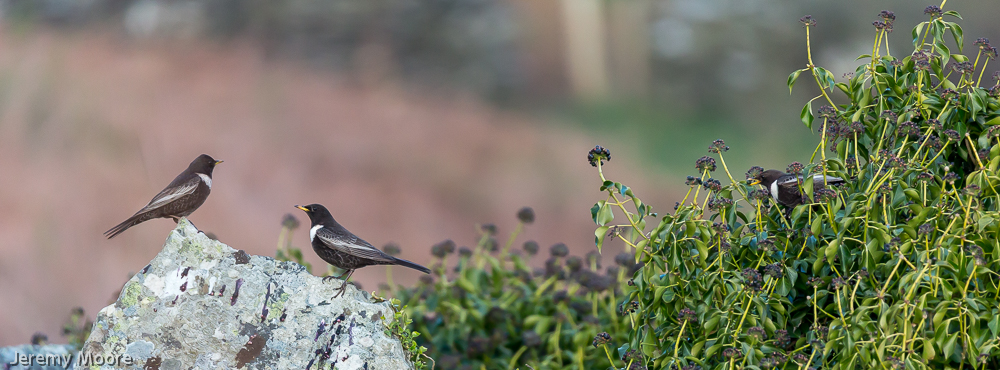
Ring ouzels, near Machynlleth

Following a talk in Aberystwyth by George Monbiot last spring on “rewilding”, a local ornithologist and friend Roy Bamford wrote a full-page article on the subject in our local newspaper, the Cambrian News. His main thrust, borne out of many years of personal experience, was that rewilding may happen – come what may – and that its effects may be unpredictable. The article was almost entirely uncontroversial but was followed a couple of weeks later by a letter from the Farmers Union of Wales. This included a personal attack on the author and a suggestion that he was quoting tittle-tattle from the internet (among other things) to support his case. I felt that this should not go unchallenged so wrote the following, which was published in the Cambrian a few weeks later.

I am writing with reference to Roy Bamford’s piece ( 3rd July) on rewilding and the subsequent letter from the Dafydd Jones, vice-chairman of the Ceredigion FUW.

Firstly I suggest that it is unfortunate that Mr Jones chose to make such personal comments in his letter. Mr Bamford has already defended himself on the letters page but a less modest man would have gone further. His knowledge is based on the many years of professional field work he has undertaken. It is upon this field work that much research into the relationship between agriculture and wildlife in the Welsh hills has been based. I cannot think of many people more qualified to make these observations than Roy Bamford. So if he quotes studies that include photographic evidence of sheep eating curlew’s eggs then this not an anecdote, it is a fact – unlikely as it may seem to most of us.

On a far more limited scale I have been surveying the same tract of land above Tal-y-bont for 20 years. I walk the same route twice a year and record every bird that I come across. I follow a fence line with improved grassland and heavy sheep grazing on one side, and unimproved grassland or “ffridd” on the other. The contrast could not be more marked. With its very low sheep numbers the ffridd is, in effect, rewilding in action, and it is home to a large and varied selection of small birds. The improved grassland might as well have been concreted over for all the wildlife it contains. A few meadow pipits and a few scavengers and that’s about it.

The farmers that Mr Jones represents have benefitted to the tune of many, many millions of pounds from the public purse since the last war. This same period has seen the Welsh uplands becoming demonstrably more and more impoverished in an ecological sense. The farming industry has itself become more depleted at the same time. Rather than the mixed farming of earlier generations, does the average hill farmer now grow more than one crop – grass? Does he farm more than one product – sheep? I suggest, in many cases, that the answer is no. Through its lack of vision the sheep farming industry has manoeuvred itself into a cul-de-sac, an evolutionary dead-end. So it is a shame that the FUW does not show a more open-minded attitude to the future – which may well include rewilding. It would be far more constructive to do so, and they would be doing their own members a service.

I could have published this letter under “name and address withheld” but chose not to. I’m not afraid to hold such opinions, which would, anyway, probably be held by a large percentage of the population. I realised that the letter might be read by the landowner whose land I walk and that there might be repercussions. And so indeed there have been. This year permission to access his land was refused.

The Cambrian News did not print the final sentence of my letter, which was as follows:

Instead we get the same anti-environment rhetoric that has become the norm from the farming unions – high on opinion and low on facts.

I’m not denying that hill farming might at times be a challenging occupation. I’m not denying that sheep farmers work hard. But so much of their income comes from the public purse. What benefit does the public receive in return for their support? By displaying such reactionary, head-in-the sand attitudes, and continuing to deny what is quite clearly true, farmers and their representatives are their own worst enemies. When the public money runs out they will need all the friends they can find.

I’m including an image of ring ouzels taken yesterday. This has become a scarce species over the decades in Wales, and they are now difficult to see, let alone photograph. But this small group of migratory birds has been feasting on ivy berries not far from here in recent days.

To follow Tales from Wild Wales, scroll right down to the bottom and click Follow

Not quite a dartford warbler…….

Arne, Dorset
Arne, Dorset

Easter week found Jane and I down in the Isle of Purbeck in Dorset. It was a part of the world I’d never seen and it also seemed to be a good chance to see, and possibly even photograph, a dartford warbler. We treated ourselves to the luxury (cough……) of a holiday flatlet in Swanage. Our first full day we decided to do a cycle ride, and, not being the hardcore types, it was soon time for a coffee stop.

We arrived at the village of Corfe Castle. Talk about picture postcard pretty! The restored Swanage railway passes through the village too, and the steam engines gave it a real flavour of the past. Purbeck has a very strong Enid Blyton connection and one could imagine the Famous Five still fitting in quite easily. However the women dressed up as wenches were, I felt, taking Heritage Britain a little too far. The Castle itself is owned by the National Trust, with an entry fee of £9.00. We decided to give that a miss. It is a spectacular ruin, however, and the National Trust tea shop nearby provided a fabulous view of it from its back garden.

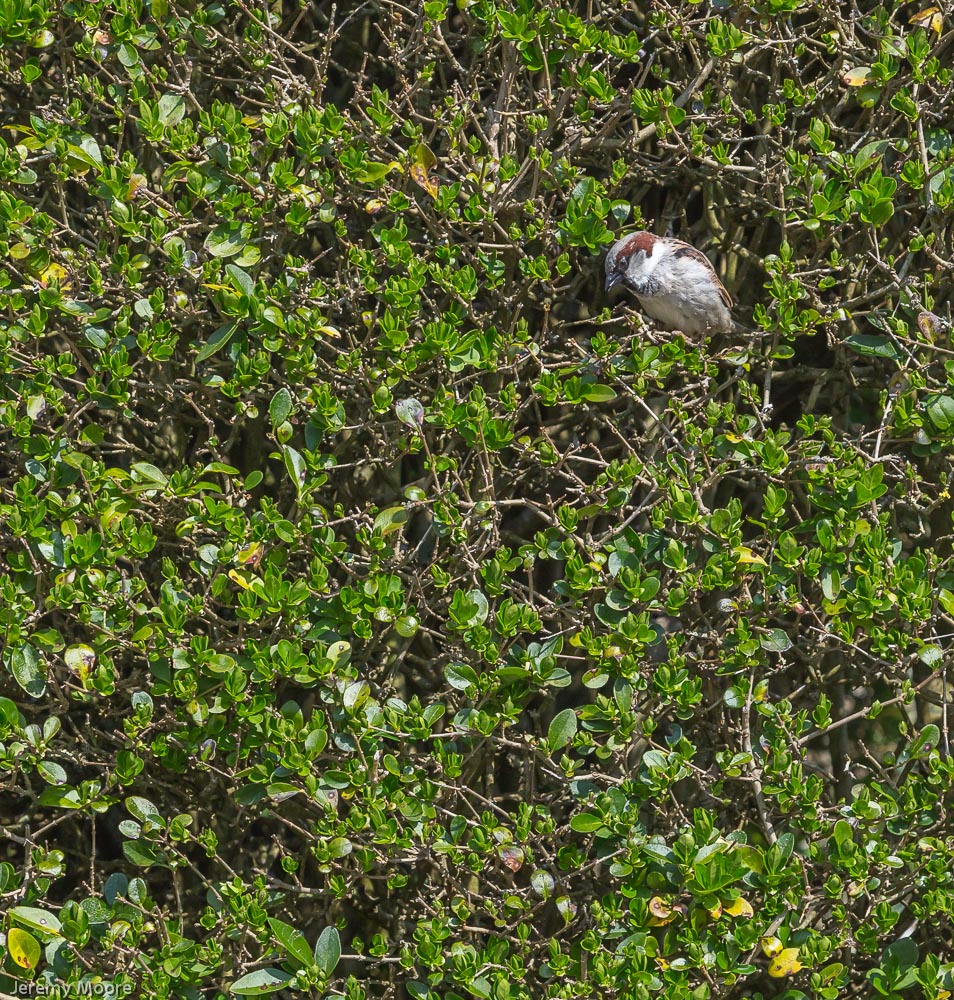
Relaxing with coffee and cake, I noticed that house sparrows were popping in and out of a severely pruned privet hedge. They were using conveniently positioned twigs as lookout posts in their search for crumbs. Although I wasn’t in photography mode that day I could see an opportunity to add some “birds in the landscape” images to my collection. I filed the idea away in my memory banks.

Jane may not have my perhaps obsessive interest in birds and/or photography but she can be very tolerant. So a couple of days later I spent the night alone in the camper van close to the Arne RSPB reserve not far from Corfe Castle. It was a fabulous still and misty morning, with the sun rising like a crimson ball though a layer of fog. I confidently set out in search of a dartford warbler. Maybe a pair. Or two. It would be easy to find them. Two hours later I still hadn’t seen or heard one and I walked back towards the van. I began to think that dartford warblers were a figment of other people’s imaginations. Then I heard an unfamiliar sound and located one of these elusive birds on the topmost twig of a gorse bush not far away. But it flew very quickly and proved impossible to track down. The same thing happened with a second bird I found a few minutes later. So I gave up.

House sparrow, Corfe Castle (click to enlarge)

After such an early start coffee was now calling and the memory of those house sparrows was getting stronger and stronger. It was time visit the Corfe Castle tea shop again. I introduced myself, told them about the project I was working on, and asked if it was OK to take some photographs in the garden. No problem.  I spent an hour there taking as many different compositions as the birds would allow.  Being at such close quarters to them I was only using the standard zoom on my Canon 5d3, so I didn’t look too conspicuous.  Ideally I would have had more time but the images have an interesting graphic quality to them, and who bothers taking photographs of house sparrows! I think there’s enough variety overall to create one triptych for the exhibition.

Not quite a dartford warbler…….but hey!


To follow Tales from Wild Wales, scroll right down to the bottom and click Follow.

What do photographers do all day?

Black grouse, north Wales

Over the winter I’ve seen a couple of episodes of the TV series entitled “What do artists do all day?”. Each programme featured a particular artist and showed them doing the sorts of things an artist might do. Like, well, painting, for instance. But what about photographers?

I’ve spent quite some time this week trying to get my PC to work more smoothly, with some success, I think I dare to say. It certainly wouldn’t make good TV but I spend so much time at the computer, and I imagine the same is now probably true for most photographers. A far cry from the days when you exposed a few rolls of film, put them in an envelope, and waited for the transparencies to come back. Oh, then there’s updating the website, writing the blog, invoicing customers, emailing contacts…..the list is endless.

How come I found myself, yesterday, pulling the vacuum cleaner apart and putting it together again, of all things? One of my most crucial pieces of equipment is the camper van. It’s my home from home and enables me to be on location first thing in the morning when so much top quality wildlife and landscape photography is done. And with the passage of time you just have to do a bit of spring cleaning. Banal, I know, but true……. and one thing leads to another……..

To give an example of how indispensable the camper van is, though, a couple of weeks ago I had another go at photographing the black grouse lek which I also wrote about here and here. I drove up the previous evening, parked up nearby and settled down for the night. It was clear and frosty so by sunrise a thick layer of ice had formed on the inside of the windscreen! At 5.15 am I could hear the birds’ bubbling and hissing calls as they began displaying nearby. But it was still more or less dark, and I had plenty of time to make some tea and observe the birds with binoculars while the day gradually dawned.

It became apparent that there were more birds present than on any previous visit, and they were taking up stances over a wider area. Having said that the amount of activity was rather variable. Some birds actively jousted with their neighbours, while others looked a bit bored. It was as if they may have been young birds which knew where they needed to be, but didn’t know what to do when they got there. As a whole the birds seemed to be rather nervous and at one point all suddenly swept away. A couple of seconds later a sparrowhawk briefly landed on the deserted lek site. One wonders if the grouse would be less easily distracted at the peak of the breeding season in a couple of weeks time. A little later two greyhens (female black grouse) also flew in, which provoked an extra burst of activity from the lekking males.

It was inevitable that on a still morning such as this extraneous noises like the rapid firing of a shutter would be heard by the birds. In anticipation of the “action shot”a shutter burst would begin just as two birds sized each other up. One could imagine how strange, and possibly distracting, this might be from the bird’s point of view.  On the other hand it was also noticeable that during a lull in activity a car engine starting (for example) might  provoke the birds into briefly displaying more vigorously.

This was my seventh visit altogether to the lek site and it was probably the best. Being a weekday there wasn’t too much disturbance as  impatient birders and other photographers came and went. Despite bright sunshine the light had a soft quality to it thanks to some atmospheric mistiness, and this was ideal for photographing these high-contrast, black-and-white subjects.  The winter yellows  and ochres of the vegetation and a layer of hoar-frost made for an attractive landscape in which to set the birds; so much so that I’m planning to include a set of three images from this visit in my forthcoming exhibition. It was also a pleasure and a privelege to be able to watch this fascinating spectacle.

So what do photographers do all day? It can really be almost anything from the sublime to the ridiculous.


To follow Tales from Wild Wales scroll right down to the bottom and click Follow

The patient birdwatcher.

Bittern, Teifi Marshes


Last Thursday saw me heading south to the Teifi Marshes, a Wildlife Trust reserve near Cardigan. After days on end cooped up in my  home-office cum prison cell thanks to rain and/or wind and/or cloud, the forecast for Thursday was promising. I decided to make an early start. So on a lovely morning I arrived on the banks of the Teifi just a few minutes after sunrise. The tide was high and it was flat calm. What a picture!

I spent a minute or two in each of the hides as I walked down the old railway track into the reserve. At the top of my day’s wish-list, I told another photographer, was a bittern. It may not have been very realistic objective but what the hell………aim high! I quickly moved on until I reached the Kingfisher hide, because a bittern is occasionally seen from there in winter. I’ve always liked this hide because it overlooks a small pool, more or less surrounded by reeds;  it is quite an intimate space. I opened a wooden flap and looked out.

At first I didn’t believe it was even actually a bird. It was too still – a fence-post perhaps? Too tall, too thin and too dark to be a bittern, anyway. I dropped my camera bag on to the wooden floor, the sound – I’m sure – carrying far on such a still morning. Trying to keep calm, I retrieved my Canon 5d3 / Tamron 150-600 zoom combo and took another look. It was a bittern, sunning itself! The sound of the shutter would travel equally clearly in these conditions; by the time I had taken the first few shots, there was no doubt that it was aware of my presence. It turned around, then began to walk along the edge of the reeds. Within three minutes of my arrival it had disappeared. I silently cursed my clumsiness.

The other photographer arrived. We waited another ten minutes or so. Then there was movement in the reeds and I located the bird half way up some reed stems. From this launch pad it flew across the pool and disappeared. Would it ever be seen again? In fact, it flew again quite soon and landed opposite the hide. This small reed-bed is somewhat degraded at the moment, the result, apparently, of being used as a starling roost.  Over most of the area the reeds are bent over (or broken) to barely half their normal height. (I believe the technical term is “trashed”…..) A crouching bittern was still completely hidden but at full height it was easily visible. Over the course of the day the bittern could be seen with varying degrees of success as it visited various parts of the reedbed. Having said that, though, its position was most often given away by the black cap to its head. It is a wonderfully camouflaged creature. The starling hypothesis gained credence after a couple of crows brought a small dark bird corpse out of the reeds and ate it. There would be plenty of food there for a bittern, too, as they are not that choosy about their diet.

Discussing the finer points of eating a dead starling......
Discussing the finer points of eating a dead starling……

I was still hoping for the ultimate bittern picture so I stayed put, despite the temperature, which must have been pretty close to freezing in the shade. The six layers of clothing I had donned early that morning weren’t really enough.  A succession of other visitors joined me in the hide, and I helped them locate the bird. They donated sandwiches, biscuits and chocolate in return. I hadn’t expected to be there so long! One christened me “the patient birdwatcher”. Towards mid-afternoon the bittern moved quite close to the railway track and I was able to photograph it reasonably successfully through the overgrown hedge (see above). Eventually a combination of thorough cold and fatigue meant it was time to call it a day. But what a day!

I’m still not sure I have the perfect bittern picture. In one otherwise excellent series of images, the bird’s surroundings are untidy. In the picture above the inverted v-shape, out-of-focus reed stem is irritating. I wonder if the content-aware cloning abilities of Photoshop would remove it successfully. Does anyone know?


To follow Tales from Wild Wales, scroll down to the bottom of the page and click Follow.