Letters to the Editor (5) …… or Spreading like wildfire (Part Three)

Derelict cottage and burnt mountain ash tree in the Rhinogydd.

At the end of part two (click to read) in this series I asked rhetorically what NRW (and the fire service) were doing in the Rhinogydd during the wildfire there in July this year. Shortly afterwards an article appeared on the Cambrian News website, and I wrote following response:

The fire started on Thursday July 9th (not the 12thas your article stated) when, allegedly, a gas stove being used by a wildcamper was knocked over and set fire to nearby vegetation. It spread, as they say, like wildfire. At some point over the weekend the farmer at Cwm Bychan (or perhaps the landowner) called in a helicopter pilot to extinguish the fire on his land, which he successfully did. The pilot offered his services to NRW in order to extinguish the fire on Crown land nearby but they turned his offer down, claiming that he was not qualified to do so.

By Monday morning (July 13th) the fire had spread from Cwm Bychan eastwards into the Rhinogydd National Nature Reserve and by that afternoon seven fire engines were present in Cwrt forestry plantation to the east of the mountains. But what were they doing there? There seemed to be no attempt to prevent the fire spreading further into the NNR.

By Tuesday afternoon (July 14th) the fires around Cwm Bychan were more or less out but the whole east side of Rhinog Fawr was ablaze and there had been no apparent attempt to put it out. So what exactly had the Fire Service and NRW been doing all that time?

A little bit more about Rhinog Fawr; it is a National Nature Reserve, Special Area for Conservation and Site of Special Scientific Interest. Furthermore, “because of its remarkable natural condition” it is also a Wales’s only “bioenergetic reserve”, so described because it is “one of a network of special sites across Europe chosen for their importance to try to preserve the genetic variety of European wildlife species – in this case heather”.

But not important enough for NRW to attempt to save the vegetation from fire, clearly. I believed that NRW and the Fire Service were doing nothing more than attempting to retain the economic value of the timber in Cwrt Forest. This was confirmed in a press release from the Welsh Government issued on July 23rd about wildfires in Wales. Among acres of verbiage it stated that in the Rhinogydd “key forestry assets have been protected.” I myself visited the area recently and saw the firebreaks which had been bulldozed along the eastern side of the plantation, which had been largely successful.

Since the fire NRW was widely criticised for being incompetent. But it is more than that. NRW is completely dominated by procedure and bureaucracy. It could not engage with a helicopter company actually on the spot, and qualified to put out wildfires, even in an emergency, because it was not on an approved list of contractors. NRW is also the result of an ill thought out merger of three different bodies, with three different priorities – forestry, water quality and nature conservation. It is not difficult to work out which of those three got the shortest straw in the new organisation.

Looking at the bigger picture, climate change deniers would also claim that this fire was the result of carelessness, rather than climate change; a wildcamper – who shouldn’t even have been there – knocking over a stove. Well yes, but how careless have we been to perform an unimaginably massive experiment in changing the composition of the atmosphere when for decades we have been warned what the result would be.

Climate chaos.

To read more Tales from Wild Wales as they are published please click the Follow button

Mr. Angry of mid-Wales..

It happens in the run-up to every election. I listen (and watch) in vain for anything relating to the environment in the BBC current affairs output (see here and here). Nowhere (with the exception of Channel 4) this year have I seen or heard any political party being tackled on their policies on climate change or nature/wildlife. It is as if there is a conspiracy of silence between the politicians and the journalists. Neither party is interested in discussing these things. Actually – I tell a lie: a couple of weeks ago I heard a trailer for exactly what I was hoping for – on the farming programme on Radio Four at 5.45 in the morning. Whoever listens to the radio at that time of day!

Last Thursday I happened to be listening to “Feedback” on Radio 4 which – in case you’re not aware – is nominally independent of the BBC. It features complaints and comments on the organisation’s output and often tackles senior BBC figures on important issues. The presenter read out two complaints from listeners about the complete lack of coverage of the large (very large apparently) ‘Restore Nature Now’ demonstration which took place in London towards the end of June. He/she reported that the BBC had been approached to answer these questions on air but had refused to do so. They just sent a short statement justifying their position.

I was furious! I immediately emailed Feedback with my own complaint about the BBC’s poor or non-existent coverage of environmental issues in its election broadcasting. I included the following points –

  1. How are voters concerned about the environment above all else (like me) supposed to know which way to vote? It is a complete dereliction of duty on behalf of the BBC, despite their ability to produce stunning wildlife documentaries containing powerful environmental messages.
  2. Millions of people in the UK are members of charities and pressure groups supporting wildlife conservation and renewal. All of us would dearly love to know what the political parties intend to do about these things but thanks to the BBC we are no wiser. It is disgraceful.

Well, fortunately, with a big thumbs up to Friends of the Earth and Greenpeace , we are now able to make a decision on which party to support. Between them they have examined the manifestos of the three main parties plus the Greens. It is the latter who top the ratings with an almost perfect score of 39 points out of 40. But you would never know it from their election publicity or their statements in the media. Why this fear of publicly putting the environment at the heart of every policy? The Lib Dems do pretty well too. Needless to say the Tories are by far the worst in every respect, although personally I believe their record over the past few years (especially under Boris Johnson) is not as bad as is made out.

Here in Ceredigion we have a Plaid Cymru MP, Ben Lake, who by all accounts is an excellent constituency MP. He was one of the very first to officially support Caroline Lucas’s Bill (now known as the Climate and Nature Bill) to put the environment first, which has not (yet) made it onto the statute book. But he has not responded to any of my recent correspondence on environment matters. Personally I have never trusted Plaid Cymru, as they tend to rely on the farmers’ vote in rural Wales. It was noticeable how Ben Lake made himself very visible at some of the farmers protests back in the winter.

So there you have it! If you have not yet decided how to vote in order to put the environment first, I do recommend looking at the FoE/Greenpeace document. There is a link to it below.

https://friendsoftheearth.uk/system-change/general-election-2024-manifestos-final-scores

To read more Tales from Wild Wales as they are published, please click the Follow button.
A bit of a rant about the BBC

I have become more and more aware over the last few years how low a priority the environment is on BBC television and radio news and current affairs.

Unfortunately I don’t sleep too well and I tend to hear rather too much of the World Service during the night. I began to notice how environmental stories would be heard on the World Service but not on Radio 4 during the Today programme the following morning. An example would be the massive protest against the construction of the Dakota XL oil pipeline which ex-President Obama eventually halted. I was disappointed (and more) that environmental issues were given such low priority during the last General Election and the run-up to the EU referendum. Caroline Lucas M.P. was occasionally given a slot on one programme or another, and without fail she performed brilliantly. With that exception it seemed that the politicians didn’t want to discuss the environment and no-one at the BBC was willing to take them to task for this. It seemed there must have been an unspoken agreement between them.

Last week on the eve of the crowning of “President Trump” a 30-minute Panorama programme looked into his links with Putin of Russia. It was largely intrigue and speculation. In contrast, half-an-hour earlier, a Channel 4 programme had looked into Trump’s links with “Big Coal” and “Big Oil”. As well as interviews with some of the main players such as lobbyists for the coal and oil industries, C4 had found actual evidence of the massive donations they had made to the Republican Party and Trump’s campaign. This was proper investigational journalism on a crucial issue.

Most recently there have been the executive orders that Trump has already signed. “Obamacare” got coverage on R4 news but not another which was made at the same time to begin to roll back Obama’s Climate Change-related legislation. Last night when the Dakota XL pipeline was given the go-ahead by Trump it was mentioned on every news bulletin on the World Service that I heard – every half-hour, I believe, together with interviews with an oil industry lobbyist and an environmentalist. Questions about the donations to Trump were asked. On Radio 4 – zilch. The Today programme did cover the Executive Order Trump had signed regarding the construction of the Mexican Wall, but rather than then mention the pipeline issue, they went on to speculate at great length about the Wall.

I can’t pretend that I hear every single minute of the Today programme or every single news broadcast. This is not a scientific survey. I’m sure someone at the BBC would be only too happy to prove me wrong but I listen to enough radio to get an impression of the pattern that has emerged. I have been a supporter of the BBC for its unbiased coverage of current affairs for many years but now I really wonder where I can go to hear politicians being challenged about their environmental policies. There is so much speculation in BBC current affairs about what such-and-such a politician will announce later and what will happen then. The BBC should remember that there are far more members of conservation organisations than of political parties. The environment is not a minority interest. It is time that their journalists got out of the Westminster bubble and began doing their job.

To follow Tales from Wild Wales, scroll right down to the bottom and click Follow

High on opinion but low on facts.

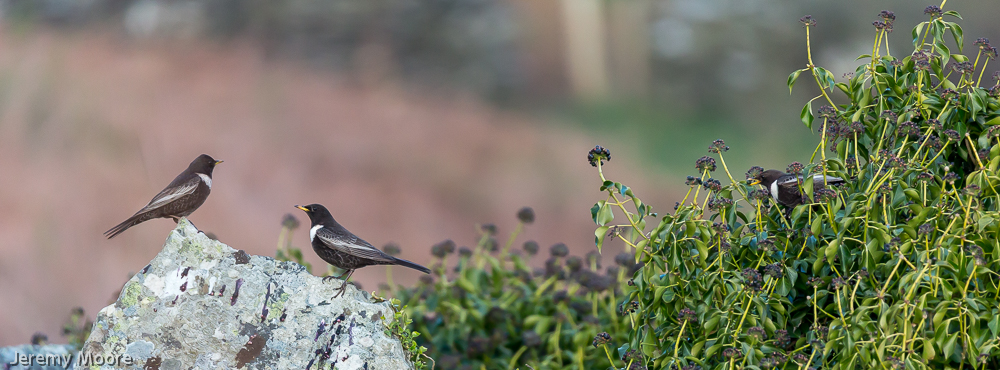
Ring ouzels, near Machynlleth

Following a talk in Aberystwyth by George Monbiot last spring on “rewilding”, a local ornithologist and friend Roy Bamford wrote a full-page article on the subject in our local newspaper, the Cambrian News. His main thrust, borne out of many years of personal experience, was that rewilding may happen – come what may – and that its effects may be unpredictable. The article was almost entirely uncontroversial but was followed a couple of weeks later by a letter from the Farmers Union of Wales. This included a personal attack on the author and a suggestion that he was quoting tittle-tattle from the internet (among other things) to support his case. I felt that this should not go unchallenged so wrote the following, which was published in the Cambrian a few weeks later.

I am writing with reference to Roy Bamford’s piece ( 3rd July) on rewilding and the subsequent letter from the Dafydd Jones, vice-chairman of the Ceredigion FUW.

Firstly I suggest that it is unfortunate that Mr Jones chose to make such personal comments in his letter. Mr Bamford has already defended himself on the letters page but a less modest man would have gone further. His knowledge is based on the many years of professional field work he has undertaken. It is upon this field work that much research into the relationship between agriculture and wildlife in the Welsh hills has been based. I cannot think of many people more qualified to make these observations than Roy Bamford. So if he quotes studies that include photographic evidence of sheep eating curlew’s eggs then this not an anecdote, it is a fact – unlikely as it may seem to most of us.

On a far more limited scale I have been surveying the same tract of land above Tal-y-bont for 20 years. I walk the same route twice a year and record every bird that I come across. I follow a fence line with improved grassland and heavy sheep grazing on one side, and unimproved grassland or “ffridd” on the other. The contrast could not be more marked. With its very low sheep numbers the ffridd is, in effect, rewilding in action, and it is home to a large and varied selection of small birds. The improved grassland might as well have been concreted over for all the wildlife it contains. A few meadow pipits and a few scavengers and that’s about it.

The farmers that Mr Jones represents have benefitted to the tune of many, many millions of pounds from the public purse since the last war. This same period has seen the Welsh uplands becoming demonstrably more and more impoverished in an ecological sense. The farming industry has itself become more depleted at the same time. Rather than the mixed farming of earlier generations, does the average hill farmer now grow more than one crop – grass? Does he farm more than one product – sheep? I suggest, in many cases, that the answer is no. Through its lack of vision the sheep farming industry has manoeuvred itself into a cul-de-sac, an evolutionary dead-end. So it is a shame that the FUW does not show a more open-minded attitude to the future – which may well include rewilding. It would be far more constructive to do so, and they would be doing their own members a service.

I could have published this letter under “name and address withheld” but chose not to. I’m not afraid to hold such opinions, which would, anyway, probably be held by a large percentage of the population. I realised that the letter might be read by the landowner whose land I walk and that there might be repercussions. And so indeed there have been. This year permission to access his land was refused.

The Cambrian News did not print the final sentence of my letter, which was as follows:

Instead we get the same anti-environment rhetoric that has become the norm from the farming unions – high on opinion and low on facts.

I’m not denying that hill farming might at times be a challenging occupation. I’m not denying that sheep farmers work hard. But so much of their income comes from the public purse. What benefit does the public receive in return for their support? By displaying such reactionary, head-in-the sand attitudes, and continuing to deny what is quite clearly true, farmers and their representatives are their own worst enemies. When the public money runs out they will need all the friends they can find.

I’m including an image of ring ouzels taken yesterday. This has become a scarce species over the decades in Wales, and they are now difficult to see, let alone photograph. But this small group of migratory birds has been feasting on ivy berries not far from here in recent days.

To follow Tales from Wild Wales, scroll right down to the bottom and click Follow