A tricky one…..

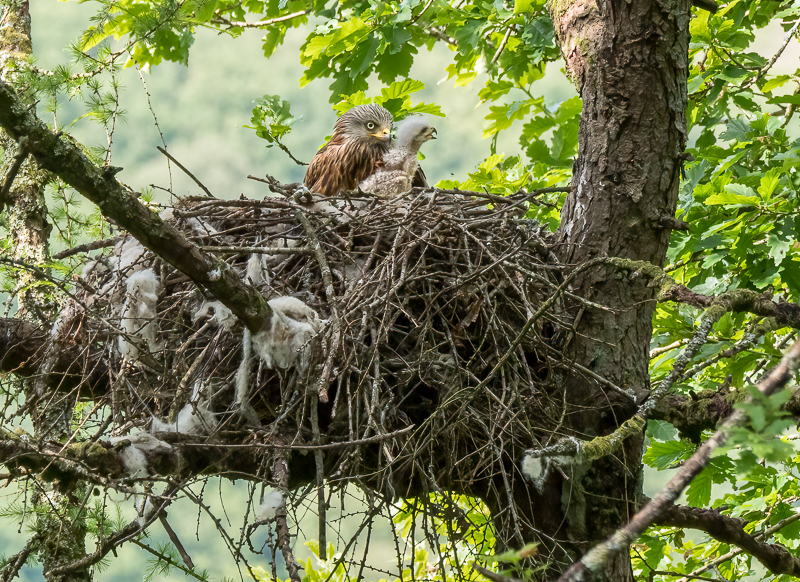
In spring 2020 we were all locked down in our homes. On my daily walk (well, one of them….), I discovered a red kite nest just five minutes away. It was easily visible from the track running through the wood and the female didn’t bat an eyelid as you walked past. When she was ‘off duty’ her mate took over and it was panic stations as soon as he saw anyone. The owners of the woodland, both red kite lovers, were managing it for firewood and wildlife and noticed exactly the same thing. They were happy to let me take my kit just inside the wood where I could be slightly closer . And the female carried on incubating as if nothing untoward was happening. It seemed like too good an opportunity to miss. Red kite is a Schedule One species in the UK, meaning that it is illegal to disturb nesting birds at any time during the breeding cycle – from nest-building to post fledging. But was I disturbing her? It didn’t look like it but it was rather a grey area legally.
Beauty is in the eye of the beholder……….

I waited until the chick had hatched and then visited the wood several times during late May. By the 21st the chick was strong enough to raise its head over the rim of the nest and I was able to photograph it with its mum looking on adoringly ( I may be anthropomorphising here ….). By the 25th it was stronger and its white down had become largely brown, with just a few tufts of white on its head. On the 30th the female was leaving the nest for short periods of time and on one occasion, while she was away, a magpie crept unseen close to the nest. As soon as she saw it she was back like a shot. I did not believe a kite could look so threatening! I was set up with the camera and long lens on the tripod, focussed on the nest, so was able to quickly take a few frames of the action. I was thrilled…… and the magpie made a hasty retreat.

You may recall that spring and early summer of 2020 were warm and sunny for long periods, often with no cloud at all, which made lockdown quite bearable. It also meant that for long periods of time photography was difficult with harsh sunlight throughout the middle of the day. Photographing in woodland in these conditions involves dark leaf and branch shadows and bright highlights, with massive contrast differences. The red kite nest was no exception. I decided to give it a break until some more photographer-friendly conditions came along. When I returned about a week later I discovered something tragic had happened to the kite chick. My friends had just discovered that it had disappeared and the parents were flying around in an anxious and agitated fashion. That was the end of the kites’ nesting attempt and they drifted off fairly soon afterwards. What had happened was a mystery, and the nest disintegrated and disappeared over the next couple of years.

Is this the same female?

So why am I recounting this story in April 2025? Well…. the kites are back! A pair has built a new nest in a different tree only about ten yards from the 2020 nest, in a very similar position, right out in the open, below eye level as seen from the track, and the female doesn’t bat an eyelid as you walk past. My guess is that she is the same bird that I photographed in 2020.

I am currently monitoring red kites in the area surrounding my home and have a licence to disturb the birds at the nest for this purpose. However it doesn’t include photography, unless incidental to the monitoring. I did inquire about a photography licence but the paperwork looked like it would take forever to complete. So I’m wondering if I can photograph the chick’s development at this nest in particular, with the very confiding female, without breaking the law. It’s a tricky one.

To read more Tales from Wild Wales as they are published, please click the Follow button.

My website : http://www.wild-wales.com
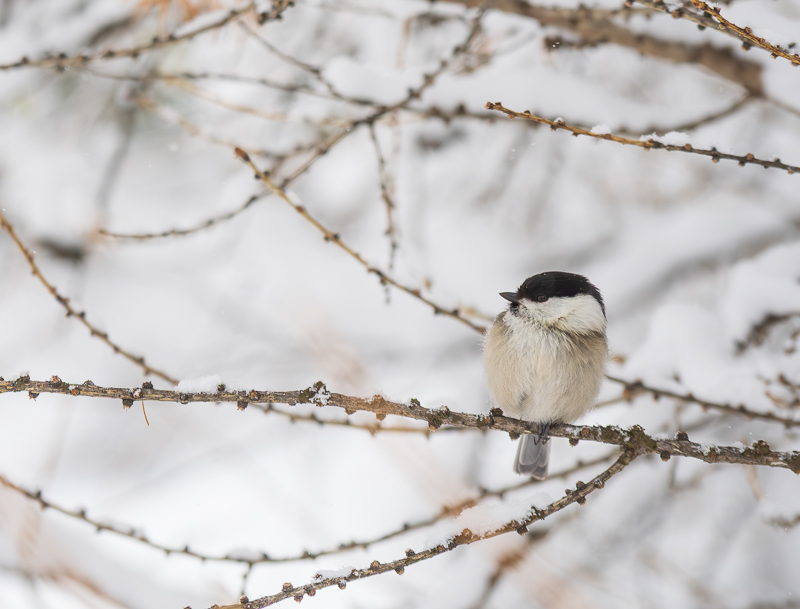
Do you know your willow tit from your marsh tit?

Willow tit……..

There can be no more difficult bird i-d challenge in the UK than distinguishing willow tit from marsh tit. According to ‘Birds in Wales’ willow tit was not even proven to occur in the UK until 1897, and for several decades following that “…its distinct identification from marsh tit was not universally accepted”. The Collins Bird Guide suggests various subtle differences; for example marsh tit has a glossy black cap while the willow’s is matt. The white cheek is more extensive on the willow than the marsh, and one (the willow tit) has a pale panel on its wing while the marsh doesn’t. The black bib is “usually” larger in the willow than the marsh. However a video from the British Trust for Ornithology now suggests that it is not safe to distinguish one from the other on any of these characteristics. The only reliable difference is a pale grey spot at the base of the upper mandible (the beak) which the marsh has but the willow doesn’t. This conclusion would have been reached following the close examination in the hand of large numbers of individuals by bird ringers, so is likely to be correct. But no wonder there was such a long period of doubt over whether both species existed in the UK.

Along with the willow tits came crested tits………

It is widely agreed that the safest way of telling one from the other is by voice. I’m not confident that I’ve ever definitively seen or heard either species, but during the winter I heard a new (to me) bird song on a regular walk in some woodland below the house. I believed it was either a willow tit or a marsh tit. It sounded very like a wood warbler, which, being a summer visitor, could not have been present. My Collins Bird Guide specifically mentions a “series of pensive, melancholy, wood warbler-like notes”, under willow tit. I hadn’t actually seen the bird but this was about as good an i-d feature as I was likely to get. I announced my record on the Ceredigion Bird Blog, with the caveat that Ian Morris – the county’s resident willow tit expert – might have an opinion on it. A few days later I had an interesting email from another Ceredigion birder who had had a similar experience to mine. Over a period of some weeks he had re-visited his location and played back a recording of the willow tit song. On every occasion he had attracted a pair of nuthatches! It’s enough to make you tear your hair out!

A few weeks later Ian Morris visited and we walked down to the location where I had heard my mystery bird. He played back the song but there was no response. It was a long shot really but he didn’t believe the habitat was right for willow tit anyway…..much more suitable for marsh …………

…………and a few nuthatches………..

One reason I recount this cautionary tale is that during March I spent a couple of days quite high in the Swiss Alps. It still being deep mid-winter some lovely conifer woodland there was blanketed with fresh snow and almost completely devoid of of birdlife. The main exceptions were flocks of tits roaming around waiting for hand-outs from folks like me. Among them were “poecile montanus” (according to the interpretation boards) which were so bold as to perch on people’s hands to grab a seed or two. This, of course, is the willow tit, which, according to the bird books, rarely even visits bird tables in winter ……..

To read more Tales from Wild Wales as they are published please click the Follow button.

Birding in Mallorca -and coots in particular ……

Red-knobbed coot : just look at the size of those feet………

Mallorca has been a destination of choice for British birders for many decades. It has a wide range of raptors, notably the massive and very rare black vulture (once close to extinction) and the exhilarating Eleonora’s falcon, plus S’Albufera – one of the Mediterranean’s best wetlands. The latter is a great place to see a wide variety of resident and migratory waders, herons, and other wetland birds. I’ve already described this year’s first visit to S’Albufera in a previous post : it didn’t go too well! But a second visit was more successful. I was surprised to discover that stone curlews breed there. One pair was nesting directly in front of a hide, and I was able to photograph a changeover – one bird replacing its incubating mate on the eggs.

Stone curlews changing over at the nest

In some ways the Mallorca is an outdoor laboratory for rare bird conservation. The black vulture survived in the mountains whereas it had died out almost everywhere else in Europe. Thanks to various conservation measures it is apparently now doing reasonably well. Several species have been re-introduced there, with varying degrees of success : Bonelli’s eagle, griffon vulture, white-headed duck, marbled duck, red-crested pochard and purple gallinule to name but a few. A couple of days after arriving I added red-knobbed coot to that list. This species – also known as the crested coot – is VERY similar to the familiar bird of UK wetlands. It is found mainly in Africa and is described as “critically endangered” or “rare” in Europe (Collins Bird Guide); “occurring locally and very rarely as relict populations” in Andalucia (Birds of Europe); and “one of Europe’s rarest breeding birds” (Bird Guides). I would have start looking at coots!

I’ll be quite upfront about it : the coot is one of my least favourite British birds. They are found just about everywhere, are easy to identify, and are always fighting (or so it seems). I barely give coots a second glance. The crested (red-knobbed) coot is distinguished from it – in the breeding season anyway – by what look like two redcurrants perched on top of its head. At S’Albufera I noticed a coot in a nearby ditch and quickly noticed its red knobs. Time to get the camera out!

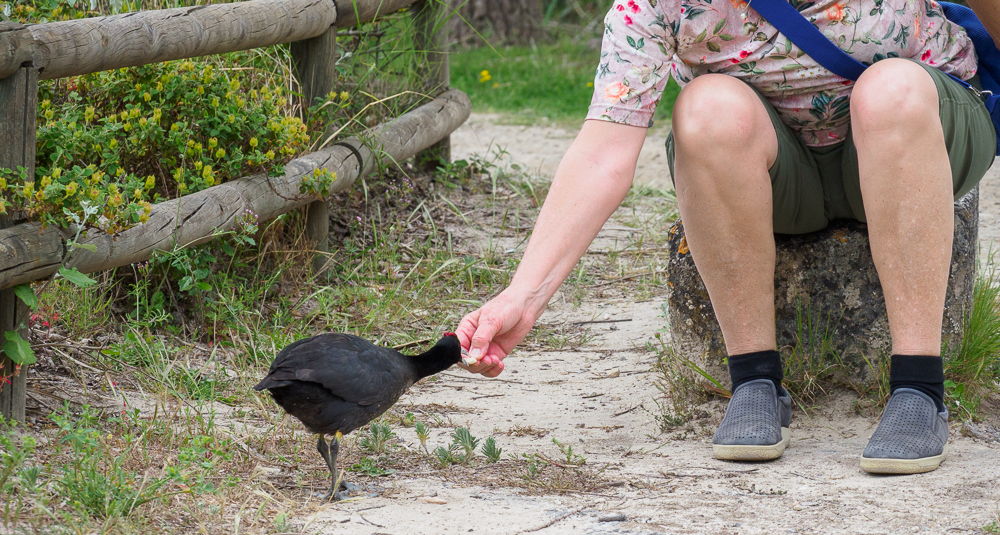
Hand-out time

It turned out to be the easiest bird I have ever photographed; I could have done it with a wide-angle lens. Not far away a birding couple sat down to have their picnic and the coot clambered out of the water for a handout. Didn’t it realise it was critically endangered? I just wish I had managed to include the “Do not feed the birds” sign nearby!

Other birds seen and photographed were Kentish and little ringed plovers (both diminutive but both feisty), glossy ibis, avocet and black-winged stilt. I know I missed seeing several species at S’Albufera and elsewhere on the island, but this trip was not about making a tick-list. I know this sounds corny but we did want to experience the “real” Mallorca as far as that’s possible, not rush around seeing the sights and the species. In this respect it helped that we didn’t have a hire car; instead we had four bases and relied on the island’s excellent train and bus services to get around. This did have its limitations, of course. I would love to have explored the spectacular Formentor Peninsula, which has no bus service, to see Eleonora’s falcons at their nesting cliffs. But as a consolation I was able to watch a flock of these elegant and sociable raptors playing around some coastal peaks near Puerto Pollensa towards the end of our stay.

I’d love to go back to Mallorca. There’s so much more to see there. But would I hire a car next time? That’s a difficult one………

To read more Tales from Wild Wales as they are published, please click the Follow button.

An intimate and a distant encounter.

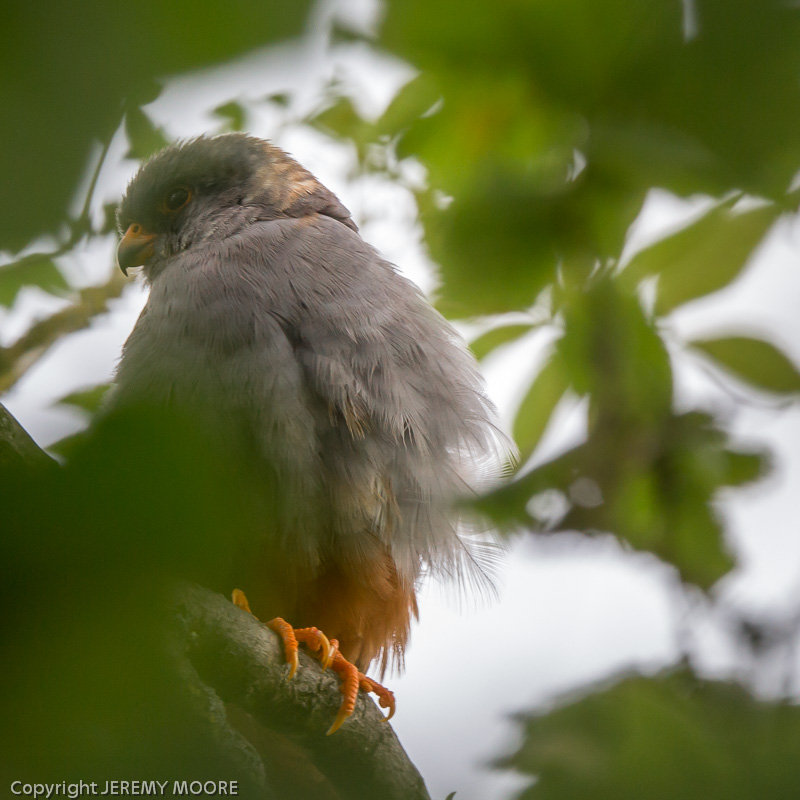
Red-footed falcon, north Staffs.

While I sometimes feel pangs of envy (…or is it lust….?) on hearing about the presence of a rare bird, I would not admit to being a twitcher. There is something rather desperate in the idea of travelling miles (or hundreds of miles) to try to see a bird which was originally found by somebody else and put out on the birders’ grapevine. I’ve sometimes described myself as the worst twitcher in the world, anyway, because on the rare occasions I’ve succumbed to temptation, the bird has usually disappeared by the time I arrive. I can justifiably claim to have been the first person not to see the great spotted cuckoo at Tenby in February 2014 because I waited too long to go down. It had probably died or been blown away during the particularly stormy day of my journey.  To fail in a pointless quest is particularly soul-destroying, I find. But if a bird is on my local patch I might eventually get round to having a quick look, sometimes successfully, sometimes not. A local bird would involve little time investment, or travel expenses or carbon emissions.

I was tempted last week, though. A red-footed falcon had been reported in Staffordshire, well over a hundred miles from here. However, a visit to my aging mother was long overdue, and she lives ……. in Staffordshire. I do like multi-purpose journeys! So Saturday morning found me on the northern outskirts of the Potteries joining a few dozen other birders staring at a red-footed falcon on an overhead electricity cable. It was hardly the most difficult twitch in the world. The click of motor-driven shutters rang out. _04A2298Being an immature male it would not be breeding this year; but one has to wonder why ever would this bird end up in north Staffordshire? It probably should have been somewhere in eastern Europe. Itcould conceivably have been escape from captivity but the only known captive red-footed falcon locally was an adult male in a rescue centre about twenty miles away. Whatever – in birder’s parlance it was “performing well” – perching on the cable in full view, searching for insects on the ground below. There was a strong breeze blowing, though, and, probably seeking shelter,  it later spent some time in a hazel bush just a few feet from the pavement on which expectant birders waited. It was so close that I had to take a few steps backwards before I could focus down on it with my binoculars. However a shield of branches and leaves made it difficult to see more than face or feet at any one time. It was an both intimate and distant encounter at the same time.

As far as the main image is concerned the bird was by no means at its closest here. I feel that the green background  sets off its plumage better than the grey sky did, however. And as for the composition, I suppose I just like to be different! Any thoughts on this?

To read more Tales from Wild Wales as they are published, please click the blue Follow button.

A winter visit to the Camargue.

Flamingos, the Camargue

Mid-winter might not seem to be the obvious time of year for the bird photographer to visit the Camargue – well known for its nesting herons, other brightly coloured summer visitors and phenomenal spring and autumn passage migration. But I wanted to have a crack at some of the reedbed specialities which are so difficult to find here in the UK. And small numbers of several species of eagle are known to winter there, although I knew I would be lucky to even see them. As it turned out the bitterns and the bearded tits were just as elusive there as they are in the UK. I may also have seen a distant glimpse of a booted eagle as it flew away in the rain.

As far as the practicalities are concerned I will summarise them first. Travel down to Nimes was by train to minimise my carbon footprint. Some nature photographers must believe their carbon emissions do not count, but that seems an irresponsible attitude in my opinion. It is quite feasible to do the journey in a day by train, even from Aberystwyth, although it seemed sensible to book a  room in Nimes in advance to avoid the risk of spending my first night on a park bench. Train fares are quite reasonable especially if they are booked in advance; London to Nimes was £110 return. I picked up a hire car at Nimes train station on my first morning and spent five of the next six nights at Salin de Badon, a “gite” right in the heart of the Camargue, owned and operated by the Societe National pour la Protection de la Nature.

Previously a hunting lodge, this old stone house is correctly described as “rustique” by its owners, although characterful would be another way of putting it! Accommodation is self-catering, there is no drinking water, and rooms are shared. But on the positive side, it has hot and cold running water and central heating, and access to three nearby hides is included. For me another big positive was getting to meet other French visitors with interests in common, and to practice my French on them! In particular I met two bird photographers there. Having asked if they could help me with French bird names, I was so knocked out by the quality of the images one showed me on his phone that the bird names largely passed me by. I can’t imagine any meeting of minds at the quite characterless hotel by the motorway outside Arles, where I spent my sixth night. You can find Salin de Badon on the internet or contact me for further information.

Great white egrets, the Camargue

As far as birds were concerned, on my first morning I discovered some large congregations of great white egrets, grey herons and cormorants on agricultural land outside the protected area. The egrets, in particular, were staring intently into a ditch, although what there was to see I have no idea. Another egret gathering nearby contained 73 of these spectacular birds (with about 50 others in nearby fields), I was able to photograph some of these using the car as a hide. I was surprised at the number of this species wintering in the Camargue – as well as this group, individuals birds could be widely seen.

Another species which has increased rapidly in recent years is the common crane. About ten years ago I felt lucky to see a flock of ten wintering birds, but now they have reached an incredible four thousand. Apparently they have discovered a new food source in spilt grain on the agricultural land surrounding the Camargue wetlands – ironic really as so much natural habitat was lost in land reclamation for rice growing. Who says nature is not adaptable? The birds roost in the reserve and commute between it and their feeding areas at sunrise and sunset. During the day, with some good fortune, they can be photographed from local roads from your car.

The flamingo is another conspicuous bird with which I spent some time. It seems an impossibly exotic species to be seen anywhere in Europe, but they are fairly widespread around the western Mediterranean in winter; their only French breeding site is in the Camargue. I managed some images of them on lagoons close to the sea, against a backdrop of the heavy industry at Fos-sur-mer, across the river Rhone. On  a more tranquil afternoon I photographed them and their reflections in still water at the same location. Despite a rather limited range of species, then, and some distinctly changeable weather, it proved a fairly profitable visit, and I’m thinking of going back in May.

To follow Tales from Wild Wales, please scroll right down to the bottom and click Follow