Little and Large

Unfledged youngster on the right, fledged bird eating prey brought in by adult on the left

As I may possibly have previously mentioned ( see this post, or this post for example) I’m a bit of a raptor nut. My favourite species is the peregrine. In 1979 I did my first species protection contract for the RSPB, keeping watch on two peregrine eyries in north Wales that were regularly robbed by falconers. The nesting sites were very distant and I barely saw the birds themselves! Most of my work consisted of driving a particular stretch of road looking for dodgy characters and checking off car registration plates against a list I was provided with. However things improved in the early 1980’s when I monitored peregrines (and other species) on the Isle of Mull and northern England for the RSPB; then in Ceredigion as a volunteer in 1983, and the following year just inside the Arctic Circle in Greenland. My activities then gradually shifted towards a full-time photography career and I soon had no time for birding. Now I have more time again and I’m spending more time watching and monitoring raptors.

Enough of the background! My point is that I know my peregrines.

I was surprised to discover in 2021 that peregrines had returned to nest in inland Ceredigion and I began occasionally visiting two cliff nesting sites near my home. In 2023, one pair reared three young and did so again in 2024. This year I visited the cliff at the beginning of May, then again at the end of the month. It was clear from the latter visit that they were using the usual ledge (an old raven nest) and probably had small young. By June 19th two young were visible and the interesting thing was that one appeared to be up to 14 days younger than the other. One looked full grown although it still had flecks of white down adhering to its body; it was exercising its wings vigorously. Comparing its appearance to the illustrations in “The Peregrine Falcon” (Derek Ratcliffe) it looked about five weeks old. The other was small and downy all over with stumpy little wings, and looked about 3 weeks old. .

My next visit was on June 30th. When I arrived both young were on the nest together; they were pretty much identical in appearance. It looked as if the younger bird had “caught up” with its sibling. Very soon one flew from the nest and landed clumsily in the ivy above the nest. After some time it flew and visited a number of different ledges before landing in full view of the other youngster, as seen in the main picture. In flight it looked confident and skilful. How long ago it had fledged I couldn’t tell. The nestling was clearly desperate to fly, standing on the edge of the nest, screaming and flapping its wings furiously. Several times it appeared to run from the back of the ledge to the front, and then slammed on the brakes. It just wasn’t confident enough to take the plunge into the outside world. After a while one of the adults arrived carrying prey, ready plucked and glistening bright crimson in the sunshine. It dumped the prey on the ledge next to the fledged youngster, leaving its poor sibling flapping and screaming even louder!

I was able to document this photographically, but I must emphasise that I was very distant from the cliff to avoid causing any disturbance. To have done so would have been illegal and also pointless, because natural behaviour patterns would have been disrupted. The photos themselves are not great, having been taken from afar and then cropped drastically. But they do the job.

Derek Ratcliffe’s masterwork “The Peregrine Falcon”, published in 1980, is a superb and comprehensive example of a monograph on a particular species. But there is no mention in it of such a wide age difference between peregrine youngsters, so I wonder how common this phenomenon might be and how it happened. This snapshot in the life of a peregrine family was absolutely fascinating. It might seem that the adult behaviour was cruel. But it is typical bird of prey behaviour designed to encourage the youngster to leave the nest if it wants food. The little thing was desperate to go but this most momentous event in its short life was yet to come.

NB. I haven’t added images of the nestlings individually or together (showing the age difference) as they would be too small. However if anyone would like to see them, just let me know.

To read more Tales of Wild Wales as they are published, please click Follow.

A walk along the beach.

Just after the New Year we went for a low tide walk along the beach at Ynyslas. It was stunning …… blue skies, no wind….everything you could want from a winter’s day. We walked from the golf club car park, round the end of the dunes to the visitor centre (soon to be closed); then after a cup of coffee back along the board walk to return to the car park along the beach. By this time lengths of the peat underlying the sand had been exposed. As I walked along, Jane drew my attention to a small flock (21 birds) of sanderling which had alighted on the peat just behind me. I hesitated for a while before extracting my camera from my backpack. I expected them to fly off immediately, but they stayed put, probing in the peat for food, and running backwards and forwards as the waves washed in and out. I had two minutes with them before they flew off as quickly and mysteriously as they had arrived.

Enjoy the photographs!

To read more Tales from Wild Wales as they are published, please click on the Follow button

A close encounter.

Play-fighting stoats, July 2020.

In an earlier post I explained how I had been unable to sharpen a particularly good (……. I thought) image in Lightroom. Under normal circumstances Lightroom does everything I need, including sharpening, but it is not designed for more extreme situations. In my post I explained that I had successfully sharpened the image in Topaz Sharpen AI, but that my trial version added a watermark. Unfortunately it was no longer available and its successor, Photo AI, costs close on $200. How much was a I willing to pay for such specialised software?

Luminar Neo also has built-in AI sharpening and is available for a more reasonable price. The marketing spiel for this software suggests that it is aimed mainly at those who wished to replace skies in their images, which is anathema to me. But I swallowed my pride and signed up for a trial. It seemed to sharpen my problem file but I could not get it to work as a plug-in to Lightroom, which was a pain. It seemed there must have been a bug in the software and their technical people were using me as a guinea pig to trouble-shoot it. I gave up. Then Photo AI appeared at a “sale” price and I took the plunge.

I have recently been going through my files from the last decade for a potential sale to a rewilding charity. In some ways this is a tedious chore involving making countless decisions between images differing only by minutiae. However at the same time I was able to re-discover some that I had completely forgotten about. The one above is a case in point.

It was taken during lockdown in July 2020. I visited a local pond a number of times during that spring and summer, as it was within walking or easy cycling distance of my home. On one visit a family of stoats appeared out of the vegetation and began playing on the road. There was probably a mother and three kits. I was treated to a close encounter with this lovely group of animals which lasted about ten minutes. The youngsters were aware of me but didn’t seem to recognise me as a threat. It was the sort of encounter that wildlife watchers dream about. There was plenty of action which was quite a challenge for me with my slow reflexes. Much of the activity seemed to be play-fighting; the sequence from which the main image was taken ending up with the right-hand animal appearing to be “playing dead” on the ground.

I came away with quite a selection of images but many were below par in some way, mainly due to the narrow depth of field that long lenses produce. In the main image the left-hand animal was perfectly sharp but the one on the right just wasn’t. Fortunately Photo AI has worked wonders on the out of focus animal and I have a photograph I can feel very proud of. One for the Countryfile calendar, perhaps………*

*Or possibly not…..I’m still a professional. But you see what I mean?

To read more Tales of Wild Wales as they are published, please click the Follow button.

Another visit to the Teifi Marshes.

Otters on the mallard pool

It almost always worth visiting the Teifi Marshes, a Wildlife Trust reserve near Cardigan (See this post as well). The big attraction for me is the reedbed which has three hides situated within it. Two are on the edge of small pools and the third overlooks a narrow creek draining into the River Teifi. Because the pools are small any wildlife using them tends to be pretty close, and all three hides are popular with wildlife photographers. It is an exceptionally good location to see and photograph kingfishers and even water rails – although my record with the latter is pretty sketchy. They are nimble and fast moving and tend to appear only close to dusk or dawn.

Last Saturday I arrived just after dawn and made my way along the old railway line (now a multi-use path) to the hides. Two otters visited the Kingfisher pool but all that could be seen of them was the top of one head and two trails of bubbles. Entering the Mallard hide I sneezed and a water rail immediately responded with its squealing call. It was on the water’s edge just below the hide but had disappeared by the time I got my gear set up. The same pool was full of activity later on with six squabbling moorhens present. There were also eight little grebes and at one point they all gathered in a semi-circle around the moorhens to watch the battle. Real school playground stuff!

Suddenly two otters appeared from the reeds. I tried to keep calm. My camera was set up correctly to photograph them as they swam slowly across the pool. I had the hide to myself and scrambled from one side to the other in an attempt to avoid having an out-of-focus kingfisher perch in the foreground. (In the end I was able to crop it out) After just one minute the otters disappeared back into the reeds as quickly and as mysteriously as they had arrived.

Unfortunately I didn’t have time to alter the aperture setting so while the otters are sharp the heron is just out of focus. Being a perfectionist this matters to me and I need some sharpening software to improve the image. Lightroom does almost everything I need my software to do but it does have its limitations. Topaz Sharpen AI does a very good job but I only have a trial version and the output has a watermark across it. I can’t get the same results from Photo AI, its successor. Shame!

If you visit the Teifi Marshes, here’s a few pointers. Coming from the south by car head for Cilgerran and take the main drive to the car park and visitor centre (parking fee payable). From the north, it is easier to park in the industrial estate south of the river, between the two bridges, and walk to the hides along the old railway track. For seeing and photographing wildlife dawn is best; by mid-morning the reserve will be the domain of dog walkers, child minders and families with limited interest in natural history. You have been warned!

To read more Tales from Wild Wales as they are published, please click the Follow button

My website : http://www.wild-wales.com

Edit: I have since found that Topaz PhotoAI DOES give a good sharp result when used on this image and I am considering purchasing it.

The advantages of insomnia.

Well, I can only think of one. Sometimes a visit to the loo before sunrise on a summer’s morning can present the photographer with scenes like this. The photograph was taken less than five minutes from my front door. Valley fog was slowly “flowing” down to the coast from the uplands; thanks to my inability to sleep I was able to get outside and take a few photographs. The sun had not yet risen above the Cambrian Mountains to the east so the light was soft and gentle.

While processing the image I found this lack of contrast frustrating at first. Adding the contrast it needed led to an unreal looking result. But that little light-bulb in my head said “think black-and-white instead” so I made the conversion. Because b&w is already an abstraction from reality I felt I could push the blacks and whites as far as they needed to go. Doing so would have been par for the course in the days of film. Having created the b&w version I then went back to the original file. Being a little more gentle with Lightroom’s sliders I produced a colour image I’m happy with. Which do you prefer?

To read more Tales from Wild Wales as they are published, please click the Follow button.

My website : http://www.wild-wales.com

After all these years…….

We moved to our present house about 17 years ago. It is high on an east/west ridge with excellent visibility in all directions and I knew it should be a great place to see the northern lights. In fact, prior to moving here I lived in a village a few miles away and drove up here to search for the aurora if it was predicted. I never succeeded. And for various reasons (frequent cloud, entertaining visitors, the sofa being too comfortable etc) I continued to fail to photograph the aurora for many years even after moving up here (see also this post) . It also took me years to realise that the camera can see what the naked eye cannot. It is sometimes said that the camera accentuates the colours of the aurora but in fact it is actually the eye which diminishes them. Let me explain.

The retina contains two types of light sensors, known as rods and cones. Rods are sensitive to light in a more general, black-and-white sense, while cones are sensitive to colour. It is thought that a black-and-white view of the world was useful in terms of our survival as individuals in a dangerous world, while the addition of colour was rather frivolous. Who needs to know what colour that predator is as it creeps around in the shadows? So the cones are less sensitive than the rods, and at low light intensities we see very little colour. Digital sensors (or film) are more objective about our surroundings at low light levels.

Last night the prediction was for a massive and “extreme” solar storm with the aurora likely to be visible all over the UK. I gradually prepared myself and waited until the last of the day’s light disappeared. It seemed to take forever! There was still a hint of daylight in the northern sky at 10.30pm when the camera showed the first greenish glow. It was another fourty minutes before any colour other than green appeared – in this case red – but from then on it was pretty spectacular. The aurora’s darker colours – blue, purple and various reds – were barely visible to the naked eye but the camera showed much of the sky to be full of colour. The display was right overhead for much of the time and could also be seen to the east, west and even the south. I used the minor road running up past the house as a solid base for the tripod. A steady stream of cars coming up from town (and then returning) suggested that news of this massive lightshow had reached the lowlands and people were heading for the hills to see it. It was quite frustrating at times especially when someone parked in a nearby passing place and left the car lights on!

A few words about the photography. At first I blundered around in the dark not knowing if I was coming or going. I settled on an ISO of 1600 and an aperture of f4. I used the camera’s exposure values and underexposed by about one stop. Shutter speeds were in the region of 2 to 8 seconds. The RAW files were, as expected, in need of some tweaking but no more than I would expect a normal landscape image to require. In most cases the black and white sliders in Lightroom were all I used. And here I have to hand it to Adobe…… the noise reduction/sharpening now built into Lightroom does a fantastic job. At ISO 1600 my Olympus m4/3 files of the night sky were really pretty grainy but they cleaned up beautifully in Lightroom.

Now for the negatives. There’s only one……. none of them are sharp. None of them. At first I couldn’t understand why; there is no sign of camera shake or depth of field problems. My little brain must have been turning it over while I slept because in the early hours I woke with the answer. I hadn’t switched the image stabilisation off when I mounted the camera on the tripod. I’ve pondered over this for years and have had long exposures ruined on other occasions. Some claim you can just leave IS switched on at all times, even when using a tripod. Now I’ve learned the lesson the hard way (again) that this is definitely not the case.

Many of the images are useable unless you enlarge them too far, especially where the foreground is of interest. But would it be too much to ask for another display tonight? And would I remember to switch the IS off? And if I did would I remember to switch it back on again afterwards?

Home Sweet Home

Edit: It clouded over so there was no second chance.

To read more Tales from Wild Wales as they are published please click the Follow button.

My Website : http://www.wild-wales.com

Letters to the Editor (3)

The first weekend of September is now the chosen date for the Ceredigion car rally. As the date approached I became more and more agitated and close to anger at the prospect and my partner Jane persuaded me that we should leave the area for the weekend. We spent a couple of days around the Somerset Levels near Glastonbury, where some brilliant bird-watching can be had; and then back up to Bristol for a couple of days. Here we went to the amazing “Van Gogh Immersive Experience”. This begins with potted history of the artist, his work, his thinking and his mental torment. It was moving to read how these four strands wove together to produce a vision which, it could be said, was truly “beyond art”. It was tragic to read that during his short lifetime he only sold one painting, while now they can sell for close to a hundred million dollars!

But the real highlight was the Immersive Experience itself. A large rectangular section of a disused warehouse was walled off. Carpets, benches and deckchairs were provided for ” participants” and constantly evolving visuals relating to the artist and his work were projected on to all four white-painted walls. Music and fragments of commentary were relayed over a sound system. It was the closest to an LSD trip that I think I have ever experienced. One truly was immersed in the experience and it was fascinating to watch children and adults just entranced, and I think humbled, by it. For some photographs, please see the next post.

Before I left home I posted my latest “Letter to the Editor” of the Cambrian News, which I understand has been published today. It is reproduced below.

Further to Chris Simpson’s letter (Cambrian News 31st August) about the Ceredigion car rally, the full details of the route have now been published. According to their information, and my calculations, the total distance driven on Rally Days will be 29,000 miles. Of that mileage approximately half will be travelled under rally conditions. The remainder will be travelling between stages and on driver’s recces. This does not include incidental mileage setting up the infrastructure, delivering marshals to locations etc. Could that double the above figure? It goes without saying that the carbon footprint of this event will be massive, not to mention other pollution such as noise, tyre and brake dust and other emissions.

This is not the only negative impact of the rally. The draconian closure of roads and footpaths and the authoritarian way those closures are being put into place show Ceredigion Council in very poor light. Ninety-nine public footpaths in north Ceredigion will be closed; the complete closure of the Promenade between the Marina and the Pier makes a nice round figure of a hundred. Imagine a holidaymaker, like one of those complaining about how dirty the town is, for example, innocently straying into Aberystwyth on Saturday evening. He/she will find half the town closed off to the general public, and rally cars screaming along the seafront between the Marina and the Pier! Then there is the “Festival of Fossil Fuels” as rally drivers show off their prized possessions on the Promenade. What kind of impression does this give to the non-rallying visitor?

I am lucky in that I will be taking a long weekend away from home, and I’m sure I’m not the only one, to get away from this obscenity. Not everyone is so fortunate, of course.  I’m sure the horror stories will begin to emerge once all the activity has died down. But I have already been on the receiving end of veiled threats of police involvement if I protest too loudly, and one of my neighbours has had the same treatment. I can’t help thinking that following the three-year hiatus due to Covid, the 2022 rally will open people’s eyes to the nature of this event. I certainly hope so.

To read more Tales from Wild Wales as they are published, please click the Follow button.

Letters to the Editor (2)

The second in an occasional series of pieces originally written for the Letters page of our local newspaper, the Cambrian News. A new editor has been in post for several months and he seems to be willing to publish letters on controversial subjects in order stimulate debate. The following is due for publication this week and follows on from an earlier letter, posted here.

It is ironic that the publication of more details about the Ceredigion car rally was followed so soon afterwards by the most severe heatwave in UK history, with record temperatures recorded all over England , Wales and Scotland, and wildfires in many eastern areas. The heatwave re-opened our eyes to the dangers of catastrophic global heating, which appears to be with us many years before climate scientists predicted.

This year’s car rally is said to be operating with “a focus on sustainability”. Rally organisers are said to be “looking at every conceivable option to improve the event’s environmental credentials and carbon footprint in a real way”. It is said that the rally will have a “compact route to minimize unnecessary road miles” and that  “measures will be introduced to target a carbon neutral outcome”.

Needless to say any such measures will be but a drop in the ocean of carbon emissions and other pollution created by this totally frivolous and irresponsible event. Although the details are still shrouded in secrecy, some information can be gleaned from their advance publicity. It looks like there will be an additional two night stages involving an extra distance of 41 miles. The number of cars taking part will increase from 120 to 150. A rough calculation suggests that carbon emissions from the timed sections and drivers recce’s will increase by 30%. This puts rally organisers’ claims to be environmentally friendly into context, I think.

We shouldn’t be surprised that rally car drivers to want to drive as fast as possible on country roads for fun because that is what they do. On their behalf rally organisers have produced a catalogue of greenwash and tokenism in an attempt to justify this climate-wrecking event.  But it is quite shocking that Ceredigion District Council have gone hand-in-hand with them in the full knowledge of its repercussions for the climate, and despite the fact that they have themselves declared a climate emergency. What kind of example does this set to the general public who might be confused about what they can or should do about reducing their own carbon footprint?

The UK Government is legally obliged to reach net-zero carbon emissions by 2050, although many believe that is far too late. Climatologists also believe that 50% of the required reductions will have to be made this decade, before 2030. How exactly does Ceredigion Council think we are going to reach that goal when it facilitates, partners and promotes events like this? Perhaps they would care to let us know?

Yours etc.

To read more Tales from Wild Wales as they are published, please click the Follow button.

Raptor nut (Part 1)

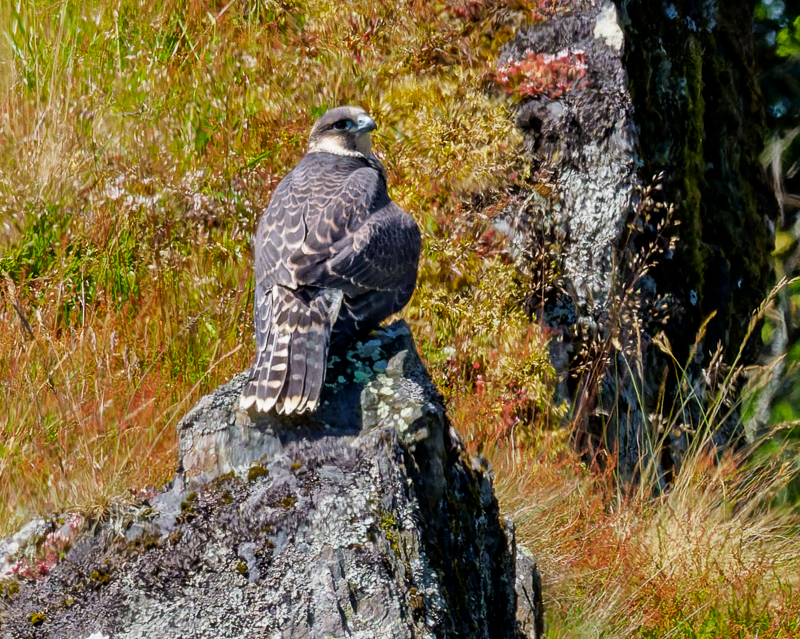
Juvenile peregrine. I got the impression this was a male.

There’s always been something special for me about birds of prey. In my “youth” (ok, I was about 30) I did several summer contracts for the RSPB which usually involved raptors and I seemed to identify with them. I spent more time with peregrines than any other species and I still seem to have an affinity with them. But I also spent many weeks with white-tailed and golden eagles on Mull, and with various species in Wales, Scotland and England. Not to mention gyr falcons and peregrines in Greenland! So you could say that since then I’ve been a bit of a raptor nut. I’d rather spend four hours watching a peregrine eyrie – even if virtually nothing happens – than four hours counting waders on an estuary.

Over the last two springs and summers I’ve been keeping my eye on several raptor eyries – from a distance, of course. It started in early 2021, during lockdown, when I discovered a pair of peregrines on a cliff within cycling distance of my home. This was exciting for me because until then I was under the impression that inland peregrine eyries had long since been abandoned in Ceredigion. I followed them through to mid-summer and saw at least one juvenile in the vicinity of the cliff. On an early visit this year I saw both adults visiting the same ledge together, which bade well for the current breeding season.

This year, following a tip-off, I found another pair nesting in an old raven nest on another cliff even closer to home. By that time the three youngsters were already well-developed and on my second visit it looked like two of them might jump and flap off the nest at any moment. One can only imagine the sense of excitement and trepidation that these young birds experience as they prepare to take their first flight. I had found a comfortable perch for myself on the opposite side of the gorge where my presence didn’t seem to worry their parents. On my third visit, a few days ago, as I approached the gorge on foot , I saw that two of the now fledged youngsters were actually using the my own perch for themselves! So I hung back and let events take their natural course. There was plenty of activity as the juveniles raced around after each other and their parents, screaming raucously. There’s nothing more stimulating to the senses than peregrines at full throttle!

I began to make plans to return to the site with my picnic chair and pop-up hide, but the truth is that I am getting very poor results from my current photographic equipment, and I don’t know why. (The image above is very much the exception.) I’ve ruled out my long lens (a Panasonic 100-400 zoom), so it looks like the problem lies with the body – an Olympus EM1 mk 2, which is now almost three years old. I’m wondering if the “in-body image stabilisation” (IBIS) is faulty or whether my settings have become corrupted in some way. Unfortunately I am a bit of a technophobe so all this is rather a challenge. But needless to say, and incredibly frustratingly, any attempt at long range bird photography is having to take a back seat for now.

In summer 2020 – again following a tip-off from a friend – I heard that merlins were nesting in a dramatic, cliff-enclosed cwm a little further away. I was not familiar with this species, so I visited the site, and was excited to see a female merlin flash by on the walk in. It all seemed very promising. Reaching the cwm I noticed several small raptors perched on erratic rocks on the grassy hillsides around the lake. I decided they were merlins but then noticed that, in the air, one of them seemed to be hovering like a kestrel. And then…….. oh….. that one’s hovering like a kestrel as well……….. Eventually the penny dropped. They were kestrels. It was all a bit puzzling. I read “The Merlins of the Welsh Marches” , by David Orton, and that whetted my appetite even more for merlin experiences.

Cliff-nesting merlins are unusual; merlins nesting anywhere in Ceredigion are unusual. In fact, merlins in Ceredigion are unusual, full stop! But last summer I managed to locate this pair’s nest on a heathery ledge part way up a low cliff above the lake. I visited the cwm several times with a few trusted friends and we all enjoyed some exciting raptor action. They are such lively, feisty little birds, especially the tiny, blue-grey male, that in a sense they almost put peregrines to shame. I visited the cwm again this spring and noticed that the merlin pair were present and showing an interest in a section of cliff high, high above the lake. Would they be nesting there this year?

To read more Tales from Wild Wales as they are published, please click the Follow button.