Fay Godwin revisited

The Dee Bridge, Flintshire (from Wales at Waters Edge)

Saturday the 18th saw the opening of a new exhibition at MOMA Machynlleth of the late Fay Godwin’s black-and-white landscape photographs. It includes a selection of original prints from the National Library of Wales’s collection linked to “The Drover’s Roads of Wales”. This was a bit of a classic from the 1980’s and one of Fay’s first forays into the world of books, and one which helped to make her name. There can be little argument that she was at that time a landscape photographer but she later came to deny this, and claim instead that she was a documentary photographer. But in my opinion this was a moot point. She worked for most of her career in the landscape and that’s good enough for me. What set her apart from most others in the same field was her knowledge of the issues around the landscape and the way she incorporated them into her photographs. While many landscape images, then and now, are stunningly beautiful they actually say very little about their subject matter. It could be said that Fay Godwin’s images, on the contrary, were landscapes with content.

Alongside these prints was another group chosen by invited photographers (including such names as Paul Hill, John Davies and John Blakemore), and others, who were inspired by Fay’s work or who had other connections with her. These were printed by Peter Cattrell, Fay’s own printer and they look absolutely sparkling. Each was asked to select one of Fay’s images and write an extended caption for it and I’m glad to say that I was one of those invited. My choice, and the caption I wrote for it is below. The image appeared on the rear cover of the third of Fay’s “landscape trilogy” – The Edge of the Land (published in 1995). With its rather enigmatic composition I assumed it was from relatively late in her career, but I have recently learned that it dated from the early 1970’s and was included in her retrospective Landmarks as a “snapshot”.

Ramsgate, Kent by Fay Godwin. Fay Godwin’s work has been a visual soundtrack for most of my photographic life. I roamed wild landscapes with my camera from the 1980’s onwards and sometimes came across quirky, incongruous or downright ugly scenes. The photographs I took of them became my “human landscapes”. It was certainly reassuring to know that Fay Godwin had already ploughed the same furrow that I was following. Whether mine work as well in colour as hers did in black-and-white, I don’t know: perhaps not. Fay Godwin’s photographic journey in the landscape began by making images to illustrate guidebooks (e.g. “The Drovers Roads of Wales”) and ended with very personal statements about her own place within it. “Ramsgate, Kent” appeared in the “Edge of the Land”, the last of her landscape book trilogy. Its meaning was probably clearer to her than it is to the viewer. But I like the way that each individual element in the picture has absolutely its own place in the image; rather like chess pieces on a board. And I have an interest in verbal messages displayed in the countryside. They tell us a lot about what we are like as a species.
Ramsgate, Kent by Fay Godwin.

Fay Godwin’s work has been a visual soundtrack for most of my photographic life. I roamed wild landscapes with my camera from the 1980’s onwards and sometimes came across quirky, incongruous or downright ugly scenes. The photographs I took of them became my “human landscapes”.  It was certainly reassuring to know that Fay Godwin had already ploughed the same furrow that I was following. Whether mine work as well in colour as hers did in black-and-white, I don’t know: perhaps not.
Fay Godwin’s photographic journey in the landscape began by making images to illustrate guidebooks (e.g. “The Drovers Roads of Wales”) and ended with very personal statements about her own place within it. “Ramsgate, Kent” appeared in the “Edge of the Land”, the last of her landscape book trilogy. Its meaning was probably clearer to her than it is to the viewer. But I like the way that each individual element in the picture has absolutely its own place in the image; rather like chess pieces on a board. And I have an interest in verbal messages displayed in the countryside. They tell us a lot about what we are like as a species.

Alongside these two strands is a separate exhibition at The Penrallt Gallery and Bookshop, a few doors up the road from MOMA. Invited photographers were asked to choose one image of their own which they felt was particularly inspired by Fay Godwin’s work. My own choice is at the top of this post and I wonder if anyone can see the parallels between it and “Ramsgate, Kent” reproduced above? While in many ways there is no similarity at all for me it is the chess board analogy I mentioned in the extended caption that applies in both examples.

The Penrallt Gallery/Bookshop was opened a few years ago by Geoff Young and Diane Bailey, both of whom, in previous lives, taught photography. They have an excellent selection of books, particularly on the arts, photography and the environment – just my sort of place, as you can imagine! It is just one of those places which is very difficult to leave without having bought something. They also show the work of  upcoming photographers and hold a regular series of talks and readings with photographers and authors, plus various writing workshops. The Fay Godwin exhibition at MOMA and the spinoff at Penrallt were organised and curated by Geoff and Diane and a brilliant job they have done of it. It deserves a far wider audience than it is likely to get in a small town in mid-Wales.

On March 11th and linked to the exhibitions is a conference on Fay Godwin’s photography (with guest speakers) and including a preview of a new film about her life : “Don’t Fence Me In”. I’m really looking forward to it. For details click on the link below ;

http://moma.machynlleth.org.uk/?page_id=810

Both exhibitions run until April 1st. For details on how to visit MOMA Machynlleth, click on the link below.

http://moma.machynlleth.org.uk/?page_id=75

For more information about the Penrallt Gallery/Bookshop, click on the link below.

http://www.penralltgallerybookshop.co.uk/


To follow Tales from Wild Wales please scroll down to the bottom and click Follow


Every picture tells a story.

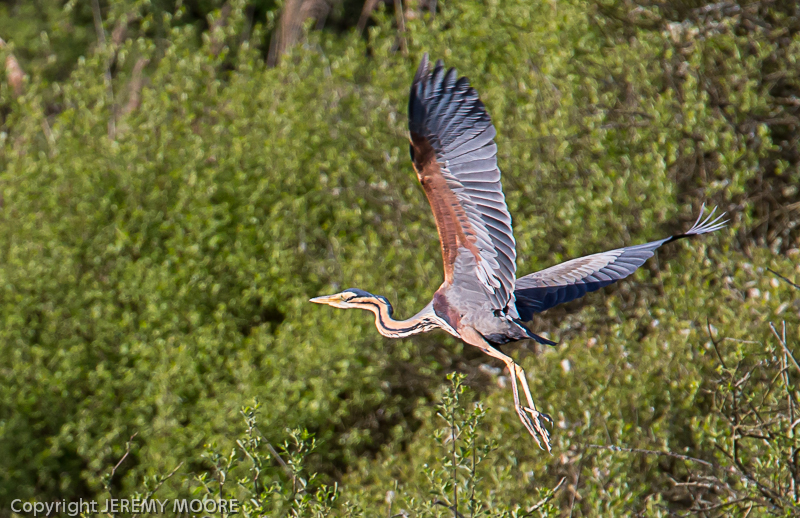
Purple heron : what an amazing creature!

I can’t have been the only photographer to have recently received junk email offering…..”Always have amazing skies!”. It goes on –

“With the killer App for Sky Replacement and our new Skies and Clouds Collections”

“With […………..] sky replacement is no longer like Rocket Science”

“Add Skies III and our amazing new Drag and Drop Cloud Formations and the skies the limit on creativity!”

“Two New Bundles to SAVE on so you’ll never have Dull Skies Again”

It goes on and on in this vein.  I find it terribly depressing. The graphic designer could thus, for example, adapt a poor quality landscape image by adding a sky downloaded from a software package. No photographic skills required whatsoever! Likewise the amateur (or professional) landscape photographer wanting short-cuts to dramatic photographs. It has until recently been difficult to incorporate stunning skies into landscape images without stunning skies being present in reality. Doing so in the days of colour film would have involved a very high level of printing skills indeed and it is probably fairly safe to say that it had rarely been done successfully. In the brave new world of digital photography much of the work involved has been already been done by the software designer.

But this kind of approach does more than make life easier for those wanting short cuts to great landscape images. It devalues photography in its most basic sense. By its very nature a photograph has documentary qualities. I don’t mean to confuse “landscape photography” with “documentary photography” here. But a photograph – any photograph – is an interpretation of a slice of reality. It is rooted in what the photographer saw through his/her viewfinder. So a landscape photograph automatically has documentary values. The very best have both aesthetic and documentary qualities in shed loads. If the photographer has added a spectacular sky – even one of their own – that link between reality and image has been lost.

Many photographers argue that all photographs are “fake” to some extent and that therefore anything goes. In my opinion this just does not hold water. I agree that the photographer makes selections and interpretations at all stages of the process. They might use film or digital, a jpeg straight out of the camera or process a RAW file to their own satisfaction. They might use a 10stop ND filter on their DSLR, a smartphone or a pinhole camera, colour or black-and-white. By making these choices the photographer interprets their surroundings in different ways. But there is a quantum leap between that and getting a sky from elsewhere – their own library  or a software program – to combine with their own image to produce a result.

If it were possible (and necessary) the photographer would physically move a minor irritant (rubbish, for example) from the foreground of a landscape image before pressing the shutter. But if not I don’t really see a problem in cloning it out at the processing stage. I’m not that much of a purist. But it is at this point we enter a very grey area indeed. Where does one draw the line between “processing” and “manipulation” – the acceptable and the unacceptable? Personally I’m happy to clone out anything which on another day might not have been there: a walker in a red cagoule, or white van in the distance, for example. Others draw the line elsewhere. But there is a line. It may well be that advertising photography is artificial through and through, and maybe we should expect that. If there was a line of telegraph poles running through a landscape, though,  I badly need and want to know about it. Every picture tells a story and a manipulated one can tell quite a different story. It could be the difference between a real wilderness and an inhabited landscape in this example.

For more thoughts on this subject see this post.

On the other hand I have no philosophical problem with improving my images at the processing stage where necessary. The more I use Lightroom the more I learn what it is capable of. I was recently introduced to the adjustment brush by my correspondent David Clegg and how useful is that? How could I have managed without it, more like! During the latter stages of my Bird/land project I was able to use the adjustment brush (rather than the radial filter) to select the bird before making minor changes to its exposure or contrast, for example.  So much more effective! See the purple heron image above.

More on Bird/land very shortly, by the way……..


To follow Tales from Wild Wales please scroll right to the bottom and click Follow