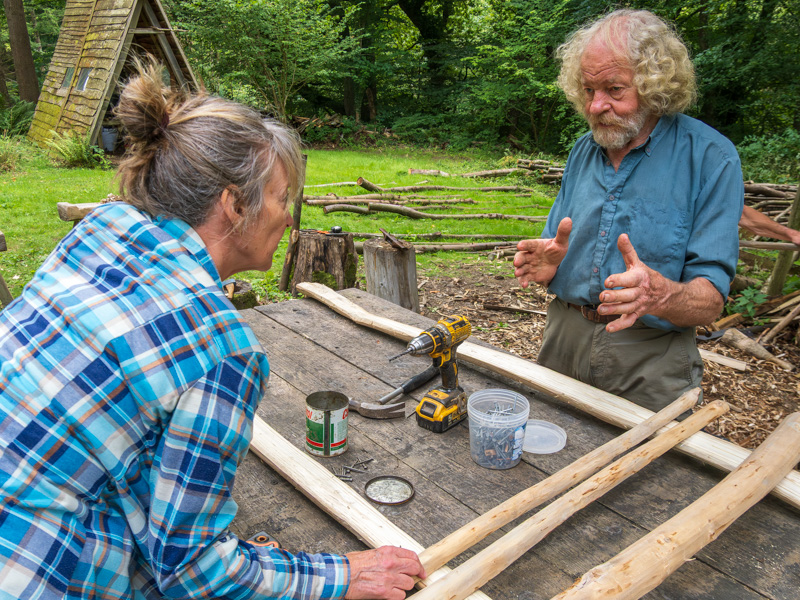
Coed Tamsin Part Four – Bob.

Although Coed Tamsin is owned by Felicia, her partner – Bob Shaw – is the heart and soul of the place. Philosopher, mystic, woodsman, teacher, and Friend of the Earth, Bob is truly one of a kind.

Born into a farming family in the south of England, he went to agricultural college there in the mid-1960’s, before moving to mid-Wales in 1969. I first met him around 1980 when he was a committed Buddhist (me less so…..), and we have met socially, in FoE, and elsewhere, over the years since then. Still somewhat “old-school”, he doesn’t have a mobile phone or computer of any kind. He has witnessed first-hand the intensification of agriculture over the last fifty years, and the consequent loss of wildlife this has entailed. And it hurts him. He can very eloquently explain how we need – and could return to – a countryside that is more nature-friendly; but, despite being very well read, he has never been able to commit his ideas down on paper.
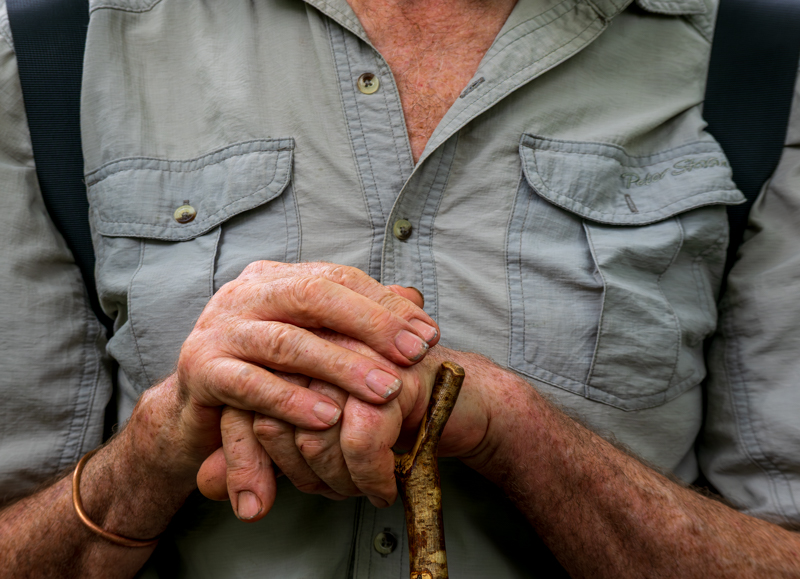
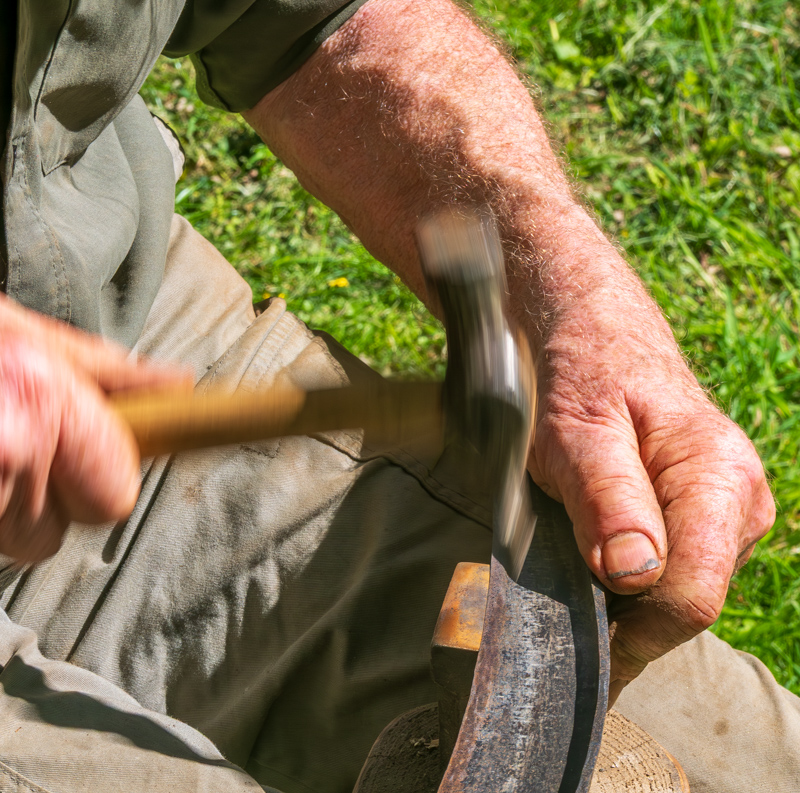
A lifetime of manual labour can be seen in his hands. They wouldn’t feature in a nail-varnish advert, but they were one of the first things I wanted to photograph during the project. And it wasn’t difficult. He was a brilliant subject, never phased by the sight of a photographer lurking around as he worked. Although he never acted the prima donna, perhaps he secretly enjoyed being the centre of attention? He does deserve it!
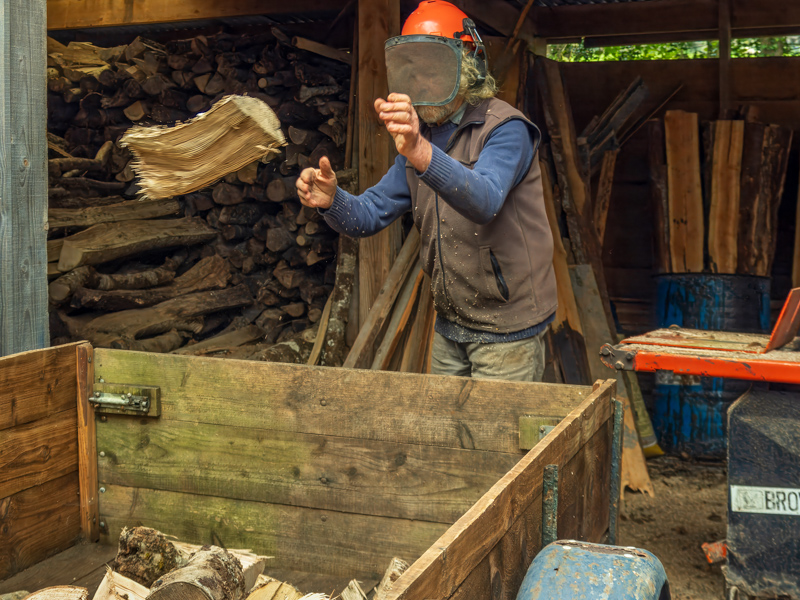
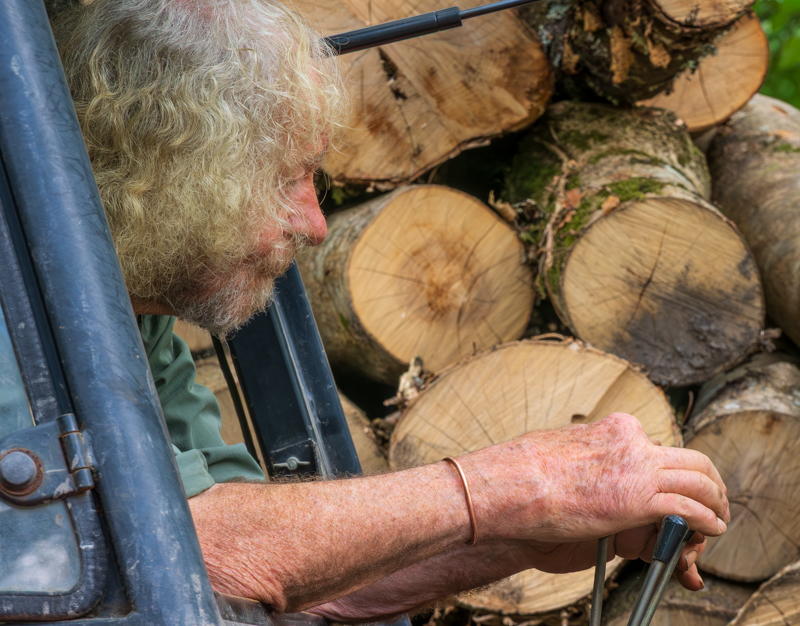
Coed Tamsin is a monument to all the hard work that Bob has put into it. I do hope that when the time comes, he and Felicia will have found a buyer who will keep the spirit of the place alive. I’d like to think that my work there – available for all to see at the National Library in Aberystwyth – will provide a visual record of the place should all else be lost. It has been an honour for me to have been the person that created it.

For an introduction to the Coed Tamsin project, please click here.

Edit: I met Bob yesterday at Coed Tamsin. We talked wildlife, farming, and people we know in common. He suggested that people should walk silently around the wood, and try imagine where the “edge” was between them (the individual), and nature. He slips these ideas in during conversation, without you even noticing.

To read more Tales from Wild Wales as they are published, please click the Follow button

Swings and roundabouts

Fish farm, Penmon: Purchased by National Library of Wales

Over a period of many years the National Library of Wales bought complete sets of prints from each of my books as it was published, or as they were exhibited. They currently have a total of 371 Cibachromes purchased in this way. This came to a sudden end about ten years ago when they took on a new member of staff whose task it was to raise income from items in its Collection. I’m not sure what her background was but this bright spark decided it would be a good idea to sell copies of photographs bought from photographers or donated by them. She obviously had no idea about copyright. I was asked to sign a statement approving this and I refused. I found it astonishing that an institution whose readers had to sign a “personal use only” statement every time they photocopied a page of one of its books should believe it could appropriate photographers work in this way.  It may have been a coincidence but no more of my work was purchased for the following decade. It was just one of the ways in which my income declined over that time.

I’m glad to say the situation seems to have changed. That particular member of staff has apparently retired and I’m now in the process of selling a set of prints from “Wales at Waters Edge” to the Library. Not the whole lot (there are over a hundred) but a selection of twenty made by their Curator of Photography Will Troughton. He has described me as “Wales’ leading environmental photographer” and goes on to say that “his meticulous work has received extensive praise from many quarters”. For months on end it feels as if one is working in a vacuum, so this came as a very pleasant surprise. Environmental photography might sound a bit of a niche but it does suit my work quite well. I’ll quite happily use a building – a castle, lighthouse or cottage – as an aid to composition in my more commercial landscapes (the postcards, for example). But in my personal work I’m usually careful to use human elements within the landscape only when I’m tring to say something about that landscape.  I’m not always sure what exactly I’m trying to say but photographs do not always provide answers; sometimes they can pose questions. In my case the question is often “What exactly is our place within the landscape?” That is also why I have always been so keen on Fay Godwin’s work. It was very pleasing to see from his choice of prints that Will understands what I am trying to do.

Life is full of ups and downs and I have also suffered a major setback recently – although hopefully only a temporary one. Most of my books have been published by Gomer Press, arguably Wales’ premier publisher. However they are clearly now downgrading their publications department and in an attempt at “restructuring” are replacing the number of posts by 50%. All eight current members of staff were asked to re-apply for the four posts now envisaged. All refused and took redundancy payments. Gomer currently thus has no publications department, and any books “in development” but not contracted have been shelved.  However I am still hoping that either Gomer Press or another publisher will take my new book up before too long. Both Jon Gower (the author) and I are well-known and respected in Wales in our respective fields so they should be leaping at the chance!

To follow Tales from Wild Wales, please scroll right down to the bottom and click Follow.