Just after the New Year we went for a low tide walk along the beach at Ynyslas. It was stunning …… blue skies, no wind….everything you could want from a winter’s day. We walked from the golf club car park, round the end of the dunes to the visitor centre (soon to be closed); then after a cup of coffee back along the board walk to return to the car park along the beach. By this time lengths of the peat underlying the sand had been exposed. As I walked along, Jane drew my attention to a small flock (21 birds) of sanderling which had alighted on the peat just behind me. I hesitated for a while before extracting my camera from my backpack. I expected them to fly off immediately, but they stayed put, probing in the peat for food, and running backwards and forwards as the waves washed in and out. I had two minutes with them before they flew off as quickly and mysteriously as they had arrived.
Enjoy the photographs!
To read more Tales from Wild Wales as they are published, please click on the Follow button
This last year has been a humdinger for seeing the Aurora Borealis, with two stunning displays here in mid-Wales on May 10th (see this post) and October 10th. But on September 12th, which happened to be my birthday, I was just about enter a restaurant in Tywyn for my birthday meal when an aurora red alert arrived on my phone. Eek…..what a dilemma!
I decided to go ahead with the meal and not let Jane (my partner) down. An hour and a half later, the meal over, we headed down to the mouth of the Afon Dysynni , a couple of miles away, where we planned to spend the night in the camper. It is here that the railway line and coastal footpath cross the river just before it reaches the sea. At high tide the river water backs up into a lagoon known as Broadwater; and as it happened there was no wind, the water was still and the sky was clear. Would there still be any sign of the aurora?
I could immediately see that the northern sky looked “unusual”, so I set up the camera on a tripod, and began taking a series of images. I wouldn’t say I’d perfected my technique by any means but I had learned from some mistakes I have previously made with long exposures. Despite it being pitch black I could see that the silhouettes of the bridges set against the night sky would make an excellent composition. It wasn’t until I examined the files on my PC that I could see what the sensor had recorded and after some judicious processing came up with an image I’m really pleased with.
To the naked eye very little could be seen but if only our (my?) vision was more sensitive to low light levels it would have looked something like this. Even the version you can see above is drab in comparison to the sparkling processed original viewed on my monitor. I could write a book – well maybe an essay – on aurora photography and what it tells us about our own vision, but that will have to wait until another day.
On a lighter note, I usually make marmalade in the run-up to Christmas and give a few jars away as presents. This morning I left a jar by the recycling bags for the bin-men to collect. I heard the lorry drawing away so rushed outside to see if they had taken it. It was still there. I ran after them and held the jar up. “Ow, thees ees resoyclin, we down’t tek glass” he said in his brummie accent. I handed the jar over and wished him a happy Christmas.
So thanks for continuing to read my ramblings and with best wishes, seasons greetings and a virtual jar of marmalade to you all.
To read more Tales from Wild Wales as they are published please click on the follow button.
It almost always worth visiting the Teifi Marshes, a Wildlife Trust reserve near Cardigan (See this post as well). The big attraction for me is the reedbed which has three hides situated within it. Two are on the edge of small pools and the third overlooks a narrow creek draining into the River Teifi. Because the pools are small any wildlife using them tends to be pretty close, and all three hides are popular with wildlife photographers. It is an exceptionally good location to see and photograph kingfishers and even water rails – although my record with the latter is pretty sketchy. They are nimble and fast moving and tend to appear only close to dusk or dawn.
Last Saturday I arrived just after dawn and made my way along the old railway line (now a multi-use path) to the hides. Two otters visited the Kingfisher pool but all that could be seen of them was the top of one head and two trails of bubbles. Entering the Mallard hide I sneezed and a water rail immediately responded with its squealing call. It was on the water’s edge just below the hide but had disappeared by the time I got my gear set up. The same pool was full of activity later on with six squabbling moorhens present. There were also eight little grebes and at one point they all gathered in a semi-circle around the moorhens to watch the battle. Real school playground stuff!
Suddenly two otters appeared from the reeds. I tried to keep calm. My camera was set up correctly to photograph them as they swam slowly across the pool. I had the hide to myself and scrambled from one side to the other in an attempt to avoid having an out-of-focus kingfisher perch in the foreground. (In the end I was able to crop it out) After just one minute the otters disappeared back into the reeds as quickly and as mysteriously as they had arrived.
Unfortunately I didn’t have time to alter the aperture setting so while the otters are sharp the heron is just out of focus. Being a perfectionist this matters to me and I need some sharpening software to improve the image. Lightroom does almost everything I need my software to do but it does have its limitations. Topaz Sharpen AI does a very good job but I only have a trial version and the output has a watermark across it. I can’t get the same results from Photo AI, its successor. Shame!
If you visit the Teifi Marshes, here’s a few pointers. Coming from the south by car head for Cilgerran and take the main drive to the car park and visitor centre (parking fee payable). From the north, it is easier to park in the industrial estate south of the river, between the two bridges, and walk to the hides along the old railway track. For seeing and photographing wildlife dawn is best; by mid-morning the reserve will be the domain of dog walkers, child minders and families with limited interest in natural history. You have been warned!
To read more Tales from Wild Wales as they are published, please click the Follow button
About thirty years ago I was part of a team of volunteers who spent a week on Ynys Enlli (Bardsey Island) looking out for Risso’s dolphins. We stayed at the lighthouse (reserved for researchers) and kept a dawn-to dusk watch for these lively cetaceans using a telescope. There were a number of sightings but all were pretty distant. One day I was on observation duty when I spotted what appeared to be a cetacean “blow” (exhalation) in the far distance. It was angled at 45 degrees to the vertical and may have been a sperm whale. I called the others out but it was just a one-off sighting.
Since then I have drifted away from marine conservation but was aware that risso’s dolphins could be seen from certain locations along the Welsh coast. As well as Enlli there were sightings from Strumble Head in Pembrokeshire, and Point Lynas on the north coast of Anglesey. In fact the latter has become a regular and almost guaranteed location at the right time of year. Many excellent photographs of risso’s have appeared on the internet in the last few years. My first visit was on September 28th 2022, when animals were certainly present and very active, but were too distant to allow successful photography. I decided to try again one day last week.
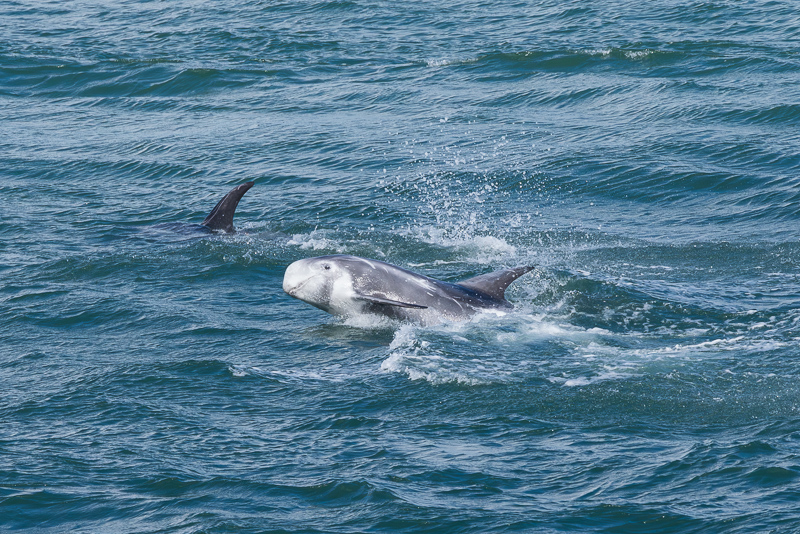
I stayed overnight with my friend Jonathan in Nantlle, about an hour’s drive on a good day from Point Lynas. We aimed to be there by high tide at 12.20 pm, but for various reasons set off far too late. Further delayed by road works and the remnants of summer holiday traffic it was actually 12.45 before we arrived at the lighthouse. A small group of Sea Watch Foundation volunteers with binoculars and clipboards were just leaving. This was not a good sign! I tentatively enquired if they had seen any dolphins and one girl told me they were “just around the corner”. A woman sitting on the rocks below the lighthouse said she had been watching them for an hour and a half. I took a quick snap as one individual disappeared beneath the waves but another small group weren’t far away. There was a sudden burst of activity from one individual in this group with vigorous tail slaps and much sea-spray, and they disappeared. It all went very quiet. I said to Jonathan “I hope it wasn’t saying to the others “Come on lads, it’s time we were off……”” But it was.
There was a fair bit of porpoise activity in the rough water off the point, and at least one more distant risso’s and a probable bottlenose dolphin or two on the walk back to the car, but that was it. What a lost opportunity!
All was not completely lost, however. I managed one sharp and pleasing image from a couple of bursts before the group disappeared (see above). It made me determined to go back to Point Lynas before the month of September was over.
I’ve just got back from a trip around Scotland with Jane, my partner. We spent a week on Mull and then went cross country to Perthshire where we visited some great friends. Photography-wise there’s no doubt that the highlight was a boat trip from Fionnphort on Mull to the islands of Lunga and Staffa. Here’s how it happened.
I have an unfortunate tendency to arrive early or late for appointments by either an hour, a day, or even a month. Yes, the latter has happened! We were staying in the campervan most of the time but I had booked one night’s accomodation in a “pod” on Iona, just a short ferry ride from Fionnphort. Not unexpectedly I got my days mixed up and found that we had a free day on Mull before the Pod was available. Our neighbour on the campsite had booked a boat trip to Staffa and Lunga on our free day so on the spur of the moment I looked online to search for spare places. To my surprise there were, and I booked them right away. A few minutes later I checked the booking and noticed that it was for the wrong day – the day we were booked in on Iona. Cue mega-panic! Late night messages to the boat company followed, and they got back straight away with the news that they would re-arrange it for the correct day. Phew……
The forecast was great for the trip with unbroken sunshine and light winds. We cruised northwards among the Inner Hebrides in perfect conditions for an hour or so before arriving on Lunga. This island was an unknown quantity to me but a few minutes after landing puffins could easily be seen amongst their burrows on its grassy edge. I didn’t realise what was to come a little higher and further along the coast.
The path wound up through broken rock and grassy slopes dotted with bluebells and other spring flowers. Puffins seemed to be everywhere and were more approachable than they are on the Pembrokeshire islands. Some were quite oblivious to any human presence. Two visitors ahead of me seemed to be photographing a low rock-face but there was actually a pair of puffins pottering in and out of their nest in a crevice just behind it. I could easily have reached out and touched them. They are absolutely enchanting birds and I make no apologies for presenting a photograph of them in all their cuteness. Perhaps we love them so much because they remind us of ourselves? (See the main pic)
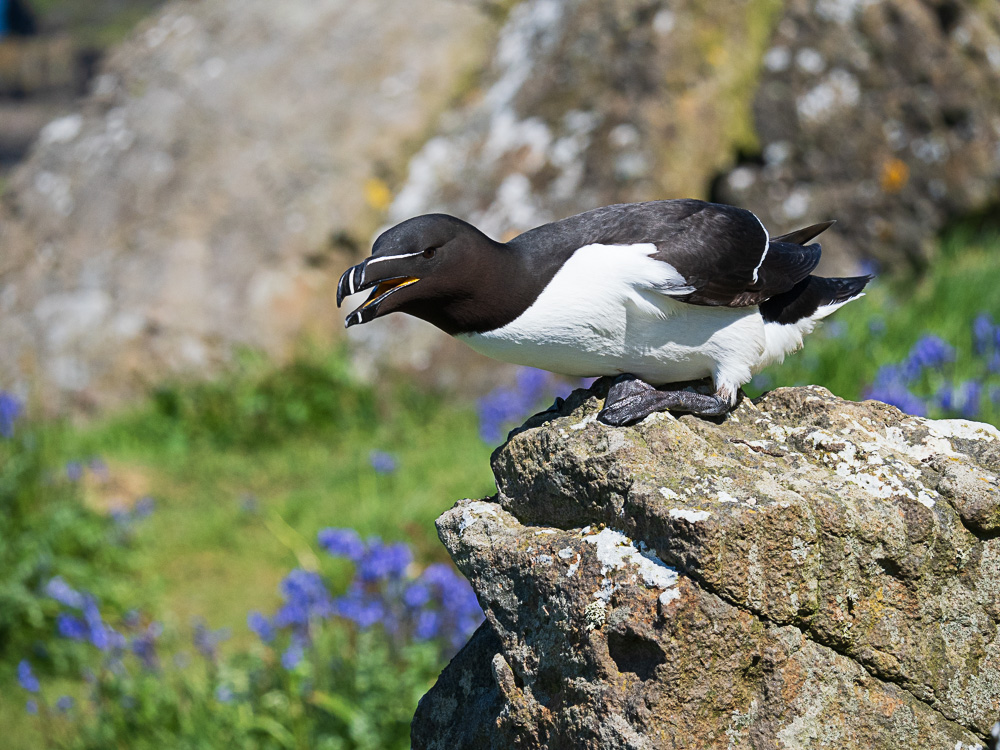
Reluctantly dragging myself away I soon came to the end of the main path close to an auk colony. While the huge majority of the birds were on the far side of a precipice that didn’t stop individuals landing this side of it close to me and the other human visitors. I’ve never been in close proximity to a shag before but one landed nearby and stayed, allowing me to photograph it at length. One young woman was sitting on a rock outcrop and a razorbill landed next to her as if she wasn’t there. It was astonishing! I reflected on how easy it would have been for the early sailors to plunder these seabird islands for food as they explored the oceans. And no wonder the great auk became extinct – it didn’t even have the advantage of flight.
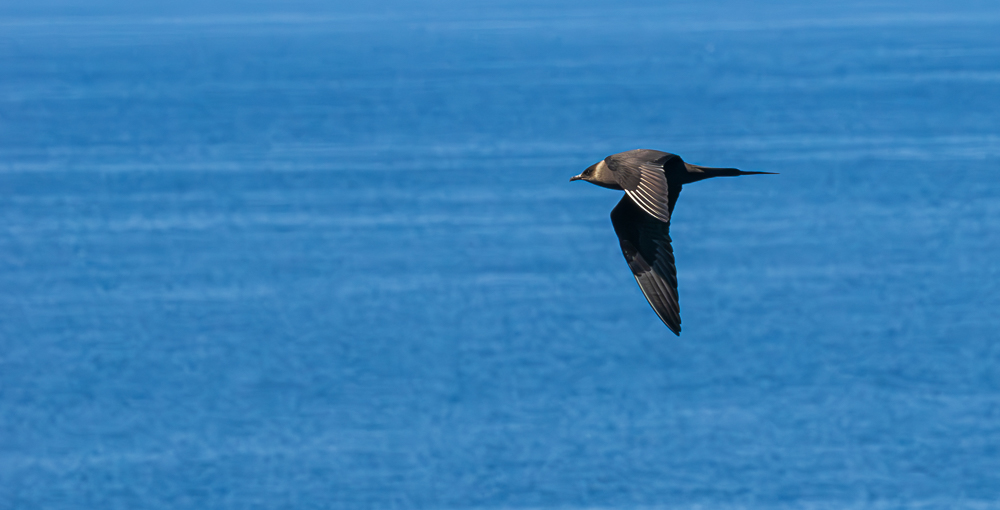
Most of these bird portraits were taken with my 24 – 100 mm zoom lens, not the long zoom that is normally obligatory for bird photography. I did, however, swap lenses to capture one of two arctic skuas which were patrolling around just offshore in an attempt to make unwary seabirds disgorge their food.
Arctic skua – much reduced in numbers following the avian flu outbreak.Basalt columns on Staffa
We only had two hours on Lunga and before long it was time to return to the boat. I was exhilarated; it had been one of the best mornings of my life. By contrast, the island of Staffa, inspiration for Mendelsohn’s piece “Fingal’s Cave” and our second port of call, was rather a disappointment. The geology was extraordinary but time was very limited and visiting the cave was like being on a production line. Boat after boat was disgorging its passengers for half an hour and then leaving.
It was only through the series of mistakes I made that we actually got to Lunga at all. If I had had time to do some research I would probably have taken the shorter and cheaper trip to Staffa only. And if it hadn’t been for our neighbour at the campsite we might never been able to appreciate the wonders of this astonishing seabird colony. Serendipity indeed!
To read more Tales from Wild Wales as they are published, please click the Follow button.
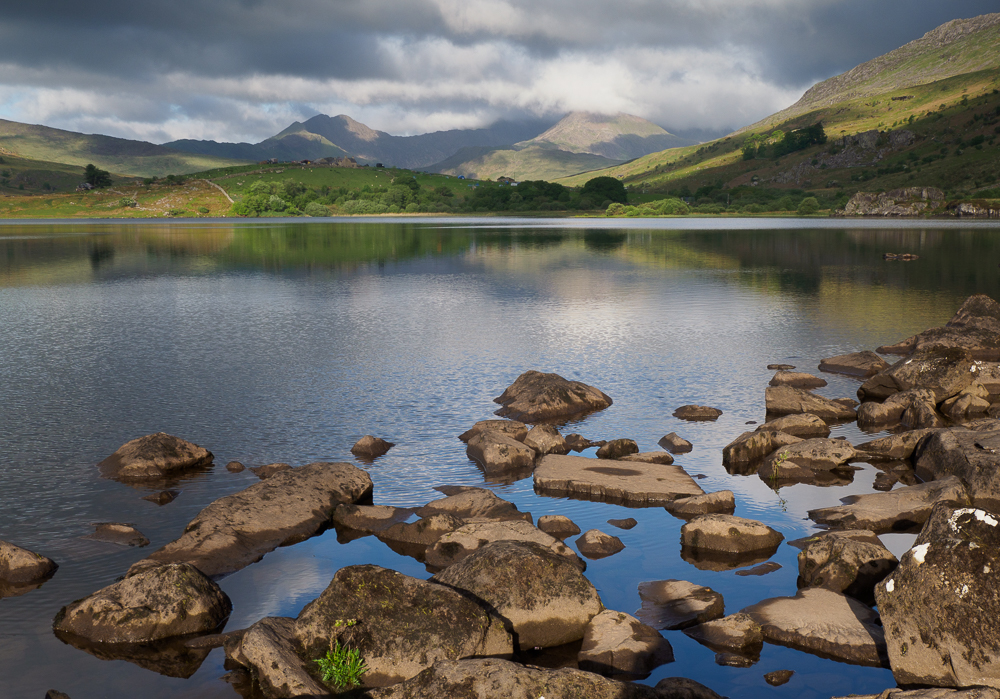
A photographer for many years now, the novelty for me of going out with the camera just for fun has long since worn off. Over time my photographic activities have become more focussed on a particular project, and since returning from Mallorca that project has been to add to my collection of possible postcards for future years. The most successful of such visits this summer was the classic location of Llyn Mymbyr, west of Capel Curig, at the end of May.
From the east end of the lake one can gaze across placid (or more likely choppy) waters towards the Snowdon Horseshoe. Halfway along, debris – brought down from the mountains by a long since disappeared torrent – almost cuts the lake in two, giving the lake its alternative name of Llynnau Mymbyr (Mymbyr Lakes). It is easy to walk to the channel joining the two waterbodies , giving views to Snowdon in one direction and back towards Capel Curig to the other. Being so close to the road the location is very popular with photographers, but it would also be well worth a decent walk to get there.
I had a feeling that something special might happen, and it did – eventually. The first morning was good, some nice light, good clouds and decent reflections. But perhaps I should have woken earlier……….. I may have missed the best conditions. I had business elsewhere during the day but returned for the evening. Again, conditions were good but not too exciting. As it was Bank Holiday weekend the campsite at the west end of the lake was busy with cars and motorhomes which provided an irritating mid-ground in front of the Horseshoe. Only in a wide-angle view would any of these images these be useable. I took my tripod around to the far side of the lake for a better angle and used a ND filter and long exposures for a different “look”, but the results were not quite what I was hoping for.
From the postcard……
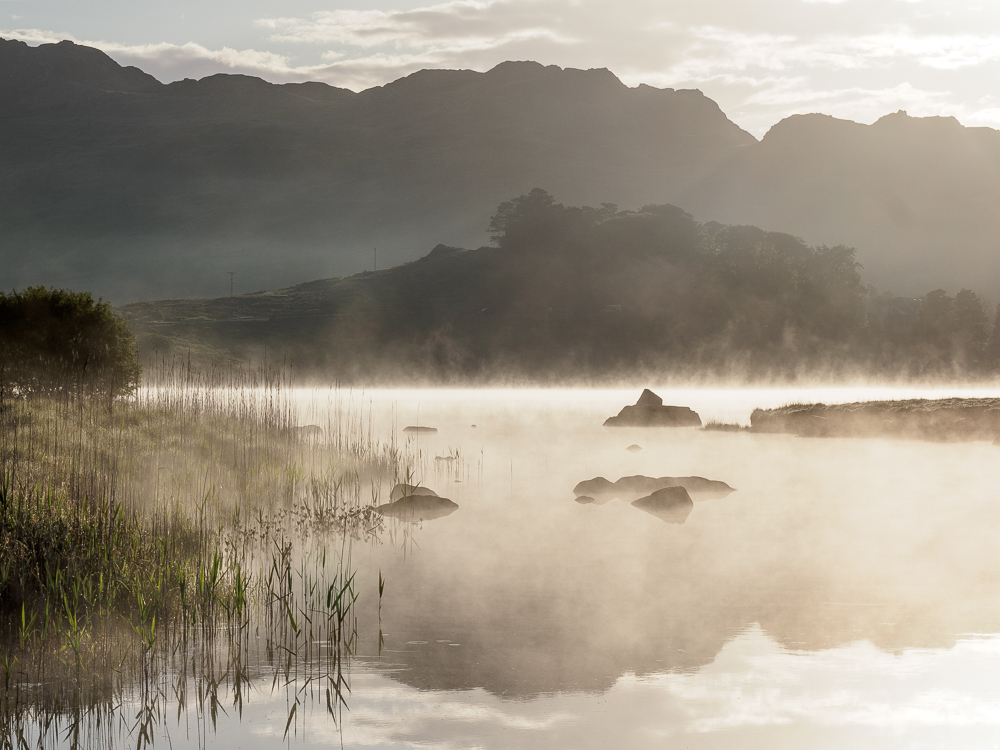
The following morning I woke early and conditions looked great: blue sky overhead but fog at ground level. I walked down to the lakeside and even at 5.40 a.m I wasn’t the first photographer around. In one of my first pictures you can see a figure crouched in the reeds by the water’s edge.
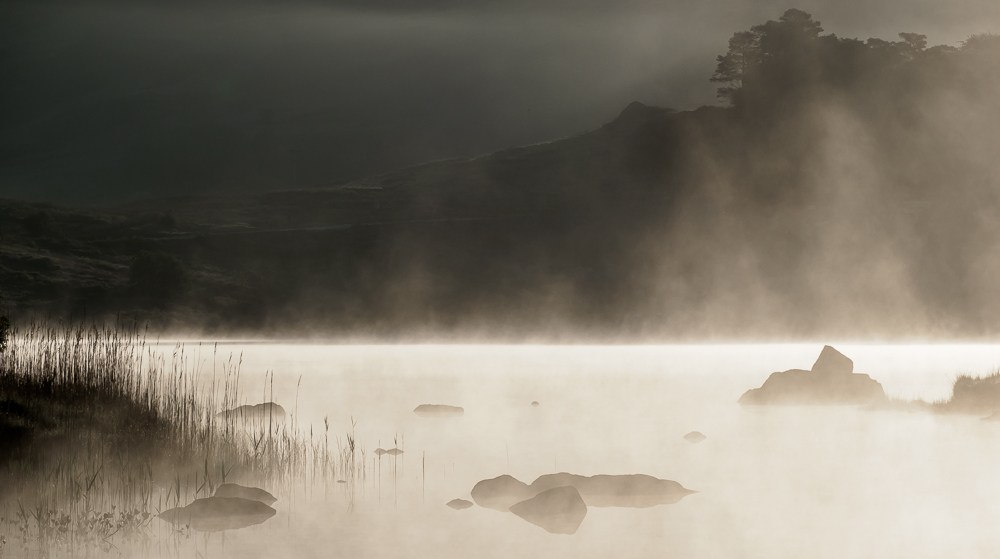
….to the minimalist
What a morning it was! The sun was already above the horizon, backlighting every feature of the landscape to the east. Mist was rising gently from the still waters of the lake. If these conditions happen at all, they are usually short-lived, but I was able to spend a good hour taking pictures in quite a relaxed fashion. I used a whole range of focal lengths from 25mm to 400 mm using both my main lenses, and got a tremendous selection of images….. if I say so myself…… ranging from the “postcard” to the minimalist.
It was the landscape photographer’s dream morning, and I was elated. But what of the other guy who appears in my first pictures? Within ten minutes he had gone. Shortly later I heard the sound of a drone flying above the lake and by the time I returned to my van in the layby his van had disappeared. I wonder how many locations he was visiting that morning, and how satisfying each one was?
To read more Tales from Wild Wales as they are published, please click the Follow button.
I’ve lived in Ceredigion for over fourty years, and worked on the Ceredigion coastal path in the 1980’s, but have never really spent much time at Mwnt. And yet, with its tiny, ancient church, sheltered beach and National Trust car park, it must be one of the most popular and attractive destinations in the county. I had heard that a large flock of chough gathered there early in the morning, and that it was also a great place to photograph bottlenose dolphins. So I decided to visit.
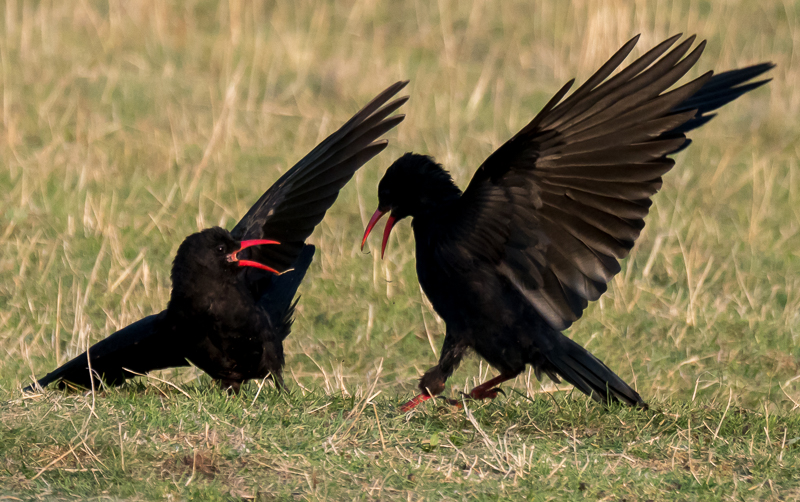
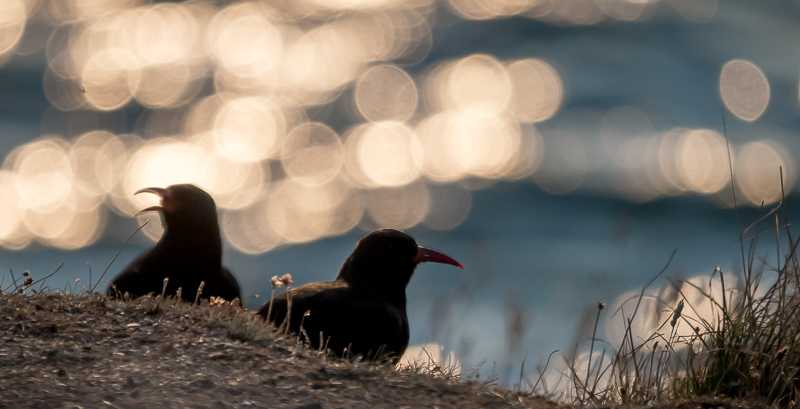
The first morning – having parked up overnight a couple of miles inland – I arrived early. Choughs were gathering on the short grass in front of the church, so I manouevred my van into a position where I could use it as a hide. The choughs were busily feeding on leatherjackets , which they were digging out of the turf with their strong red beaks. I counted a total of twenty-nine altogether. They were barely troubled by the occasional passer-by, flying a short distance away before quickly returning. One thing I noticed was that they both hop and walk, the latter giving them quite a pronounced waddle!
Them’re chuffs, them are…….
I overheard the following conversation between one couple as they walked through the flock –
Him : “Them’re chuffs, them are”
Her : “Warrar?”
Him : “Them, they’re chuffs”
Her : (louder) “Warrar???”
Examining the pictures on the camera’s screen, it looked like very few of them were perfectly sharp. I blamed myself. I thought I was out of practice. But then I had an idea: was the viewfinder’s dioptre adjustment wrongly set? I re-adjusted it and found that most of the pictures were in fact quite acceptable. I must have rotated the adjustment dial getting the camera in or out of my bag. This is an ongoing problem with digital cameras . They have so many buttons and dials it is virtually impossible NOT to change settings in normal day-to-day use. Typically the focus point moves from centre to somewhere near the edge and you wonder why it won’t focus properly. There should be a lock button somewhere which would prevent these accidental changes.
As more and more people arrived, so the choughs began to filter away. I returned the next morning for another session. Parking in the same spot I waited for the birds to arrive. And so they did. It was mostly good-natured, co-operative feeding, but not always. Twice there were short but vicious tussles between individuals, who very rapidly resumed feeding alongside each other shortly later. I’m told by Adrienne Stratford, an expert on chough behaviour, that these spats are mostly between two juveniles – possibly even nest-mates. Far more often, however, two birds could be seen nestled close to each other, gently preening each other’s plumage.
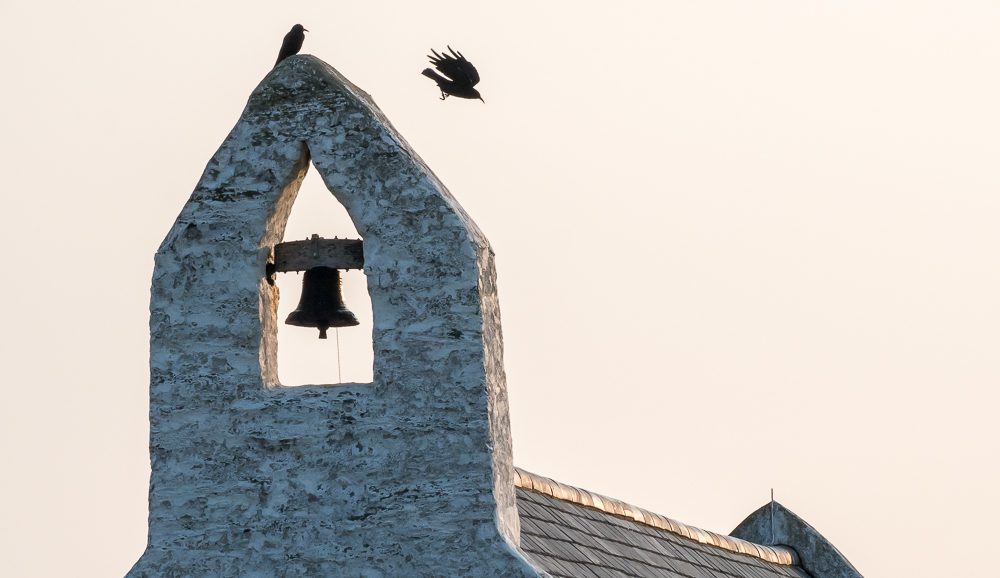
Having pretty much exhausted the possibilities of individuals and groups of chough digging into what looked like a lawn, I turned my attention elsewhere. Occasionally choughs would rest on the church tower or a gravestone, and I thought that could make a nice picture, even though the birds themselves would be small in the frame. It turned out be quite an easy task with such co-operative creatures, and the pictures work well for me.
O
When I first started bird photography (for the book Wales – at Waters’ Edge) it was beyond my wildest dreams that I would be able to photograph chough. They seemed so rare and elusive. But as I have got to know them better I’ve realised they’re actually one of the most approachable species in Wales. At the same time they have lost some of their mystique; but is still so nice to spend some time in the presence of one of my favourite birds.
As for the dolphins I spent some time scanning the sea , and one afternoon picked out a small group heading quickly westwards some distance offshore; the more I looked the more I found. They were scattered over a wide expanse of water covering perhaps 1/2 mile by 1/2 mile. There were probably dozens altogether, possibly as many as fifty. Presumably they were bottlenose but a large group of commons was seen off the Teifi estuary not far away at about the same time, so who knows? When conditions are right (and when the mood takes them) bottlenose dolphins come very close inshore at Mwnt, and some great photographs have been taken of them. So I shall keep my eyes and ears open and make another visit before too long.
To read more Tales from Wild Wales as they are published, please click the Follow button.
In Part One I described the background to my hunt for the lady’s slipper orchid, but some detailed research was required for its actual location. A “re-introduced” plant at Gait Barrows would be fine but when would they be flowering? One local naturalist told me via email that, despite the cold spring, they were already flowering by mid-May, and this was confirmed a few days later by someone at Natural England ; not on the limestone pavement itself but “at the bottom of the field with the bird’s-eye primroses”. This sounded promising!
It was a five-hour drive to the camp site at Silverdale where we had booked a three-night stay. We spent the first morning at the nearby Leighton Moss RSPB reserve, and then headed off to Gait Barrows. We were a fair way into the NNR on a public footpath when we came across some birds-eye primroses on the other side of a fence. Entering the enclosure I followed a path as far it went without finding anything. I began to search a little harder and found four rosettes of orchid leaves bursting through the leaf litter but which species they were I had no idea.
Birds eye primroses
The primroses are a delight in themselves and I began to photograph them. Then I heard voices. Jane had been resting nearby and was now talking to another visitor. They came over and found me lying on the ground lining up the primroses. Had we come to see the orchids? You bet! I retraced my steps with him and there they were ……….. one clump withered and brown and another with two flowers in perfect condition. I think you will agree they are extraordinary; I don’t know how I could have missed them! On closer examination you could see that each plant and each stem was surrounded by copper rings, presumably to deter slugs. It was a straightforward task to photograph them and I then returned to the bird’s eye primroses.
The orchid enthusiast also mentioned fly orchids and I was keen to see that species as well. Following his instructions the next day I found myself on a grass verge beside a main road a few miles away. There could not be more of a contrast between two related species than between the fly and the lady’s slipper. One is showy and exotic and the other subtle and understated – but no less exquisite for that.
Fly orchid
Photographing the fly orchids proved much more difficult than I expected. In his book “The Orchid Hunter” Leif Bersweden says of them –
“[Fly orchids are] ……. true masters of stealth and camouflage. They appear slowly and softly, shifting in and out of focus. …….. You’ll see one three meters away yet remain unaware that one has crept right up to your knee. Over the years I’ve realised that looking for fly orchids is a futile activity; their ability to vanish right in front of your eyes is unprecedented.”
Several plants were already marked by sticks but I found an unmarked one, and mentally noted its location before I went to fetch my camera bag. On my return it was impossible to re-locate it. When I tried to photograph one of the marked plants, my lens refused to auto-focus, I worried about cars going past, about my van parked across the road in the quarry entrance next to the “No Parking” sign, and if I was crushing unseen plants in my attempt to get down to fly orchid level in the vegetation. All very frustrating but it was eventually “job done”.
Later I returned to Gait Barrows to see if I could find the lady’s slipper on the limestone pavement where they were originally planted. Most naturalists are happy to help and I asked several for directions, but with no joy. Either they weren’t interested in orchids or I was told variously that “they had all died or been picked”, “they have all been re-located”, “they are still in leaf”, and “the new warden isn’t watering them, so they’re late flowering” . But with photographs of the lady’s slipper already in the can I could relax; and it was a bonus to see a stunning little butterfly called the Duke of Burgundy in a clearing on the reserve specially created for them.
To read more Tales from Wild Wales as they are published, please click the Follow button
As mentioned in a previous post I spent a week touring southern England last month. The main attractions were the great bustards of Salisbury Plain but my first stop was actually a little north of there, at Cricklade, near Swindon. Here, at North Meadow, on the floodplain of the Upper Thames, is an ancient hay meadow. Unlike many other similar sites it has not been ploughed or dug up for gravel extraction. It has retained its ancient system of management and is now a National Nature Reserve. It is alive with wild flowers, including 80% of the UK’s snakeshead fritillaries. Its crop of hay is taken off in late summer after the wild flowers have set seed.
A small proportion of the flowers are white.
I arrived at North Meadow at dawn on a cold May day to find a wisp of freezing fog in the air and countless thousands of fritillaries in bloom. Good timing? Possibly …….. but the sheer number of flowers was overwhelming. My first reaction was to try to photograph them en masse before the fog and frost dispersed. I was like a headless chicken! However the long telephoto lens needed to do a mass of flowers justice has a very narrow depth of field and most individual blooms were out of focus. I eventually settled down to photographing small groups of flowers or individuals, and even then a long focal length was required to reach photogenic specimens from the safety of the footpath. My first intention was to show flowers complete with ice crystals but they soon melted into tiny water droplets which proved to be more attractive. I moved on later that day to Salisbury Plain.
I have always found orchids fascinating. With only roughly fifty species in the UK it is a plant family which the non-botanist can get to grips relatively easily. My parents were great wild orchid lovers, and there’s no doubt there’s something special about orchids, something exotic, and exciting. The extreme rarity of some species only adds to their appeal. I had long harboured the desire to see the lady’s slipper orchid in the wild in the UK. This species with its extraordinary flowers was found in and around woodland on limestone in various parts of northern England. Its looks were its downfall, though; it was picked and collected to extinction by 1917. Then, in 1930, one single plant was found somewhere in the Yorkshire Dales. It has remained there ever since, its location only known to a select few. It is legally protected, fenced off and under close surveillance 24/7 to deter thieves and photographers.
Over a period of decades, however, a programme to reintroduce the lady’s slipper orchid to its former haunts has been under way. With great difficulty plants have been grown from seed at Kew Gardens and replanted in suitable locations across northern England. At one National Nature Reserve in Lancashire, Gait Barrows, the plants in the limestone pavement are made available for public viewing every year, and it was in this area that I made some inquiries. When would they be flowering this year after such a cold spring?
We’re well into autumn now and I recently decided I needed some photographs of that spectacular fungus, the fly agaric. I was up in north Wales for a couple of days, and a mixed forecast suggested I might get some sunny scenic landscape photography done; any cloudy conditions being more suitable for more intimate “autumn colours” and woodland scenes. Yes, I know I’m a traditionalist but at my age what do you expect!
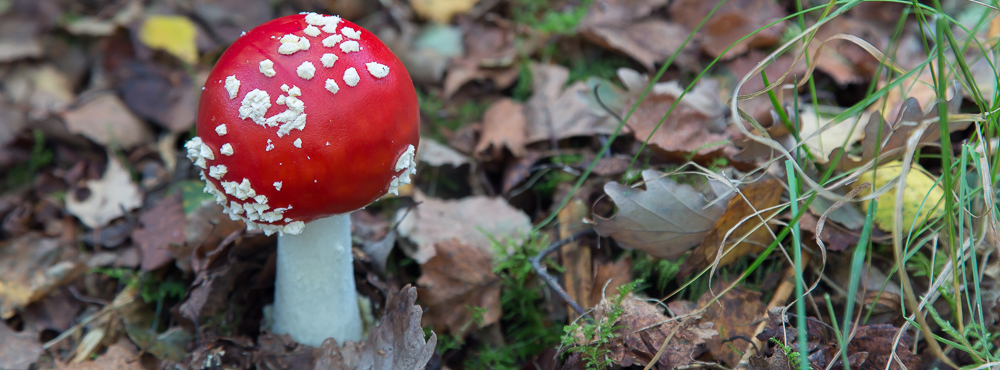
By mid-morning on the first day it was starting to brighten up although a strong southerly wind was blowing. My first destination was a hilltop above Betws-y-coed, with the town deep in the valley below and the main peaks of Eryri in the background. But why not first spend an hour or so looking for fly agarics in the woodland leading to my destination? Two minutes later, right by the path, I had found my first! It was a perfect specimen, I thought, in my excitement, so I got the tripod out and began taking some ground level shots with my telephoto zoom. A passer-by told me that fly agarics were very common this year; some images he showed me on his phone looked great, and I realised my own specimen was not actually that special – tall and broad, yes; but crimson in colour with flecks of white on the cap? No, not really. I had a look around.
Fly agarics are usually associated with birch trees (and sometimes pine or other species). The fungus has a mutually beneficial relationship with the roots of the tree which helps both species thrive. What I found on my short exploration amazed me. Over an area of perhaps a hundred metres by fifty, I found several dozen fly agarics. Most were already past their best, being flat-capped, or even bowl shaped, with the red colouration having already faded towards orange. But I found one particularly photogenic group among some birch trees and did a bit of “gardening” to expose them. One was already broken off at ground level so I decided to make a feature of it alongside several other complete ones. Things are rarely as simple as you hope for, though, in this case because the sun was now shining brightly, creating areas of high contrast on the woodland floor. Every so often a tiny wispy cloud passed in front of the sun but even this didn’t give me the even lighting I needed for this shot. I wandered around, found more fly agarics, did some tai chi, looked at the sky over and over again, waited and waited some more. Eventually I realised that a better image would also include the mushrooms’ habitat so I swapped to a wide angle, placing them in the foreground with birch trees and bracken taking up the rest of the frame. Contrast was still a problem so I tried two other techniques:
1) Using a ND grad over the brightest part of the image (at the top), and
2) Bracketing with the intention of combining two images in Lightroom at the processing stage.
To some extent both worked, but the image (above) was processed using the HDR control in Lightroom. I had to examine individual frames carefully and choose those with the least subject movement for combining: the wind was still strong.
Thirty-six hours later I was back, and within five minutes had found a tiny, perfect little specimen freshly emerged from its protective sheath, looking just like something you might find in a very upmarket cake shop (see above). And it really wasn’t a difficult shot to take; a little gardening to clear dead bracken stems and twigs, tripod, aperture priority, f5.6 for minimal depth of field, and ….success!
Llyn Crafnant
The intervening day was glorious – warm, sunny and cloud-free; perfect for pure enjoyment but not great for the landscape photographer. I spent the night in the van by Llyn Crafnant above Trefriw. I do love the length of these autumn nights. No problem getting a good night’s sleep and no rush to be up before dawn. It was perfectly calm for several hours in the morning and, having found a good spot by the lakeside, I took a long series of images of the head of the valley and its reflection as the sun rose. In the end it was the very last image I took that was my favourite, so perhaps I should have waited longer!
Beyond the head of the valley, completely invisible from within it, lay the great peaks of Eryri – the Carneddau, Tryfan, the Glyderau, Yr Wyddfa and its outliers, and finally Moel Siabod. It was half-an-hour’s walk to a point where they could all be seen. Or so I thought: it actually took something like an hour and by the time I got there the sun was really too high and the sky too blue for successful image-making. But it was a great walk and I will do it again another day. As for the hoped-for view above Betws-y-coed, cloud was covering the peaks on both of my visits. Oh, and I got drenched in a two-hour downpour in woodland near Dolgellau on the way home. Light rain showers, the Met Office forecast said……….
To read more Tales from Wild Wales, scroll right down to the bottom and click Follow.












 Tales from Wild Wales