You may have heard about Happisburgh…..

If you follow environment issues in the media you’ll probably have noticed that this Norfolk village is currently the go-to location for items about sea-level rise and coastal erosion. Like other communities on the East Anglian coast it has been threatened by the sea for hundreds of years. Some – like the nearby Whimpwell and the better-known Dunwich – have long since disappeared beneath the waves. Jane and I had booked a week’s holiday in the Norfolk Broads for the first week in May, and I noticed that Happisburgh was only a few miles away. I thought the village might provide some interesting subject matter for the photographer.

I had no idea what to expect visually other than the “Road Closed” sign that features in all the media. Arriving late in the morning I clambered across a pile of earth blocking an old field gateway to reach the cliff top. Directly below me a flock of sand martins were excitedly excavating nesting burrows in the sandy escarpment facing the sea. They barely noticed me at all and only made themselves scarce when a kestrel cruised by. This photo-op felt like a real bonus; the only drawback being the strong and distracting shadows of the birds created by the sun beating down from a clear blue sky. The sand martins were frantically landing and taking off again; you could see tiny showers of sand falling from burrow entrances, and a close examination of the photographs shows a pattern of scrape marks made by their claws on the cliff-face.

By the time I got down to the beach it was about 1pm. and the sun was high in the sky, creating some very harsh light: definitely not the time of day for the landscape photographer to be at work! All sorts of debris lay on the sand; bits of tarmac complete with double-yellow lines, a manhole with the cover missing, sections of brick wall and reinforced concrete. Electric cables trailed from the cliff top and pipework stuck out at strange angles. A brick septic tank was perched precariously close to the cliff top. And it all looked rather disappointing in the unforgiving light.

But a short distance further on – wow! Here were the skeletons of sea defences and two large rectangular concrete blocks resting on metal girders that emerged from the sand. I had no idea what they were but they looked bizarre; and wispy cirrus clouds in a deep blue sky added to the surreal nature of the scene. Normally successful landscape photography requires shadows to help give a three-dimensional quality to a scene. But here the almost complete lack of them seemed to add to the dreamlike quality of my surroundings. It was a one day in a hundred day.

Returning to the village I had a chat with the ladies at the “Sarnies by the Sea” sandwich shack. I said I had heard of Happisburgh for all the wrong reasons, but how did they feel? One said that she felt very bitter that the authorities were happy to let her village fall into the sea “like all the others”. This was the reaction of most of those I talked to, and you have to sympathise with them. One resident’s house had been valued in 2008 at less than the cost of a loaf of bread. Another villager explained that the concrete blocks are the foundations for a metal staircase which ran from the cliff-top down to the beach. It opened in 2003. The extraordinary speed with which the coastline is retreating, and the very low-lying nature of its hinterland, explains why official policy for this stretch of coast is “managed retreat”.

Unfortunately by this time the sand martins were nowhere to be seen. Perhaps nest-burrowing is a morning only job for them? I did find their activities illuminating, though. If a fragile creature like a sand martin can burrow into the cliffs using only their tiny claws what chance does the land have against such a formidable opponent, fuelled by climate change, as the North Sea?

NB : For more details about Happisburgh and coastal erosion there see the comprehensive Village website.

/http://happisburgh.org.uk/

The photograph on its homepage is worth studying. I’m not sure when it was taken but since then the caravan site on the far left-hand side has been relocated completely and I estimate that land equivalent to the outermost three rows of caravans has now disappeared.

To read more Tales from Wild Wales as they are published, please click on the Follow button

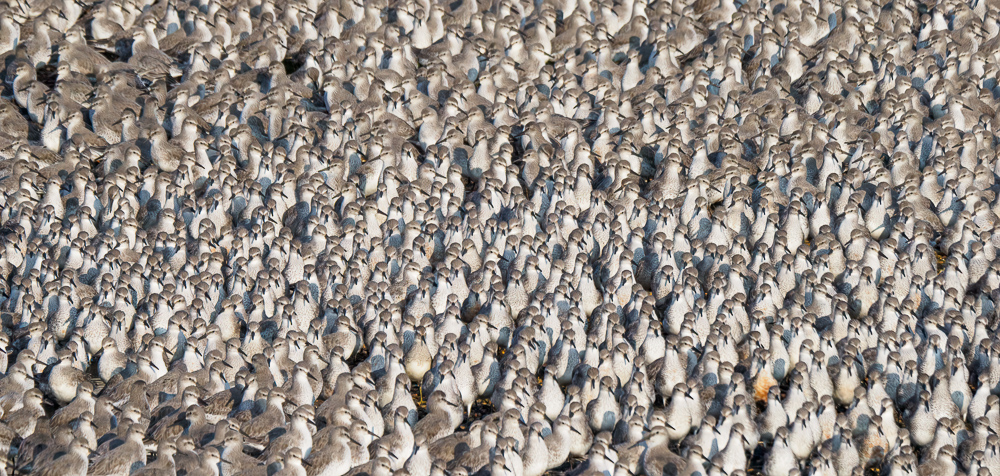
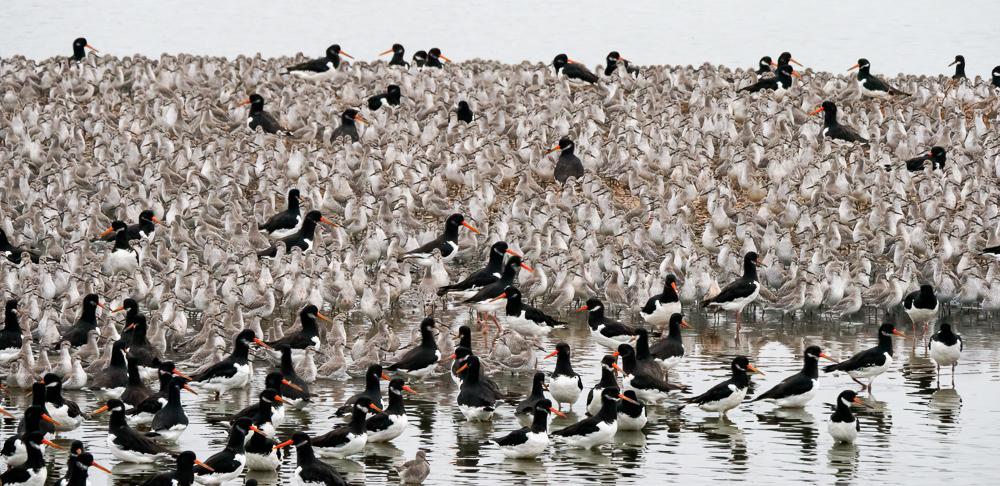
Carpets of knot (part three).

After the drama and intensity of my session in the hide with waders arriving in countless thousands (see this post), it was a relief to find myself outside in calm and sunny conditions, with the waters of the Wash gently lapping at the shoreline. Other birders and photographers were moving towards the main hide, however, and I thought it was about time I headed in the same direction.

To my surprise the photographers’ screen was more sparsely populated than it had been the previous day. Rather than squeezing onto the bench I stood at the back and set up my tripod, which enabled me look through the viewing slot without the discomfort of bending down. And there, just a few score yards away, was a veritable carpet of knots. Within this huge throng of life, large groups of birds surged from right to left, forwards and back, The predominant colour at any one time varied between the white of their breasts and the mid-brown of their backs. The occasional brick-red remnant of their summer plumage could also be seen on a few individuals (see below). It was an entirely charming spectacle, and I couldn’t help smiling. The light was perfect, bright without being harsh, illuminating the birds to perfection.

I recognised a couple of well-known bird photographers in the screen – Chris Gomersall and David Tipling – and there may have been others. There was clearly a workshop session going on, although I’m not sure who the leader was. An authoritative voice announced that “this is as good as it gets”. I took burst upon burst of images.

Having now examined all the results, I do question some of the photographic choices I made during the session. Among other things I was trying to show how groups of birds moved within the flock while others stayed still. I hoped to do this by reducing the ISO rating below Olympus’s base level of 200, and using shutter speeds as long as 1/25th second, but the moving birds just looked blurred. Using long focal lengths such as 300 mm (equivalent to 600 mm on full frame) resulted in too narrow a depth of field in many cases. But looking on the bright side, when I got it right, the images showed what excellent results my kit is capable of in good, contrasty, light.

I mentioned taking ” burst after burst” of images. During this one session alone, lasting about two hours, I took more than seven hundred images. Only a limited number of compositions were possible from the hide, so many bursts differed from the next only by minute differences in focus, exposure or depth of field. At something like 10 frames a second moving birds moved only a few millimeters between frames, if that. Ploughing through such a huge number of files while processing is a real chore. To be frank, it does my head in! But I fear that is the lot of the bird photographer. On a recent session photographing bramblings in a rowan tree I took 638 images over a period of four hours, and only about 1% of them are really worth keeping. I’m beginning to wondering if taking jpg’s rather than raw files might be the answer.

Most photographers waited till most of the knot had returned to the mudflats. I think we were waiting for all of the massive flock to burst into flight together, but it wasn’t to be. They flew off in dribs and drabs. All in all, though, it had been a fabulous morning, and I walked back to the car park a very contented man.

To read more Tales from Wild Wales as they are published, please click Follow button.

Carpets of knot (part one).

A carpet of knot at Snettisham

It was still well before dawn. I had left my van and was searching for the footpath to the shoreline without a torch. Around me dark figures were emerging from vehicles, dimly lit car boots were open and people were hurriedly donning extra layers, rucksacks and waterproofs. The sensible ones had headtorches. I had a very dim memory of the carpark layout from my last visit, and realised I had walked past the exit. I turned round, pretended to know what I was doing and fell in behind a couple with a powerful torch.

I was on the west coast of Norfolk, at Snettisham, and had come to see one of the great wildlife spectacles in the UK. I visited twice in autumn 2013 whilst working on my Bird/land exhibition (see this link), and was last here in March 2016. Snettisham is on the eastern bank of The Wash, which is the winter home to many, many thousands of waders. At the highest of tides waders are pushed onshore and most gather at an old gravel pit, where the RSPB has constructed some hides. The rhythm of the tides is such that the highest waters are between 6am and 9am, or 6pm and 9pm, and in winter are without fail before dawn or after dusk. Therefore there’s a very limited number of “spectaculars” (as they are known) during daylight hours. It is well worth the effort to get there.

After half an hour’s walk a little grey light had begun to seep through the heavy cloud cover. Wader flocks were gathering offshore and beginning to fly into the gravel pits. It was a dazzling display as thousands of tiny birds flickered overhead in the gloom. I saw several photographers hurrying towards the hides at the southern end of the lagoon and decided I ought to follow them. The small wooden viewing “screen” has room on a bench for about eight people and it was standing room only by the time I squeezed in. At one point photographers were three deep!

It has to be said that conditions were not ideal. Thanks to their small sensor m43 cameras struggle at medium/high ISO’s and I don’t trust my Olympus kit at ISO’s higher than 1600. Even though many images at that ISO rating can be rescued by software such as Topaz Denoise, some just can’t. It was still very gloomy and shutter speeds were far longer than I had hoped for. In the case of the example above exposure was 1/60th at f8 – which, at an effective focal length of 500 mm, is really pushing it. However when this particular flock flew I kept my finger on the shutter button and made a series of images which – when fully processed – will be impressionistic and “interesting”; traditional bird photographers won’t like them at all.

Once the action was over I took a quick look at the new “observatory” – the word hide really doesn’t do it justice. It’s a huge, glass-fronted structure with stepped seating inside, rather like a theatre auditorium. And what a show! Low down to one side an area of the front wall has been reserved for photographers. Holes have been provided through which they can poke their lenses but they are very close to ground level; although mats have been provided it’s an uncomfortable position to work from. Has this been over-thought, I wonder? But full credit to the RSPB for providing such a facility which, to be honest, absolutely anyone can use, member or not.

Following high tide the birds return to the higher mud flats and roost until their feeding grounds become available. As I walked back to the car park I vowed to return the following day when better light was forecast.

NB : A timetable for next year’s “Whirling Wader Spectaculars” can be found here.

To read more Tales from Wild Wales as they are published, please click the Follow button.