
Subscribe to continue reading
Subscribe to get access to the rest of this post and other subscriber-only content.
Thoughts on photography and other things by Jeremy Moore.
Subscribe to get access to the rest of this post and other subscriber-only content.
Back in the 1990’s I was involved in a local environmental group – Friends of Cardigan Bay – whose focus was the bottlenose dolphins which frequented the Bay. One of our main campaigning issues was for the proper treatment of sewage. Until 1989 water supply and sewage disposal in the UK were both the responsibility of water authorities which ‘marked their own homework’. Britain was often described as “The Dirty Old Man of Europe” for its filthy beaches, rivers and coastal waters. It was only thanks to the UK’s membership of the EU that things did not get completely out of hand. European legislation led to Britain being prosecuted for water quality failings at our beaches and rivers.
It seemed sensible to me that water supply and disposal should become the responsibility of private companies while their activities should be regulated by a separate, publicly funded, body, the National Rivers Authority, later the Environment Agency, which in Wales morphed into Natural Resources Wales. I then took my eye off the ball, and, with so many other environmental problems to be dealt with, so, it seemed, did most activists. The assumption was that the system was working.
Perhaps the system did work for a while. But the Tory Party returned to power, and with it came austerity. The Conservatives believe in “light touch regulation” – or to put it another way – as little regulation as possible, preferably none – and rather than dismantle them completely, the regulatory bodies were starved of the funding they needed to function properly.
Privatisation of the water industry was never popular with the general public, and water quality has thankfully become a big political issue in the last few months. Thanks to high profile individuals like Feargal Sharkey, much criticism has appeared in the media over the polluted state of our rivers and beaches, the lack of investment, the huge salaries paid to company directors and the massive dividends paid out to shareholders. In Wales the River Teifi is so badly polluted by sewage and agricultural run-off that any housing developments in the river’s catchment have been put on hold. The river just can’t deal with any more nutrients.
A new threat has emerged in recent years – the proliferation of IPU’s (intensive poultry units), otherwise known as chicken factories. These are basically meat production units on family (and other) farms where upwards of 100,000 chickens (….. up to a million!) are reared in huge sheds at any one time. Typically there are seven or eight “crops” of birds per year, which means that each bird must reach its maximum weight by about six weeks old, to allow for cleaning and re-stocking. It is difficult to justify the use of the term agriculture to describe them; they are high-tech facilities in which heat, lighting and feed are controlled to a minute degree to maximise the birds’ growth rate. If they must exist, they would be more appropriately located in industrial units on the outskirts of our larger towns and cities. However, as long as they remain classified as agricultural developments, they largely fall outside the control of local authority planning system. This is described as a “planning void”. I am unsure of the exact business model underlying them but each individual farming business has little control of their operation other than the disposal of the waste products. And that is the big problem. Such huge numbers of birds produce massive quantities of excrement, and it is the farmer’s responsibility to dispose of it. Much of it is spread on land surrounding the farm. It is then washed into the nearest watercourse during periods of rain.
The River Wye is “protected” as a Special Area of Conservation from source to sea. Despite that, IPU’s are particularly common in its catchment on both sides of the English / Welsh border. It is said that there are 20 (or possibly up to 44….) million chickens in the area. The Wye and its tributaries are badly affected by the massive input of nutrients from chicken droppings spread on the land around the IPU’s. Notwithstanding its SAC status the river is in ecological decline (some say “crisis”) and has become prone to developing algal blooms. It is said that it is dying.
But why, oh why the Wye?
Here is my understanding of the situation in a nutshell. In 2013 the giant American multi-national agribusiness Cargill, through its newly formed subsidiary Avara, agreed with Tesco to process chicken meat on an industrial scale. As a result Avara invested £35 million in refurbishing and expanding its chicken processing plant at Hereford. Having done that it needed more birds to process, and farmers in the Wye valley were keen to sign up. Presumably each one has a contract agreeing to host a certain number of “crops” of birds every year, which remain the property of Avara, to buy all their feed and day-old chicks from specified suppliers, to supply only Avara, and use only labour supplied by Avara to remove dead stock and grown birds and clean the buildings out every seven weeks. Each IPU is, in effect, a satellite of Avara’s main processing facility, with one exception. Removing the chicken excrement is the farmers’ responsibility.
It’s funny that, because Cargill (Avara’s parent company) has faced court action in the USA over the last twenty years for polluting watercourses with chicken excrement. They have denied responsibility, placing the blame on individual farmers, but settled out of court. Avara would have known that their massive expansion of chicken production in the Wye catchment would lead to pollution problems, but carried on anyway. Throughout its history Cargill has been beset by scandal and controversy. Only this month (May 2023) it has been subject to a new legal challenge over deforestation and human rights violations in Brazil, where most of the soy used for chicken feed in Europe is grown. Cargill has been described as “the worst company in the world” and if you would like to read more about them click on the links below. But beware – it does not make pleasant reading.
For more information on Cargill see the following:
https://unearthed.greenpeace.org/2020/11/25/cargill-deforestation-agriculture-history-pollution/
and https://www.mightyearth.org/cargillreport
Part 2 will follow shortly.
To read more Tales from Wild Wales as they are published, please click the Follow button

For a while I have been itching to get down and dirty with some industrial landscapes. I toyed with the idea of a trip down to the south-west of England to photograph the “Cornish Alps” – the china-clay tips and quarries around St Austell, and I still may do that before too long. But then the memory gradually came back to me that there was still an area of heavy industry right here in Wales which may well now be unmatched for visual impact in the whole of the UK. Most evidence of heavy industry in Wales has been tidied way, all of the collieries and most of the steel works closed and demolished. But despite periodic threats of closure, what might be called the Port Talbot sacrifice zone is still in operation.
Strangely I still have a warm feeling about the years when coal extraction and steel making were staple industries in many parts of the UK. It probably dates back to my very earliest era of picture taking which came to an end in 1968, with the demise of steam power on British railways. I still regret I never tried to photograph heavy industry in the 1980’s and 90’s in the Welsh valleys, for example, when it was still cheek-by-jowl with otherwise unspoilt countryside. I did visit Port Talbot to photograph the steel works in the mid-1990’s and well remember a very unpleasant encounter with a security guard on the beach – which I hadn’t realised was actually owned by British Steel. On another visit about ten years ago I had a frightening encounter at night on a car park, which turned out to be a dogging venue, in my camper van. So that was two reasons why, photographically speaking, I have never really done the place justice!
My first location was actually the promenade at nearby Aberafan, which has some bizarre life-size concrete wildlife models on it – emperor penguins and a whale. Then I made my way to the south end of the steel works site where a public footpath runs down a track through fields to the beach – all now owned by Tata Steel. Having arrived at the foreshore I stood very prominently there for ten minutes and pointed my camera at things to make sure I could be seen by security if present. There didn’t seem to be anyone around. I began the walk back along the public footpath but strangely there is no barrier between it and the site itself, so no disincentive at all to keep out….. I soon found myself amongst coal conveyor belts and huge piles of coal. From somewhere came the evocative (for me) smell of burning coal.
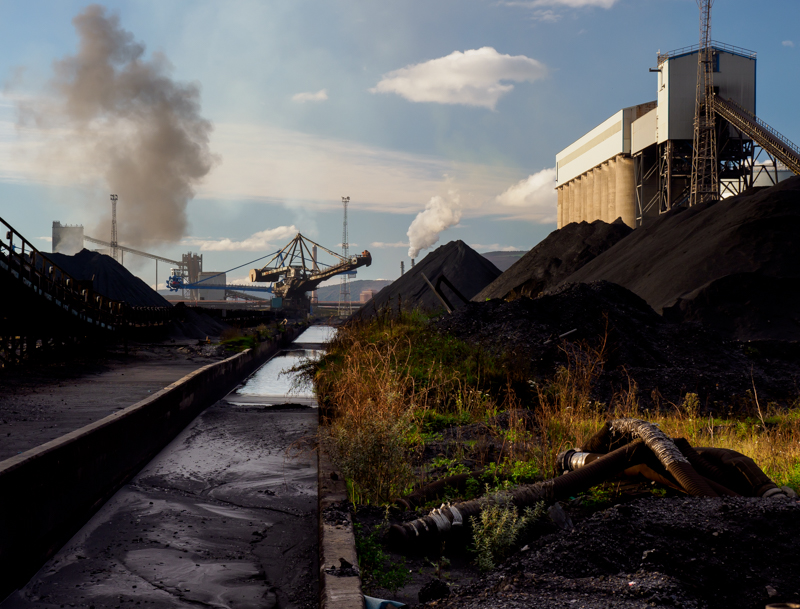
I pottered around with the camera for almost an hour without interruption. After a while some stubborn cloud moved away and allowed some beautiful late afternoon sunlight to illuminate some of the structures. These were just the type of images I never thought I’d have the opportunity to take, but I didn’t push my luck by intruding too far into the site. Suddenly I got a very strong feeling that my time was up and hurried back to the track. At that very moment there was a rumble and a clatter as one of the conveyor belts started up; and a small yellow pick-up truck appeared. I had timed my exit perfectly!
The next day I climbed steeply up a hillside overlooking Port Talbot which gave me an overall view of the site beyond it. I took my tripod and full photographic kit this time which gave me a complete range of focal lengths from 24 to 800 mm (full frame equivalent). The longer focal lengths were the most useful as I was more than a mile from the nearest edge of the extensive steel works site. The top (main) image was taken with my Olympus EM1 mk 2 and the Panasonic 100- 400 zoom set at 350 mm. In full frame terms that’s 700 mm or 14x magnification. These figures are way beyond what could have been obtained with reasonably priced equipment even ten years ago. I have examined the file closely and the quality is really pretty good even at 100%.
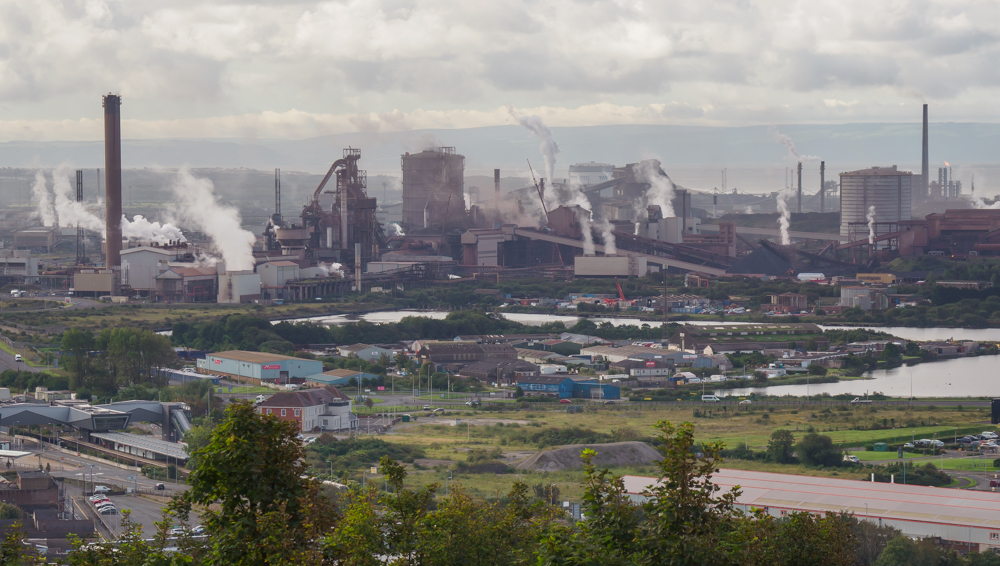
One thing that really puzzled me about these images was the white balance. I normally use “auto” and it’s usually fine, but as you can see the main image has a dirty pink / salmon colour cast. At first I corrected this in post-processing but that didn’t look right either. I then noticed a shorter focal length image showing some foreground foliage which looked perfectly normal. I have concluded that the centre of the site in the main picture is suffused with coloured fumes emitted by one of the processes there. You can see this contrast in the third image (@132mm equivalent). Who would live near Port Talbot? The air quality must be dreadful.
But I do think these photographs have a message for all of us. I don’t know what type of steel this plant produces but no matter how environmentally friendly a lifestyle we live, if we use a car, or a saucepan, or a fridge, or a filing cabinet, somewhere in the world a steel works like this was involved in its production.
To read more Tales from Wild Wales as they are published, please click on the blue Follow button.
 Tales from Wild Wales