Campare and contrast.

Visitor display at the Urdaibai Visitor Centre

There’s no doubt that a highlight of my visit to the Basque country was San Juan Gaztelugatxe on the coast near Bermeo (see previous post) . But there were others too. We planned to do a “compare and contrast” exercise between the Dyfi Biosphere and the Urdaibai Biosphere as the areas are superficially similar. Both sit within regions using a minority language. Each is based on a single river catchment and each has a core area where wildlife is strictly protected. For Machynlleth – a town of about 2200 people in a very rural area of mid-Wales – think Gernika, with its population of 16,000, in the still rural but more highly developed Basque country. For the downmarket holiday resort of Borth in Ceredigion, think Bermeo, once the centre of a thriving whaling industry, now thankfully part of the town’s history. For the Dyfi estuary think the estuary of the Oka. The obviously very well funded Urdaibai is in startling contrast to the Dyfi, with two part-time members of staff, surviving on a shoestring and with its future very much in doubt. So there are similarities but the small scale and perceived lack of importance of one contrasts strongly with the other.

Each has a visitor centre in its core area and the fate of the two couldn’t be more different. In Wales, Ynyslas Visitor Centre near the mouth of the Dyfi was closed last year by its operator, Natural Resources Wales, in very controversial circumstances. It had been open in several different guises for at least 46 years and been steadily developed over that time; I worked there in 1978 when I first moved to Wales. Meanwhile the “Bird Centre” in the Urdaibai was opened in 2012, and is a startlingly modern (high-tech even) facility with large picture windows overlooking lagoons created in the wetlands. It is equipped with telescopes so that staff and visitors can study the estuary’s wildlife.

Breakfast at Urdaibai

And what is more, you can stay there! The bedrooms are modern and comfortable and at breakfast time you emerge into the “guest lounge” reserved for overnight visitors. It is on the top floor and has a wonderful view of the estuary. Telescopes are available and every table has a pair of binoculars for each guest. What a lovely touch! A delicious buffet meal is laid out and you just help yourself. You can eat your fill over a leisurely breakfast and watch birds at the same time. The highlight for me was a black-winged kite, (a distant view only, admittedly), seen as I tucked in to toast, croissants, fruit and coffee. Talk about a breakfast with a view!

Edit: The top photograph lists Biospheres throughout the world but for some reason omits the Dyfi!

For more information about the Urdaibai Biosphere and the Bird Centre see the following –

https://en.wikipedia.org/wiki/Urdaibai_estuary

https://www.birdcenter.org/en

To read more Tales from Wild Wales as they are published, please click on the Follow button

As seen in the Game of Thrones (apparently)….

My partner Jane works at the Dyfi Biosphere reserve in Machynlleth, which has links to the Urdaibai Biosphere near Bilbao, in the Basque Country. So we decided to have a short holiday there in September. We’re both keen on train travel and it was a chance for me to use the Interrail pass which I had bought last December and which expired this month. So we took the sleeper train to Bayonne in France and then onward to Hendaye on the Spanish border. From there we transferred onto the narrow gauge (but electrified) line towards Bilbao. I can’t say I would recommend the latter. It took three hours and stopped at fifty-one stations! At each one the doors slid open and clanged shut, with numerous accompanying beeps. Think a three hour journey on the Tube and you’ve just about got it. But arrive we did, eventually. There is a very good network of local trains and buses in the Bilbao area so we used public transport exclusively while were there.

I knew little about the Basque Country before leaving and even less about the language. It’s fair to say that the distribution of letters in a Basque edition of Scrabble would be very different to the UK version……. X, Z and K would only score one point each, for starters! It is hilly and heavily wooded country with a dramatic coastline. One of the most well-known features of the latter is the islet of Gaztelugatxe – complete with a chapel dedicated to San Juan on its summit – linked to the mainland by a stone bridge. It is considered to be a pilgrimage site, and has always been a popular destination for visitors. It was used as a location in The Game of Thrones, and now, at busy periods, you need to book a ticket online before visiting. And there can still be queues. I knew nothing about this, of course, and was disappointed to discover that no passes were available for the day that I could visit. It took me a while to discover that in late September there were no longer any restrictions. Lucky me!

My visit started with a bus journey from Bermeo (the nearest town) well before dawn on a showery morning. It was still dark when the bus left me at the side of the road above the island. By the time I had reached the coastline it was light but no sun lit the island. A passing break in the clouds allowed a few sunbeams to hit the chapel but the camera was still in my bag. I then discovered that I had left my polariser in the hotel. This was becoming a habit!

3.2 seconds at f8.
2.5 seconds at f8

However, when I got to the bridge and looked along the coastline things started took a turn for the better. Talk about moody! Stormy skies, rock stacks, skerries with white water breaking over them, and rain showers passing across the landscape. I decided that long exposures using a neutral density filter would make the best of the conditions. Without a tripod I had to brace the camera carefully against a stone wall and rely on the image stabilisation for which Olympus kit is renowned. I took a series of exposures in the region of 1.6 to 4 seconds long and hoped for the best. Short breaks in the cloud even allowed the sun to illuminate the most prominent stack, leaving everything else in shadow. All my extremities were crossed at this moment! And the islet with its chapel was illuminated for short periods of time too.

I spent hours processing some of these photographs on my return home to the UK. Most of the long exposures needed some serious sharpening, but taking into consideration how long they actually were, that’s not surprising. Without the latest technology they would have been virtually impossible (without a tripod), say, ten years ago. Thank goodness I had arrived early because by mid-morning the area was thronged by visitors. And thank goodness it hadn’t been a blue sky day!

To read more Tales from Wild Wales as they are published, please click the Follow button.

Watching me, watching you.

Following a successful and worthwhile visit to the Teifi Marshes, culminating in a stunning photograph of an osprey carrying a fish (click to view) , I continued towards St Davids. One of my very best postcard customers has a shop there and I had been asked to do some more designs of the area. I have to consciously think “postcard” when this is the objective. I suppose I expect other people to have the same visual sense as I do. It was a sunny day with little cloud and a rather dusty atmosphere – not surprising considering all the dry weather we have had this summer. Long distance visibility was not great.

And I couldn’t find my polarising filter. I had “mislaid” (not quite officially “lost”) my first choice polariser and could mentally picture my spare sitting on the desk at home. I don’t use one for bird photography but find it indispensible for landscapes. Without it, what would I actually do on this trip? I decided to concentrate on the area around the Cathedral and Bishops Palace, both situated in the shallow valley of the River Alun, west of the main built up area. I was on the edge of the woodland overlooking the Bishops Palace when I happened to glance upwards – and there was a fox calmly looking down on me as I went about my business.

First sight of the fox (ISO 1600, 1/13 sec at f4)

The only lens I had with me (a 12-100 mm zoom) was long enough. I had time to adjust various settings for optimal quality, but I was grateful for the image stabilisation built in to the lens. By this time light levels were rather low.

Eventually the fox carried on its way. I quietly followed it on a parallel path and then, reaching a track, went upwards. The fox re-appeared from the vegetation and looked at me silently again. I took another burst of images, including the main photo above. I’m going to have to admit here that there was some extraneous and out-of-focus vegetation around the animal but I found it was easy enough to remove it using Lightroom’s AI Removal tool. (Almost too easy, really: where will it end?) None of these images would win the Wildlife Photographer of the Year for that reason , but I’m contented enough. What do you think?

Would this make a good postcard, I wonder?
Or perhaps this?

I had a fitful night’s sleep, waking about 4 a.m. and frantically ransacking the van again for my polariser, but to no avail. Come the morning I looked through my bag again and there was the polariser. It was just sitting there in one of the pockets. How could I have missed it?? So it was over to the Cathedral with a spring in my step. As well as being a crucial photographic tool for me I think it must also be a comfort blanket. The Cathedral has surely been photographed a million times and it was difficult to envisage anything different, especially with a postcard in mind. I spent a while around the Cathedral grounds trying to find something new but I’m not sure I succeeded.

To read more Tales from Wild Wales as they are published, please click the Follow button.

Pipsqueaks.

Bardsey Island (Ynys Enlli in Welsh) is situated off the tip of the Lleyn Peninsula (Penllyn), separated from the Welsh mainland (Y Tir Fawr) by only a short sea crossing, but it could be many miles away. With its remote location, the island tends to attract rare migrants; it also has a manx shearwater colony and a bird observatory. Together with Jane (my partner) and three good friends, I spent last week there. It was actually my seventh stay on the island; each week has been quite different and I well my remember my first. I picked up an infection, probably from the spring water supplied to the houses, which laid me low for a few days. Alone in my accommodation, I felt very ill indeed and believed I could have died there without anyone knowing! Fortunately in recent years a water purification system has been installed.

After another visit I was chatting to a Welsh-speaking neighbour and told her I had just spent a week on Enlli. She looked at me very strangely, and then explained that Enlli is the name of the psychiatric ward at the local hospital. I’ve always used the name Bardsey since then…….

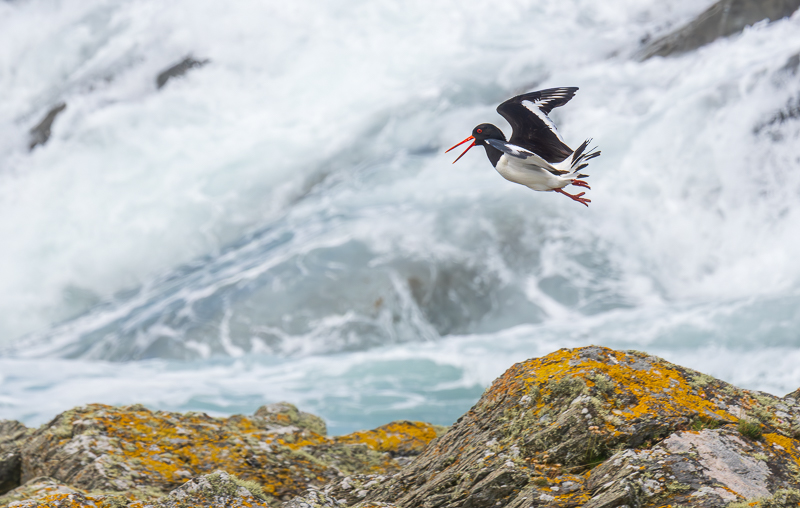
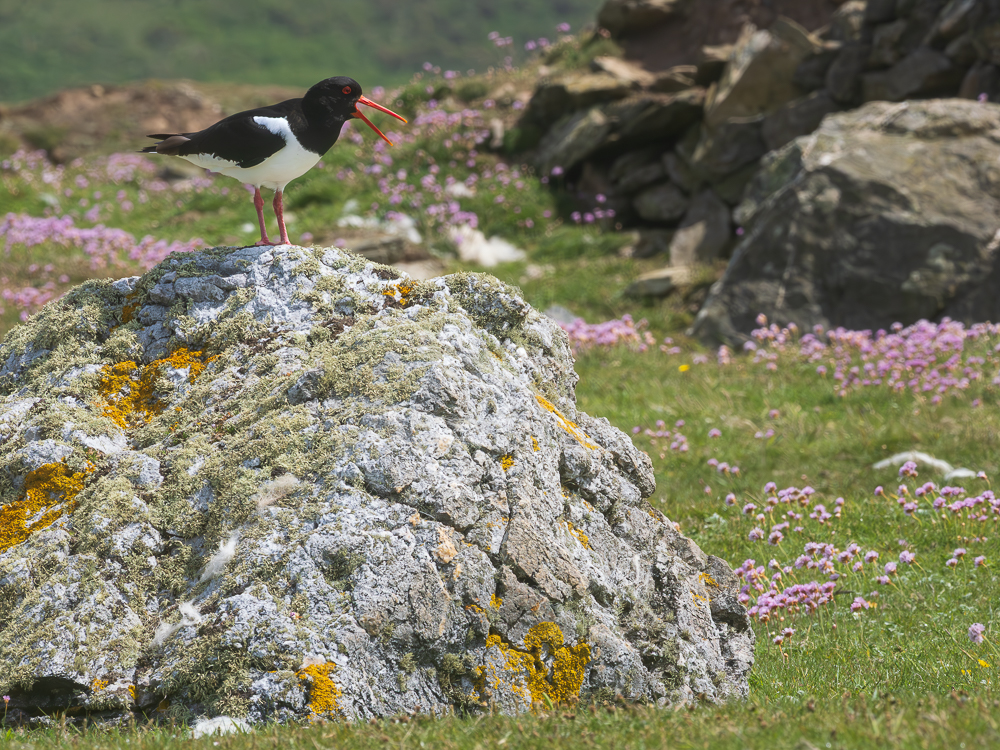
I don’t usually resort to cliches such as “bird of the week” but just this once I’m going to. It could have been the (scarlet) rosefinch which my friend Jonathan first identified, and whose song could be clearly heard from our kitchen table for a couple of days. The island has a large population of my favourite bird, the chough, and their calls could frequently be heard wherever you were. But the chough is a Schedule One (specially protected) species during the breeding season so I tended to avoid them. So I’m going to plump for something much more familiar – the oystercatcher. As you walked around the island you would pass from one oystercatcher territory to the next, and you would be subject to a new tirade of raucous high-pitched screeching. One bird was particularly aggressive, repeatedly flying noisily towards me at eye-level and only veering away at the last second. I believe on one occasion its wing tip brushed my arm as it flew past.

Their behaviour and alarm-calling is designed to alert their youngsters of the presence of a potential predator (in this case me) and it is obviously very successful. No matter how hard I tried I never managed to locate a single chick. They leave the nest as soon as they hatch and must hide amongst the pebbles and boulders amongst which they are feeding. But I wondered how intelligent the adults actually are. I found that while I was standing upright I was fair game for all the aggression that they could muster. But if I made a half-hearted attempt to “hide” or lower my profile their behaviour became calmer and their calling quieter. It was during these moments that I was able to photograph them in a more relaxed fashion. I ended up with hundreds of oystercatcher images, and have spent many hours deleting and processing them since I returned home.

It was during these lulls in activity that also I coined a new name for the species – “pipsqueaks”. After all, they don’t actually eat oysters ………….

Enjoy…….

Please click the Follow button if you would like to receive more Tales from Wild Wales as they are published.

My website : www.wild-wales.com

Golden Hour at the Steel Works.

Family duties took me down to Swansea at the end of March, which gave me the opportunity to spend a day around Port Talbot and its steel works. It seemed like eighteen months since I had last been there (see this post) but on checking my files I discovered that it was three and a half years ago! “Doesn’t time fly” doesn’t really do that justice……

If you live in Wales you will probably have heard the steel works is threatened with closure, yet again, and this time it looks final. Its owners – the Indian multinational Tata – say that the plant loses over £1m a day, and if that is true who can blame them. But it is by far the biggest employer in the area and some 2800 jobs are likely to be lost, while there must be countless other local businesses whose survival depends indirectly on it. It is also the biggest single polluter in Wales, and is responsible for 2% of the UK’s total carbon emissions. Tata say that once the plant is levelled, they will build an electric arc furnace to recycle scrap steel into new steel. This process emits less carbon dioxide but is also less labour-intensive than making virgin steel in a blast furnace. Many jobs will still be lost, and, to be honest , Port Talbot and its environs are already pretty run down. Such are the dilemmas involved in reducing our dependence on fossil fuels.

I had been studying the OS 1:25000 map of the area in great detail before my visit, and had identified some potential new viewpoints. But my first location was the one I discovered on my previous visit, on the hillside directly above Port Talbot town centre. From there one looks south-eastwards towards the works, the nearest point of which is more than a mile away. I was going to need my long lens and a tripod.

Honest light?

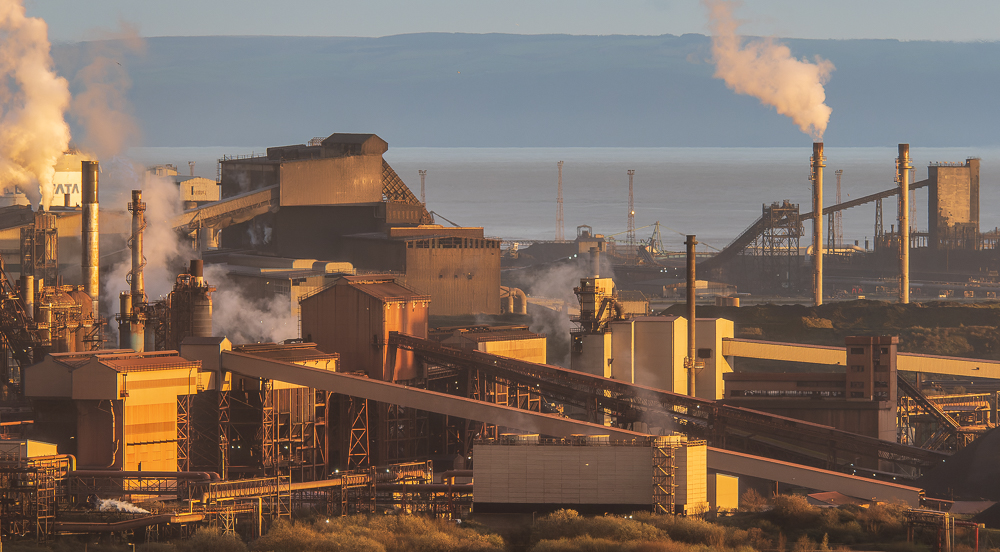
Over a period of an hour or so I took a range of images at focal lengths from 250mm – 300mm , that’s x10 to x12 magnification. Weather conditions were quite atmospheric; dry and mostly cloudy with little wind, lending an almost monochromatic air with very subtle colouration to the photographs (see above). It was a good start. I then moved further uphill, but found the visual impact of the works was less powerful the higher I got. My second location involved an steep drive on a minor road above the works and then an easy walk. I was higher still here and even more disappointed. From this height the works had a toytown feel to it. It just didn’t hit home at all.

“Son of Banksy” by Steve Jenks

Driving back through the backstreets of Port Talbot I took a left turn on a hunch and was soon confronted by a colourful mural on two walls of a garage. A man was fixing his car nearby so I went over for a quick chat. It turned out that this garage wall was the exact location of the “Port Talbot Banksy” which suddenly appeared in December 2018. It had been bought by an art dealer and removed for safe-keeping, but remained on display in the town until 2022. The mural that I came across, purely by chance, by the street artist Steve Jenks, has none of the subtlety of the original. But the works features prominently on it, which adds another layer of human connection with the steel industry in Port Talbot.

Golden Hour at the Steel Works

It was late afternoon by now and I could see a slot in the clouds close to the horizon in the western sky. It looked like I might get some golden hour light on the works if I was patient. I returned to my original viewpoint, and the sun crept slowly towards the slot. When it did finally emerge the steel complex was bathed in golden light. Right on cue a thick cloud of orange-brown smoke belched out from the centre of the complex and dissipated into the air above it. It was an exciting moment but………..

……………it felt almost indecent to photograph this filth in such gorgeous conditions. Does the landscape photographer have a responsibility to be honest about their subject matter, or to portray it in the best conditions possible? My day’s photography had asked more questions than it had provided answers. But I’m going to go out on a limb here: this is one of the best photographic locations in Wales.

For now.

To read more Tales from Wild Wales as they are published, please click the Follow button.