In search of starlings at Glastonbury and Aberystwyth

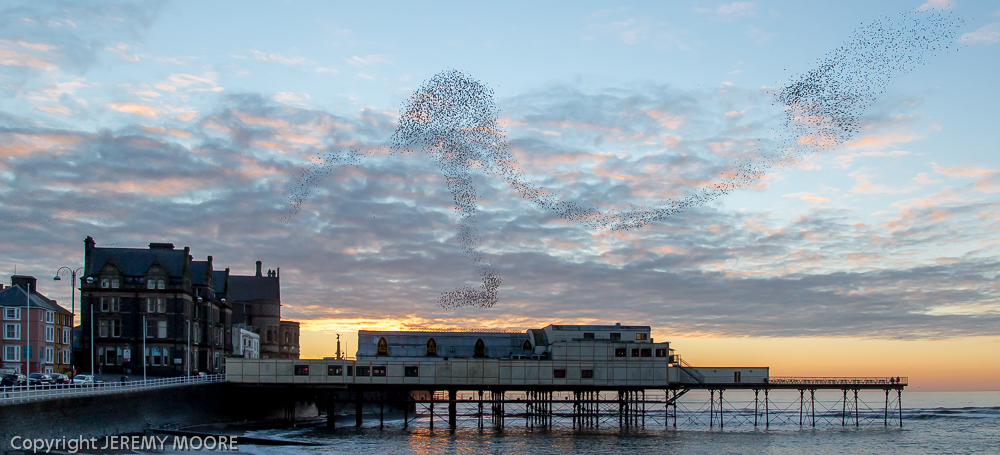
Starlings, Avalon marshes, Somerset

Last weekend Jane and I headed off to Glastonbury for a few days. It’s an unreal place. If ever you needed to visit a personal transformation coach, an angelic reiki practitioner or a shamanic hairdresser, make for Glastonbury. It would be easy to sneer at the apparent pretentiousness of it all, but that would be unfair. While there may be some charlatans involved, I’m sure many of these people are quite genuine in their thinking; and I sometimes think how comfortable it must be to live according to a ready-made belief system. It was curious to note the vigorous campaign for the retention of the last remaining bank (Barclays, if I remember correctly….) in the town, though.

An extensive area of former peat workings near Glastonbury has been reclaimed to create a cluster of wetlands and reedbeds, now known as the Avalon Marshes. These are home to several rare bird species, notably bittern and great white egret. The latter was fairly prominent at the Ham Wall RSPB reserve, and I photographed one on a beautiful, still, winter’s morning with warm light and a hint of frost on the ground. The former lived up to its reputation for skulking. But arguably the biggest  draw on the Avalon Marshes in winter is its huge starling roost, which I spent three evenings trying to capture. For roosting, the birds have a very large area to choose from, and they can move from one site to another on a daily basis. Even the local birders and photographers admit to being unable to predict what they are likely to do next. On my first visit I found a likely looking foreground at sunset and hoped a flock would fill the sky with interesting shapes. Needless to say it didn’t work out how I had hoped, but there was the above; I’m not sure yet if the image works or not.

On the second night, from a different location,  I watched as huge flocks gathered over farmland and in trees to the east against a dull background; and later, with mounting disbelief, as a continuous stream of starlings moved from one section of reedbed to another. The process lasted some 15 – 20 minutes; there must have been millions of birds altogether. But it was a frustrating encounter;  they flew too low over the ground to photograph successfully. On the third night I sought out the trees where they had gathered the previous evening but again the results were disappointing.

Starlings at Aberystwyth

Back in Aberystwyth,  decent sunsets have encouraged me to visit the starling roost three times this week. Tuesday was just the most gorgeous winter evening; cloud had largely cleared during the afternoon and there was no wind. The starlings must have felt it too. For a few brief moments a flock briefly indulged in one of their spectacular ribbon/bracelet formations before dropping in under the pier. At last! Something to write home about……

For the last couple of months my camera bag might have been a door stop for all the use it has had, so it was good to pick up the camera again….. even if I could barely remember what some of its buttons were for! But the experience did remind me how important it is to be familiar with the controls of your equipment. A few seconds delay and confusion can mean the difference between getting the shot and missing it. And which shutter speed would blur the movement of birds in flight most successfully? I just couldn’t remember. But there is one thing about trying to photograph wildlife – it teaches you patience.


To follow Tales from Wild Wales, scroll down to the bottom of the page and click Follow.


More from Cwm Idwal.

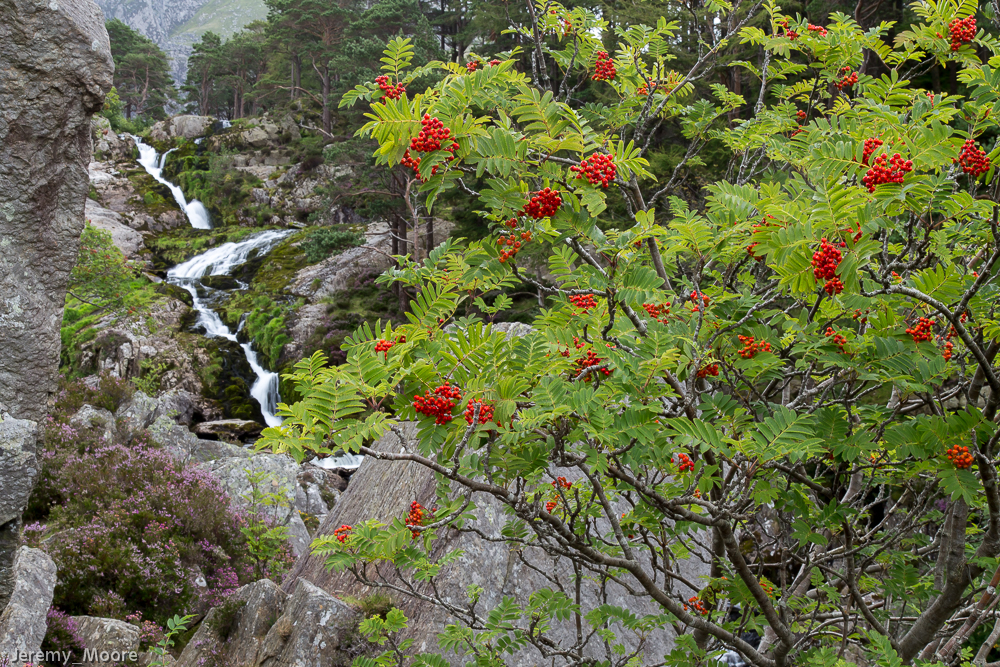
Rowan, Ogwen Cottage

Last week I posted about my eventually successful visit to Cwm Idwal in Snowdonia. But alongside the story of the photographs there was a quite different narrative running in parallel.

On my first visit to the Cwm, amongst the huge boulders below Twll Du, I came across some small brown birds. I quickly twigged that they were twite, which, strangely enough, I had been reading about the previous evening. As far as British birds go they are probably the supreme example of the “little brown job”. Visually there are no distinguishing features at all unless you can see the pale pink rump patch, but they do have a distinctive twanging call, which confirms their identity. At first it was just a couple of birds, then a juvenile begging food from a parent, then a bird leaving a possible nest site and finally a flock of 15 – 20 birds.

On my return to Idwal Cottage I looked around for someone to report my sightings to. There was no-one but a girl from the National Trust, who “thought she had heard of twite” but that was it. While I drank my coffee I noticed the nearby organic burger van, whose owner, Gwyn Thomas, the local farmer, was conversing with customers. My partner has worked with him so I went over for a chat. Eventually I brought up the subject of my  sightings. To my surprise and delight he is quite an authority on twite! Along with several other farmers in Nant Ffrancon he grows a seed crop for them to feed on during the autumn before they move down to the coast for the winter. I’m sometimes not a great admirer of farmers but this man is a star!

During our conversation a car drew up alongside and the driver came over. I recognised him but couldn’t put a name to the face. Gwyn left me with him and a tentative conversation began. I wondered aloud if I had seen him on TV. “No, I work on radio…” he replied. Not really a great help! “I did a book with you!” he added. It came to me in a flash. It was Dei Tomos, the author with whom I had worked on the Welsh version of “Wales at Waters Edge”. I buried my head in my hands in embarrassment! To be fair though, it was hardly a collaboration and we had only met once, and he couldn’t place me at first either.

The social aspect of my weekend continued the following morning. Back at Ogwen Cottage after a third unsuccessful visit to the Cwm, I was drinking coffee by my van. A familiar figure appeared. It was Martin Ashby, owner of Ystwyth Books in Aberystwyth, and one oldest and most valued friends. He was with his mate Nigel Dudley and just about to set off on a long walk up in to the Carneddau. I reluctantly turned down their invitation to join them.

On my return home I reported my twite records to the BTO Officer for Wales, Kelvin Jones. He told me that twite are declining steeply in Wales, and there is a project going to try to reverse this. Apart from the feeding project mentioned above birds are being ringed on the coast in winter in the hope that sightings in summer of ringed birds can reveal more about their movements. Although I had not seen any rings it seems my sightings had been the first this summer! The rarest breeding bird in Wales may actually now be twite, he said. (Does that make them rarer than osprey,  I wonder……)

Just a note on the photograph above. While dull, cloudy conditions are usually the kiss of death for most “big” landscapes, they can be ideal for details within the landscape. This lovely rowan tree was just below Ogwen Cottage.

To read more about Gwyn Thomas and his work in Cwm Idwal, click here.


To follow Tales from Wild Wales, scroll down to the bottom and click Follow


High on opinion but low on facts.

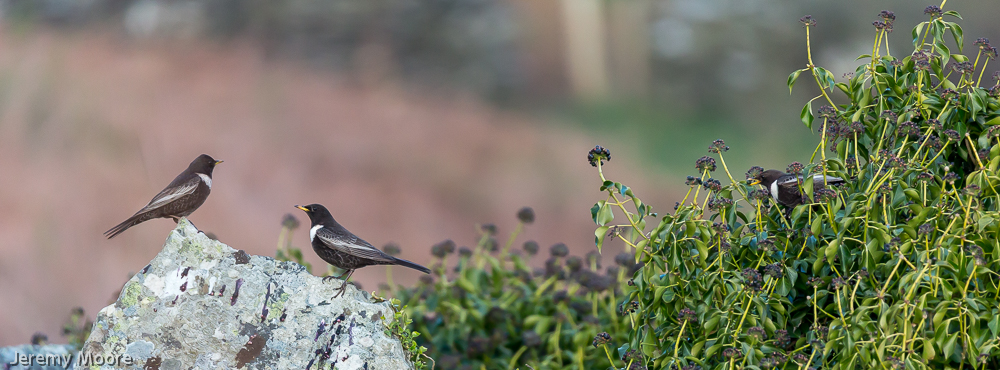
Ring ouzels, near Machynlleth

Following a talk in Aberystwyth by George Monbiot last spring on “rewilding”, a local ornithologist and friend Roy Bamford wrote a full-page article on the subject in our local newspaper, the Cambrian News. His main thrust, borne out of many years of personal experience, was that rewilding may happen – come what may – and that its effects may be unpredictable. The article was almost entirely uncontroversial but was followed a couple of weeks later by a letter from the Farmers Union of Wales. This included a personal attack on the author and a suggestion that he was quoting tittle-tattle from the internet (among other things) to support his case. I felt that this should not go unchallenged so wrote the following, which was published in the Cambrian a few weeks later.

I am writing with reference to Roy Bamford’s piece ( 3rd July) on rewilding and the subsequent letter from the Dafydd Jones, vice-chairman of the Ceredigion FUW.

Firstly I suggest that it is unfortunate that Mr Jones chose to make such personal comments in his letter. Mr Bamford has already defended himself on the letters page but a less modest man would have gone further. His knowledge is based on the many years of professional field work he has undertaken. It is upon this field work that much research into the relationship between agriculture and wildlife in the Welsh hills has been based. I cannot think of many people more qualified to make these observations than Roy Bamford. So if he quotes studies that include photographic evidence of sheep eating curlew’s eggs then this not an anecdote, it is a fact – unlikely as it may seem to most of us.

On a far more limited scale I have been surveying the same tract of land above Tal-y-bont for 20 years. I walk the same route twice a year and record every bird that I come across. I follow a fence line with improved grassland and heavy sheep grazing on one side, and unimproved grassland or “ffridd” on the other. The contrast could not be more marked. With its very low sheep numbers the ffridd is, in effect, rewilding in action, and it is home to a large and varied selection of small birds. The improved grassland might as well have been concreted over for all the wildlife it contains. A few meadow pipits and a few scavengers and that’s about it.

The farmers that Mr Jones represents have benefitted to the tune of many, many millions of pounds from the public purse since the last war. This same period has seen the Welsh uplands becoming demonstrably more and more impoverished in an ecological sense. The farming industry has itself become more depleted at the same time. Rather than the mixed farming of earlier generations, does the average hill farmer now grow more than one crop – grass? Does he farm more than one product – sheep? I suggest, in many cases, that the answer is no. Through its lack of vision the sheep farming industry has manoeuvred itself into a cul-de-sac, an evolutionary dead-end. So it is a shame that the FUW does not show a more open-minded attitude to the future – which may well include rewilding. It would be far more constructive to do so, and they would be doing their own members a service.

I could have published this letter under “name and address withheld” but chose not to. I’m not afraid to hold such opinions, which would, anyway, probably be held by a large percentage of the population. I realised that the letter might be read by the landowner whose land I walk and that there might be repercussions. And so indeed there have been. This year permission to access his land was refused.

The Cambrian News did not print the final sentence of my letter, which was as follows:

Instead we get the same anti-environment rhetoric that has become the norm from the farming unions – high on opinion and low on facts.

I’m not denying that hill farming might at times be a challenging occupation. I’m not denying that sheep farmers work hard. But so much of their income comes from the public purse. What benefit does the public receive in return for their support? By displaying such reactionary, head-in-the sand attitudes, and continuing to deny what is quite clearly true, farmers and their representatives are their own worst enemies. When the public money runs out they will need all the friends they can find.

I’m including an image of ring ouzels taken yesterday. This has become a scarce species over the decades in Wales, and they are now difficult to see, let alone photograph. But this small group of migratory birds has been feasting on ivy berries not far from here in recent days.

To follow Tales from Wild Wales, scroll right down to the bottom and click Follow

Urban peregrines

Urban peregrines in Derby

It is no secret that peregrine falcons have been nesting on Derby Cathedral tower for a number of years. A nesting platform was provided for them in 2006 and the same two adults have reared young every year since then. Progress of the breeding attempt can be followed on the internet, so I knew that this year the youngsters had fledged during the middle of June. Nevertheless young peregrines stay in the vicinity of the nest for some time after fledging so I thought a visit might still be worthwhile.

Last Wednesday I arrived in Derby to find no sign of the birds in the vicinity of the Cathedral. I spent a while recce-ing the area for a future visit. A good location would not be easy to find. But during my wandering I had noticed a bird perched on the lettering about fifteen stories up on the side of the Jury’s Inn Hotel not far away. Without binoculars it was not possible to tell if it was a peregrine or a feral pigeon, but I knew the peregrines sometimes perched or roosted there.

By early afternoon I had found my own perch – jammed in between  the bridge railings and the eight-lane Derby Inner ring road as it crossed the River Derwent. Traffic screamed past just a couple of feet away from me. But I was exactly at right-angles to the side of the hotel where the bird was perching, and at about the optimum distance away. I spent an interesting afternoon there.

Sleeping peregrine
Sleeping peregrine (click to enlarge)

At one point a juvenile flew from the lettering to meet one of its parents about 150 feet above my head. The adult was carrying prey – a whole bird complete with two trailing legs – and the youngster turned over underneath him/her and took the prey in mid-air. I could just hear them screaming at each other above the roar of the traffic. The youngster took the prey on to the roof of a nearby block of flats to eat it. A few minutes later a peregrine (probably the same one) arrived, carrying the remains of a bird, and circled over my head, eating from its talons like a hobby does. As an ex-RSPB species protection warden I’ve spent many weeks (months!) watching peregrines but couldn’t remember ever seeing that before.

For long periods nothing at all happened.  Every so often a yell would come from the passenger seat of a van as it flew past. There was a little to-ing and fro-ing as adult peregrine replaced juvenile on the lettering and vice versa. At one point the juvenile appeared to fall asleep with its chin on the letter “r” and its feet stretched out behind it! I pondered over the thought that these young peregrines would regard their urban surroundings as completely normal while their coastal cousins might find them absolutely abhorrent if they were to encounter them.

It was not a particularly challenging scene to photograph. I wanted to include the lettering as the environment within which these urban raptors lived their lives, so I set up the Canon 5d3 with long telephoto on a tripod and trained it on the side of the hotel. I would need to use the perspective control tools in Lightroom to try to disguise the upwards angle at which the images were taken, so I zoomed out a fair way to allow for the cropping that would come with it.  I also needed to remember that the meter reading would need to be over-ridden to account for the largely white subject matter – in this case by about one stop, although had the side of the building been lit by the sun at least two stops would have been required. Probably the most important thing I needed was a great deal of patience, and in this case, by the side of the Derby inner ring-road – a slightly thicker skin than normal.

Postscript:

For information on the Derby Cathedral Peregrine Project, click  here


To follow Tales from Wild Wales scroll right down to the bottom of the page and click Follow.