Digging in to the memory banks (part one)

Golden eaglet, Isle of Mull, summer 1981


To coincide with the Bird/land exhibition, I’ve been invited to give the annual Halstatt lecture at MOMA as part of the Machynlleth Festival. Rather than just running through a series of images from the exhibition this talk will have quite a strong personal content. The fee is reasonably generous so I have the time and opportunity to look back over my career as a photographer. I often wonder how the most minute details of people’s lives can be recalled by those engaged in writing their autobiographies. How can conversations be remembered if they took place decades ago? Perhaps authors keep a diary on the offchance that it might be needed or maybe there’s a liberal dash of artistic licence involved? But photographs can certainly help and I’ve been delving back into my slide collection and memory banks to see what I can find.

My first encounter with a camera came when my father gave me one of his old ones. I was about 14 and rushed around Britain taking pictures of the last steam trains in the couple of years before they were pensioned off. I even did a little developing and printing in the school darkroom until it was demolished. But I’m going to skip the very early years and move on to the late 1970’s after I moved to rural Wales. I was developing a keen interest in both wildlife and photography and North Ceredigion was a wonderful place to find myself. I was looking for a career in wildlife conservation and despite knowing very little about birds got a species protection job with the RSPB in 1979. I was sent to a remote part of north Wales where I was expected to watch two separate peregrine eyries about three miles apart which were annually robbed by falconers. I had hoped to be able to watch peregrines at close quarters but in fact spent most of the time cruising around the local roads looking for suspicious visitors. Police training would have been handy!

It was not really a success. I have two lasting memories of my couple of months there. Firstly managing to mentally construct a human figure on a ledge close to the eyrie half way up a cliff-face when in fact it was a jumble of rocks. I don’t think the local bobby was amused when he arrived. Or maybe he actually found it hilarious – bloody amateurs! Secondly I recall striking up a conversation, for some unknown reason, with a stranger who had just parked his car in a layby and was setting out for a walk. “Yes, I’m working for the RSPB” I happily told him. I suppose it was a bit odd when he returned quickly to his car and sped off. Back at base I discovered his car number plate on a list of those belonging to known nest-robbers. Later I did get to grips with another dodgy group of characters but I think by that time the peregrines had failed anyway.

As a result of my incompetence and obvious lack of knowledge about birds it took another couple of years before I worked for the RSPB again. But this time, in 1981, I suppose it was a really plum job – to spend the summer on Mull and check the island out for breeding white-tailed eagles. A group had wintered there but most were probably too young to start a serious breeding attempt. Once this had been established I turned my attention to the island’s peregrines, and then moved on to survey the whole of Mull for golden eagles. One imagines these wary birds nesting on the most inaccessible precipices but in fact, where there is a high density of them, they will build a nest on any tiny little outcrop or rocky stream side. It was quite an eye-opener! One of the classic texts on golden eagles was written by Seton Gordon during his stay on Mull and he photographed an eyrie there containing three large eaglets. I was able to clamber up to the same ledge where a pair of goldies was rearing just the one youngster in 1981. It was a rather placid creature despite its enormous size. See the picture above.

It might sound idyllic but there were many disadvantages. There is always the danger of accidents when one is tramping the hills alone. Scrambling along a crumbling line of inland cliffs I slipped and pulled a large rock down on to my head. Despite bleeding profusely I had to get myself to the local cottage hospital to be stitched up. It was a long walk over rough moorland and then a ten-mile drive to get there. I also managed to upset the local landowner network which did not go down well with RSPB HQ! I had been told by a Forestry Commission worker of a golden eagle pair whose nest had fallen out of an oak tree in a forestry plantation. The adults were rearing the eaglet on the ground and had rebuilt the nest around it. I just had to see this! Well, it was my job…….

As I entered the area through tall deer-proof forestry gates I came across a group of people coming the other way. I told them it was illegal to disturb Schedule One bird species at the nest without a licence. A very frosty conversation ensued. When I returned to my digs my landlord (a large landowner) told me that I had actually been on private forestry land. The people I questioned were the landowner and his pals and they were not amused. The island phone lines must have been buzzing that afternoon and from that moment onwards I was persona non grata on most of Mull!

The Halstatt lecture is at 1 p.m. on August 26th at MOMA Wales, Machynlleth, Powys. Tickets are £6.00 each. Call 01654 703355 for more details.

To follow Tales from Wild Wales, please scroll right to the bottom and click Follow.

An intimate and a distant encounter.

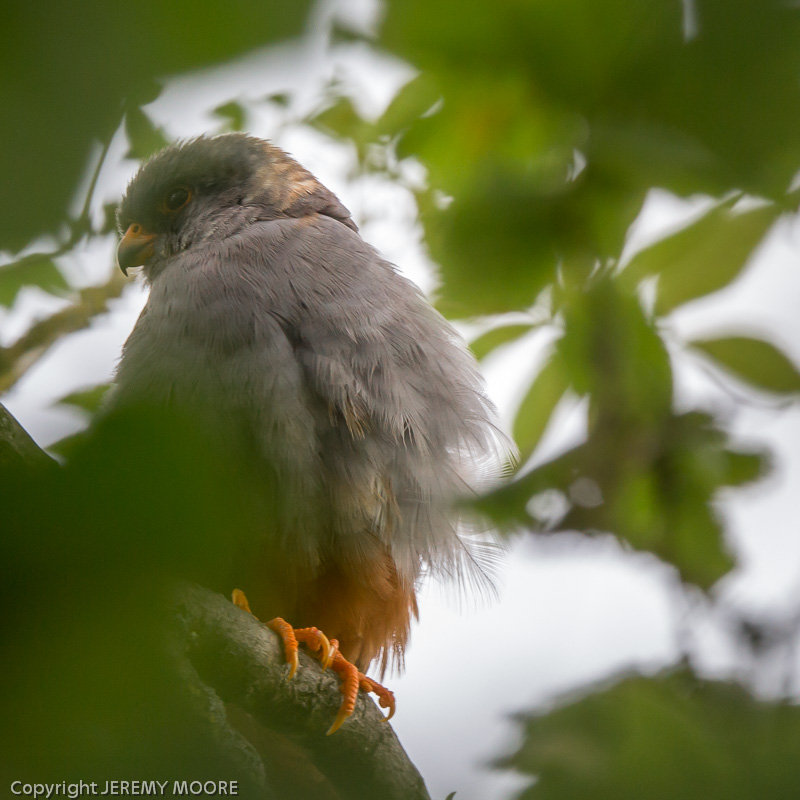
Red-footed falcon, north Staffs.

While I sometimes feel pangs of envy (…or is it lust….?) on hearing about the presence of a rare bird, I would not admit to being a twitcher. There is something rather desperate in the idea of travelling miles (or hundreds of miles) to try to see a bird which was originally found by somebody else and put out on the birders’ grapevine. I’ve sometimes described myself as the worst twitcher in the world, anyway, because on the rare occasions I’ve succumbed to temptation, the bird has usually disappeared by the time I arrive. I can justifiably claim to have been the first person not to see the great spotted cuckoo at Tenby in February 2014 because I waited too long to go down. It had probably died or been blown away during the particularly stormy day of my journey.  To fail in a pointless quest is particularly soul-destroying, I find. But if a bird is on my local patch I might eventually get round to having a quick look, sometimes successfully, sometimes not. A local bird would involve little time investment, or travel expenses or carbon emissions.

I was tempted last week, though. A red-footed falcon had been reported in Staffordshire, well over a hundred miles from here. However, a visit to my aging mother was long overdue, and she lives ……. in Staffordshire. I do like multi-purpose journeys! So Saturday morning found me on the northern outskirts of the Potteries joining a few dozen other birders staring at a red-footed falcon on an overhead electricity cable. It was hardly the most difficult twitch in the world. The click of motor-driven shutters rang out. _04A2298Being an immature male it would not be breeding this year; but one has to wonder why ever would this bird end up in north Staffordshire? It probably should have been somewhere in eastern Europe. Itcould conceivably have been escape from captivity but the only known captive red-footed falcon locally was an adult male in a rescue centre about twenty miles away. Whatever – in birder’s parlance it was “performing well” – perching on the cable in full view, searching for insects on the ground below. There was a strong breeze blowing, though, and, probably seeking shelter,  it later spent some time in a hazel bush just a few feet from the pavement on which expectant birders waited. It was so close that I had to take a few steps backwards before I could focus down on it with my binoculars. However a shield of branches and leaves made it difficult to see more than face or feet at any one time. It was an both intimate and distant encounter at the same time.

As far as the main image is concerned the bird was by no means at its closest here. I feel that the green background  sets off its plumage better than the grey sky did, however. And as for the composition, I suppose I just like to be different! Any thoughts on this?

To read more Tales from Wild Wales as they are published, please click the blue Follow button.

Bird/land

Jeremy Moore birdland 40 - oystercatchers 2 (small)

One afternoon last winter I felt a moment of panic. I was reviewing work in progress on my exhibition  – Bird/land – and realised I had broken the back of it.  There would soon come a time when it was complete.

Now, six months later, it really is ready. Since my return from France in early May I managed to get a picture of ringed plovers at Ynyslas which, combined with four other wader images, makes a nice set of five ( a quintych, perhaps?). A couple of days later it was a real bonus to find a pair of oystercatchers with a nest about three yards from a hide at Ynyshir (see above). I’ve also spent many, many hours patiently checking and adjusting every image (more than 100 of them) individually. Within each of the thirty-five works the ground colour of the images need to match. So much time spent sitting at my desk when I would rather have been outside……..

Last week I went over to St Harmon near Rhayader where Andrew Jackson is printing and framing the exhibition for me. I was very happy with most of them and he kindly agreed to reprint a few which weren’t quite up to my rigourous (and probably quite arbitrary) standards. I picked them up yesterday and they will be delivered to the gallery on Monday morning in time to be hung for the exhibition opening on Saturday June 27th. For background on the project see this post.

Bird/land consists of 35 works, many of them triptychs, in which birds and their surroundings are both integral to the               images. Within each work, the images are linked by species, location, or aesthetic considerations, or sometimes all three. Each image is in panoramic format. There are also two single images.

Subject matter extends from house sparrows at a National Trust teashop to migrant dotterel on a Welsh mountain-top. In this way Jeremy Moore explores his twin passions for wildlife and landscape in every photograph.

For each work sold a donation will be made towards the reconstruction of the hides at the RSPB’s Snettisham reserve in Norfolk, which were destroyed by the storm surge in December 2013.

Bird/land is at MOMA Wales, Machynlleth, Powys, from Saturday June 27th until September 19th 2015.

Jeremy Moore will be giving the annual Halstatt lecture at MOMA during the Machynlleth Festival on Wednesday August 26th.

Bird/land has been supported by the Arts Council of Wales.

I’ve added some of the works to my website, so log into that to see them and click on the Bird/land gallery. Or click on this link .

Why the panic that I experienced over the winter, then?  Not happy just to get the thing over and done with? As a photographer I thrive while I am working on a specific project. It gives me the impetus to keep moving forward. In years gone by I was happy just to be exploring the world with my camera, but there’s no doubt that with age and experience that inner drive fades away. So will there be a huge gap in my life? You bet there will be.

To follow Tales from Wild Wales, scroll right down to the bottom of the page and click Follow

Every picture tells a story.

Purple heron : what an amazing creature!

I can’t have been the only photographer to have recently received junk email offering…..”Always have amazing skies!”. It goes on –

With the killer App for Sky Replacement and our new Skies and Clouds Collections

With […………..] sky replacement is no longer like Rocket Science

Add Skies III and our amazing new Drag and Drop Cloud Formations and the skies the limit on creativity!”

Two New Bundles to SAVE on so you’ll never have Dull Skies Again

It goes on and on in this vein.  I find it terribly depressing. The graphic designer could thus, for example, adapt a poor quality landscape image by adding a sky downloaded from a software package. No photographic skills required whatsoever! Likewise the amateur (or professional) landscape photographer wanting short-cuts to dramatic photographs. It has until recently been difficult to incorporate stunning skies into landscape images without stunning skies being present in reality. Doing so in the days of colour film would have involved a very high level of printing skills indeed and it is probably fairly safe to say that it had rarely been done successfully. In the brave new world of digital photography much of the work involved has been already been done by the software designer.

But this kind of approach does more than make life easier for those wanting short cuts to great landscape images. It devalues photography in its most basic sense. By its very nature a photograph has documentary qualities. I don’t mean to confuse “landscape photography” with “documentary photography” here. But a photograph – any photograph – is an interpretation of a slice of reality. It is rooted in what the photographer saw through his/her viewfinder. So a landscape photograph automatically has documentary values. The very best have both aesthetic and documentary qualities in shed loads. If the photographer has added a spectacular sky – even one of their own – that link between reality and image has been lost.

Many photographers argue that all photographs are “fake” to some extent and that therefore anything goes. In my opinion this just does not hold water. I agree that the photographer makes selections and interpretations at all stages of the process. They might use film or digital, a jpeg straight out of the camera or process a RAW file to their own satisfaction. They might use a 10stop ND filter on their DSLR, a smartphone or a pinhole camera, colour or black-and-white. By making these choices the photographer interprets their surroundings in different ways. But there is a quantum leap between that and getting a sky from elsewhere – their own library  or a software program – to combine with their own image to produce a result.

If it were possible (and necessary) the photographer would physically move a minor irritant (rubbish, for example) from the foreground of a landscape image before pressing the shutter. But if not I don’t really see a problem in cloning it out at the processing stage. I’m not that much of a purist. But it is at this point we enter a very grey area indeed. Where does one draw the line between “processing” and “manipulation” – the acceptable and the unacceptable? Personally I’m happy to clone out anything which on another day might not have been there: a walker in a red cagoule, or white van in the distance, for example. Others draw the line elsewhere. But there is a line. It may well be that advertising photography is artificial through and through, and maybe we should expect that. If there was a line of telegraph poles running through a landscape, though,  I badly need and want to know about it. Every picture tells a story and a manipulated one can tell quite a different story. It could be the difference between a real wilderness and an inhabited landscape in this example.

For more thoughts on this subject see this post.

On the other hand I have no philosophical problem with improving my images at the processing stage where necessary. The more I use Lightroom the more I learn what it is capable of. I was recently introduced to the adjustment brush by my correspondent David Clegg and how useful is that? How could I have managed without it, more like! During the latter stages of my Bird/land project I was able to use the adjustment brush (rather than the radial filter) to select the bird before making minor changes to its exposure or contrast, for example.  So much more effective! See the purple heron image above.

More on Bird/land very shortly, by the way……..


To follow Tales from Wild Wales please scroll right to the bottom and click Follow


What a difference an hour makes…..

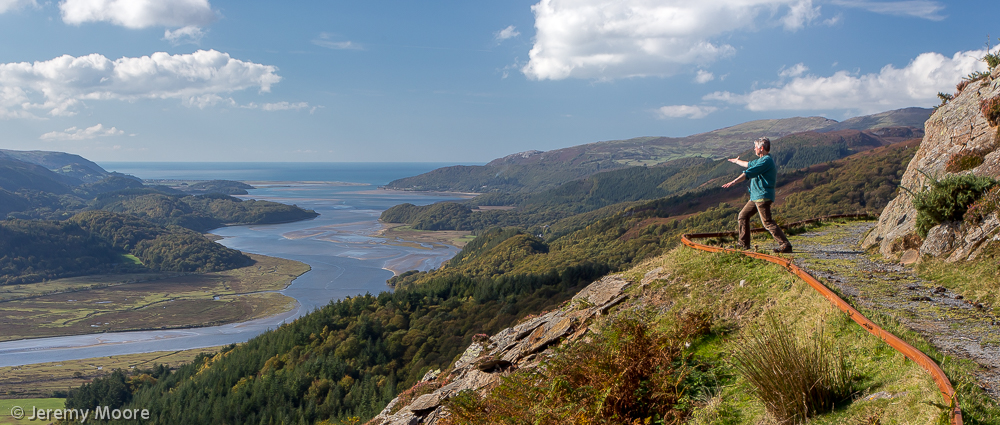
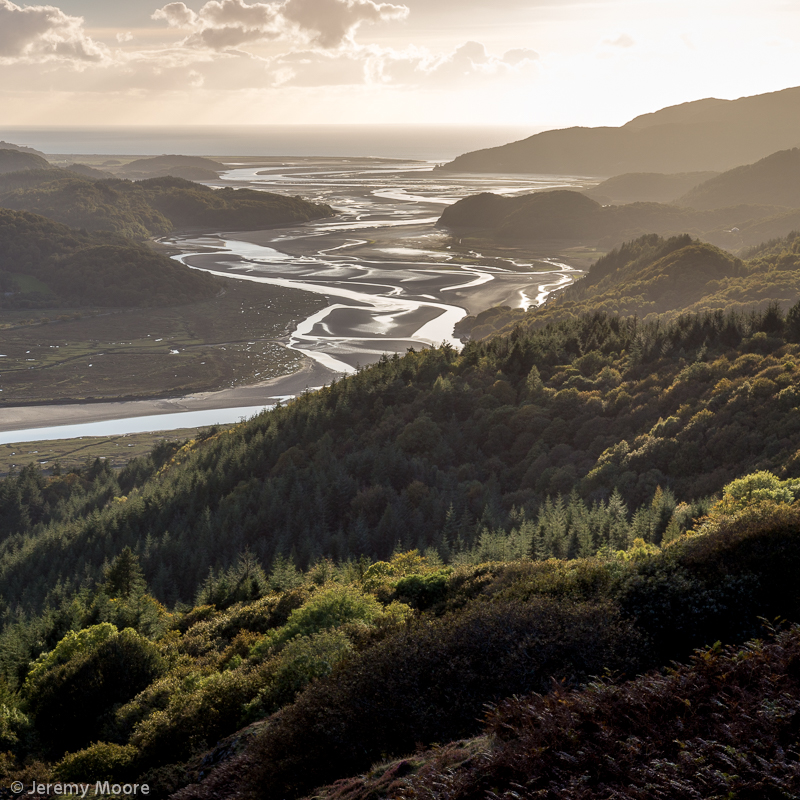
Mawddach estuary at 7 am.

After doing deliveries around north Wales on Friday I had the day free on Saturday for photography. Friday had been damp and drizzly with plenty of low cloud but no wind. A continuation of the calm conditions overnight coupled with the passage of a cold front suggested that better times would soon come. I guessed that there would be plenty of “interesting clouds” to photograph the next morning. I sat out Friday evening and then drove down to the Mawddach estuary to arrive just before dark. I could see that the low cloud had aligned itself in distinct layers along the steep sides of the estuary although it was too dark to photograph it. I set my alarm for 5 a.m. I didn’t want to miss a thing!

I had parked up by the side of a minor road near Barmouth with a view right down the estuary and across to Cadair Idris. Groggily I crept out of the van to find that the cloud had coalesced into a huge amorphous blob with no photographic potential whatsoever. Although it was cloud-free to the west it would take the sun quite some time to rise above the blob. Time to enjoy the birdsong and make a leisurely cup of tea. I decided to head for the Panorama Walk above the head of the estuary. At least I’d get some exercise!

The cloud was very slowly drifting downstream above the estuary and lifting. Would the sun ever break through to light up the landscape? I felt sure that all over Snowdonia photographers were making amazing images but that here it was no-go time. At last, at 7 a.m., a few gaps appeared and a dramatic scene was revealed (see top picture). Although the clearance lasted only a couple of minutes it had been worth getting up so early.

I turned my attention south- and west- wards. The tide was out, revealing beautifully patterned sandbanks; river channels reflected the blue sky as they coiled through the sand. I floundered through deep heather and young gorse to a lower viewpoint closer to the river. The brilliant young greens of oak woodland appeared. Even a gorse bush in full flower. This landscape had everything other than sunlight to illuminate it. I was close to prayer. And then, exactly an hour after the first short clearance, the cloud receded inland to allow the sun to appear. I took a series of images and stepped back to admire the view for its own sake.

Mawddach estuary 8 am.

I used a polarising filter to saturate the colours and a one-stop graduated ND filter to hold back the sky a little. It is sometimes  said that a one-stop grad is virtually useless but I find that in conjunction with a polariser it gives perfect, natural-looking skies. This may be a conventional image in many ways but for me it sums up the beauty of the Welsh landscape at the most stunning time of year. And I need new images of the Mawddach estuary for postcards. Job done!

Dotterel Days

Dotterel, Pumlumon
Dotterel, Pumlumon

The rounded mountain-top of Pumlumon in mid-Wales (more of a large hill, really, but still 2468 ft above sea level) is a recognised stopping off point for dotterel in the spring. In late April a single dotterel was reported on its summit so a couple of days later I decided to go for it. Leaving the house at lunch-time, I had reached the summit two hours later. I scoured and scanned for the bird but found nothing. Then there was a sudden movement on the ground three yards in front of me. There it was! What a gorgeous creature!

I spent a happy hour photographing it in light winds and warm sunshine. It was nice to “share the moment” with Janet Baxter, who I had overtaken on the way up. And whose dog, fortunately, was more well-behaved than it sometimes is! I was back down in time to take my van to the garage by 5.30 pm, as planned. Sorted! It’s very unusual for an expedition like this to work out so successfully. I was happy, too, that I was able to reach the summit and return so quickly, Carrying just the one lens and camera body, a snack and bottle of water helped.

Bearing in mind the image was taken in mid-afternoon on a cloudless day in late April, the sun was quite elevated. Contrast was therefore high and the shadows in the bird’s belly and chest were darker than I would have liked. Selecting this area with Lightroom’s radial filter and judicious use of the highlight and shadows sliders was quite successful in bringing this problem under control.

Other dotterel days……

1. A single bird was seen and photographed on a Lake District hilltop while I was an RSPB warden in 1981. This was during my first era of bird photography. I gave one transparency to a local ornithologist with whom I was working. It later appeared under his own name in the Cumbrian Bird Report for that year. The same image later appeared in my book “Heart of the Country” (published in 2003) to accompany one of the late Bill Condry’s Guardian Country Diaries – in which he laments never having seen one!

2. While working for the Nature Conservancy Council in Scotland in 1986 I spent a day – under licence – surveying a Grampian hilltop for breeding dotterel, with a group of friends and colleagues. During the survey I lifted a male dotterel off its nest with my finger.

3. A trip of dotterel seen on Foel Grach in the Carneddau (north Wales) in May 1987.

4. A trip seen on Pumlumon with a friend in May 1995. One bird was wearing coloured leg rings. From the combination of colours it was identified by the BTO: it had been ringed as a chick in Scotland 8 years previously and not seen since.

5. Three birds seen on a coastal field near Ynyslas in early May 2013. As I approached the field I met the farmer who was just leaving in his Land Rover. I asked him about the dotterel and he invited me to jump in: he would take me to see them. As we approached the birds they took off and flew strongly northwards, never to be seen again.

So almost every dotterel sighting in my life has a story attached to it. Their lifestyle is extraordinary. The female is the more brightly coloured bird. She takes the male’s role and vice-versa. She lays a clutch of eggs for her mate to incubate, then travels further north to do the same for another male. I particularly like the thought that they migrate from hill top to hill top, stitching Europe’s mountains together as they go.

To follow Tales from Wild Wales, please scroll right down to the bottom and click Follow

High on opinion but low on facts.

Ring ouzels, near Machynlleth

Following a talk in Aberystwyth by George Monbiot last spring on “rewilding”, a local ornithologist and friend Roy Bamford wrote a full-page article on the subject in our local newspaper, the Cambrian News. His main thrust, borne out of many years of personal experience, was that rewilding may happen – come what may – and that its effects may be unpredictable. The article was almost entirely uncontroversial but was followed a couple of weeks later by a letter from the Farmers Union of Wales. This included a personal attack on the author and a suggestion that he was quoting tittle-tattle from the internet (among other things) to support his case. I felt that this should not go unchallenged so wrote the following, which was published in the Cambrian a few weeks later.

I am writing with reference to Roy Bamford’s piece ( 3rd July) on rewilding and the subsequent letter from the Dafydd Jones, vice-chairman of the Ceredigion FUW.

Firstly I suggest that it is unfortunate that Mr Jones chose to make such personal comments in his letter. Mr Bamford has already defended himself on the letters page but a less modest man would have gone further. His knowledge is based on the many years of professional field work he has undertaken. It is upon this field work that much research into the relationship between agriculture and wildlife in the Welsh hills has been based. I cannot think of many people more qualified to make these observations than Roy Bamford. So if he quotes studies that include photographic evidence of sheep eating curlew’s eggs then this not an anecdote, it is a fact – unlikely as it may seem to most of us.

On a far more limited scale I have been surveying the same tract of land above Tal-y-bont for 20 years. I walk the same route twice a year and record every bird that I come across. I follow a fence line with improved grassland and heavy sheep grazing on one side, and unimproved grassland or “ffridd” on the other. The contrast could not be more marked. With its very low sheep numbers the ffridd is, in effect, rewilding in action, and it is home to a large and varied selection of small birds. The improved grassland might as well have been concreted over for all the wildlife it contains. A few meadow pipits and a few scavengers and that’s about it.

The farmers that Mr Jones represents have benefitted to the tune of many, many millions of pounds from the public purse since the last war. This same period has seen the Welsh uplands becoming demonstrably more and more impoverished in an ecological sense. The farming industry has itself become more depleted at the same time. Rather than the mixed farming of earlier generations, does the average hill farmer now grow more than one crop – grass? Does he farm more than one product – sheep? I suggest, in many cases, that the answer is no. Through its lack of vision the sheep farming industry has manoeuvred itself into a cul-de-sac, an evolutionary dead-end. So it is a shame that the FUW does not show a more open-minded attitude to the future – which may well include rewilding. It would be far more constructive to do so, and they would be doing their own members a service.

I could have published this letter under “name and address withheld” but chose not to. I’m not afraid to hold such opinions, which would, anyway, probably be held by a large percentage of the population. I realised that the letter might be read by the landowner whose land I walk and that there might be repercussions. And so indeed there have been. This year permission to access his land was refused.

The Cambrian News did not print the final sentence of my letter, which was as follows:

Instead we get the same anti-environment rhetoric that has become the norm from the farming unions – high on opinion and low on facts.

I’m not denying that hill farming might at times be a challenging occupation. I’m not denying that sheep farmers work hard. But so much of their income comes from the public purse. What benefit does the public receive in return for their support? By displaying such reactionary, head-in-the sand attitudes, and continuing to deny what is quite clearly true, farmers and their representatives are their own worst enemies. When the public money runs out they will need all the friends they can find.

I’m including an image of ring ouzels taken yesterday. This has become a scarce species over the decades in Wales, and they are now difficult to see, let alone photograph. But this small group of migratory birds has been feasting on ivy berries not far from here in recent days.

To follow Tales from Wild Wales, scroll right down to the bottom and click Follow

Not quite a dartford warbler…….

Arne, Dorset
Arne, Dorset

Easter week found Jane and I down in the Isle of Purbeck in Dorset. It was a part of the world I’d never seen and it also seemed to be a good chance to see, and possibly even photograph, a dartford warbler. We treated ourselves to the luxury (cough……) of a holiday flatlet in Swanage. Our first full day we decided to do a cycle ride, and, not being the hardcore types, it was soon time for a coffee stop.

We arrived at the village of Corfe Castle. Talk about picture postcard pretty! The restored Swanage railway passes through the village too, and the steam engines gave it a real flavour of the past. Purbeck has a very strong Enid Blyton connection and one could imagine the Famous Five still fitting in quite easily. However the women dressed up as wenches were, I felt, taking Heritage Britain a little too far. The Castle itself is owned by the National Trust, with an entry fee of £9.00. We decided to give that a miss. It is a spectacular ruin, however, and the National Trust tea shop nearby provided a fabulous view of it from its back garden.

Relaxing with coffee and cake, I noticed that house sparrows were popping in and out of a severely pruned privet hedge. They were using conveniently positioned twigs as lookout posts in their search for crumbs. Although I wasn’t in photography mode that day I could see an opportunity to add some “birds in the landscape” images to my collection. I filed the idea away in my memory banks.

Jane may not have my perhaps obsessive interest in birds and/or photography but she can be very tolerant. So a couple of days later I spent the night alone in the camper van close to the Arne RSPB reserve not far from Corfe Castle. It was a fabulous still and misty morning, with the sun rising like a crimson ball though a layer of fog. I confidently set out in search of a dartford warbler. Maybe a pair. Or two. It would be easy to find them. Two hours later I still hadn’t seen or heard one and I walked back towards the van. I began to think that dartford warblers were a figment of other people’s imaginations. Then I heard an unfamiliar sound and located one of these elusive birds on the topmost twig of a gorse bush not far away. But it flew very quickly and proved impossible to track down. The same thing happened with a second bird I found a few minutes later. So I gave up.

House sparrow, Corfe Castle (click to enlarge)

After such an early start coffee was now calling and the memory of those house sparrows was getting stronger and stronger. It was time visit the Corfe Castle tea shop again. I introduced myself, told them about the project I was working on, and asked if it was OK to take some photographs in the garden. No problem.  I spent an hour there taking as many different compositions as the birds would allow.  Being at such close quarters to them I was only using the standard zoom on my Canon 5d3, so I didn’t look too conspicuous.  Ideally I would have had more time but the images have an interesting graphic quality to them, and who bothers taking photographs of house sparrows! I think there’s enough variety overall to create one triptych for the exhibition.

Not quite a dartford warbler…….but hey!


To follow Tales from Wild Wales, scroll right down to the bottom and click Follow.

What do photographers do all day?

Black grouse, north Wales

Over the winter I’ve seen a couple of episodes of the TV series entitled “What do artists do all day?”. Each programme featured a particular artist and showed them doing the sorts of things an artist might do. Like, well, painting, for instance. But what about photographers?

I’ve spent quite some time this week trying to get my PC to work more smoothly, with some success, I think I dare to say. It certainly wouldn’t make good TV but I spend so much time at the computer, and I imagine the same is now probably true for most photographers. A far cry from the days when you exposed a few rolls of film, put them in an envelope, and waited for the transparencies to come back. Oh, then there’s updating the website, writing the blog, invoicing customers, emailing contacts…..the list is endless.

How come I found myself, yesterday, pulling the vacuum cleaner apart and putting it together again, of all things? One of my most crucial pieces of equipment is the camper van. It’s my home from home and enables me to be on location first thing in the morning when so much top quality wildlife and landscape photography is done. And with the passage of time you just have to do a bit of spring cleaning. Banal, I know, but true……. and one thing leads to another……..

To give an example of how indispensable the camper van is, though, a couple of weeks ago I had another go at photographing the black grouse lek which I also wrote about here and here. I drove up the previous evening, parked up nearby and settled down for the night. It was clear and frosty so by sunrise a thick layer of ice had formed on the inside of the windscreen! At 5.15 am I could hear the birds’ bubbling and hissing calls as they began displaying nearby. But it was still more or less dark, and I had plenty of time to make some tea and observe the birds with binoculars while the day gradually dawned.

It became apparent that there were more birds present than on any previous visit, and they were taking up stances over a wider area. Having said that the amount of activity was rather variable. Some birds actively jousted with their neighbours, while others looked a bit bored. It was as if they may have been young birds which knew where they needed to be, but didn’t know what to do when they got there. As a whole the birds seemed to be rather nervous and at one point all suddenly swept away. A couple of seconds later a sparrowhawk briefly landed on the deserted lek site. One wonders if the grouse would be less easily distracted at the peak of the breeding season in a couple of weeks time. A little later two greyhens (female black grouse) also flew in, which provoked an extra burst of activity from the lekking males.

It was inevitable that on a still morning such as this extraneous noises like the rapid firing of a shutter would be heard by the birds. In anticipation of the “action shot”a shutter burst would begin just as two birds sized each other up. One could imagine how strange, and possibly distracting, this might be from the bird’s point of view.  On the other hand it was also noticeable that during a lull in activity a car engine starting (for example) might  provoke the birds into briefly displaying more vigorously.

This was my seventh visit altogether to the lek site and it was probably the best. Being a weekday there wasn’t too much disturbance as  impatient birders and other photographers came and went. Despite bright sunshine the light had a soft quality to it thanks to some atmospheric mistiness, and this was ideal for photographing these high-contrast, black-and-white subjects.  The winter yellows  and ochres of the vegetation and a layer of hoar-frost made for an attractive landscape in which to set the birds; so much so that I’m planning to include a set of three images from this visit in my forthcoming exhibition. It was also a pleasure and a privelege to be able to watch this fascinating spectacle.

So what do photographers do all day? It can really be almost anything from the sublime to the ridiculous.


To follow Tales from Wild Wales scroll right down to the bottom and click Follow

A missed opportunity

Every now and again an image appears in my mind’s eye which never got converted into pixels. It is often a perfect line of a dozen black-necked grebes bobbing up and down in choppy waters close to the edge of the Etang de Vaccares, in the Camargue. I spotted them from the car as I passed by last May, pulled over, identified them and drove on, impatient to get somewhere else. How I wish I had spent just a few minutes photographing these fabulous birds.

On Tuesday last week I finished my final postcard selling circuit and was feeling, well, a little elated. During the day I had received an “Aurorawatch” amber text alert, signifying that the Northern Lights might be visible that night. As darkness fell a cloudless sky revealed itself. No moon was visible and conditions seemed perfect; I was unusually confident about seeing the aurora. About eight o’clock I went outside and looked northwards. There was an distinctive white-ish glow right across the northern horizon and – yes – some faint “pillars” or searchlight beams apparently extending upwards from it. I called Jane, then grabbed my mobile phone to call a few friends who I thought might be interested. By about 8.30 pm the glow was still there but the “pillars” had disappeared.

Our house faces due south/north and there is virtually no light pollution; it is perfect for seeing the aurora. Many nights since moving here I have looked northwards in the hope of seeing something but with no success. Occasionally I have woken in the morning to hear reports that the aurora had been visible the previous evening while I had been watching some garbage on television. But over the years I have at least become very familiar with the northern night sky. I know there is a faint glow to the north-east on a clear night which may emanate from Machynlleth, and another to the north-west. So I was certain that the glow we were seeing was out of the ordinary.

About 11 pm I was in our north-facing bathroom and had a last quick peek out of the window. The glow was still there, but there was now a dark gap between it and the horizon. I grabbed a coat and rushed outside again. This time there was no possible confusion – the dark gap was the normal night sky and the glow was the aurora which had moved southwards. Faint pillars moved across the sky. This was the real thing!

But did I get my camera out? No, I did not. In comparison with the aurora images that are widely available the display was so faint that I doubted it would even register on the sensor. I was happy to enjoy seeing it. I just didn’t appreciate how much more prominent and more colourful the aurora always is in photographs than in real life. Images I saw on television and on the internet the next day showed me what an opportunity I had missed. One photographer from northern England had been able to see nothing with the naked eye but went out to a dark place, pointed the camera northwards and pressed the shutter. Hey presto……. an aurora.

So now there is another image in my mental gallery of untaken photographs. I suppose most people have a gallery like this. Do you?

To follow Tales from Wild Wales, scroll right to the bottom and click Follow.