My fifteen minutes of fame.

I wonder if most landscape/outdoor photographers are as solitary as this one? I suspect not. But if I’m not out in the landscape with my camera or binoculars I can usually be found sitting at my desk watching cat videos on Youtube or scrolling though Facebook er….. sorry……. er ……..processing images and running my business. Rarely does the phone ring or an exciting proposal arrive by email. I’m not naturally gregarious and promoting my work comes pretty low down on my list of priorities these days. But an unexpected opportunity came my way last weekend.

I was attending “The Eye” photography festival at Aberystwyth Arts Centre.. It is devoted to documentary photography and photo-journalism and its organiser – Glenn Edwards – has been able to bring some of the biggest names in the genre to little old Aberystwyth over the years. While these are not my specialities I do appreciate good photography of all types and I have always found it a stimulating event.

During the first lecture I noticed that my friend Will Troughton was in the audience. He is the photography curator at the National Library of Wales in Aberystwyth and has always been a supporter of my work. So I went over to have a chat, during which he told me that one of the afternoon events was a visit to the Library. He had selected some prints from its huge Photography Collection (almost a million prints altogether) for attendees to browse through. As well as work from some of the greats of 19th Century photography, he had also chosen some more contemporary work including some of mine. So alongside Carleton Watkins prints of the nineteenth-century American West, and a set of prints of Native Americans from the same era by Edward Sherriff Curtis, was a selection from my exhibition Bird/land (click here to visit my website).

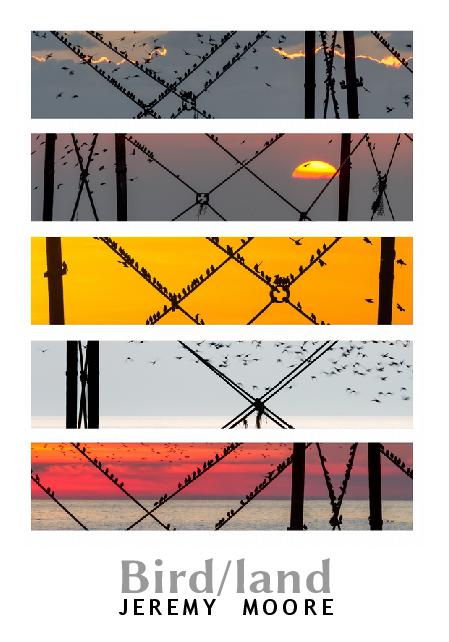
As it happened I had a one-off copy of the Bird/land book with me, so I offered to come down to the Library with him. While I hadn’t prepared a presentation I was introduced as the photographer and it gave me the opportunity to talk about Bird/land with some knowledgeable and interested photographers. I also had a copy of another one-off book with me – the result of a very long term project variously known as ‘my black-and-white project’, the ‘Fay Godwin project ‘, or, most definitively, ‘A Sideways Glance(click here to visit my website.) The two books are so different in style and subject matter that it must seem difficult to believe that the same photographer could have produced both. But I am living evidence that he did! Both books provoked a great deal of interest and some good feedback.

This was a real boost to my confidence. Back at the Arts Centre I collared Glenn Edwards and showed them to him as well. The documentary style of A Sideways Glance was more to his liking, I suspect, and he looked through it very carefully, finally giving me very positive feedback. A few years ago I had hoped that he might give me a slot at “The Eye” but I think his intention has always been to bring photographic excellence to Aberystwyth, rather than showcase local photographers.

The following morning one of the other photographers asked me if it was possible to buy a copy of Bird/land, and I had to explain it was a one-off, and therefore quite expensive. But we agreed on a price and I’m just about to send it off to him down in Pembrokeshire.

As for me, until the weather improves, it’s back to the cat videos!

If you are interested in buying a copy of Bird/land, please let me know. It is in hardback, 28 x 28 cm in size with 20 double-page spreads, on very thick paper in “lay-flat” style. It contains a total of 117 images mostly in the form tryptichs. The price would be £95 including postage.

NB. Sadly it looks like this will have been the final “Eye” in Aberystwyth due to declining attendances. It was good while it lasted!

To receive more Tales from Wild Wales as they are published, please click the Follow button.

Pipsqueaks.

Bardsey Island (Ynys Enlli in Welsh) is situated off the tip of the Lleyn Peninsula (Penllyn), separated from the Welsh mainland (Y Tir Fawr) by only a short sea crossing, but it could be many miles away. With its remote location, the island tends to attract rare migrants; it also has a manx shearwater colony and a bird observatory. Together with Jane (my partner) and three good friends, I spent last week there. It was actually my seventh stay on the island; each week has been quite different and I well my remember my first. I picked up an infection, probably from the spring water supplied to the houses, which laid me low for a few days. Alone in my accommodation, I felt very ill indeed and believed I could have died there without anyone knowing! Fortunately in recent years a water purification system has been installed.

After another visit I was chatting to a Welsh-speaking neighbour and told her I had just spent a week on Enlli. She looked at me very strangely, and then explained that Enlli is the name of the psychiatric ward at the local hospital. I’ve always used the name Bardsey since then…….

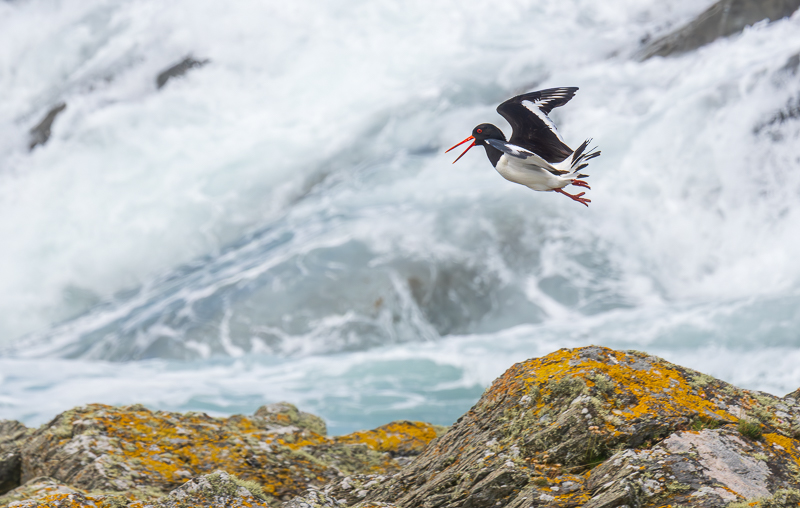
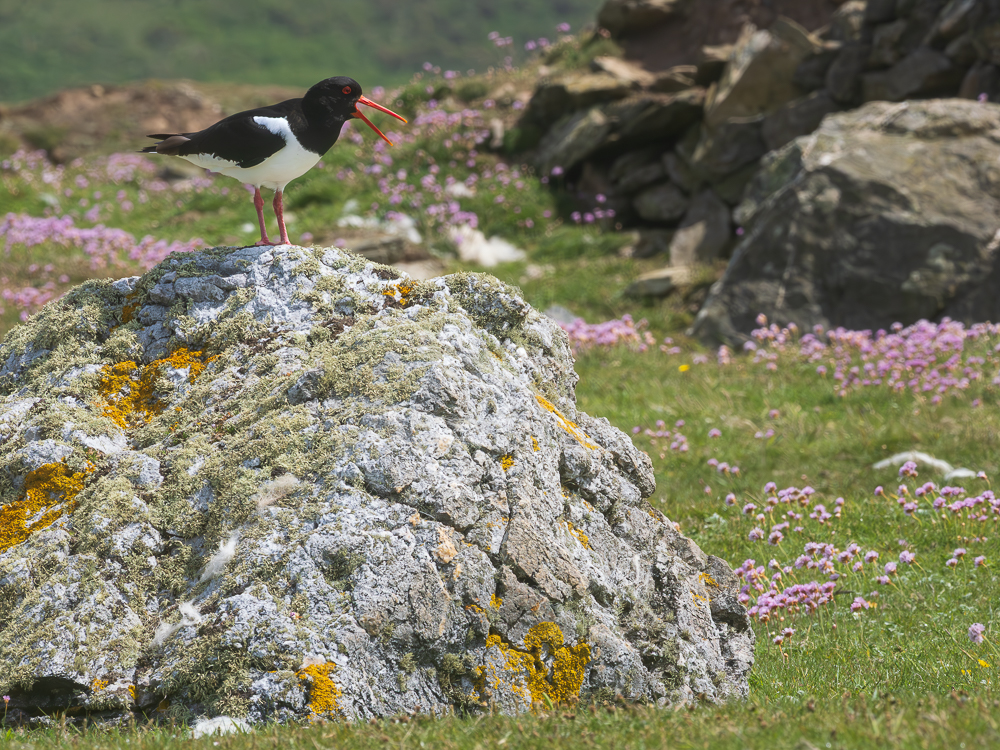
I don’t usually resort to cliches such as “bird of the week” but just this once I’m going to. It could have been the (scarlet) rosefinch which my friend Jonathan first identified, and whose song could be clearly heard from our kitchen table for a couple of days. The island has a large population of my favourite bird, the chough, and their calls could frequently be heard wherever you were. But the chough is a Schedule One (specially protected) species during the breeding season so I tended to avoid them. So I’m going to plump for something much more familiar – the oystercatcher. As you walked around the island you would pass from one oystercatcher territory to the next, and you would be subject to a new tirade of raucous high-pitched screeching. One bird was particularly aggressive, repeatedly flying noisily towards me at eye-level and only veering away at the last second. I believe on one occasion its wing tip brushed my arm as it flew past.

Their behaviour and alarm-calling is designed to alert their youngsters of the presence of a potential predator (in this case me) and it is obviously very successful. No matter how hard I tried I never managed to locate a single chick. They leave the nest as soon as they hatch and must hide amongst the pebbles and boulders amongst which they are feeding. But I wondered how intelligent the adults actually are. I found that while I was standing upright I was fair game for all the aggression that they could muster. But if I made a half-hearted attempt to “hide” or lower my profile their behaviour became calmer and their calling quieter. It was during these moments that I was able to photograph them in a more relaxed fashion. I ended up with hundreds of oystercatcher images, and have spent many hours deleting and processing them since I returned home.

It was during these lulls in activity that also I coined a new name for the species – “pipsqueaks”. After all, they don’t actually eat oysters ………….

Enjoy…….

Please click the Follow button if you would like to receive more Tales from Wild Wales as they are published.

My website : www.wild-wales.com

A tricky one…..

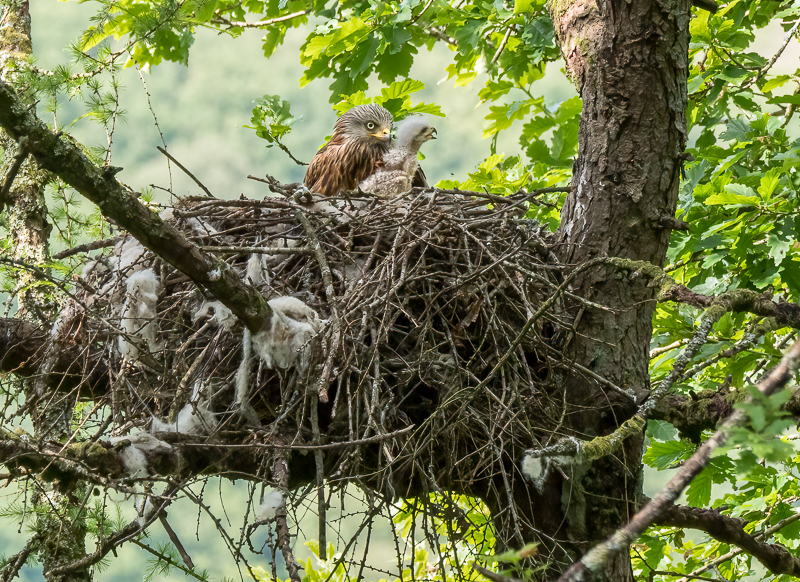
In spring 2020 we were all locked down in our homes. On my daily walk (well, one of them….), I discovered a red kite nest just five minutes away. It was easily visible from the track running through the wood and the female didn’t bat an eyelid as you walked past. When she was ‘off duty’ her mate took over and it was panic stations as soon as he saw anyone. The owners of the woodland, both red kite lovers, were managing it for firewood and wildlife and noticed exactly the same thing. They were happy to let me take my kit just inside the wood where I could be slightly closer . And the female carried on incubating as if nothing untoward was happening. It seemed like too good an opportunity to miss. Red kite is a Schedule One species in the UK, meaning that it is illegal to disturb nesting birds at any time during the breeding cycle – from nest-building to post fledging. But was I disturbing her? It didn’t look like it but it was rather a grey area legally.

Beauty is in the eye of the beholder……….

I waited until the chick had hatched and then visited the wood several times during late May. By the 21st the chick was strong enough to raise its head over the rim of the nest and I was able to photograph it with its mum looking on adoringly ( I may be anthropomorphising here ….). By the 25th it was stronger and its white down had become largely brown, with just a few tufts of white on its head. On the 30th the female was leaving the nest for short periods of time and on one occasion, while she was away, a magpie crept unseen close to the nest. As soon as she saw it she was back like a shot. I did not believe a kite could look so threatening! I was set up with the camera and long lens on the tripod, focussed on the nest, so was able to quickly take a few frames of the action. I was thrilled…… and the magpie made a hasty retreat.

You may recall that spring and early summer of 2020 were warm and sunny for long periods, often with no cloud at all, which made lockdown quite bearable. It also meant that for long periods of time photography was difficult with harsh sunlight throughout the middle of the day. Photographing in woodland in these conditions involves dark leaf and branch shadows and bright highlights, with massive contrast differences. The red kite nest was no exception. I decided to give it a break until some more photographer-friendly conditions came along. When I returned about a week later I discovered something tragic had happened to the kite chick. My friends had just discovered that it had disappeared and the parents were flying around in an anxious and agitated fashion. That was the end of the kites’ nesting attempt and they drifted off fairly soon afterwards. What had happened was a mystery, and the nest disintegrated and disappeared over the next couple of years.

Is this the same female?

So why am I recounting this story in April 2025? Well…. the kites are back! A pair has built a new nest in a different tree only about ten yards from the 2020 nest, in a very similar position, right out in the open, below eye level as seen from the track, and the female doesn’t bat an eyelid as you walk past. My guess is that she is the same bird that I photographed in 2020.

I am currently monitoring red kites in the area surrounding my home and have a licence to disturb the birds at the nest for this purpose. However it doesn’t include photography, unless incidental to the monitoring. I did inquire about a photography licence but the paperwork looked like it would take forever to complete. So I’m wondering if I can photograph the chick’s development at this nest in particular, with the very confiding female, without breaking the law. It’s a tricky one.

To read more Tales from Wild Wales as they are published, please click the Follow button.
My website : http://www.wild-wales.com

Do you know your willow tit from your marsh tit?

Willow tit……..

There can be no more difficult bird i-d challenge in the UK than distinguishing willow tit from marsh tit. According to ‘Birds in Wales’ willow tit was not even proven to occur in the UK until 1897, and for several decades following that “…its distinct identification from marsh tit was not universally accepted”. The Collins Bird Guide suggests various subtle differences; for example marsh tit has a glossy black cap while the willow’s is matt. The white cheek is more extensive on the willow than the marsh, and one (the willow tit) has a pale panel on its wing while the marsh doesn’t. The black bib is “usually” larger in the willow than the marsh. However a video from the British Trust for Ornithology now suggests that it is not safe to distinguish one from the other on any of these characteristics. The only reliable difference is a pale grey spot at the base of the upper mandible (the beak) which the marsh has but the willow doesn’t. This conclusion would have been reached following the close examination in the hand of large numbers of individuals by bird ringers, so is likely to be correct. But no wonder there was such a long period of doubt over whether both species existed in the UK.

Along with the willow tits came crested tits………

It is widely agreed that the safest way of telling one from the other is by voice. I’m not confident that I’ve ever definitively seen or heard either species, but during the winter I heard a new (to me) bird song on a regular walk in some woodland below the house. I believed it was either a willow tit or a marsh tit. It sounded very like a wood warbler, which, being a summer visitor, could not have been present. My Collins Bird Guide specifically mentions a “series of pensive, melancholy, wood warbler-like notes”, under willow tit. I hadn’t actually seen the bird but this was about as good an i-d feature as I was likely to get. I announced my record on the Ceredigion Bird Blog, with the caveat that Ian Morris – the county’s resident willow tit expert – might have an opinion on it. A few days later I had an interesting email from another Ceredigion birder who had had a similar experience to mine. Over a period of some weeks he had re-visited his location and played back a recording of the willow tit song. On every occasion he had attracted a pair of nuthatches! It’s enough to make you tear your hair out!

A few weeks later Ian Morris visited and we walked down to the location where I had heard my mystery bird. He played back the song but there was no response. It was a long shot really but he didn’t believe the habitat was right for willow tit anyway…..much more suitable for marsh …………

…………and a few nuthatches………..

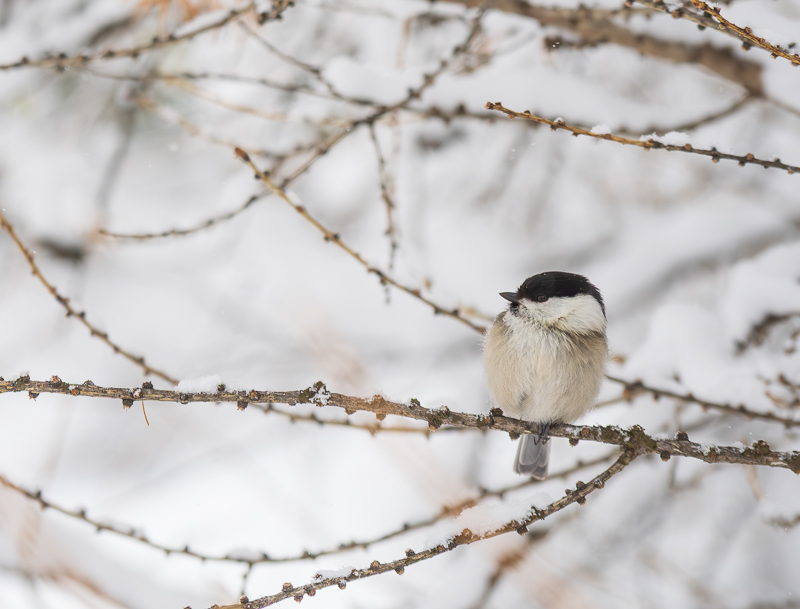
One reason I recount this cautionary tale is that during March I spent a couple of days quite high in the Swiss Alps. It still being deep mid-winter some lovely conifer woodland there was blanketed with fresh snow and almost completely devoid of of birdlife. The main exceptions were flocks of tits roaming around waiting for hand-outs from folks like me. Among them were “poecile montanus” (according to the interpretation boards) which were so bold as to perch on people’s hands to grab a seed or two. This, of course, is the willow tit, which, according to the bird books, rarely even visits bird tables in winter ……..

To read more Tales from Wild Wales as they are published please click the Follow button.

Not too choosy……

Following on from my last post about birds in the landscape, here’s another example. One day recently I stopped in my local village for some diesel. As I opened the van door I heard a collared dove calling overhead. It was in a bucket under the petrol station canopy. Wow! I excitedly told the petrol station staff who were a bit non-plussed. Hadn’t I noticed before?

It turned out that the dove had tried to nest in a pot-hole on the ground last year, and then transferred its attentions to the top of the sign – without the bucket. The twigs it brought in for the nest just blew away. The garage owners took pity on the poor thing and strapped a wooden base to the top of the sign and then balanced the bucket of sand on top of that. The doves took to it immediately. Last year it raised a youngster and apparently this year it has already reared one young. On my last visit, it called, and its mate called back from a nearby garden.

They obviously don’t waste any time, these collared doves, and they’re not too choosy either.

To read more Tales from Wild Wales as they are published, please click the Follow button.
(Still) shooting itself in the foot……..

The Upper Llyfnant valley (with newly bulldozed tracks)

Living in west Wales as I do the issue of gamebird shooting has rarely raised its unpleasant head. I knew there was a shoot on the Dyfi estuary but it didn’t really seem like a problem. That all changed in a big way over the summer.

Cwmrhaiadr had been farmed in a fairly wildlife-friendly way for decades, is much loved by local people, and is stunningly beautiful. It consists mainly of the Upper Llyfnant valley, which runs north-south along the Ceredigion / Powys boundary, a few miles from Machynlleth. The river then swings westwards and flows into the Dyfi estuary. It is short but sweet. At the head of the valley is Pistyll-y-llyn (“waterfall of the lake”), down which the infant Llyfnant plunges from the Cambrian Mountain plateau into the lowlands. The farm was purchased by a businessman from Essex (he paid cash…), who sold the shooting rights to a Shropshire-based company, and began turning the valley into a commercial game-bird shoot. New roads were bulldozed throughout. It was lockdown so few people knew what was going on.

The valley has been renamed “Dyfi Falls”. The cost of a day’s shooting? A staggering £2640 (+ VAT).

The moorland at the head of the valley is a Site of Special Scientific Interest (SSSI); this includes the cliffs and steep hillsides at the head and upper reaches of the valley. Another SSSI lies a few miles downstream. It is deciduous woodland, a remnant of the “temperate rainforest”; rich in lichens, bryophytes and invertebrates. It would be susceptible to changes in the quality of the water running through it, and the air surrounding it..

In their early publicity the shoot company (Cambrian Birds) boasted about releasing 40,000 birds or more (pheasants and red-legged partridges) into the valley. Imagine that! Although this figure seems to have disappeared from their website they have never denied it. Certainly if you walk there (or anywhere within a few miles) you are continually tripping over pheasants, and I saw flocks of partridges totalling at least fifteen hundred birds. The shooting industry itself has estimated that only 35% (on average) of released birds are actually shot. At Cwmyrhaiadr that leaves 26,000 to die of starvation, predation, disease, parasites or being run over by cars. And of the estimated 57 million released annually in the UK – yes, you did read that correctly – 37 million will die similarly unfortunate deaths. One may view the shooting of birds for pleasure as unpleasant but these figures show that in every way the industry has a callous disregard for living creatures.

Now, regarding the SSSI. It is quite clear to anyone visiting the valley that the gamekeeper has cynically placed many of the feeding hoppers as close as possible to the SSSI boundary. A trail of feed has illegally been laid – inside the SSSI – along the footpath from the valley bottom to the top of the waterfall. Cambrian Birds’ publicity states –

“The steep sided valleys will allow us to present high-flying birds flying straight back to their home at the centre of the estate”

And on their social media pages they excitedly tell us –

“Can’t wait to see these [pheasants] flying off the tops of those hills!”

The trouble is, those hills are the SSSI and (supposedly) protected from the release of non-native birds. Cambrian Birds may be (largely) respecting the letter of the law but certainly not the spirit. Or as one planning officer I spoke to put it:

They are very good at pushing the boundaries“.

For many years the RSPB has been equivocal about gamebird shooting. It accepted that in agricultural lowland Britain woodland was retained for the rearing and release of gamebirds. This provided habitat for many other species of wildlife and would otherwise probably have been felled to increase agricultural production. However the Society now recognises that the nature of gamebird shooting has changed, saying in a recent report –

there are substantial negative environmental consequences from the industrialised form of this shooting, including the direct and indirect impacts that released birds can have on other wildlife. ” 

It has now told the industry that if it does not put its house in order within 18 months – reducing the quantity of birds released, for example – it will call for statutory regulation of gamebird shooting. The RSPB is a powerful organisation and this may bear some fruit. But we should also remember that the landowning class has its own political party which is currently in power with a very large majority.

Meanwhile the pressure group Wild Justice is pursuing a legal case against the government in the High Court, arguing that it is failing in its duty to protect native species in the UK from the excesses of the shooting industry. . The industrial quantities of non-native birds released into the countryside amount to “a very serious ecological assault” upon it, Wild Justice says. The biomass of pheasants and red-legged partridges released every year “exceeds that of all native UK birds put together“, it adds. The Court case will be heard in early November.

What of the shooting industry itself? The British Association for Shooting and Conservation (BASC) portrays itself as the voice of the reason in the debate. It has a series of “guidelines” for the industry, for example, and a “policy” of zero tolerance over the killing of birds of prey. As for the RSPB’s new position on gamebird shooting, the BASC says –

 if the RSPB really wants to regain some good will and positive influence with the shooting world, they would do well to start formally recognising and celebrating where and how things are going right.”

The problem is that this has been the RSPB’s position for many years already. Self-regulation has failed to keep the shooting fraternity in check. Raptors continue to be killed on shooting estates, for example, and many believe that the industry is completely out of control. Hence the RSPB’s change of heart. So will the shooting industry begin to mend their ways? If the example of Cwmrhaiadr is anything to go by, the answer is a resounding “no”.

POSTSCRIPT: On November 12th I walked up the Llyfnant valley to observe and photograph the shoot that was taking place on that day. I kept a very low profile, carefully using public rights of way (where they weren’t blocked) and open access land. I left my van at the end of the public road adjacent to the entrance to Cwmrhaiadr. When I returned I found that two of my tyres had been slashed.

To read more Tales from Wild Wales as they are published, please click the Follow button.

Bird/land rides again

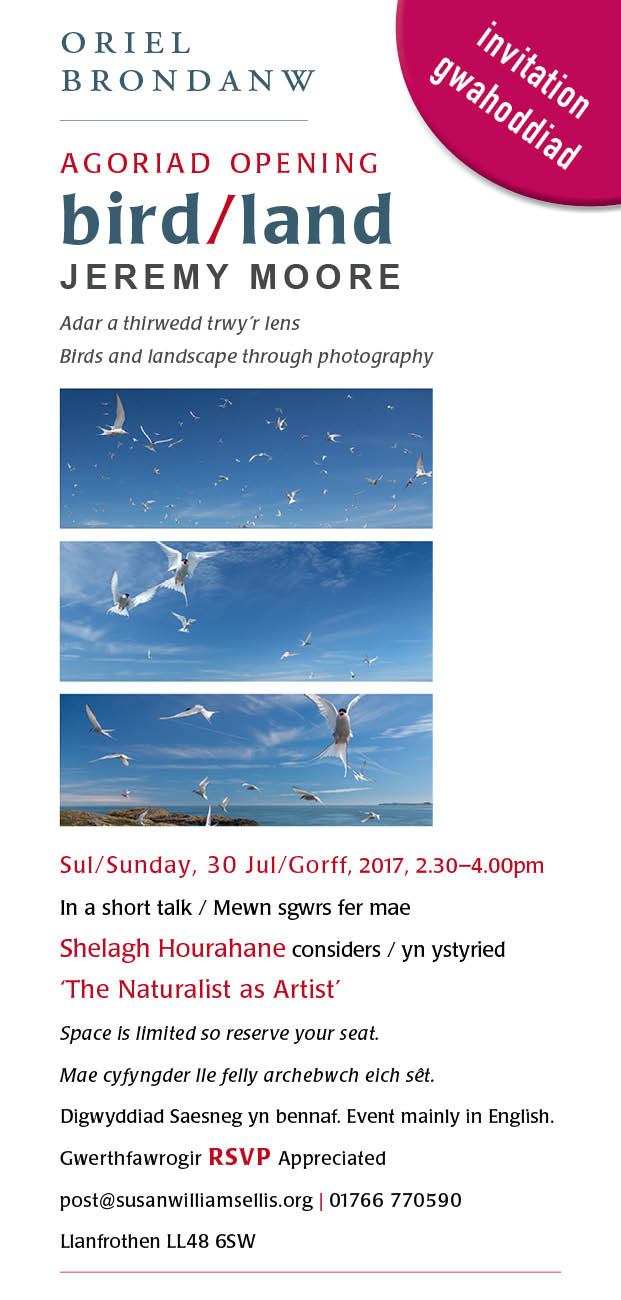
Bird/land is showing again this summer, at Plas Brondanw, between Penrhyndeudraeth and Beddgelert in the heart of the Snowdonia National Park.

Set in a stunning location, Plas Brondanw was the home of the late Clough Williams Ellis – creator of Portmeirion,  the surreal Italian-style village on the Dwyryd estuary. The gardens at Plas Brondanw have been open to the public for many years but this is the first year the house has opened its doors. It is a very different venue to those at Machynlleth and Aberystwyth. Each room contains maybe 6 or 8 works, punctuated by windows which overlook the gardens and the surrounding landscape. But I think they work well there.

The official opening is on Sunday 30th – details above – and I will be giving a talk on Sunday August 13th, at 2.30 pm. Places for both events genuinely are limited. Opening hours for the exhibition are Wednesday to Sunday, 10.30 am until 4 pm. The exhibition closes on August 28th.

Edit: In the first paragraph I wrote that Plas Brondanw is in the heart of the National Park. It certainly feels as if it is, but in fact it’s on its edge. North and east of Porthmadog the National Park boundary diverts inland to exclude the village of Penrhyndeudraeth and the low-lying farmland drained when the Cob (the causeway to Porthmadog) was built just over two hundred years ago. One can only imagine the exquisite beauty of the area before it was drained. Even now at big spring tides on still days the mountains are reflected beautifully in the flooded Glaslyn River. And who knows, in these times of sea-level rise and “managed retreat” the day could come again when this land is fully tidal again.


To follow Tales from Wild Wales, scroll down to the bottom and click Follow

As seen on Springwatch…..

Swallow’s nest (with flash)

Last week we hurtled down to Pembrokeshire in the heat. Jane had an event to attend in Haverforwest and I wanted to do some bird photography in the Marloes area. We had an evening boat trip lined up too, which took us into the bays on the north and south coasts of Skomer Island amongst all the seabirds.

I headed out with my long lens on Wednesday morning and spent some time around the Deer Park. There were two family parties of chough in the area and a group of adult non-breeders. After a couple of hours I headed back to Lockley Lodge for some coffee, and then into the nearby Marine Nature Reserve building with its illuminated displays and pilot whale skeleton. The main attraction for me here was the swallow’s nest built into the eye socket of the skull, which had earlier been featured on Springwatch. I was delighted to find four large, bouncing, baby swallows being fed frequently by their parents, despite regular interruptions by human visitors. There was another swallow’s nest in the ladies toilets next door, apparently, and I had previously seen a couple in the gents; so I guess this particular pair was more discerning than some of the others……

Adult leaving swallows’ nest (no flash).

Unless the doorway was almost blocked the adults took no notice of people at all; and with the nest at little more than head height this was an opportunity not to be missed. I set up the tripod in the corner of the room and attached the camera and long lens. But boy, was it dark! Even at 3200 ASA I was exposing at slower than 1/100th second. It would be nice to think that I could capture the young gaping excitedly (but without moving) on the nest while the adult hovered artistically beside them with food but it just wasn’t going to happen. Time for Plan B.

Flash.

I never use flash. I don’t have a flash gun and my 5d3 definitely doesn’t have one built in. Maybe the 6d (back in the van) had a built in flash? It was worth a try; but no joy. Then there was the little Panasonic GX7 which I carry around with me when I can. Yessss! I was in luck. After a long time fiddling around with menus I finally worked out how to use it. You press the button and the flash pops up. Surely it can’t be that easy…..?

With the 5D3 and other SLR’s (I imagine) you press the shutter and keep pressing – the result being a burst of images which capture the action at up to 12 frames a second – although the 5d3 is rated at 6 fps and seems slower than that. With the GX7 it’s one frame at a time; that is, in this situation, one frame each time the parent brought food for the young. Fortunately the feeding visits were coming thick and fast and I never had long to wait. I wouldn’t say I’m totally happy about any of the results, however. Technically those with flash are much better, but I didn’t quite get the composition right on any of them. Those without might be artistically more pleasing but those conditions were really was pushing the camera beyond its limits, even one as capable as a 5D3. It was difficult to process any of the images to any meaningful extent without degrading the image even further into unusability.

Nevertheless it was lovely just to watch the young begging enthusiastically for food, and the adults bringing it in so fearlessly. I love swallows and it is a source of sadness that they no longer nest in our garden shed.


To follow Tales from Wild Wales, scroll right down to the bottom and click Follow.

Bird/land opens at Aberystwyth Arts Centre

Page1

These are exciting times as my exhibition Bird/land opens at Aberystwyth Arts Centre. It’s in the Photography Gallery (Gallery 2) on the top floor and is showing until August 27th. Opening hours are as follows:

Monday – Saturday 8 am > 11 pm; Sunday 12 noon > 8 pm; Free entry.

It’s an expanded version of the original exhibition, with eight new small single images and nine new triptychs. I must say it looks very tasteful in there. So if you’re in mid-Wales in the next couple months do drop in and have a look around!

I’ll be giving a talk in the Arts Centre’s cinema at 5.30 pm on Thursday July 14th. Entry is free of charge.

For a sneak preview of the work, go to my website and click on the Bird/land gallery, or click on this link.


For background to the exhibition click here to link to my Blog.


To follow Tales from Wild Wales please scroll right down to the bottom and click Follow

More from Cwm Idwal.

Rowan, Ogwen Cottage

Last week I posted about my eventually successful visit to Cwm Idwal in Snowdonia. But alongside the story of the photographs there was a quite different narrative running in parallel.

On my first visit to the Cwm, amongst the huge boulders below Twll Du, I came across some small brown birds. I quickly twigged that they were twite, which, strangely enough, I had been reading about the previous evening. As far as British birds go they are probably the supreme example of the “little brown job”. Visually there are no distinguishing features at all unless you can see the pale pink rump patch, but they do have a distinctive twanging call, which confirms their identity. At first it was just a couple of birds, then a juvenile begging food from a parent, then a bird leaving a possible nest site and finally a flock of 15 – 20 birds.

On my return to Idwal Cottage I looked around for someone to report my sightings to. There was no-one but a girl from the National Trust, who “thought she had heard of twite” but that was it. While I drank my coffee I noticed the nearby organic burger van, whose owner, Gwyn Thomas, the local farmer, was conversing with customers. My partner has worked with him so I went over for a chat. Eventually I brought up the subject of my  sightings. To my surprise and delight he is quite an authority on twite! Along with several other farmers in Nant Ffrancon he grows a seed crop for them to feed on during the autumn before they move down to the coast for the winter. I’m sometimes not a great admirer of farmers but this man is a star!

During our conversation a car drew up alongside and the driver came over. I recognised him but couldn’t put a name to the face. Gwyn left me with him and a tentative conversation began. I wondered aloud if I had seen him on TV. “No, I work on radio…” he replied. Not really a great help! “I did a book with you!” he added. It came to me in a flash. It was Dei Tomos, the author with whom I had worked on the Welsh version of “Wales at Waters Edge”. I buried my head in my hands in embarrassment! To be fair though, it was hardly a collaboration and we had only met once, and he couldn’t place me at first either.

The social aspect of my weekend continued the following morning. Back at Ogwen Cottage after a third unsuccessful visit to the Cwm, I was drinking coffee by my van. A familiar figure appeared. It was Martin Ashby, owner of Ystwyth Books in Aberystwyth, and one oldest and most valued friends. He was with his mate Nigel Dudley and just about to set off on a long walk up in to the Carneddau. I reluctantly turned down their invitation to join them.

On my return home I reported my twite records to the BTO Officer for Wales, Kelvin Jones. He told me that twite are declining steeply in Wales, and there is a project going to try to reverse this. Apart from the feeding project mentioned above birds are being ringed on the coast in winter in the hope that sightings in summer of ringed birds can reveal more about their movements. Although I had not seen any rings it seems my sightings had been the first this summer! The rarest breeding bird in Wales may actually now be twite, he said. (Does that make them rarer than osprey,  I wonder……)

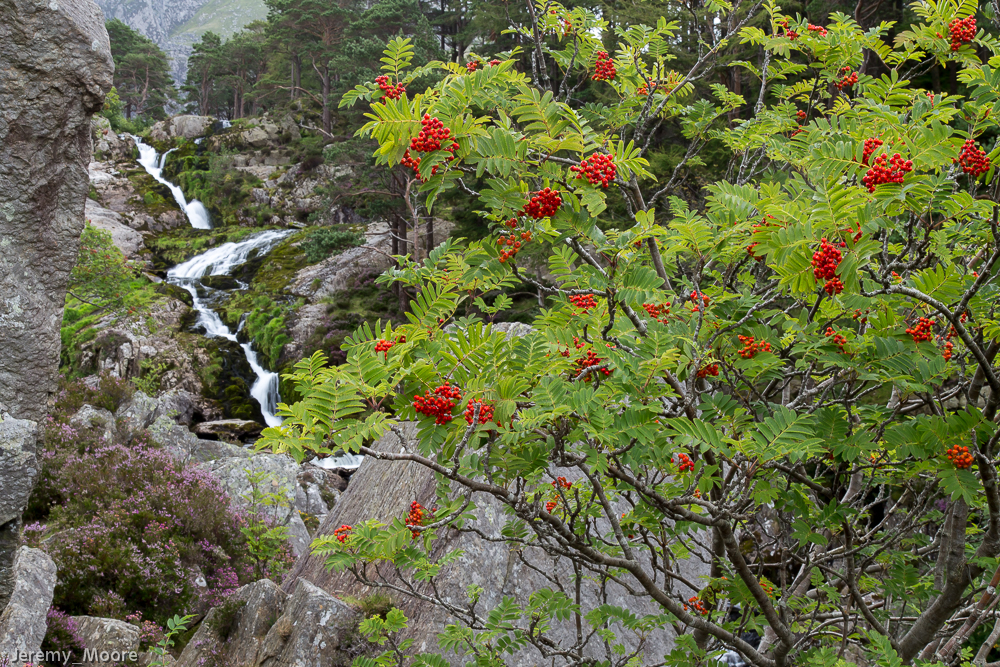
Just a note on the photograph above. While dull, cloudy conditions are usually the kiss of death for most “big” landscapes, they can be ideal for details within the landscape. This lovely rowan tree was just below Ogwen Cottage.

To read more about Gwyn Thomas and his work in Cwm Idwal, click here.


To follow Tales from Wild Wales, scroll down to the bottom and click Follow